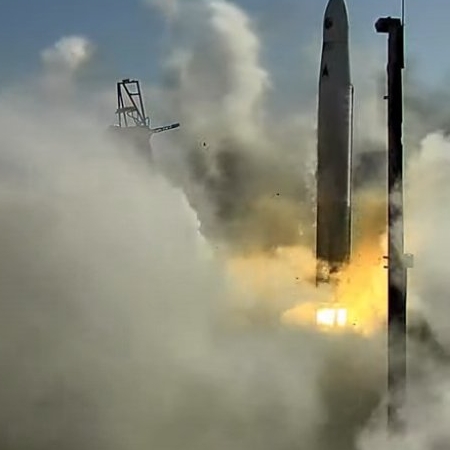
Tomorrow’s final launch of Europe’s Ariane-5 rocket delayed indefinitely

Arianespace officials today cancelled tomorrow’s final launch of its Ariane-5 rocket — supposedly to be replaced by the not-yet-flown Ariane-6, citing issues with “three pyrotechnical transmission lines that are associated with the Ariane 5’s solid rocket boosters.”

No new launch date has been set. There is the possibility that to resolve this issue the rocket will have to be rolled back to its assembly building and destacked. If so, the launch will be delayed months.

At the moment, Europe has only managed one launch in 2023, a far cry from the seven to twelve launches it used to do annually, before SpaceX came along and offered a cheaper rocket that could launch more frequently and quicker.

Hat tip to BtB’s stringer Jay.

2 comments

Some real pushback: Former Starbucks employee, fired to give Starbucks a white scapegoat, wins $25 million in lawsuit

Enthusiastically supports racial discrimiation
Punished enthusiastically for enthusiastically
supporting racial discrimination

Bring a gun to a knife fight: Shannon Phillips, a former Starbucks employee for thirteen years who was fired from the company following a racial incident at one of its stores, has been awarded back pay and $25.6 million in compensatory and punitive damages by a jury, who ruled she was fired simply because she was white and Starbucks needed a scapegoat.

The controversy began when the staff at a Starbucks store called the police on two blacks sitting in the store.

Rashon Nelson and his friend Donte Robinson were arrested at the Philly Starbucks in April 2018 after an employee called 911 to say they weren’t paying customers and had refused to leave. The men, who said they had been simply sitting at a table waiting for a potential real estate business partner to arrive, were arrested for trespassing.

In response to the widespread protests that followed, Starbucks temporarily shut its 8,000 locations nationwide in order to give its employees “anti-bias training,” while coming to an out-of-court settlement with the two men, whereby they each were paid a symbolic $1 but the company set up a $200,000 program to help young entrepreneurs.

The company also decided to fire Phillips, even though she was not at the store when the incident occurred. That firing was because she had objected to the company’s order for her to suspend a white manager who had had no connection to the incident at all.
» Read more

5 comments

Taiwan company issues letter of intent to build cubesat facility in California city

The city of Paso Robles in California has now received an official letter of intent from the Taiwan cubesat company Gran Systems, describing its desire to build spaceport there.

The CEO of Gran Systems recently toured the proposed Paso Robles Spaceport and tech corridor area and met with Paso Robles Airport Manager Mark Scandalis to discuss opportunities for establishing its California facility in Paso Robles.

Though the news article refers to this as a “spaceport,” I don’t think this has anything to do with launching rockets. Instead, this spaceport is part of Paso Robles’ effort to establish an industrial park at its airport, including space companies such as satellite builders, and Gran Systems has decided to rent space there, probably to widen its market in the U.S.

1 comment

Scientists detect evidence of phosphorus coming from the interior of Enceladus

Using archival data from the Cassini orbiter, scientists have now detected the first evidence of phosphorus – a key element in the development of life on Earth – coming from the interior of the Saturn moon Enceladus.

The small moon is known to possess a subsurface ocean, and water from that ocean erupts through cracks in Enceladus’ icy crust as geysers at its south pole, creating a plume. The plume then feeds Saturn’s E ring (a faint ring outside of the brighter main rings) with icy particles.

During its mission at the gas giant from 2004 to 2017, Cassini flew through the plume and E ring numerous times. Scientists found that Enceladus’ ice grains contain a rich array of minerals and organic compounds – including the ingredients for amino acids – associated with life as we know it.

Phosphorus, the least abundant of the essential elements necessary for biological processes, hadn’t been detected until now. The element is a building block for DNA, which forms chromosomes and carries genetic information, and is present in the bones of mammals, cell membranes, and ocean-dwelling plankton. Phosphorus is also a fundamental part of energy-carrying molecules present in all life on Earth. Life wouldn’t be possible without it.

“We previously found that Enceladus’ ocean is rich in a variety of organic compounds,” said Frank Postberg, a planetary scientist at Freie Universität Berlin, Germany, who led the new study, published on Wednesday, June 14, in the journal Nature. “But now, this new result reveals the clear chemical signature of substantial amounts of phosphorus salts inside icy particles ejected into space by the small moon’s plume. It’s the first time this essential element has been discovered in an ocean beyond Earth.”

You can read the paper here. It is very important to emphasize that though phosphorus is essential for life, life in the underground ocean of Enceladus has not been discovered. The scientists have merely found evidence of this specific ingredient needed for life, suggesting that these ingredients are common in our solar system. Going from a list of ingredients to a finished dish one can eat is something else entirely.

4 comments

Arianespace signs deal with Spanish rocket startup PLD

Following up with its agreement with the UK rocket startup Orbex, Arianespace yesterday also signed a deal with the Spanish rocket startup PLD to study using that company’s as-yet-unflown Miura-5 rocket.

Like the Orbex deal, this agreement makes it possible for Arianespace to arrange launches using PLD’s rocket. It also tells us that Arianespace and the European Space Agency are shifting from designing and building their own rockets — a process that has failed to produce any profit and had presently left Europe with no launch capability — to acting simply as a customer buying that capability from independent competing private companies.

For this to work however both Orbex and PLD will have to get their rockets off the ground.

0 comments

China launches 41 satellites on single launch, a record for that country

China today successfully used its Long March 2D rocket to place 41 satellites in orbit, a new record for that country, lifting off from its interior Taiyuan spaceport in north China.

No word on where the rocket’s first stage crashed within China, or whether it landed near any habitable areas. The Chinese state-run press also provided no information about any of those 41 satellites.

The leaders in the 2023 launch race:

40 SpaceX
23 China
8 Russia
5 Rocket Lab

American private enterprise still leads China 45 to 23 in the national rankings, and the entire world combined 45 to 39, with SpaceX by itself still leading the rest of the world, excluding other American companies, 40 to 39.

0 comments

June 14, 2023 Quick space links

Courtesy of BtB’s stringer Jay.


  • Diagram from ULA outlining the pattern of decay for orbital debris, depending on orbit
  • This diagram was posted in connection with a proposal from ULA’s CEO, Tori Bruno, suggesting a system similar to carbon credits to eliminate space junk. Bruno also suggests the U.S. should “kickstart” this program. The timing, the same day the WEF released its own space junk guidelines, suggests he is all-in on strong international regulation, along with the kind of scams (such as carbon credits) that this regulation always goes hand-in-hand with. It also suggests he wants to use that regulation to beat down his competitors, since on the open market ULA is failing miserably at this task.

1 comment

Drainage channel between two Martian hollows

Drainage channel between two Martian hollows
Click for original image.

Cool image time! The picture to the right, cropped, reduced, and sharpened to post here, was taken on April 28, 2023 by the high resolution camera on Mars Reconnaissance Orbiter (MRO). Dubbed a “terrain sample” by the camera team, it was likely taken not as part of any specific research project but to fill a gap in the camera’s schedule so as to maintain that camera’s proper temperature. When they have to do this, they try to pick interesting targets, though there is no guarantee the result will be very interesting.

In this case the camera snapped what appears to be a drainage channel between two deeper hollows. The channel sits about 100 feet above the western hollow and 260 feet above the eastern hollow. This makes some sense, as the overall drainage in this region is going from the west to the east, and then to the north.
» Read more

0 comments

Astronomers detect vaporized elements in atmosphere of hot Jupiter-sized exoplanet

Using the Gemini telescope in Hawaii, astronomers have detected several elements in atmosphere of hot Jupiter-sized exoplanet, dubbed WASP-76b, that would normally be found in rocks, but here are vaporized because the exoplanet orbits so close to its star.

In 2020 and 2021, using Gemini North’s MAROON-X (a new instrument specially designed to detect and study exoplanets), Pelletier and his team observed the planet as it passed in front of its host star on three separate occasions. These new observations uncovered a number of rock-forming elements in the atmosphere of WASP-76b, including sodium, potassium, lithium, nickel, manganese, chromium, magnesium, vanadium, barium, calcium, and, as previously detected, iron.

Due to the extreme temperatures of WASP-76b’s atmosphere, the elements detected by the researchers, which would normally form rocks here on Earth, are instead vaporized and thus present in the atmosphere in their gaseous forms. While these elements contribute to the composition of gas giants in our Solar System, those planets are too cold for the elements to vaporize into the atmosphere making them virtually undetectable.

The data not only suggests such elements exist in the solar system’s gas giants, but that such elements are common in solar systems elsewhere. That possibility increases the chances of other planets like Earth, capable of sustaining life as we know it, in addition to sustaining life as we don’t know it.

2 comments

World Economic Forum decides its business is running space too!

We’re the government and we’re here to help you! The World Economic Forum (WEF) yesterday released its proposed new set of guidelines for mitigating space junk in orbit, even though some of the most important commercial satellite operators (SpaceX and Viasat) have not signed on.

The Space Industry Debris Mitigation Recommendations document, released by the WEF June 13, outlines recommendations to avoid collisions that can create debris by limiting the lifetime of satellites in orbit after they have completed their missions and improving coordination among satellite operators.

Among those recommendations is to establish a success rate for “post-mission disposal,” or removal of satellites from orbit after the end of their missions, to 95% to 99%. That disposal should be completed no more than five years after the end of each satellite’s mission.

You can read the guidelines here [pdf], which the WEF is pushing governments worldwide to adopt. Though SpaceX and Viasat have not signed on, 27 companies have endorsed the guidelines, including OneWeb, Airbus, Axiom, and a host of orbital tug and space junk removal startups, the latter of which all benefit from these guidelines.

While the proposals makes some sense, everyone in the space industry should remain skeptical, and resist the call for more government regulation. Once this power is given to government it will never be recanted, and will only grow with time. Moreover, all signs indicate that such interference by law by government is unnecessary. Both satellite operators and most rocket companies (the exception mostly China) have been making strong efforts to deal with the issue of space junk, for profit. The fact that there are a host of orbital tug and space junk startups right now illustrates this. Investors have realized there is money to be made removing satellites and space junk. They don’t need government telling them what to do.

6 comments

BepiColumbo about to do third Mercury flyby

In its long journey to get into orbit around Mercury, BepiColumbo needs to do nine different flybys of the inner planets, with third fly-by of Mercury coming up on June 19, 2023.

The mission launched into space on an Ariane 5 from Europe’s Spaceport in Kourou in October 2018 and is making use of nine planetary flybys: one at Earth, two at Venus, and six at Mercury, to help steer into Mercury orbit.

After this flyby, the mission will enter a very challenging part of its journey to Mercury, gradually increasing the use of solar electric propulsion through additional propulsion periods called ‘thrust arcs’ to continually brake against the enormous gravitational pull of the Sun. These thrust arcs can last from a few days up to two months, with the longer arcs interrupted periodically for navigation and manoeuvre optimisation.

The spacecraft will zip past Mercury at a height of 147 miles. If all goes well, this dual orbiter mission, carrying both a European and a Japanese orbiter will arrive in 2025, beginning a planned three year mission in different complementary orbits.

5 comments
1 448 449 450 451 452 2,413