December 5, 2022 Quick space links

Courtesy of BtB’s stringer Jay.


3 comments

Today’s blacklisted American: Pernicious anti-white bigotry controls the government in Seattle

Seattle: dedicated to segregation!
Seattle, controlled by Democrats and dedicated to the new segregation!

“Segregation today, segregation tomorrow, segregation forever!” Because of the continuous and never-ending racial bigotry that is now normal in Seattle and which eventually forced him from his city job, Joshua Diemert has sued for $300,000 in compensatory and punitive damages.

You can read the lawsuit here [pdf].

The list of abuses against Diemert is beyond horrible. Simply because he is white he was forced to resign a supervisor position so that two unqualified minorities could replace him, was then denied later promotions, then investigated for no reason, and was later accused of being a genocidal Nazi while being forced to attend critical race theory classes that routinely labeled all whites as bigots. As only one small example, consider these details from his complaint:
» Read more

16 comments

The steep interior rim of Aristarchus Crater

Aristarchus Crater
Click for larger image.

Cool image time! The photo to the right, cropped, reduced, and sharpened to post here, is a just released image taken by Lunar Reconnaissance Orbiter, looking across the top of Aristarchus Crater on the Moon from a height of only 60 miles, with the dark surrounding plateau in the foreground contrasting sharply with the bright crater interior. For scale, the distance from the floor of the crater to the top of the rim is about 9,000 feet. The bright central peak is about 1,300 feet tall. The contrast in brightness inside and outside the crater is explained thus:

Adjacent to Aristarchus crater is the Aristarchus plateau, one of the largest volcanic centers on the Moon. Here we find one of the largest rilles [on the Moon, dubbed Vallis Schröteri], a massive pyroclastic deposit, and the source of extensive flood basalts.

These volcanic materials are considered relatively young (for the Moon) – 1.5 to 2.5 billion years. The pyroclastic deposit formed when magma was explosively ejected from the vent and broke into small droplets quenched as glass in the cold vacuum of space as they fell back to the surface. Due to their high glass content, the pyroclastic deposits are distinctly low in albedo (relatively dark), providing a dark background for the bright Aristarchus crater. Within the crater, some of these pyroclastic deposits may be visible as the darkest areas on the far wall, and glassy impact melt is moderately lower in reflectance than the bright, rocky materials exposed on areas of the crater floor and walls.

The overview map below shows both the crater and the vent from which Vallis Schröteri belched.
» Read more

0 comments

Curiosity’s recent and future travels amid the Martian mountains

Curiosity's recent and future travels on Mars
Click for full panorama.

Overview map
Click for interactive map.

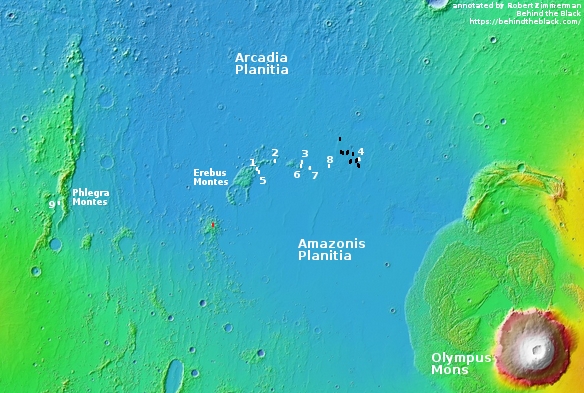
The panorama above, created from 31 images taken by Curiosity’s right navigation camera on December 5, 2022, provides us a wonderful overview of the rover’s recent and future travels amid the lower foothills of Mount Sharp in Gale Crater.

The overview map to the right provides context. The blue dot indicates Curiosity’s present position. The yellow lines indicate the approximate area viewed by the panorama. The red dotted line indicates Curiosity’s planned route, with the white dots the route it has actually traveled. On the panorama, the pink dotted line indicates where it has been, and the red dotted line where it is going.

For scale, Kukenan is estimated to be about 1,500 feet high. Though Chenapua in front seems comparable, it is actually much smaller, only about 200 to 300 feet high, at the most. Orinoco, though lower on the mountain, is probably about 300 to 400 feet high.

To really see the magnificence of this terrain, you must click on the panorama and explore the full image. Curiosity is truly traveling amid mountains, and is the first human robot to do so on another world.

0 comments

The uncertainties surrounding India’s proposed first manned mission

Link here. The article does a nice job of outlining the program, dubbed Gaganyaan, as well as the many issues that has caused the first launch to be delayed more than three years.

The key quote however is this:

Despite the government claiming that there would be no delays due to Covid, the first uncrewed flight was rescheduled from 2020 to 2021 and then again to 2022. The dates were once again revised to late 2023 or early 2024, announced Union minister of state for science and technology Jitendra Singh in September this year. [emphasis mine]

The highlighted claim is quite amusing, considering how India’s government space agency ISRO shut down entirely because of the Wuhan panic for more than two years, and remains somewhat dormant even now. As a result of that panic, ISRO lost almost its entire commercial market to American companies.

Read the entire article. It summarizes the state of Gaganyaan in good detail, which also implies that a first launch in ’24 remains questionable.

0 comments

December 4, 2022 Quick space links

These links are courtesy of myself, as it is Sunday and want to provide them quickly so I can do other things.


5 comments

December 2, 2022 Quick space links

Courtesy of Jay, BtB’s intrepid stringer, trolling Tweeter so we don’t have to.


  • Major management organization at Astra
  • According to CEO Chris Kemp, the reorganization has four engineering and manufacturing managers reporting directly to him, reducing a layer of management. Of the four managers involved, two once worked at Blue Origin, one at SpaceX, and one at Google.

9 comments

Pushback: Kroger must pay $180K to two Arkansas workers, fired for refusing to support the queer agenda

Kroger's rainbow heart apron

Bring a gun to a knife fight: To settle a lawsuit Kroeger has agreed to pay $180K to two Arkansas workers whom the company had fired when both asked to be excused from wearing company aprons that included a rainbow heart that they believed endorsed the queer agenda.

Workers at the store got the new uniforms in April 2019 that included a rainbow heart embroidered on the top left portion of the bib, according to court documents. Both of the workers believe the “literal interpretation of the Bible,” held “religious belief that homosexuality is a sin” and “sincerely believed the apron violated (their) religious beliefs,” according to the lawsuit.

One employee asked to wear their nametag over the logo. Another asked for a different apron. Both employees were fired within two months.

The image to the right shows an apron with this rainbow heart. While some suggest this heart has nothing to do with promoting homosexual rights, the company’s strong advocacy of the queer agenda says otherwise. From Kroger’s own website:
» Read more

15 comments

Martian glaciers below 30 degrees latitude

A Martian glacier below 30 degrees north latitude
Click for full image.

Cool image time! The picture to the right, cropped, reduced, and sharpened to post here, was taken on September 28, 2022 by the high resolution camera on Mars Reconnaissance Orbiter (MRO). While it shows what looks like a somewhat typical Martian glacial flow pushing through a gap between hills, this glacial flow is not typical. It sits at just under 30 degrees north latitude, closer to the equator than almost any glacial feature on Mars. Moreover, the younger impact crater on top suggests this glacier has been here for some time. Though the impact is younger than the crater, it is not that young, as the dark streaks normally seen in the first years after impact are gone.

Thus, this glacier suggests that not only can near surface Martian ice exist closer than 30 degrees latitude from the equator, it can survive there for a considerable amount of time.

Nor is this glacial flow, so close to the equator, unusual for this region of Mars.
» Read more

0 comments

Sunspot update: The Sun’s unprecedented pause to maximum continues

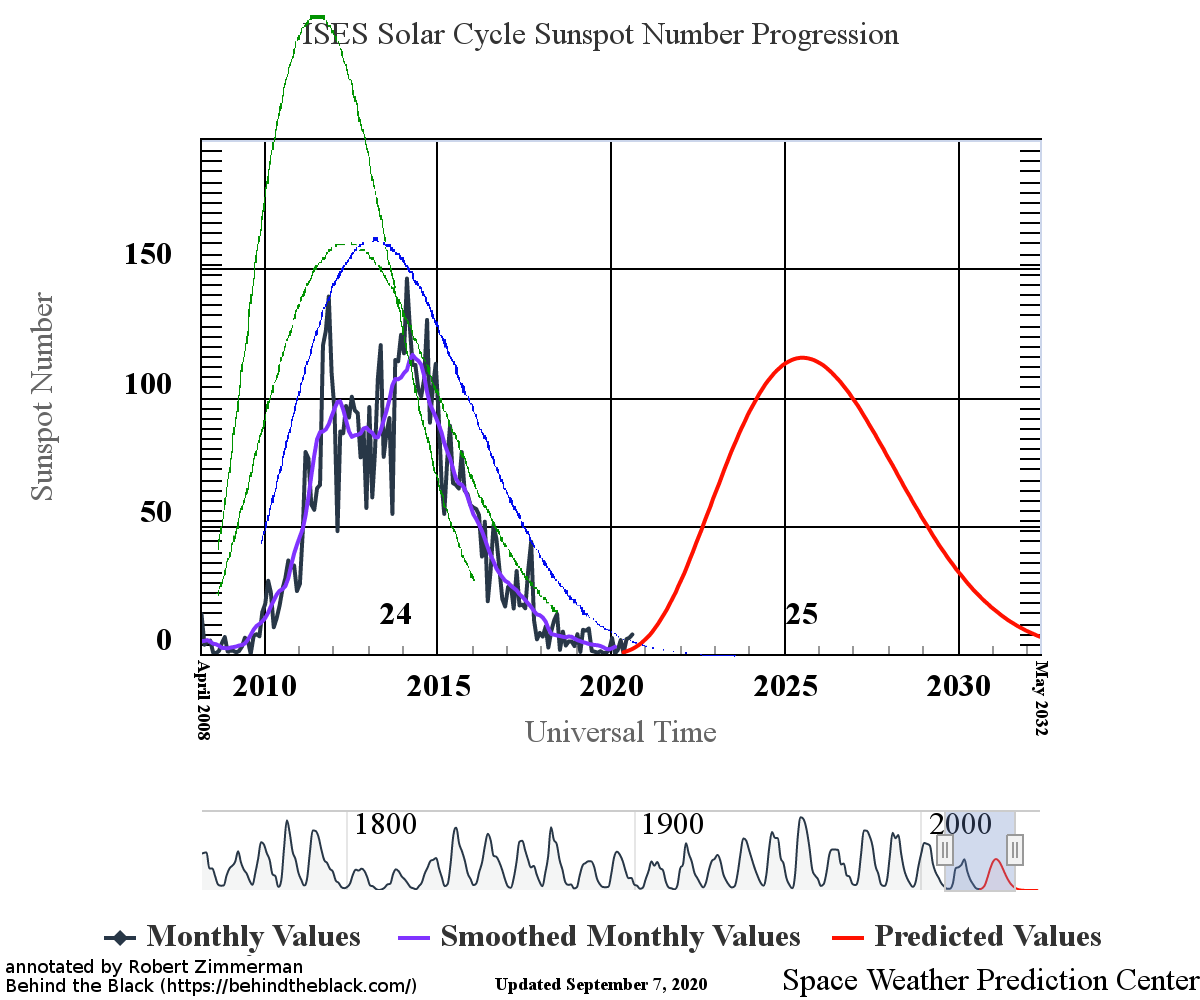
It is the beginning of the month, and NOAA has once again published its update of its monthly graph that tracks the number of sunspots on the Sun’s Earth-facing hemisphere. Below is the newest graph, adding November’s numbers to the timeline and annotated by me with some additional details added to provide context.

Sunspot activity dropped in November, though still remained significantly higher than the prediction, a sunspot number of 77.6 compared to the predicted number of 57.4. At 77.6, the Sun continues the pause that began in June in the ramp up to solar maximum. For the past half year the Sun’s sunspot output has essentially stalled at approximately the same level.

» Read more

13 comments

FCC puts the squeeze on SpaceX’s Starlink

More than two years after SpaceX had first requested regulatory permission to launch its full 30,000 Starlink satellite constellation, FCC (under the Biden administration) has finally made a decision, and in doing so it has arbitrarily reduced the number of satellites SpaceX can launch to 7,500.

On November 29th, 2022, the FCC completed that review and granted SpaceX permission to launch just 7,500 of the ~30,000 Starlink Gen2 satellites it had requested permission for more than 30 months prior. The FCC offered no explanation of how it arrived at its arbitrary 75% reduction, nor why the resulting number is slightly lower than a different 7,518-satellite Starlink Gen1 constellation SpaceX had already received a license to deploy in late 2018. Adding insult to injury, the FCC repeatedly acknowledges that “the total number of satellites SpaceX is authorized to deploy is not increased by our action today, and in fact is slightly reduced.”

That claimed reduction is thanks to the fact that shortly before this decision, SpaceX told the FCC in good faith that it would voluntarily avoid launching the dedicated V-band Starlink constellation it already received a license for in order “to significantly reduce the total number of satellites ultimately on orbit.” Instead, once Starlink Gen2 was approved, it would request permission to add V-band payloads to a subset of the 29,988 planned Gen2 satellites, achieving a similar result without the need for another 7,518 satellites.

In response, the FCC slashed the total number of Starlink Gen2 satellites permitted to less than the number of satellites approved by the FCC’s November 2018 Starlink V-band authorization; limited those satellites to middle-ground orbits, entirely precluding Gen2 launches to higher or lower orbits; and didn’t even structure its compromise in a way that would at least allow SpaceX to fully complete three Starlink Gen2 ‘shells.’ Worse, the FCC’s partial grant barely mentioned SpaceX’s detailed plans to use new E-band antennas on Starlink Gen2 satellites and next-generation ground stations, simply stating that it will “defer acting on” the request until “further review and coordination with Federal users.”

Apparently, the FCC’s decision here was essentially a rubber-stamp of recommendations by Amazon, whose Kuiper constellation (so far entirely unlaunched) would be SpaceX’s direct competitor. In other words, the FCC is now taking sides against Starlink to favor its competitors.

Read the entire article. In every way this FCC decision smacks of politics, partly to help a Democratic ally (Jeff Bezos) and partly to hurt someone the Democrats now see as an enemy (Elon Musk).

19 comments
1 534 535 536 537 538 2,411