
July 21, 2020 Zimmerman/Batchelor podcast
Embedded below the fold in two parts.
» Read more
Embedded below the fold in two parts.
» Read more
Russia today successfully launched a Progress freighter to ISS using its Soyuz-2 rocket.
The leaders in the 2020 launch race:
17 China
11 SpaceX
8 Russia
3 ULA
3 Japan
The U.S. still leads China 18 to 17 in the national rankings. Expect these numbers to change almost daily during the rest of July. A lot of launches are on tap.

On Christmas Eve 1968 three Americans became the first humans to visit another world. What they did to celebrate was unexpected and profound, and will be remembered throughout all human history. Genesis: the Story of Apollo 8, Robert Zimmerman's classic history of humanity's first journey to another world, tells that story, and it is now available as both an ebook and an audiobook, both with a foreword by Valerie Anders and a new introduction by Robert Zimmerman.
The print edition can be purchased at Amazon or any other book seller. If you want an autographed copy the price is $60 for the hardback and $45 for the paperback, plus $8 shipping for each. Go here for purchasing details. The ebook is available everywhere for $5.99 (before discount) at amazon, or direct from my ebook publisher, ebookit. If you buy it from ebookit you don't support the big tech companies and the author gets a bigger cut much sooner.
"Not simply about one mission, [Genesis] is also the history of America's quest for the moon... Zimmerman has done a masterful job of tying disparate events together into a solid account of one of America's greatest human triumphs."--San Antonio Express-News
The tenth anniversary retrospective of Behind the Black continues: Today’s repost comes from October 20, 2011, following Elon Musk’s National Press Club speech where he announced he was going to vertically land the Falcon 9 first stages so they could be reused. In comparing the new commercial competitive space industry with NASA’s government-run space program, I tried to outline the fundamental reason the former was always going to do better than the latter.
———————————————–
Elon Musk and the forgotten word

When Elon Musk gave his speech at the National Press Club on September 29, he was asked one question to which he really did not know the answer. He faked it, but his response illustrated how completely forgotten is one fundamental fact about American society — even though this fact is the very reason the United States became the world’s most wealthy and powerful nation less than two centuries after its founding.
To explain this fundamental fact I think I need to take a step back and talk about the ongoing war taking place right now over how the United States should get its astronauts into space. On one side we have NASA and Congress, who want NASA to build a new heavy-lift rocket to carry its Orion capsule beyond Earth orbit. On the other side we have a host of independent new space companies, all vying for the chance to launch humans and cargo into space for fun and profit.
Which is right? What system should the United State choose?
» Read more
UPDATE: According to news reports, China tonight successfully launched Tianwen-1 towards Mars, with arrival expected in February 2021.
Below the fold is a live stream of the launch of the Long March 5 rocket. It is not in English, and since it was not linked to China’s mission control, it only covers the first two minutes or so, after which the rocket went out of sight.
The leaders in the 2020 launch race:
17 China
11 SpaceX
7 Russia
3 ULA
3 Japan
The U.S. still leads China 18 to 17 in the national rankings.
» Read more

Now available in hardback and paperback as well as ebook!
From the press release: In this ground-breaking new history of early America, historian Robert Zimmerman not only exposes the lie behind The New York Times 1619 Project that falsely claims slavery is central to the history of the United States, he also provides profound lessons about the nature of human societies, lessons important for Americans today as well as for all future settlers on Mars and elsewhere in space.
“Zimmerman’s ground-breaking history provides every future generation the basic framework for establishing new societies on other worlds. We would be wise to heed what he says.” —Robert Zubrin, founder of the Mars Society.
All editions are available at Amazon, Barnes & Noble, and all book vendors, with the ebook priced at $5.99 before discount. All editions can also be purchased direct from the ebook publisher, ebookit, in which case you don't support the big tech companies and the author gets a bigger cut much sooner.
Autographed printed copies are also available at discount directly from the author (hardback $29.95; paperback $14.95; Shipping cost for either: $6.00). Just send an email to zimmerman @ nasw dot org.
An evening pause: Hat tip Wayne Devette.
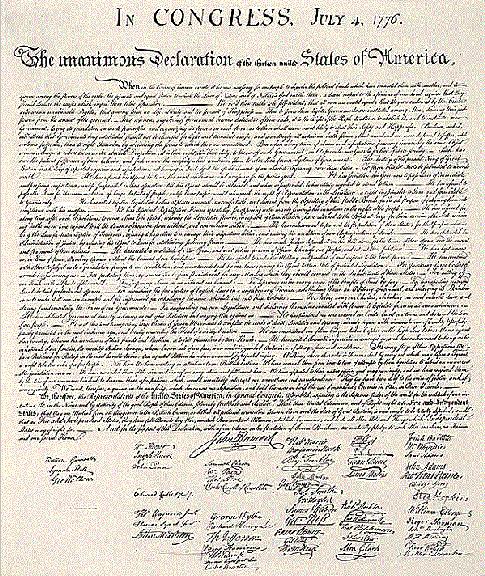
The last four months in the United States have probably been the ugliest seen in generations. Not only were Americans summarily put under house arrest, with churches shut and free speech muzzled, in major urban Democratically-controlled cities elected officials played favorites, allowing free speech and free movement to the leftist political activists whom these Democrats preferred, while using their police power to aggressively oppress conservatives and anyone who might be considered an opponent.
On top of this ugliness, we had our first experience of an American Kristallnacht. Not only were those leftist protesters free to protest while other Americans were on lockdown, these leftist radicals were allowed by these Democratic politicians to use violence and looting to terrorize the general population.
The nation we have today is no longer a land of liberty. Many things we only four months ago took for granted are now denied us.
» Read more
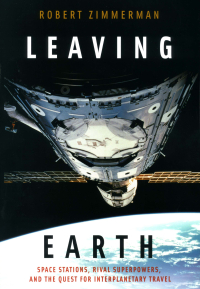
Leaving Earth: Space Stations, Rival Superpowers, and the Quest for Interplanetary Travel, can be purchased as an ebook everywhere for only $3.99 (before discount) at amazon, Barnes & Noble, all ebook vendors, or direct from my ebook publisher, ebookit.
If you buy it from ebookit you don't support the big oppressive tech companies and I get a bigger cut much sooner.
"Leaving Earth is one of the best and certainly the most comprehensive summary of our drive into space that I have ever read. It will be invaluable to future scholars because it will tell them how the next chapter of human history opened." -- Arthur C. Clarke
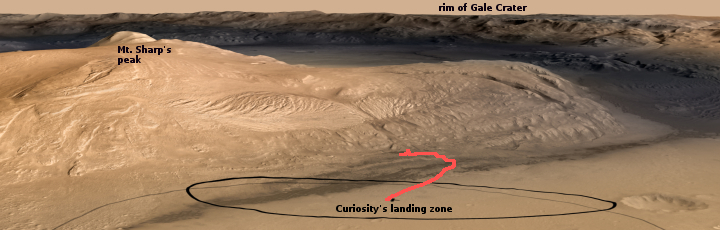
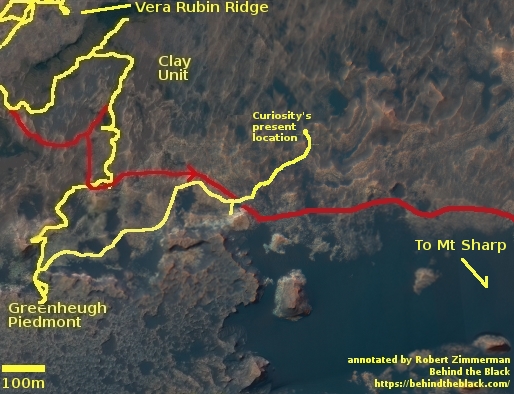
The artist’s oblique drawing above, as well as the map to the right, provide some context as to Curiosity’s present location and its entire journey in Gale Crater. For the overall context of Curiosity’s travels, see my March 2016 post, Pinpointing Curiosity’s location in Gale Crater. For all rover updates since then through May 2020, go here.
Since my last update on July 7, 2020, Curiosity has quickly moved a considerable distance to the east, as planned, skirting the large sand field to the south in its journey to the best path upward onto Mt. Sharp. The science team however has detoured away from their planned route, shown in red on the map, heading downhill a bit in order to find one last good location in the clay unit to drill. They are at that location now and are presently scouting for the best drilling spot.
About a week ago, before heading downhill, they had stopped to take a set of new images of Curiosity’s wheels. » Read more
Japan’s space agency JAXA has revealed that it is looking at two fast-spinning asteroids as possible destinations for its Hayabusa-2 spacecraft after it has dropped off its samples from the asteroid Ryugu on December 6.
The candidate asteroids on the agency’s list are asteroid 2001AV43 which Hayabusa2 would reach in November 2029 after flying by Venus, and asteroid 1998KY26 which the probe would reach in July 2031 after passing by another asteroid.
JAXA says both asteroids are rotating on their axis once every 10 minutes. The high-speed spinning indicates that the asteroids’ inner structures are likely different from that of asteroid Ryugu on the first mission, which consists of pieces of rocks.
The spacecraft will no longer have the equipment for returning additional samples, but everything else is functioning and it has the fuel.
The tenth anniversary retrospective of Behind the Black continues: In 2013 Diane and I made a trip back east to visit the Smokey Mountains and do some hiking. Coincidentally, our trip took place at the end of September, when the budget battle between Obama and the Republicans in Congress was about to cause a government shutdown. This essay, the first of three, describes the extra effort and money being exerted by Obama’s administration to make that shutdown as unpleasant and as inconvenient to the American public as possible. The later two essays, linked to as an update at the top of the essay, outline what happened next.
——————————-
Shut down fascism in the Smoky Mountains
See my October 2, 2013 update here.
Today, October 1, 2013, my wife Diane and I went hiking in Great Smoky Mountains National Park. We did this despite the news from Washington that the federal government had shut down due to the lack of a funding from Congress and that all the national parks were closed.
The news reports had said that the National Park Service would close all roads into the park except for New Found Gap Road, the one road that crossed over the mountains from Tennessee to North Carolina. They couldn’t close this road because it was a main thoroughfare used by the public for basic transportation. Moreover, my research into the hikes we wished to do told me that several of those hikes originated on trailheads along this road. In traveling the road the day before, we had seen that these trailheads would not only be difficult to close, it would be dangerous and stupid to close them. For one, the road was windy and narrow. If there was a car accident or someone had car problems, any one of these parking areas might be essential for the use of the driver as well as local police and ambulances. For another, there are people still backpacking in the mountains who will at some point need to either exit with their cars or be picked up at these trailheads. Closing the trailheads will strand these hikers in the park, with dangerous consequences.
So, despite the shutdown, off we went to hike the Appalachian Trail, going to a well known lookout called the Jump Off, an easy 6.5 mile hike that leaves from the parking area at New Found Gap, the highest point on New Found Gap Road that is also on the border between Tennessee and North Carolina. It is also probably one of the most popular stopping points along the road, visited by practically every tourist as they drive across.

The hike itself was beautiful, if a bit foggy and damp. The picture above shows one of the clearest views we had all day. Nor were we alone on this hike. We probably saw one to two dozen other hikers, heading out to either the Jump Off or Charles Bunion (another well known day hike destination along this section of trail).
» Read more
An evening pause: Hat tip Diane Zimmerman.
China has rolled out its Long March 5 rocket and is now preparing to launch its Tianwen-1 orbiter/lander/rover to Mars this coming Thursday, July 23rd, some time between 12 am and 3 am (Eastern).
A Long March 5 rocket is set for liftoff with China’s Tianwen 1 mission some time between 12 a.m. and 3 a.m. EDT (0400-0700 GMT) Thursday, according to public notices warning ships to steer clear of downrange drop zones along the launcher’s flight path.
Chinese officials have not officially publicized the launch date. Chinese state media outlets have only reported the launch is scheduled for late July or early August, and officials have not confirmed whether the launch will be broadcast live on state television.
This will be the first operational launch of the Long March 5, which has had three previous test launches, with the first two failing. The success of the December launch, as well as the May success of the related Long March 5B, made this Mars mission possible.
After achieving orbit in February 2021 and spending two months scouting the landing site, the lander will descend to the surface, bringing the rover with it. The prime landing site is Utopia Planitia, in the northern lowland plains.

Click for full image.
Today’s cool image is not only cool, it gives a nice feel for the likely shallow ice table that is probably found close to the surface throughout the lowland northern plains of Utopia Planitia, which is also the prime landing site for China’s Taenwen-1 Mars lander/rover, scheduled for launch sometime in the next four days. [Update: there are now indications the launch will not occur until early August.]
The photo to the right, rotated, cropped, and reduced to post here, was taken on May 9, 2020 and shows a nice collection of strange land forms on the western edge of Utopia Planitia. In this one picture we can see large mounds that might be evidence of cryovolcanic activity (mud volcanoes), strings of small mounds that might be the same but that also suggest underground faults and voids, and distorted and eroded craters that could have buried glacial material in the interiors.
The largest crater in the upper left looks like it is actually filled with ice that has also spilled over to fill the adjacent and linked depression.
This location is quite typical of Utopia Planitia. See for example this post from May 13, 2020: The blobby wettish flows of Mars. In the mid-latitudes here we find ample evidence that buried very close to the surface is an ice table that when hit by an impact melts to form these strangely shaped craters.
China’s actual target landing area is far to the east of today’s cool image, in an area that is appears far less rough. » Read more