A faint irregular cloud of stars

A faint irregular cloud of stars
Click for original picture.

Cool image time! The picture to the right, cropped, reduced, and sharpened to post here, was released today by the science team of the Hubble Space Telescope. It shows an irregular galaxy thought to be about 44 million light years away.

Alongside its hazy shape, NGC 7292 is remarkably faint. As a result, astronomers classify NGC 7292 as a low surface brightness galaxy, barely distinguishable against the backdrop of the night sky. Such galaxies are typically dominated by gas and dark matter rather than stars.

Astronomers directed Hubble to inspect NGC 7292 during an observational campaign studying the aftermath of Type II supernovae. These colossal explosions happen when a massive star collapses and then violently rebounds in a catastrophic explosion that tears the star apart. Astronomers hope to learn more about the diversity of Type II supernovae they have observed by scrutinising the aftermath and remaining nearby stars of a large sample of historical Type II supernovae.

NGC 7292’s supernova was observed in 1964 and accordingly given the identifier SN 1964H. Studying the stellar neighbourhood of SN 1964H helps astronomers estimate the initial mass of the star that went supernova, and could uncover surviving stellar companions that once shared a system with the star that would become SN 1964H.

I searched but was unable to locate any 1964 images of this galaxy when the supernova was still visible, so I could not pinpoint its location in the picture. It has long since faded away.

Note that the reddish smudges scattered throughout the picture are likely galaxies so far distant that their light has shifted entirely into the reddish spectrum. This likely places them one to several billions of light years away, not millions.

2 comments

SpaceX launches another 52 Starlink satellites

Just after midnight tonight (Pacific) SpaceX successfully launched another 52 Starlink satellites, its Falcon 9 rocket lifting off from Cape Canaveral.

The first stage successfully completed its ninth flight, landing on a drone ship in the Atlantic, the 199th time that SpaceX has accomplished this so-called impossible task. The two fairing halves completed their fourth and fifth flights respectively.

The leaders in the 2023 launch race:

39 SpaceX
22 China
8 Russia
5 Rocket Lab

American private enterprise now leads China 44 to 22 in the national rankings, and the entire world combined 44 to 38, with SpaceX by itself leading the rest of the world, excluding other American companies, 39 to 38.

3 comments

Astronomers admit new satellite constellations “are not a threat” to Hubble

In a June 5, 2023 press release from the Space Telescope Science Institute (STScI) that operates both the Hubble and Webb space telescopes, astronomers admitted that the increased number of orbiting satellites from SpaceX and OneWeb have had little impact on Hubble’s observations, and even that impact has been reduced by new software tools.

Stark applied the new tool, based on the image analysis technique known as the Radon Transform, to identify satellite trails across Hubble’s camera with the widest field of view, the Advanced Camera for Surveys (ACS). In 2002 the satellite streaks were present in five percent of ACS exposures, with many of those too faint to discern easily. This rose to ten percent by 2022, although the typical brightness of the detected trails remained unchanged.

…”To date, these satellite trails have not had a significant impact on research with Hubble,” said Tom Brown, Head of STScI’s Hubble Mission Office. “The cosmic rays that strike the telescope’s detectors are a bigger nuisance.”

Radiation from space hits the ACS electronic detectors on every exposure, leaving streaks. These are easy to identify from exposure to exposure. The same holds true for artificial satellites. “The average width I measured for satellites was 5 to 10 pixels. The ACS’ widest view is 4,000 pixels across, so a typical trail will affect less than 0.5% of a single exposure. So not only can we flag them, but they don’t impact the majority of pixels in individual Hubble images. Even as the number of satellites increases, our tools for cleaning the pictures will still be relevant,” said Stark. [emphasis mine]

In other words, the claims by many astronomers that the increase in satellites is a threat to astronomy have been exaggerated. The new satellites might have a greater impact on ground-based telescopes, but based on these numbers (which would be comparable if not better for the giant 8-meter-plus big telescopes on Earth), that impact should be as easily mitigated.

I am gob-smacked that STScI issued this press release, since it undercuts the entire political narrative of the astronomical community that demands these new satellite constellations be either regulated, limited, or even banned, because otherwise all astronomy will be impossible. Based on the information presented here, none of those regulations are justified, at all, and that narrative is an utter lie.

9 comments

China tests parachutes on recent Long March 3B launch

During a May 17, 2023 launch of a Long March 3B rocket, China tested the use of parachutes to better control the descent and landing of the rocket’s boosters.

The system was used on a Long March-3B rocket carrying a BeiDou navigation satellite into orbit on May 17 from the Xichang Satellite Launch Center in Sichuan Province, according to the academy.

Developed by the academy, the parachute brought down the rocket boosters to a predetermined location, narrowing the range of the landing area by 80 percent.

Based on the limited information provided by China’s state-run press, it appears this system was only tested on the four strap-on boosters, not on the first stage core. Regardless, such a system, which appears to be a copy of the system Rocket Lab has been developing for the last four years, will significantly reduce the hazards to Chinese inhabitants who live in the drop zones of these rockets.

Note too that China previously tried to copy SpaceX’s grid fins. Apparently its engineers found it difficult if not impossible to reverse engineer that concept, so they apparently decided to try copying Rocket Lab’s parachute methods instead.

3 comments

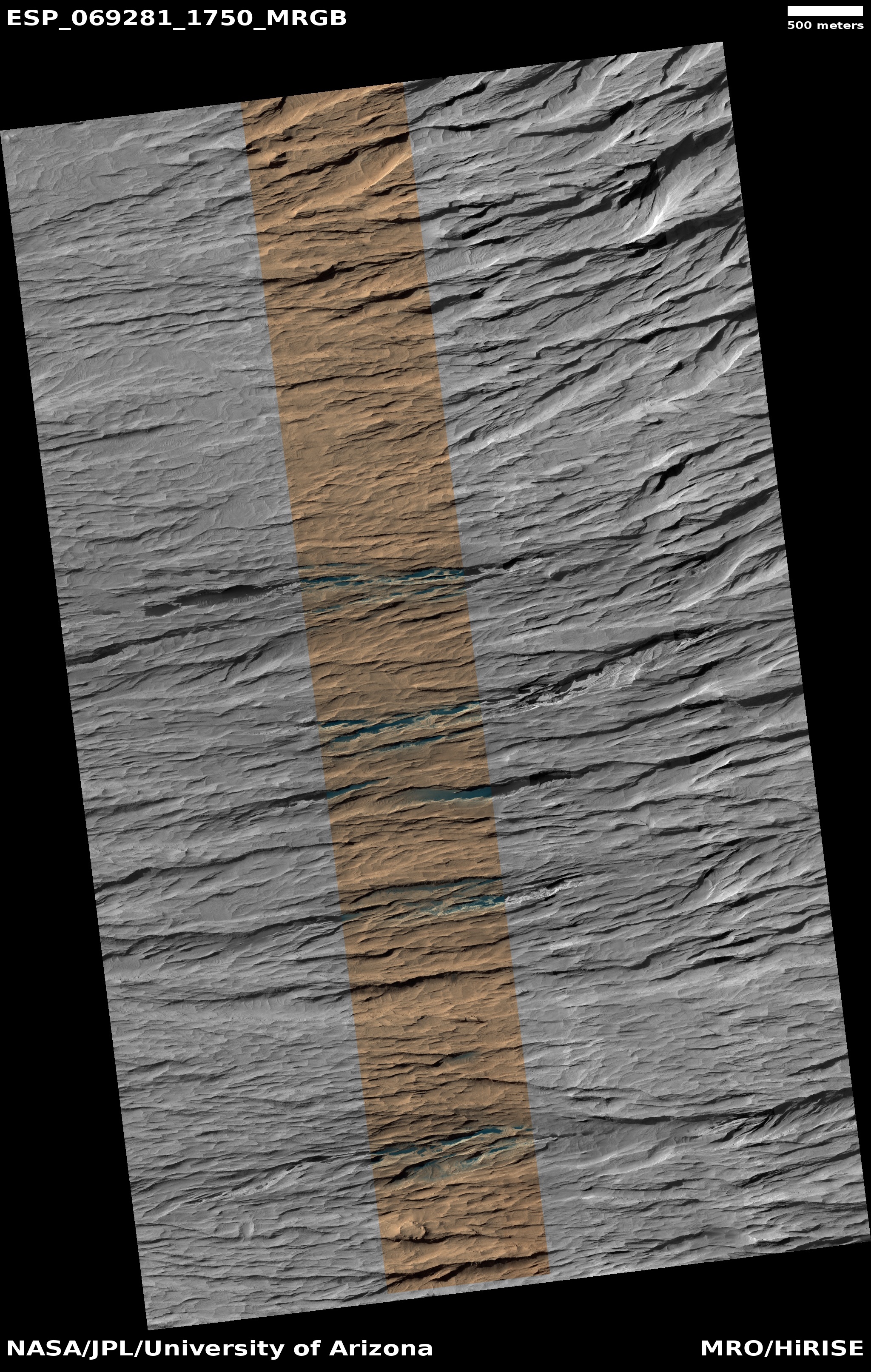
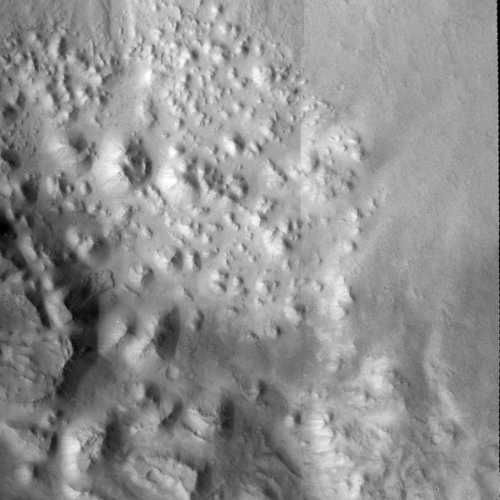
Eroding glacier on Martian slope?

Eroding glacier on Martian slope?
Click for original image.

Cool image time! The picture to the right, enhanced, cropped, reduced, and sharpened to post here, was taken on April 1, 2023 by the high resolution camera on Mars Reconnaissance Orbiter (MRO). It shows what the science team labels as “Rough Ground and Bright Exposures” on the flanks of a wide mountain range on Mars, whose highest point is about 4,400 feet higher to the northeast and about 30 miles away.

The arrow indicates the downhill grade. Notice the smooth flat areas that seem to only partially cover much rougher terrain below. To my eye this top layer resembles an Earth glacier that has partly sublimated or melted away, exposing the rougher bedrock below that has been ground and scraped by the glacier previously.

However, this is not on Earth, so assuming it is like an Earth glacier is dangerous.
» Read more

0 comments

Firefly buys orbital tug company Spaceflight

Firefly Aerospace announced yesterday that it has purchased the orbital tug company Spaceflight, and will now offer its Sherpa tug as part of its launch services.

Spaceflight Inc. was known as a leader in arranging launches of small satellites on small launch vehicles or as secondary payloads on larger launch vehicles, deploying more than 460 payloads. Spaceflight had also developed its own series of orbital transfer vehicles called Sherpa, using a mix of chemical and electric propulsion systems.

Spaceflight has worked with a wide range of launch providers, although at one point it ran afoul of one of its largest partners, SpaceX. However, Firefly said that Spaceflight’s services will, going forward, be used only with Firefly’s vehicles.

Though Firefly will honor the contracts Spaceflight arranged for smallsats to be launched on other rockets, it appears it will be no longer be acting as a launch arranger. Instead, it will offer smallsats a package launch deal, including both its Alpha rocket and the tug. For this deal to pay off however Firefly has got to get Alpha operational. The two launches scheduled for this summer should do this, assuming they fly with no problems.

0 comments

Space Force awards SpaceX and ULA contracts for six launches each

As part of its long term launch agreement with SpaceX and ULA, the Space Force today awarded both companies contracts for six launches each, all to occur beginning in 2025.

According to the overall agreement, each company got five-year contracts to launch as many as 40 missions. ULA won 60% of the missions and SpaceX 40%. However, the delays to ULA’s Vulcan rocket will likely change those numbers:

In a report released June 8, the Government Accountability Office noted that the NSSL program office continues to order launch services from ULA and SpaceX amid concerns about Vulcan’s delays. “ULA delayed the first certification flight of the Vulcan launch system … to accommodate challenges with the BE-4 engine and a delayed commercial payload, nearly two years later than originally planned,” said GAO. “In the event that Vulcan is unavailable for future missions, program officials stated that the Phase 2 contract allows for the ability to reassign missions to the other provider.”

One of the reasons that ULA has not hurried its effort to make Vulcan reusable and more competitive with SpaceX is that is already has this guaranteed military launch commitment. It doesn’t need to be as competitive.

What needs to happen is a third or fourth company has to enter the market, giving the military other options. The military also has to cancel this long term launch agreement, which limits the number of companies it will do business with to just SpaceX and ULA. It would be much better to open the competition up to everyone. The ULA would be forced to compete.

4 comments

X-ray telescope on ISS develops light leak

The NICER X-ray telescope on ISS has developed a light leak that now limits its use during daylight hours.

The team suspects that at least one of the thin thermal shields on NICER’s 56 X-ray Concentrators has been damaged, allowing sunlight to reach its sensitive detectors.

Pending any repair attempts, observations during the daytime are now restricted to objects in the sky opposite the Sun. Night observations remain unaffected.

2 comments

Study: Long periods of weightlessness caused changes in the brain

Scientists studying the brains of 30 astronauts who spent from two weeks to one year on ISS have found that the longer a person stayed in weightlessness the greater the changes caused in the brain, and the longer it takes to recover.

Their findings, reported today in Scientific Reports, reveal that the brain’s ventricles expand significantly in those who completed longer missions of at least six months, and that less than three years may not provide enough time for the ventricles to fully recover.

Ventricles are cavities in the brain filled with cerebrospinal fluid, which provides protection, nourishment and waste removal to the brain. Mechanisms in the human body effectively distribute fluids throughout the body, but in the absence of gravity, the fluid shifts upward, pushing the brain higher within the skull and causing the ventricles to expand.

“We found that the more time people spent in space, the larger their ventricles became,” said Rachael Seidler, a professor of applied physiology and kinesiology at the University of Florida and an author of the study. “Many astronauts travel to space more than one time, and our study shows it takes about three years between flights for the ventricles to fully recover.”

You can read the paper here. The expansion of ventricles is a normal process due to aging, but I could not find any description in the paper noting its impact, for good or ill. Long periods of weightlessness brings it about quickly, but only temporarily.

5 comments

China’s Kuaizhou-1A solid-fueled rocket launches satellite

China’s Kuaizhou-1A solid-fueled rocket today successfully placed what its state-run press described as a “experiment satellite … to verify satellite communication and remote sensing technologies.”

The rocket lifted off from China’s interior Jiuquan spaceport in the Gobi desert. No word on where the rocket’s three lower stages crashed, or whether they did so near habitable areas.

The leaders in the 2023 launch race:

38 SpaceX
22 China
8 Russia
5 Rocket Lab

American private enterprise still leads China 43 to 22 in the national rankings, and the entire world combined 43 to 38, with SpaceX by itself now tied those other nations combined 38 to 38.

1 comment

Ice-filled fissure on Mars?

Ice-filled fissure on Mars?
Click for original image.

Cool image time! The picture to the right, cropped, reduced, and sharpened to post here, was taken on February 15, 2023 by the high resolution camera on Mars Reconnaissance Orbiter (MRO). The science team labeled this a “Terrain Sample”, which suggests but doesn’t guarantee that it was to fill a gap in the camera’s schedule in order to maintain that camera’s proper temperature, and therefore was targeted at a relatively random but potentially interesting location.

What we see is a fissure canyon, about 250 to 300 feet deep with cliffs about 125 high, that appears surrounded and even filled with icelike features. Even the craters on the plateau above the canyon appear like they either impacted in ice, or have since been filled and eroded by that ice.

But is it ice?
» Read more

0 comments

Scientists claim to identify cause of Sun’s fast solar wind

The uncertainty of science: Using data from the Parker Solar Probe, scientists now believe they have identified the cause of Sun’s fast solar wind that streams from the magnetic regions on the Sun that are dubbed coronal holes.

In a paper published June 7, 2023 in the journal Nature, a team of researchers used data from NASA’s Parker Solar Probe to explain how the solar wind is capable of surpassing speeds of 1 million miles per hour. They discovered that the energy released from the magnetic field near the sun’s surface is powerful enough to drive the fast solar wind, which is made up of ionized particles—called plasma—that flow outward from the sun.

The results depend a great deal on computer modeling, based on our presently limited understanding of magnetic field processes in environments like stars. It will need to be confirmed by more data from Parker as well as later probes.

1 comment
1 317 318 319 320 321 1,353