Webb’s first deep field infrared image reveals hundreds of very early galaxies

The uncertainty of science: Using the Webb Space Telescope to take a 32-day-long infrared exposure, scientists have obtained the deepest deep field picture of the universe’s earliest time period, within which they have found more than 700 galaxies, 717 to be exact.

The initial survey of these galaxies appear to reveal several facts.

About a sixth of early galaxies in the JADES sample are in the throes of star formation of a kind we don’t see in the nearby universe, Endsley explains, marked by extremely bright emission at certain wavelengths. “Stars within very early galaxies are forming in these super-compact clumps,” he adds, “forming hundreds, perhaps thousands of these very massive, young stars all at once, basically within the span of a couple millions of years.”

But they weren’t “on” all the time. The low fraction of galaxies with such emission suggests that individual clumps would suddenly light up with new stars and then rest for some time. This “bursty” mode of star formation could explain the unexpectedly bright galaxies announced by other astronomers — they were simply looking at the galaxies fired up with unexpectedly intense star formation.

However, while these findings explain too-bright galaxies, they don’t explain the too-massive galaxies, another early, albeit controversial find from JWST data. Endsley explains that even as hot, massive newborn stars light up their galaxy, they’re not necessarily associated with all that much mass. “We’re not really finding evidence of these over-massive objects within our JADES sample,” he states.

In other words, this data appears to contradict earlier data from Webb that other researchers said revealed galaxies that were too massive and developed to have formed that soon after the Big Bang.

All of this data remains somewhat uncertain, and is based on only tiny tidbits of information, gleaned from mere smudges of red-shifted infrared light. Much more research will be required, some not possible by Webb, before we have any solid answers, and even then there is going to be a lot of uncertainty.

4 comments

Boeing sued for stealing specialized tooling to assembly SLS

A Colorado company, Wilson Aerospace, on June 6, 2023 filed a lawsuit against Boeing, claiming that the company conspired with Wilson’s direct competitors to steal the designs of its specialized tool for installing the core station engines on SLS.

According to the lawsuit, after some initial discussions, Boeing arranged for a “live” demonstration of Wilson’s torque device, during which participants could handle and operate it to verify the tool’s capability and performance. What Wilson claims it did not realize, however, is that some of the participants in this demonstration were not Boeing employees. “Wilson later learned that at least seven of those in attendance for the live presentation were external to Boeing and were, at the time, employees of Wilson’s direct competitors,” the lawsuit states. “This fact was concealed from Wilson who was deceived by Boeing and the ‘Bogus Boeing Employees’ into giving the presentation by falsely suggesting to Wilson that everyone was a Boeing employee.”

The complaint alleges that Boeing subsequently used information from this demonstration, as well as proprietary drawings and designs, to work with Wilson’s competitors to develop a cheaper solution. “Boeing concealed these facts from Wilson as part of its scheme to defraud Wilson and to transmit Wilson’s IP to its direct competitors,” the lawsuit states.

The company is demanding a jury trial. If its charges are proved true, it will be another piece of evidence demonstrating the level of corruption that exists at Boeing.

6 comments

ULA completes dress rehearsal launch countdown and static fire test of Vulcan

ULA yesterday successfully completed a full dress rehearsal launch countdown new Vulcan rocket, including a short 2-second static fire test of the rocket’s two first stage BE-4 engines.

A Vulcan rocket fired its two BE-4 engines in a static-fire test called the Flight Readiness Firing (FRF) at 9:05 p.m. Eastern from Cape Canaveral’s Space Launch Complex 41. The engine start sequence started at T-4.88 seconds, ULA said in a statement an hour after the test, with the engines throttling up to their target level for two seconds before shutting down, concluding the six-second test.

The test appeared to go as planned. “Nominal run,” Tory Bruno, president and chief executive of ULA, tweeted moments after the test.

This dress rehearsal had originally been scheduled for late May, but issues on the rocket required ULA to scrub the launch and return the rocket to the assembly building.

There appear to be only three issues remaining before that first launch can occur. First there is the hydrogen leak that caused the destruction of the rocket’s Centaur upper stage during a static fire engine test in March. The company has apparently still not determined what action — if any — must be taken on this.

Second is whether the rocket’s primary payload, Astrobotic’s Peregrine lunar lander, is ready for launch. It appears it has completed all ground testing, but there were questions whether its software has been adjusted for a new landing site that NASA assigned it in February.

Third is scheduling. Peregrine’s monthly launch windows are only four to five days long each month. This limitation also has to be juggled with other ULA launches on the same launchpad, using its soon-to-be retired Atlas-5 rocket.

1 comment

Chinese pseudo-company launches its rocket for 2nd time

The Chinese pseudo-company CAS Space yesterday successfully launched its rocket Lijian-1 rocket for second time, lifting off from China’s interior Jiuquan spaceport in the Gobi Desert and carrying a record (for China) of 26 cubesats.

As was usual for China, its state-run press revealed almost nothing about the satellites. Nor did it provide any information about where the rocket’s lower stages crash-landed in China, or if they did any damage or landed near habitable areas.

This pseudo-company is actually even more pseudo than other Chinese pseudo-companies, as it is a direct spin-off created by the government Chinese Academy of Sciences, with most of its investors directly linked to that academy.

The leaders in the 2023 launch race:

38 SpaceX
21 China
8 Russia
5 Rocket Lab

American private enterprise still leads China 43 to 21 in the national rankings, and the entire world combined 43 to 37, with SpaceX by itself beating those other nations combined 38 to 37.

0 comments

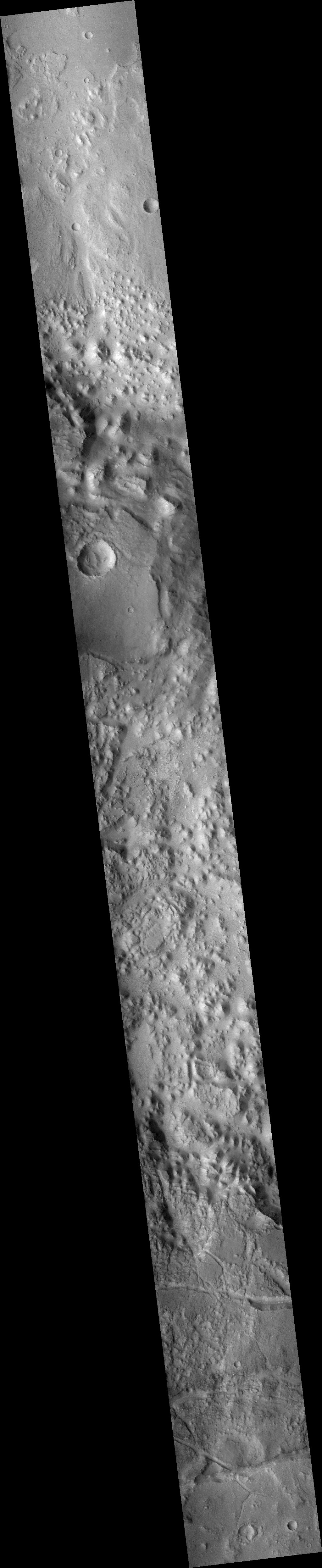
Distorted floor of a Martian crater

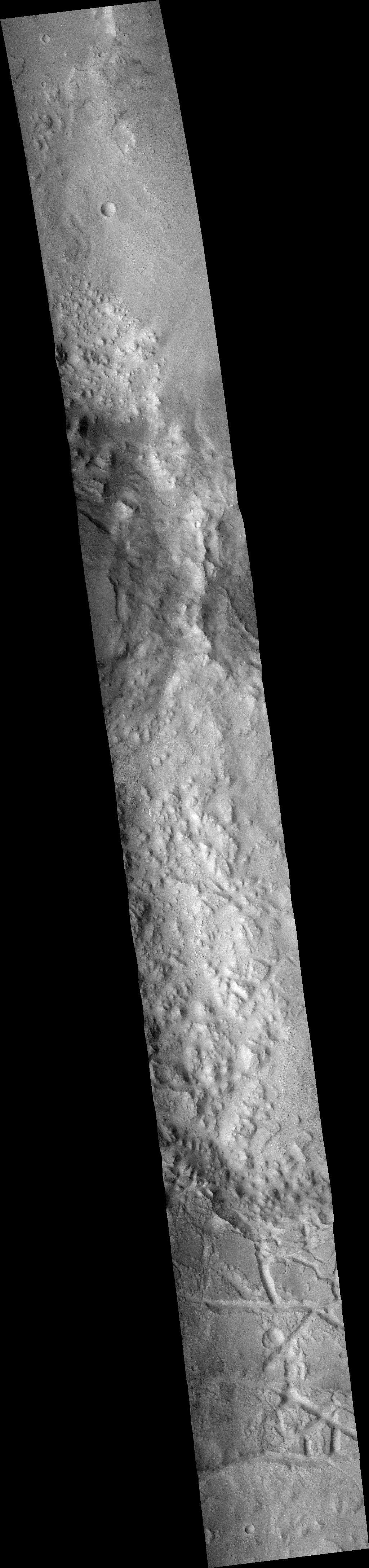
Overview map

Distorted floor of a Martian crater
Click for original image.

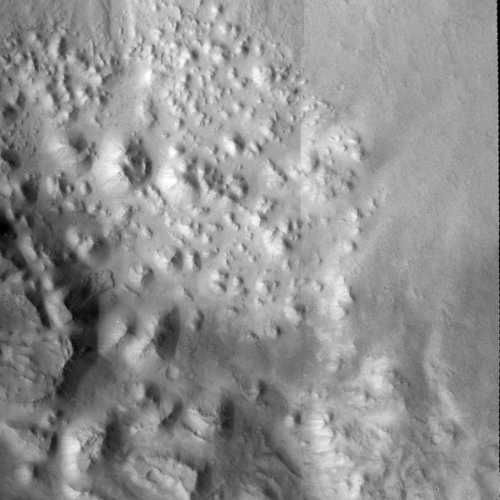
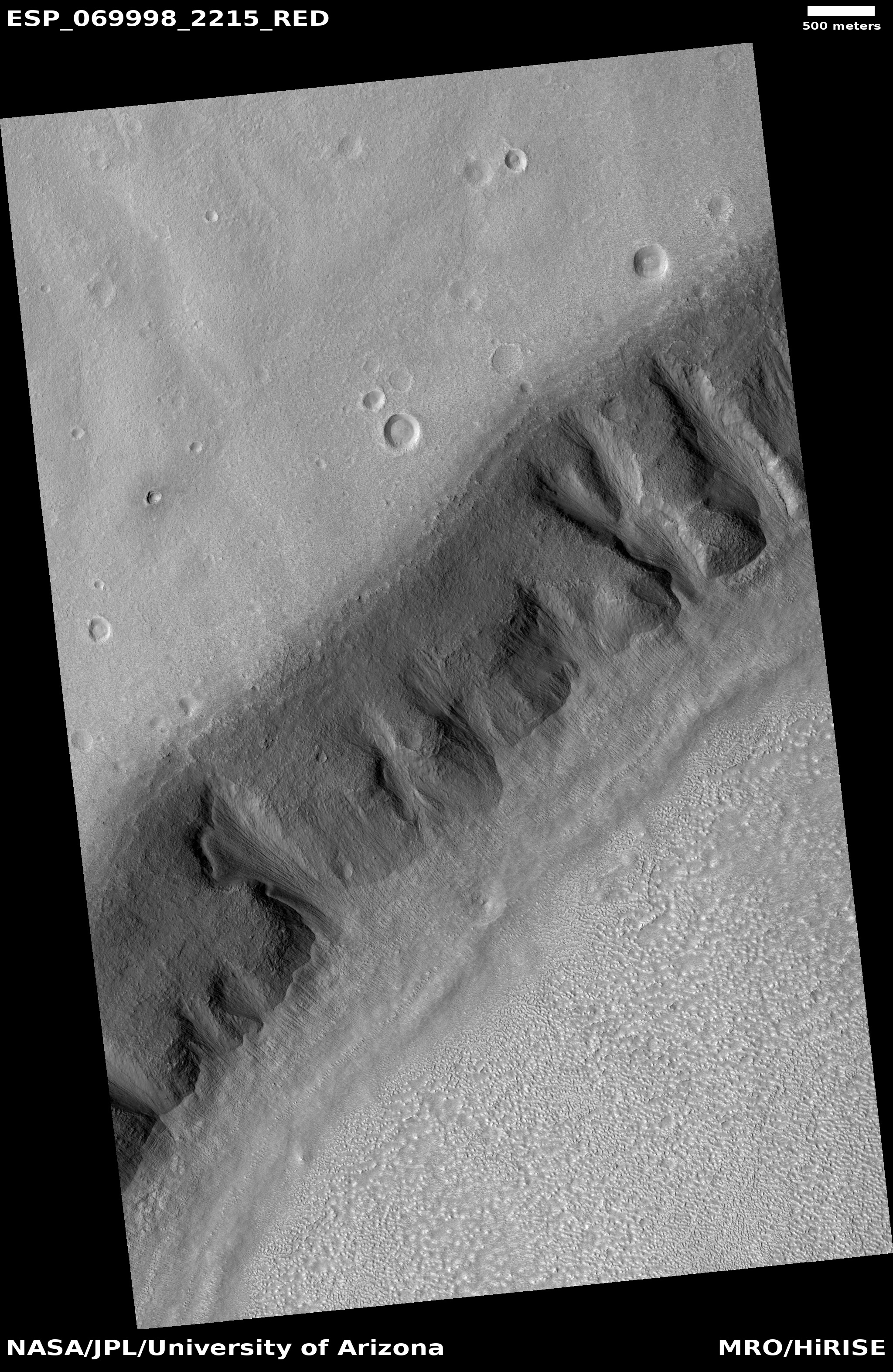
Cool image time! The picture to the right, rotated, cropped, reduced, and sharpened to post here, was taken on February 18, 2023 by the high resolution camera on Mars Reconnaissance Orbiter (MRO). It shows what the science team labels “Mantle Layers in Southern Mid-Latitudes.”

I would be less vague. These strangely shaped features invoke the typical glacial features seen throughout the mid-latitudes of Mars. The knobs and outcrops suggest some underlying breakdown that the top layers of glacial material has covered. They also suggest some form of sublimation or erosion process to the glacier itself.

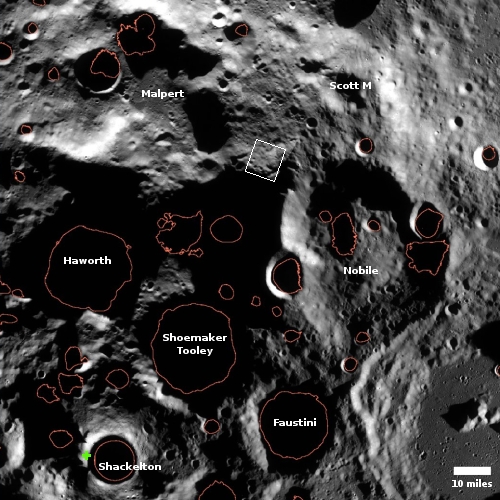
The white rectangle inside the inset on the overview map above marks this location, covering the floor of an unnamed 10-mile-wide crater in the cratered southern highlands at 41 degrees south. In this region all the craters show some evidence of this sublimation, all suggesting that there is a near-surface underlying ice layer that when exposed vanishes to leave depressions or hollows. Here however it appears that ice layer is mostly intact, the knobs and ridges indicating the shape of the bedrock and large breakdown below.

0 comments

Gemini telescope in Hawaii fixed, captures nearby supernova

Gemini North image of supernova in Pinwheel Galaxy
Click for original image.

The Gemini telescope in Hawaii, which was damaged in 2022 during normal maintenance operations, has now been fixed and resumed observations, beginning with a spectacular image of the newly discovered supernova in the Pinwheel Galaxy, only 20 million light years away.

The Gemini North telescope, one half of the International Gemini Observatory operated by NSF’s NOIRLab, has returned from a seven-month hiatus literally with a bang, as it has captured the spectacular aftermath of a supernova, a massive star that exploded in the large, face-on, spiral Pinwheel Galaxy (Messier 101). The supernova, named SN 2023ixf [as indicated by the arrow], was discovered on 19 May by amateur astronomer Koichi Itagaki.

Since its discovery, observers around the globe have pointed their telescopes toward Messier 101 to get a look at the burst of light. Over the coming months, Gemini North will allow astronomers to study how the light from the supernova fades and how its spectrum evolves over time, helping astronomers better understand the physics of such explosions.

As one of the closest supernova to occur in years, SN 2023ixf has become a major target by astronomers. This type of supernova signals the collapse and death of a star 8 to 10 times the mass of the Sun. Since the life cycle of such massive stars is not yet fully understood, this nearby supernova provides a great opportunity for astronomers to learn more.

2 comments

Firefly delays NASA launch to August

According to papers filed with the FCC, Firefly’s July launch attempt of its Alpha rocket, carrying a set of NASA cubesats, has now been delayed one month to August.

Meanwhile, a second launch by Firefly for the Space Force is presently tentatively scheduled for June, and the company says it is wrapping up preparations for that launch. That contract’s prime focus is to demonstrate to the military the ability to launch with only a 24-hour notice.

If so, then this new rocket company, which has only launched twice before, with the second launch barely reaching orbit, will be launching twice in only a matter of weeks, both times from its launchpad at Vandenberg.

0 comments

OneWeb offers its satellite constellation broadband service to the maritime industry

With its full constellation of 634 satellites in orbit, OneWeb has now made its satellite constellation broadband service available to the maritime industry.

With 634 OneWeb operational satellites now in orbit, the OneWeb constellation is complete and fully operational down to 35 degrees latitude. OneWeb will have the final ground stations completed and operational requirements in place, ensuring the company remains on track to deliver full global maritime services by the end of the year. Now OneWeb will start selling services to the maritime industry, via its specialist maritime distribution partners.

OneWeb and its partners have also developed a range of hardware terminal products which are available from trusted maritime communications providers Intellian and Kymeta. Offering hardware terminal products from two established providers with different form factors enables greater choice for customers.

More information here.

1 comment

NASA names winners in annual student rocket competition

NASA yesterday named the winners in its annual student rocket launch competition, which took place at the Marshall Space Flight Center in Alabama on April 15, 2023.

The live stream of the competition is available here, cued to when the rockets begin launching.

The number of awards is a bit too many, making it seem that NASA wanted to make sure every team got some form of participation award. Nonetheless, these students demonstrated that they will soon be building real rockets, as part of the new and emerging rocket industry.

0 comments

Martian dust devil where none had been before

Dust devil on Mars
Click for original image.

Today’s cool Mars image is especially cool because it is of the exact same place on Mars I had featured in a picture only a little more than one month ago. I return to this spot only a month later because the location was yesterday’s featured captioned image from the high resolution camera team of Mars Reconnaissance Orbiter (MRO). The difference is that this time the camera captured a dust devil there that wasn’t there previously. From the caption:

The dust devil is casting a shadow, which can be used to estimate its height. This image is part of ongoing monitoring activities by HiRISE of seasonal activities on Mars.

Over the years, HiRISE has observed many dust devils. Just like on Earth, dust devils develop when the Sun heats up the ground such that it warms the air directly above it. When air heats up its density decreases causing it to rise up while colder air sinks down driving local convection.

If the region is windy, the wind my end up rotating the “convection cells” caused by the vertical motion of air leading to development of a dust devil. Since the main requirements for development of such features are the presence of dust and a warm ground, we focus our monitoring of dust devils in regions on Mars that are known to be dusty (like Syria Planum), and during the late spring and summer time, when we expect the ground to be warm.

» Read more

2 comments

Hubble snaps picture of another jellyfish galaxy

Another jellyfish galaxy
Click for original image.

Astronomers today released another picture of a jellyfish galaxy taken by the Hubble Space Telescope, with that picture to the right, cropped, reduced, and sharpened to post here. From the caption:

The jellyfish galaxy JO206 trails across this image from the NASA/ESA Hubble Space Telescope, showcasing a colourful star-forming disc surrounded by a pale, luminous cloud of dust. A handful of bright stars with criss-cross diffraction spikes stand out against an inky black backdrop at the bottom of the image. JO206 lies over 700 million light-years from Earth in the constellation Aquarius.

This image is the sixth and final such photograph in this survey. You can view all of these images here. The study has found that star formation does not seem to be significantly different inside the galaxy versus the tentacles that stretch out beyond due to pressure from the intergalactic material. This suggests that the influence of this intergalactic material on the formation of stars is relatively minor.

0 comments

NASA: Psyche asteroid mission now targeting October ’23 launch

A report [pdf] from NASA on the steps taken by JPL to get the Psyche asteroid mission back on track after it failed to meet its launch date last fall says those steps are working, and the spacecraft should now succeed in meeting its new October ’23 launch date.

Both the report and today’s press release are filled with vague PR blather interspersed with complementing JPL for addressing the issues, including hiring about a dozen more people to get the main software issue that had prevented last year’s launch solved. I noticed one point however that was not mentioned clearly in the press release nor had been made clear in the earlier investigation report that today’s newly released report labels as “COVID-19 Related” issues.

The return to majority in-person work has made a tremendous difference in restoring visibility and informal communications across the project. Drop-in meetings, social coffee hours, off-site intensives, and individuals “walking the floor” have improved team interaction, problem-solving, efficiency, and trust. The team is also making judicious use of remote and hybrid access options as appropriate to ensure flexibility while not compromising their collaboration.

In other words, the panic over Wuhan had so restricted in-person contact at JPL that it had hampered the project’s development. Based on the vague language used to describe almost everything else mentioned in this new report, it appears that this issue more than anything else contributed the launch delay. Not surprisingly, no one at NASA, JPL, Caltech, or in the government wishes to make this admission bluntly. It would illustrate once again the foolishness of the lockdown policies imposed during the panic by the government and academia.

6 comments
1 318 319 320 321 322 1,353