Blobs and jellyfish in space

Blobs and Jellyfish
Click for original image.

Cool image time! The picture to the right, cropped and reduced to post here, was taken by the Hubble Space Telescope and released today.

The galaxy JW100 features prominently in this image from the NASA/ESA Hubble Space Telescope, with streams of star-forming gas dripping from the disc of the galaxy like streaks of fresh paint. These tendrils of bright gas are formed by a process called ram pressure stripping, and their resemblance to dangling tentacles has led astronomers to refer to JW100 as a β€˜jellyfish’ galaxy. It is located in the constellation Pegasus, over 800 million light-years away.

Ram pressure stripping occurs when galaxies encounter the diffuse gas that pervades galaxy clusters. As galaxies plough through this tenuous gas it acts like a headwind, stripping gas and dust from the galaxy and creating the trailing streamers that prominently adorn JW100. The bright elliptical patches in the image are other galaxies in the cluster that hosts JW100.

The image was part of a research project studying star formation in the tendrils of jellyfish galaxies.

The blob near the top of the image is another galaxy in this same galaxy cluster. It is an elliptical galaxy that also happens to have two central nuclei, caused when two smaller galaxies merged. The central regions of each have not yet merged into one.

5 comments

SpaceX launches two SES communication satellites

Only a few hours after SpaceX launched 52 Starlink satellites from California, the company successfully launched two communications satellites for the Luxembourg company SES, using its Falcon 9 rocket launching from Cape Canaveral.

The first stage completed its sixth flight, landing safely on a drone ship in the Atlantic. The rocket’s two fairings completed their third and seventh flights, respectively.

The leaders in the 2023 launch race:

19 SpaceX
11 China
4 Russia
2 Rocket Lab

American private enterprise now leads China 21 to 11 in the national rankings of this year’s launches, and the whole world combined 21 to 17. SpaceX by itself is tied with the rest of the world, including other American companies, 19 to 19.

4 comments

Starship launch still stalled by FAA

According to a tweet by Elon Musk today, Starship will be ready for its first orbital test launch in a few weeks.

Musk also noted however that SpaceX is still awaiting the FAA’s launch license, and because of this he now expects the launch in the third week in April.

Why it is taking months for the FAA to issue this license is disturbing, and suggests that under the Biden administration the feds are behaving more and more like the incompetent Civil Aviation Authority in the UK, which stonewalled Virgin Orbit’s launch for months so that the company now sits on the verge of bankruptcy.

Hat tip to BtB’s stringer Jay for this story, who will be gone for the next two weeks on vacation. Have fun Jay.

5 comments

SpaceX launches another 52 Starlink satellites

SpaceX today successfully put another 52 Starlink satellites into orbit using its Falcon 9 rocket launching from Vandenberg Space Force Base in California.

The first stage completed its 8th flight, landing on a drone ship in the Pacific.

A second SpaceX launch today, this time from Cape Canaveral, Florida, is set to launch very shortly, so the leader board for the 2023 launch race will also change as well:

18 SpaceX
11 China
4 Russia
2 Rocket Lab

American private enterprise now leads China 20 to 11 in the national rankings, and the entire globe combined 20 to 17. SpaceX now trails the entire world, including American companies. 18 to 19.

5 comments

The ubiquitous presence of ice in the Martian mid-latitudes

Ice in the Martian mid-latitudes
Click for original image.

Cool image time! The picture to the right, rotated, cropped, rotated, and sharpened to post here, was taken on November 28, 2022 by the high resolution camera on Mars Reconnaissance Orbiter (MRO). Labeled merely as a “crater with mesa”, it gives us another example of the presence of glacial ice in the mid-latitudes of Mars.

That mesa is what planetary scientists have labeled “concentric crater fill,” a glacial feature found in numerous craters throughout the mid-latitude bands from 30 to 60 degrees latitude. The ground in the terrain surrounding the crater could be also be impregnated with ice, but based on the location as shown in the overview map below, it is just as likely to be lava.

In fact, the location of this particular crater illustrates why concentric crater fill might become the best source of ice for future colonists.
» Read more

0 comments

Both India’s Chandrayaan-3 and Intuitive Machine’s Nova-C lunar landers pass vibration tests


Click for interactive map.

According to separate announcements just released, both India’s Chandrayaan-3 lander/rover and Intuitive Machine’s private Nova-C lunar lander have passed their last ground tests and are now ready for launch to the Moon later this year.

India’s space agency ISRO successfully completed testing of its Chandrayaan-3 lunar lander/rover in early March, completing vibration tests of the spacecraft and proving it will be able to survive the stresses during launch. The spacecraft successfully completed radiation testing in February.

ISRO is now targeting June 2023 for Chandrayaan-3’s launch.

Intuitive Machines meanwhile announced yesterday that its Nova-C lander has completed vibration testing, and is ready for launch later this year.

The map to the right shows the landing sites of these planned landers near the Moon’s south pole (indicated by the white cross), as well as Russia’s long-delayed lunar lander, Luna-25, which is now targeting a July launch.

0 comments

Astra asks for more time from Nasdaq before its stock is delisted

The rocket startup Astra has now asked Nasdaq to give it an extra six months beyond the early April deadline to get its stock price above $1 in order to avoid getting delisted from the stock market.

With its share price at $0.42 upon closing Thursday, Astra Chief Financial Officer Axel Martinez wrote in a blog post that the space company formally requested on Monday another six-month window to raise the share price above $1 for 10 consecutive business days as required to stave off a delisting.

It appears the company might be considering a reverse-stock split, whereby stocks are combined with the total number reduced, thus artificially raising the stock price. Nasdaq will consider this tactic an acceptable solution, though it is also considered a last-ditch approach.

Right now Astra is no longer an operational rocket company, having discontinued its Rocket-3 rocket. It says it is developing a new rocket, dubbed Rocket-4, but whether it can get this operational before it runs out of money or gets delisted remains unknown.

5 comments

Rocket Lab and China launch satellites successfully

Both the American company Rocket Lab and China have successfully placed satellites in orbit in the past day.

First, Rocket Lab successfully placed two Earth observation satellites for the company Capella yesterday. This was also its second launch from Wallops Island in Virginia. The company made no attempt to recover the first stage.

Next, China today used its Long March 3B rocket to place its own Earth observation satellite into orbit from its Xichang spaceport, located in the country’s northeast but far from the ocean. No word on whether the rocket’s first stage and four strap-on boosters crashed near habitable areas.

The leaders in the 2023 launch race:

17 SpaceX
11 China
4 Russia
2 Rocket Lab

For the rest of the year, I will only list the leaders with each launch update. At this moment, American private enterprise leads China 19 to 11 in the national rankings, and the entire world combined 19 to 17. SpaceX alone now trails the rest of the world combined, including American companies, 17 to 19.

These numbers will likely change later today, as SpaceX has two launches scheduled in just a few hours. One launch will place two communications satellites in orbit for the Luxembourg company SES. The other will launch another 52 Starlink satellites.

2 comments

Endless ripple dunes in Mars’ third largest impact basin

Ripple dunes in Mars' third biggest impact basin
Click for original image.

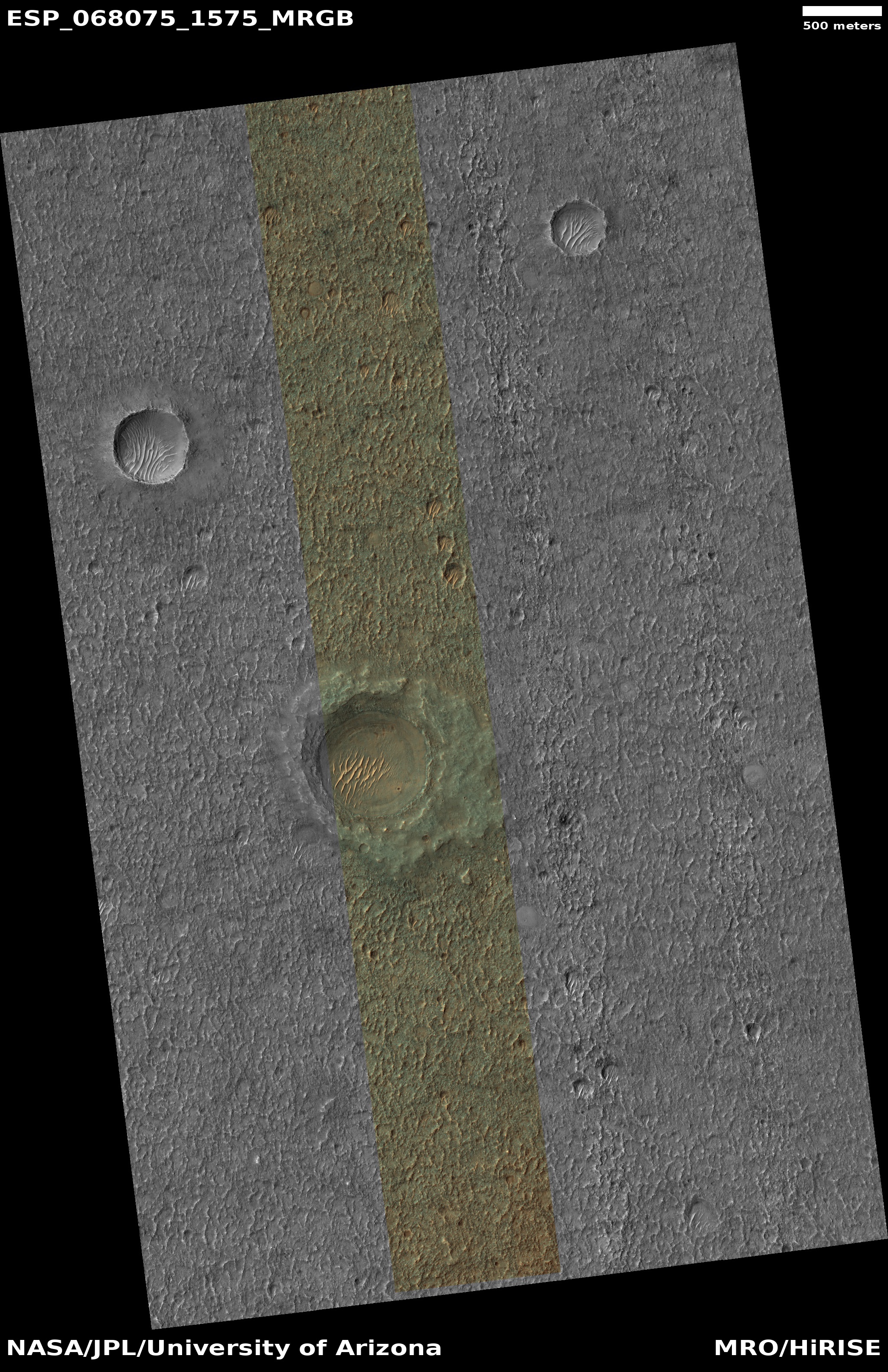
Cool image time! The picture to the right, cropped to post here, was taken on November 30, 2022 by the high resolution camera on Mars Reconnaissance Orbiter (MRO).

The section cropped shows only a small portion of the endless ripple dunes seen in this area. The color strip provides us some interesting other details as well as mysteries. The orange indicates dust on the ridges as well as the higher terrain near the center of the picture. The green in the hollows as well as to the east and west suggests coarser materials that have settled in lower elevations. This supposition is reinforced by the orange area near the bottom of the picture where the ripples have mostly dissipated. This is a high spot, and we appear to be looking at a dusty surface. (This impression is clearer in the full image.)

The latitude is high, 48 degrees south, but as far as I know orbital images have not found a lot of ice evidence in this part of Mars.
» Read more

0 comments

Student cubesat demonstrates how to use a solar sail for satellite deorbit

Using cheap off-the-shelf parts students at Brown University have successfully tested a simple solar sail in space and shown how it can be used to de-orbit satellites efficiently and inexpensively.

They built a satellite on a shoestring budget and using off-the-shelf supplies available at most hardware stores. They even sent the satellite β€” which is powered by 48 Energizer AA batteries and a $20 microprocessor popular with robot hobbyists β€” into space about 10 months ago, hitching a ride on Elon Musk’s SpaceX rocket.

…The students added a 3D-printed drag sail made from Kapton polyimide film to the bread-loaf-sized cube satellite they built. Upon deployment at about 520 kilometers β€” well above the orbit of the International Space Station β€” the sail popped open like an umbrella and is helping to push the satellite back down to Earth sooner, according to initial data. In fact, the satellite is well below the other small devices that deployed with it. In early March, for instance, the satellite was at about 470 kilometers above the Earth while the other objects were still in orbit at about 500 kilometers or more.

Based on the data, it is expected the cubesat will burn up in the atmosphere in five years, not twenty-five or so predicted for the other cubesats launched to the same orbital elevation.

This experiment above all proves that most of the very expensive demo missions to test this kind of technology have been grossly over-budget. The entire cost of this student-built project was just $10,000, and it actually was more successful in proving this technology than a number of past solar sail projects that cost millions.

4 comments

Another study finds evidence of active volcanism on Venus

Changes in volcanic vent on Venus over eight months
Click for original image.

Using archival data from the Magellan spacecraft that orbited Venus in the early 1990s scientists think they have identified an active vent that appeared to change shape based on radar images taken eight months apart.

From the abstract of their paper:

We examine volcanic areas on Venus that were imaged two or three times by Magellan and identify a ~2.2 km2 volcanic vent that changed shape in the eight months between two radar images. Additional volcanic flows downhill from the vent are visible in the second epoch images, though we cannot rule out that they were present but invisible in the first epoch due to differences in imaging geometry. We interpret these results as ongoing volcanic activity on Venus.

This result is different that other research released last month that used Magellan data to identify geological features on Venus most likely to be active. In today’s results the scientists think they have spotted an actual volcanic eruption, as shown in the two images to the right. The image is taken from Figure 2 of the paper, with the changes in the center bottom vent clearly visible.

There is much uncertainty in these results that must be mentioned. The images are not optical but radar, so the scientists had to do a lot of computer processing to get the final result. They also compared this work with computer simulations to help confirm their conclusions.

The results also leave open the question of the total amount of volcanism presently active on Venus. As the scientists note in their conclusion, “With only one changed feature, we cannot determine how common currently active volcanism is on Venus.”

Nonetheless, the research using both new and archival data in the past thirty years is increasingly telling us that there is some active volcanism on Venus, hidden beneath its thick hellish cloudy atmosphere.

2 comments

Reassessed fuel measurements give Mars Odyssey until 2025 before it runs out

Using more refined methods for measuring the fuel left on Mars Odyssey, the oldest orbiter circling Mars at this time, engineers have determined that it will not run out until 2025, not this year as previously thought.

Mars Odyssey has been in orbit around Mars since 2001. The fuel is used by thrusters to help maintain the spacecraft’s orientation, which is mostly done by reaction wheels, or gyroscopes. We should therefore not be surprised if by 2025 engineers figure out a way to get the reaction wheels to do the whole job, when the fuel runs out.

5 comments
1 345 346 347 348 349 1,353