Confused glaciers in a Martian crater

Confused glaciers in a Martian crater
Click for original image.

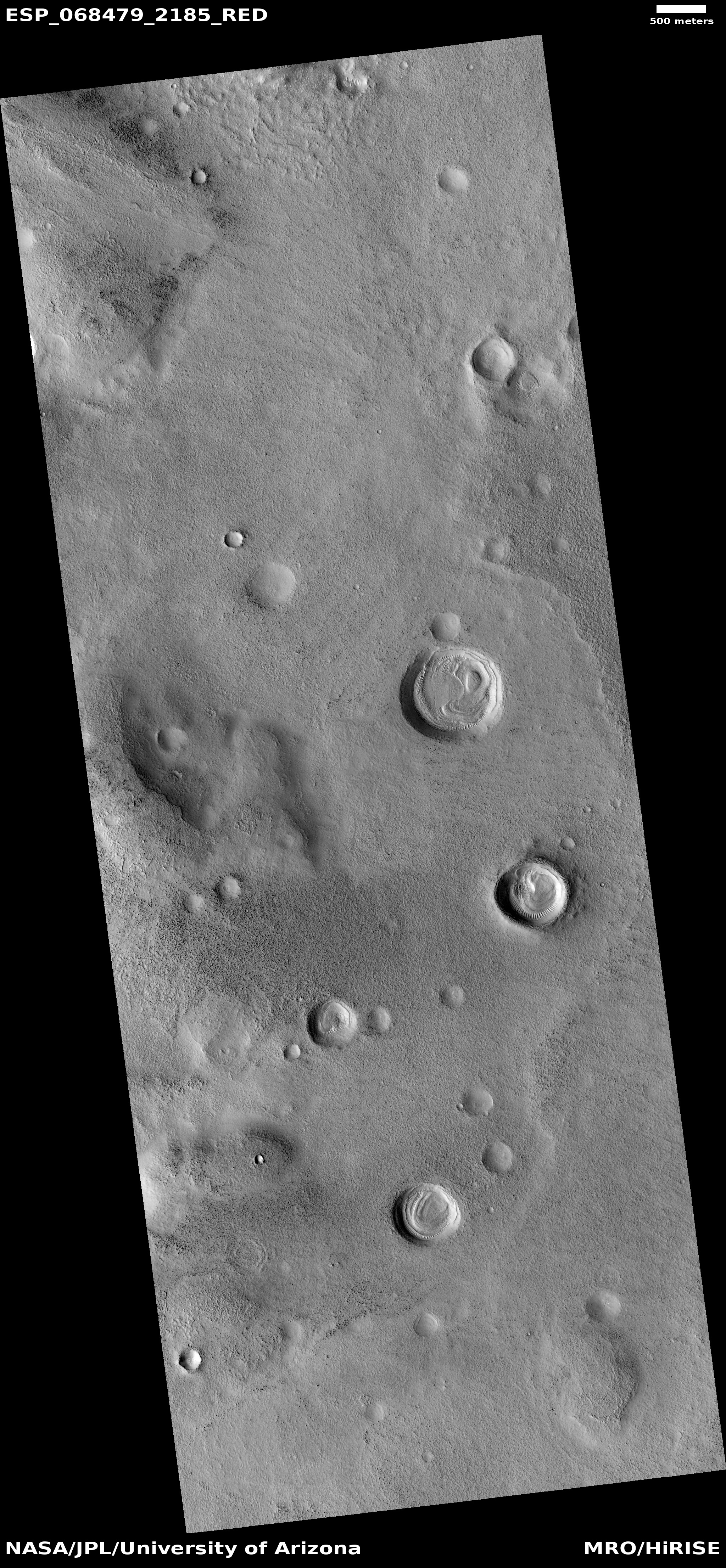
Cool image time. The picture to the right, cropped to post here, was taken on February 2, 2023 by the high resolution camera on Mars Reconnaissance Orbiter (MRO), and shows a strangely blobby crater in the northern mid-latitudes where glacial features are frequently found inside craters.

In this case however the glacier seems very confused. As this is in the northern hemisphere, you would expect glacial material to survive on the north-facing southern interior slopes of the crater, where there is year-round less sunlight. The mottled eroded terrain in the south part of the crater floor suggests this. However, the crater also clearly has a terraced glacier on its south-facing northern interior slopes.

Why has the glacial material survived in both places, but not in the center of the crater?

In addition, there is that strange roughly circular feature attached to the south side of the crater. What formed it? Is it a glacier on the plains surrounding the crater? Or are we looking at volcanic material?

This crater is also unique. The crater just to its southwest (partly seen in the cropped image above), is a much more typical glacial-filled mid-latitude crater, its interior material more evenly distributed and its circular rim only slightly distorted.
» Read more

0 comments

No ice inside permanently shadowed crater near Moon’s south pole?

Marvin crater as seen by Shadowcam
Click for original image.

Overview map

Using a camera on South Korea’s lunar orbiter Danuri, dubbed Shadowcam and designed to look into the permanently shadowed craters at the Moon’s poles, scientists have taken an image that sees into the forever dark region of one such crater.

The picture to the right, released on March 13, 2023 by the Shadowcam science team, is of the crater Marvin, located about 16 miles to the east of the south pole. The pink outline indicates the area that is thought to be permanently shadowed.

The second image to the right provides a wider view of the south pole region, with the craters labeled and outlined by the green lines. The orange lines mark permanently shadowed areas. The white box indicates the approximate area covered by the Shadowcam picture. One of the candidate landing sites for Starship, as part of NASA’s Artemis program, is the eastern rim of Shackleton, essentially at the south pole itself.

Previous data suggests that ice should be found in those permanently shadowed areas, because other orbiters have detected evidence of hydrogen there. The Shadowcam picture above however shows nothing that strongly suggests the presence of ice, unless that darker flat area on the floor of the crater is ice-infused dust. If so however, it is quite ancient and solid, based on the presence of several craters within it.

The press release makes no mention of this question, probably because the scientists are still analyzing the data. This first look however suggests the ice is not there, or is in a form that is going to require a lot of processing to extract the water from it.

1 comment

Samples from Ryugu found to contain uracil, one of the four nucleobases in RNA

Japanese researchers analyzing the samples returned by Hayabusa-2 from the rubble-pile asteroid Ryugu have identified the molecule uracil, one of the four nucleobases that form the molecule RNA.

Hayabusa 2 collected 5.4 grams from two spots on Ryugu and delivered them to Earth on December 6, 2020. Early studies showed the samples contained many organic compounds. That led Oba’s group to analyze two 10-milligram samples using the same sensitive technique they had used earlier on meteorites. The technique can detect nucleic acid bases at levels down to parts per trillion in small samples.

Now, they report in Nature Communications that uracil is present at a level of parts per billion in both Ryugu samples. While this concentration is different than they’d previously found in meteorites, Oba says that might be because the parent bodies of the meteorites and of Ryugu underwent different levels of aqueous alteration and other processes. They also detected niacin (vitamin B3) as well as other organic molecules, but they didn’t find any other nucleobases.

RNA is formed from four nucleobases, uracil, adenine, cytosine, and guanine. To form DNA, the fundamental building block of life, uracil is replaced by thymine.

This data reinforces other data that suggests the formation of these essential molecules for life is relatively common and easy, at least in our solar system.

0 comments

Dimorphus is dry, based on data obtained before and after DART hit it

Data collected by the ground-based Very Large Telescope (VLT) in Chile before and after the impact by the DART probe in September 2022 has revealed that the rubble-pile asteroid Dimorphos is very dry, with little or no water.

[The astronomers] observed the Didymos–Dimorphos system on 11 occasions, from just before the impact to about a month afterwards. MUSE [one of VLT’s instruments] is able to split the light from the double-asteroid into a spectrum, or rainbow, of colors, to look for emission at specific wavelengths that corresponds to specific molecules. In particular, Opitom’s team searched the ejecta for water molecules and for oxygen that could have come from the break-up of water molecules by the impact. However, no evidence of water was detected. Dimorphos, at least, seems to be a dry asteroid.

You can read the paper here.

Some theories prior to DART’s impact suggested that there could be ice within some inner solar system asteroids. Finding none instead suggests that inner solar system asteroids are very distinct and different from the icy comets and asteroids either coming from or orbiting in the outer solar system.

0 comments

Webb detects “hot sand clouds” in atmosphere of exoplanet

Using the Webb Space Telescope, astronomers have detected “hot sand clouds” in atmosphere of exoplanet 40 light years away, along with evidence of water, methane, carbon monoxide, carbon dioxide, sodium, and potassium.

You can read the paper here [pdf]. The exoplanet itself appears to have some features that resemble that of a brown dwarf, or failed star, instead of an exoplanet.

Although VHS 1256 b is more on the heavier side of the known exoplanets, its gravity is relatively low compared to more massive brown dwarfs. Such very low-mass stars can only burn deuterium for a relatively short duration. Consequently, the planet’s silicate clouds can appear and remain higher in its atmosphere, where the JWST can detect them. Another reason its skies are so turbulent is the planet’s age. In astronomical terms, it is pretty young. Only 150 million years have passed since it formed. The planet’s heat stems from the recent formation process – and it will continue to change and cool over billions of years.

The sand clouds are hot, in the range of 1,500 degrees Fahrenheit.

These results were obtained as part of an early-release program from Webb, and illustrate the potential of the infrared space telescope for learning many specific details about brown dwarfs and exoplanets.

0 comments

Russia’s Luna-25 unmanned lunar lander to be delivered to Vostochny in early June


Click for interactive map.

According to Russia’s state-run press, its Luna-25 unmanned lunar lander will finally be delivered to its launchsite in Vostochny in the first ten days of June 2023, after many years of delays.

The press announcement made no mention of a launch date after delivery, though according to an earlier report Roscosmos is aiming for a July 13, 2023 launch date.

The landing site on the Moon is Boguslawsky crater, as indicated by the green dot on the map to the right. If it occurs as planned, it will join three other landers now targeting 2023 lunar landings, Ispace’s Hakuto-R1, Intuitive Machines Nova-C, and India’s Chandrayaan-3, with three of four landing in the Moon’s south pole regions. The white cross marks the location of the south pole itself, on the rim of Shackleton Crater.

0 comments

Virgin Orbit resumes limited operations

In anticipation of a possibly deal to save the company, Virgin Orbit officials have resumed limited operations, bringing back a small number of employees to work on crucial issues required for its next launch.

“Our first step will begin Thursday of this week, when we plan to return a subset of our team to focus on critical areas for our next mission,” Virgin Orbit said in a statement. “We are looking forward to getting back to our mission and returning to orbit.”

…Reuters reported that Virgin Orbit is working on a $200 million infusion from Texas-based venture capital investor Matthew Brown via a private share placement, citing a term sheet. Following a meeting by Virgin Orbit’s board on Tuesday, the two sides plan to close the deal on Friday, according to the non-binding term sheet, Reuters said.

Should the company resume full operations and launch again, I am certain it will not launch from the United Kingdom, at least not until the UK has fixed its launch licensing bureau, the Civil Aviation Authority, which took so long to approve Virgin Orbit’s launch from Cornwall it practically bankrupted the company.

5 comments

Hakuto-R1 enters lunar orbit

Lunar map showing Hakuto-R1's landing spot
Hakuto-R1’s planned landing site is in Atlas Crater.

The lunar lander Hakuto-R1, privately-built by the Japanese company Ispace, has now successfully entered lunar orbit in anticipation of its landing sometime next month.

Tokyo-based ispace said that its HAKUTO-R Mission 1 lander entered orbit at 9:24 p.m. Eastern March 20 after a burn by its main engine lasting several minutes. The company did not disclose the parameters of the orbit but said that the maneuver was a success.

…Entering orbit is the seventh of 10 milestones ispace set for the mission that started with launch preparations. The final three milestones are completing “orbital control maneuvers,” the landing itself and going into a steady state of activities after landing.

The spacecraft carries several payloads, the most significant of which is the United Arab Emirates Rashid rover.

If Hakuto-R1 completes its 10 milestones successfully, it will lay the groundwork for Ispace’s second Hakuto-R mission to the Moon in 2024, and an even larger lander on a third mission to follow, this time built in partnership with the American company Draper and carrying NASA payloads.

0 comments

A half-mile high Martian cliff on the verge of collapse

A half-mile Martian cliff on the verge of collapse
Click for original image.

Cool image time! The picture to the right, cropped and reduced to post here, was taken on December 24, 2022 by the high resolution camera on Mars Reconnaissance Orbiter (MRO). It shows erosion gullies coming down off a mountain side, just north of a massive cliff that I estimate to be around 2,000 to 3,000 feet high.

Note the north-south-trending cracks. These suggest that this entire half-mile-high cliff face is slumping downward, cracking as it does so. The cracks at the start of the high flat-topped thumb-shaped mesa near the image bottom are especially intriguing. They suggest that this entire mesa might eventually separate and give way.

There is a specific reason this cliff face is slumping, as shown in the overview map below.
» Read more

12 comments

South Korean private rocket startup completes first suborbital rocket test

Innospace, a South Korean private rocket startup, on March 19, 2023 successfully completed the first test flight of a suborbital prototype, launching from Brazil’s Alcantara Launch Center.

The rocket flew for 4 minutes and 33 seconds before falling into the designated safety zone. The engine lasted for 106 seconds, which fell short of the previously planned 118 seconds, yet its performance was stable, according to Innospace. Hanbit-TLV, the test vehicle, is a 16.3-meter (53.5-foot) single-stage rocket designed to verify the performance of a 15-ton-thrust rocket engine developed by Innospace.

The company will now develop its full-scale orbital rocket, dubbed Hanbit-Nano, “capable of carrying 50-kilogram (110-pound) payload into space, equipped with a 15-ton-thrust hybrid engine powered by solid fuel and liquid oxidizer.” A 2024 launch is the goal, possibly from a new commercial spaceport in Norway.

More information here. The rocket also carried a payload for the Brazilian military, which is why by contract Innospace officials could not release the exact altitude reached by the rocket.

0 comments

A verde valley on Mars

A verde valley on Mars
Click for original image.

In the southwest where I live, a valley dubbed “verde” (which means “green” in Spanish) is generally a place with a somewhat persistent river with lots of lush plant life. The Verde Valley in Arizona is the perfect example, with “close to 80% of the valley’s land … national forest.”

On Mars there is also a verde valley, but the name is not descriptive in the least. The picture to the right, rotated, cropped, and reduced to post here, was taken on January 22, 2023 by the high resolution camera on Mars Reconnaissance Orbiter (MRO) and shows one section of the Martian Verde Vallis, draining south to north.

The dark rippled patches inside this shallow canyon are sand dunes. In fact, though MRO has not taken many high resolution images of Verde Vallis, every one shows the valley with further patches of ripple dunes. See for example this image of a section of the valley just a bit farther north.
» Read more

2 comments
1 344 345 346 347 348 1,353