India’s Mars orbiter mission ends after eight years

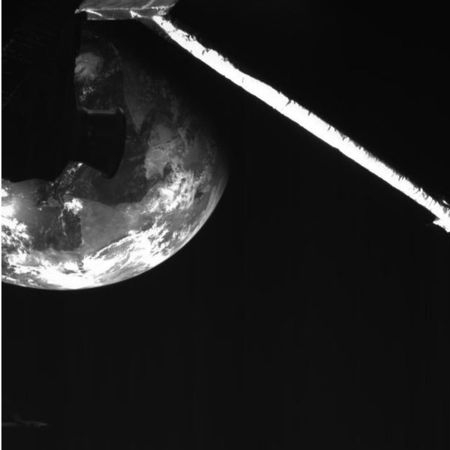
After eight years in orbit around Mars, India’s Mars orbiter mission, Mangalyaan, has run out of fuel for controlling its orientation, ending its mission.

The Rs 450 crore Mars Orbiter Mission was launched onboard PSLV-C25 on November five, 2013, and the MOM spacecraft was successfully inserted into Martian orbit on September 24, 2014 in its first attempt. “Right now, there is no fuel left. The satellite battery has drained,” sources in the Indian Space Research Organisation (ISRO) told PTI. “The link has been lost”.

There was, however, no official word from the country’s national space agency, headquartered here.

During its mission it produced more than a thousand images, though the mission’s primary objective was technological, proving that India itself could design, build, launch, and manage a planetary mission to another world. For India, Mangalyaan was thus an unqualified success.

0 comments

Fabric debris spotted on Ingenuity during 33rd flight

Tattered fabric debris on Ingenuity's leg during flight
Click to see full movie of flight.

In reviewing the images from Ingenuity’s 33rd flight on September 24, 2022, engineers have spotted what looks like a tattered piece of fabric fluttering on the end of one of the helicopter’s legs, and then disappearing.

The image to the right, cropped, enhanced, and labeled to post here, comes from an animation created from all images taken during the flight.

A small piece of foreign object debris (FOD) was seen in footage from the Mars helicopter’s navigation camera (Navcam) for a portion of its 33rd flight. This FOD was not visible in Navcam footage from the previous flight (32). The FOD is seen in Flight 33 Navcam imagery from the earliest frames to approximately halfway through the video, when it fell from the leg and drifted back to the Mars surface.

The engineers do not yet know what this was, but it apparently caused no harm to the helicopter. It also is likely not from either Ingenuity or Perseverance, as both are functioning perfectly. Most likely it is a piece of the parachute used during landing and then ejected.

7 comments

NASA now aiming for SLS launch in November

In finding that Hurricane Ian caused little damage at its vehicle assembly building at Kennedy, NASA managers have decided to target the the November 12 to 27 launch window for the first launch of its SLS rocket.

According to this graph [pdf], November 27th is the only date that will provide NASA with the longest mission for Orion (38 to 42 days). Furthermore, the mission precludes launches on November 13, 20-21, and 26.

Expect them to aim for November 12th, even though that will result in an Orion mission only 26 to 28 days long.

10 comments

Firefly successfully completes first orbital launch of its Alpha rocket

Alpha 1:48 into flight

Capitalism in space: Firefly, a company that just two years ago had gone into bankruptcy, tonight successfully launched their new Alpha rocket into orbit on its second test launch. The screen capture to the right shows the rocket 1:48 minutes into flight, its first stage still firing.

A final 2nd stage engine burn has completed, and we now have confirmation of deployment of the payload satellites. My sources tell me that the second stage under-performed, putting the satellites into a 223x283km orbit, rather than the planned 300km orbit, which will shorten the lifespan of the smallsats. As this was a test launch, not an operational one, this issue does not to my mind make the launch a failure.They reached orbit and the satellites were successfully deployed.

Thus, Firefly now joins SpaceX, Rocket Lab, ULA, Virgin Orbit, and Northrop Grumman as an operational American commercial rocket companies. Astra had been operational, but it has stepped down as it builds a new rocket.

The leaders in the 2022 launch race:

43 SpaceX
41 China
12 Russia
7 Rocket Lab
6 ULA

American private enterprise now leads China 61 to 41 in the national rankings, and is tied with the entire world combined, 61 to 61.

6 comments

Watching Firefly’s next attempt to launch tonight

Firefly will try again to complete the first successful launch of its Alpha rocket tonight from Vandenberg Space Force Base.

Last night they attempted twice to launch, the first aborting about 4 minutes before launch, the second aborting at T-0, with the first stage engine’s actually igniting and then shutting down.

I have embedded the live stream below. The launch window opens at 12:01 am (Pacific) and lasts two hours, giving them time for at least two launch attempts, should an abort occur on the first attempt.

» Read more

2 comments

A look back at Virgin Galactic’s failed history

Link here. Doug Messier has probably provided the best news coverage of every up and down (mostly down) of Virgin Galactic since its beginning. As he notes at the beginning of his article:

A lot can happen in 18 years.

A mother can go from holding her newborn baby in her arms to sending her child off the college for the first time. In between, the child has learned to walk and talk, endured the rigors of puberty, and spent at least 13 years in school.

During that same time, Virgin Galactic essentially accomplished nothing, while wasting billions in private investment capital. Meanwhile, Richard Branson pumped and dumped, getting out when the getting was good and leaving others to hold the bag.

Definitely worth the read. The story of Virgin Galactic demonstrates the risks inherent in capitalism and freedom. Freedom allows for big dreams, but before you commit to any dream you better look it over very carefully or you might be burned.

3 comments

NASA releases first Juno image from the first close fly-by of Europa in decades

First released Juno image of Europa
Click for full image.

Kevin Gill's processed Juno image of Europa
Click for full image.

NASA yesterday released the first image from the successful close fly-by by Juno of Jupiter’s moon Europa since the 1990s. That photo, reduced and sharpened, is above.

The first picture NASA’s Juno spacecraft took as it flew by Jupiter’s ice-encrusted moon Europa has arrived on Earth. Revealing surface features in a region near the moon’s equator called Annwn Regio, the image was captured during the solar-powered spacecraft’s closest approach, on Thursday, Sept. 29, at 2:36 a.m. PDT (5:36 a.m. EDT), at a distance of about 219 miles (352 kilometers).

This is only the third close pass in history below 310 miles (500 kilometers) altitude and the closest look any spacecraft has provided at Europa since Jan. 3, 2000, when NASA’s Galileo came within 218 miles (351 kilometers) of the surface.

Meanwhile, the raw images have been pouring in, and citizen scientists have been quickly processing them. The photo to the right is only one example, created by Kevin Gill. I have cropped it to show one section in full resolution.

Expect many more processed images, especially those taken at closest approach, in the coming days.

2 comments

SpaceX and Jared Isaacman offer private mission to NASA to raise Hubble’s orbit

Capitalism in space: In a press release issued yesterday, NASA revealed that it has signed an unfunded agreement with SpaceX and Jared Isaacman’s Polaris program (which has purchased a series of manned missions on Dragon) to study the possibility of sending one of those private manned missions to the Hubble Space Telescope to raise its orbit.

SpaceX – in partnership with the Polaris Program – proposed this study to better understand the technical challenges associated with servicing missions. This study is non-exclusive, and other companies may propose similar studies with different rockets or spacecraft as their model.

Teams expect the study to take up to six months, collecting technical data from both Hubble and the SpaceX Dragon spacecraft. This data will help determine whether it would be possible to safely rendezvous, dock, and move the telescope into a more stable orbit.

In my book describing the history of the people who created Hubble, The Universe in a Mirror, I repeatedly noted how throughout its history people have tried to kill it, first in the design phase, then in the budget, then during construction, then after it was launched and the mirror was found to be ground incorrectly, and then after the Columbia accident when NASA management tried to cancel its last shuttle servicing mission.

Every attempt failed. As I have noted in that book and many times since its publication, Hubble is a telescope that will not die. NASA has for years intended to launch a mission to de-orbit it when its orbit had decayed enough that it was unstable. I’ve always said that when that time came, someone would propose and push for a mission to instead raise that orbit.

That prediction is now coming true. Though no robot arm exists yet for Dragon to use to grab Hubble in any rendezvous attempt, creating one is hardly difficult. At that point raising the telescope’s orbit becomes relatively trivial.

Whether such a mission could do more, such as replace Hubble’s ailing gyroscopes, is unknown. It would be foolish however not to review that possibility as well.

12 comments

Firefly to try again to complete first launch of its Alpha rocket

UPDATE: After a first abort about T-minus 4 minutes at around midnight, the launch team quickly recycled for a new launch at 12:52 am. At T-0 the rocket then aborted at launch.

There is still more than an hour in the launch window, so assuming they can rapidly pin down the cause of the abort, another attempt is possible, though unlikely. CONFIRMED: They will try again tomorrow, with the same launch window.

Though frustrating, these repeated launch attempts are actually wonderful real time training for Firefly’s launch team. The rocket is still in good condition, and they get to practice analyzing a situation under pressure and acting quickly to move forward.

Capitalism in space: Firefly will once again attempt to complete the first successful launch of its Alpha rocket tonight, with the launch scheduled for 12:01 am (Pacific) from Vandenberg Space Force Base. The launch window lasts two hours, so if they have an abort for a minor fixable reason there is a good chance they will still be able to cycle around and try again.

I have embedded below the live feed from Everyday Astronaut, which begins at around 10 pm (Pacific), two hours before the launch.

This will be their second attempt, with the first failing one year ago when one engine in the first stage shut down prematurely due to a loose connection. They attempted to launch this second rocket for the first time earlier this month, but had to scrub due to weather.

The rocket carries five small satellites, including one, Serenity, that was built by BtB reader (and supporter) Joe Latrell, builder of cubesats in a shop behind his garage.
» Read more

0 comments

Master Du – A donkey gets a manicure

An evening pause: This guy, Master Du, specializes in trimming the hoofs of donkeys that have become deformed and need specialized work. (Make sure the closed captions are on to get some translation of the narration.) This is how it is done in China. I wonder how that compares to the techniques used in the U.S., and other nations.

Hat tip Diane Zimmerman, who found this work so interesting she ended up watching Master Du videos for more than an hour.

10 comments

Lunar mountains and wrinkle ridges

Montes Recti on the Moon

Cool image time! The photo above, taken by Lunar Reconnaissance Orbiter (LRO), was released today by the orbiter’s science team, and provides us an oblique look at the mountains dubbed Montes Recti (lower right) and the wrinkle ridges near them (lower left). The highest point in this mountain range is about 5,900 feet high.

The image looks west across the northern part of the mare region dubbed Mare Imbrium, the dark area on the Moon’s visible hemisphere near its top. In the distance can be the mountains that form part of mare’s rim. The rounded peak in the top right is Promontorium Laplace (about 8,530 feet high). It is named this because it projects out (a promontory) into the mare a considerable distance from the rim. The crater at top center is Laplace D. As for the wrinkle ridges, the scientists describe them like so:

Tectonic landforms are those formed by forces that act to either contract or pull apart crustal materials. These forces develop faults or breaks in the crustal materials, and movement or slip along the faults form either positive or negative relief landforms. On the Moon, positive relief contractional landforms are the most common. The most significant contractional landforms on the Moon are wrinkle ridges, found exclusively in the dark mare basalts.

Essentially, something caused the ground to contract, which caused it to break at these ridges and be forced upward.

3 comments

Jupiter’s north pole cyclones appear as stable as those at the south pole

The northern polar cyclones of Jupiter
Click for original figure.

In reviewing five years of data from Juno, scientists now conclude that the polygon of large storms surrounding Jupiter’s north pole appear as stable as the same poloygon of storms found at the south pole.

Each polygon is made up of a central polar cyclone (PC) surrounded by a number of circum-polar cyclones (CPC). The image to the right, Figure 1 from the paper, compares the north polar storms from 2017 (top) to 2022 (bottom). During the five years of observations the whole polygon “rotated approximately 15° westward,” though it essentially maintained its structure.

After 5 years, the 8 + 1 North PCs structure and the 5 + 1 South one show very small changes; the lifetime of a single cyclone is therefore longer than 25 years and possibly longer than 75 years. Also, single cyclones have their peculiar morphology and this is often retained after 5 years, both in radiance and in morphology. In particular, this is the first time that we can observe the North CPCs system since the discovery in 2017, and we find that the structure is almost unperturbed.

The question that appears to remain unanswered by this data is whether these storms are deep-rooted to the interior of Jupiter or shallow structures. The stability suggests the latter, but this remains unproven.

0 comments
1 404 405 406 407 408 1,354