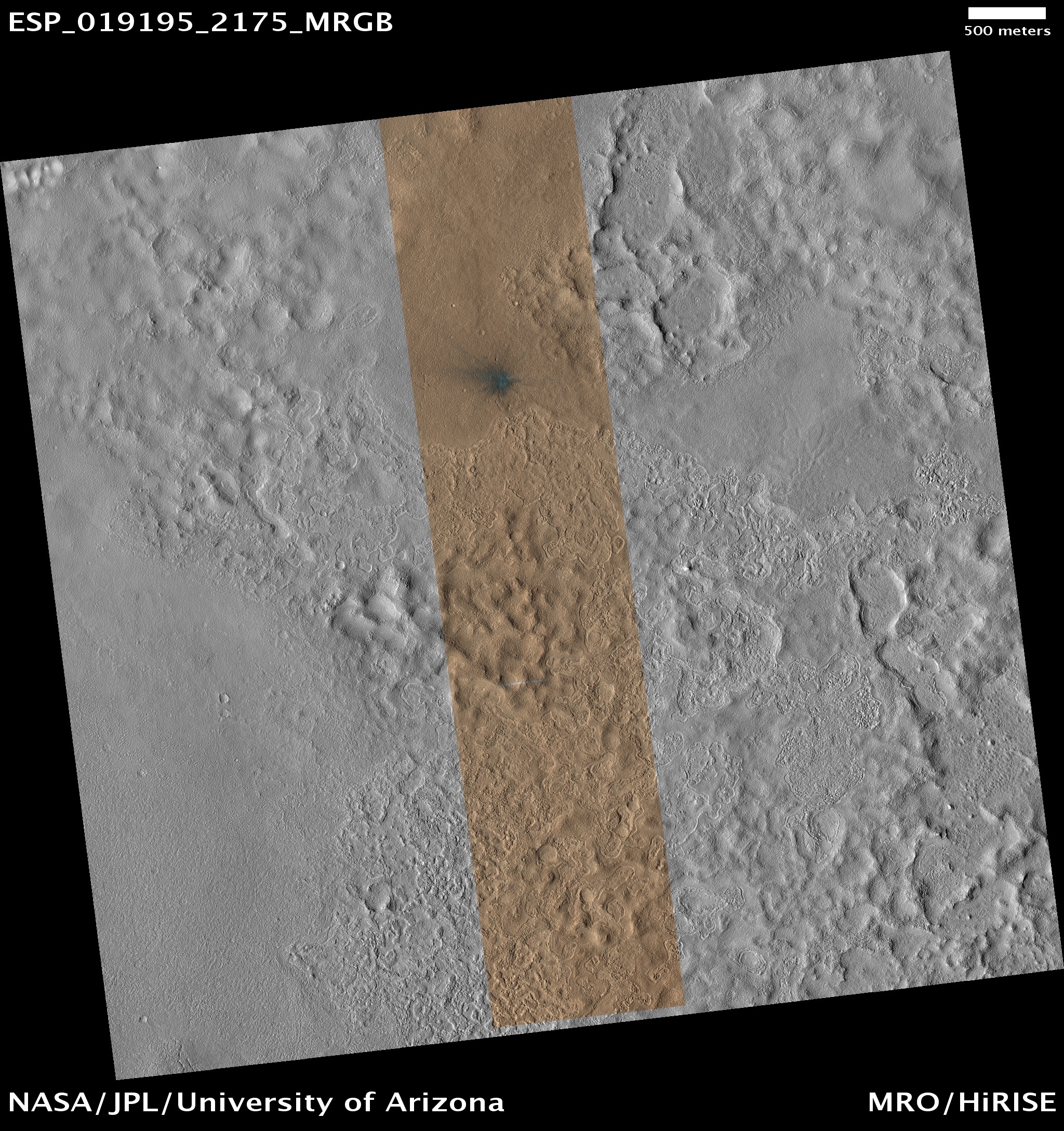
September 26, 2022 Quick space links

Courtesy of stringer Jay, who trolls Twitter so I don’t have to.

Mostly shows views of the Earth.

At the link the reason given is the “problems with the delivery of foreign-made parts.” Or to put it more bluntly, the sanctions against Russia due to its unprovoked invasion of the Ukraine has blocked many sophisticated computer parts that Russia cannot make itself.

All fantasy at this point. Russia’s been promising a next generation capsule replacing Soyuz for more than a decade.

Video at the link. The test occurred on September 23, 2022. No word yet on when they plan to launch.

0 comments

Zig-zag ridges on Mars

Zig-zag ridges on Mars
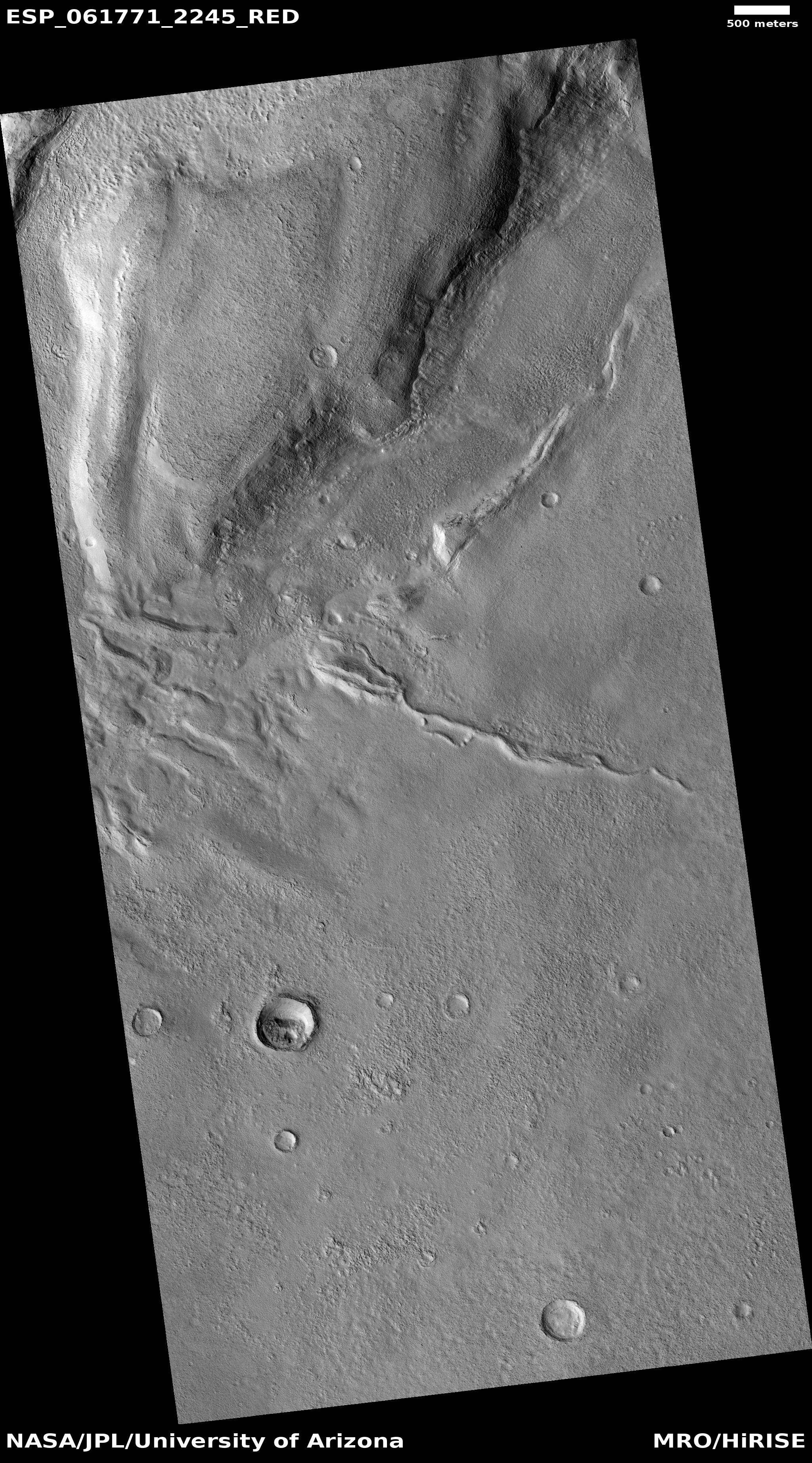
Click for full image.

Cool image time! The photo to the right, cropped and reduced to post here, was taken on April 9, 2022v by the high resolution camera on Mars Reconnaissance Orbiter (MRO). It shows a series of parallel zig-zag ridges in a flat, knobby terrain.

I don’t presume to explain this at all. According to one research paper,

This interplana region consists of extensive networks of ridgesโ€”the eponymous Aeolis Dorsaโ€”and is interpreted as having formed by topographic inversion of fluvial and alluvial deposits.

Why these ridges zig-zag however does not seem to fit into either a fluvial or alluvial explanation, both of which involve the flow of water. The quote implies these could be inverted stream channels (where the compacted streambed becomes a ridge when the surrounding terrain erodes away), but once again, the distinct zig-zag pattern seems wrong. Rivers meander, but they don’t generally turn right and left so sharply. And why should we see parallel zig-zags? This doesn’t seem to fit with a river channel origin.

The particular location, as shown on the overview map below, is close to the dry Martian equator, on the edge of Medusae Fossae Formation, the largest field of volcanic ash dust on Mars.
» Read more

1 comment

A galaxy slowly being eaten by its black hole

Spiral galaxy
Click for full image.

Cool image time! The photo to the right, rotated and reduced to post here, was taken by the Hubble Space Telescope. From the caption:

NGC 5495, which lies around 300 million light-years from Earth in the constellation Hydra, is a Seyfert galaxy, a type of galaxy with a particularly bright central region. These luminous cores โ€” known to astronomers as active galactic nuclei โ€” are dominated by the light emitted by dust and gas falling into a supermassive black hole. This image is drawn from a series of observations captured by astronomers studying supermassive black holes lurking in the hearts of other galaxies.

Essentially Seyfert galaxies are galaxies whose central supermassive black hole has become dominant, large enough that its gravity is slowly eating up the rest of the galaxy. As it increasingly swallows stars and gas, the black hole emits more and more energy, thus becoming an active galactic nuclei.

Two stars from our own galaxy also dominate this picture, one inside and to the right of the galaxy’s center, and the other the bright star at the bottom of the picture, both identified by the diffraction spikes.

1 comment

Astroscale to partner with UK companies to develop mission to remove two defunct orbiting satellites

Capitalism in space: The Japanese-based company Astroscale has signed an agreement with the United Kingdom’s space agency to develop a mission — in partnership with a number of UK companies — to remove two defunct orbiting satellites.

The COSMIC mission will be developed in collaboration with 10 UK-based partner companies in England, Scotland and Northern Ireland including: MDA UK, Thales Alenia Space UK, Nammo, GMV-NSL, NORSS, Goonhilly, Satellite Applications Catapult, Willis Towers Watson, and other advisory and industrial partners.

What Astroscale brings to the table is its magnetic capture system that it has already tested in orbit.

This is also the second contract Astroscale has won in Europe for its space junk removal technology. In May it signed a deal with OneWeb to de-orbit two of its satellites.

0 comments

Watch DART smash into asteroid today

At 7:14 pm (Eastern) the NASAโ€™s Double Asteroid Redirection Test (DART) spacecraft will crash into the small and harmless asteroid Dimorphus to see if such an impact could be used in the future to change the path of another asteroid aimed at Earth.

Dimorphus is 525 feet in diameter, and is a small moon of the larger half-mile-wide asteroid Didymos. Both are presently about 7 million miles away from Earth.

I have embedded the live streams below, one from a DART camera, dubbed DRACO, that will view the asteroid as the spacecraft approaches, and the other from NASA’s official live stream. From the DRACO live stream webpage:
» Read more

1 comment

NASA managers decide finally to roll SLS back to assembly building

NASA managers this morning finally gave up on launching their SLS rocket in an early October launch window and scheduled rolling back the rocket to the assembly building tonight.

NASA will roll the Artemis I Space Launch System rocket and Orion spacecraft back to the Vehicle Assembly Building on Monday, Sept. 26. First motion is targeted for 11 p.m. EDT.

Managers met Monday morning and made the decision based on the latest weather predictions associated with Hurricane Ian, after additional data gathered overnight did not show improving expected conditions for the Kennedy Space Center area. The decision allows time for employees to address the needs of their families and protect the integrated rocket and spacecraft system. The time of first motion also is based on the best predicted conditions for rollback to meet weather criteria for the move.

Based on this graph [pdf] provided by NASA earlier this year, the next launch window is from October 17 to October 31, followed by another from November 12 to November 27. It is unclear whether they can meet that first window, even if all engineers do is check and recharge the flight termination system batteries.

The question of the rocket’s two solid-fueled boosters however looms. Both are now one year past NASA’s use-by date, and it appears somewhat unknown what the risks are using them. Replacing them however will entail a significant delay, from three to six months.

As I said this weekend, NASA managers face no good choice, because of the impractical and inefficient design of this rocket.

4 comments

Ganymede as seen by Juno

Ganymede as seen by Juno
Click to see full image.

Cool image time! The picture to the right, cropped and reduced to post here, was taken on June 7, 2021 when Juno made a close fly-by of Jupiter’s moon Ganymede. It has been reprocessed to bring out the details by citizen scientist Brian Swift.

Note the bands and parallel light and dark ridges that criss-cross the planet. Scientist as yet do not understand what caused them. Note also the bright impact craters, suggesting the release of water ice from below.

This image anticipates Juno’s upcoming September 29, 2022 fly-by of Europa, one of Jupiter’s other Galilean moons. The orbiter will pass only 221 miles above its surface, and get the best images in decades, since the Galileo mission in the 1990s.

3 comments

China’s Kuaizhou-1A rocket launches two satellites

Early today China’s smallsat Kuaizhou-1A rocket successfully launched two “experimental” satellites into orbit from an interior spaceport.

The satellites are part of a classified program, so little is known about them.

The leaders in the 2022 launch race:

43 SpaceX
39 China
12 Russia
7 Rocket Lab
6 ULA

American private enterprise still leads China 60 to 39 in the national rankings and the entire world combined 60 to 59.

Tomorrow ABL Space will attempt to launch from Alaska its RS1 smallsat rocket for the first time. Later in the week Firefly will make its second attempt to launch its Alpha rocket successfully. I will embed the live streams, if available.

0 comments

NASA managers might forego SLS rollback and aim for Oct 2nd launch

Based on the present hurricane track, NASA managers are considering the possibility of leaving SLS on the launchpad so that they can go for a launch on October 2, 2022.

NASA managers will meet this evening to evaluate whether to roll back or remain at the launch pad to preserve an opportunity for a launch attempt on Oct. 2. The exact time of a potential rollback will depend on future weather predictions throughout the day and could occur Monday or very early Tuesday morning.

If they stay on the launchpad, it means the flight termination system is questionable at launch. If the rocket goes out of control during its first test launch — a not-unreasonable possibility for a new rocket — there is a chance the range officer will not be able to destroy it.

If they roll back to the assembly building, it means the rocket’s two solid strap-on boosters will either have to be replaced, delaying the launch months more, or the rocket will launch with two boosters that are questionable.

Every choice they face is a bad one, simply because this rocket is really not well designed for practical use.

8 comments

SpaceX successfully launches 52 Starlink satellites

Capitalism in space: Using its Falcon 9 rocket SpaceX today successfully put another 52 Starlink satellites into orbit.

The first stage successfully landed on a drone ship in the Atlantic, completing its fourth flight. The two fairing halves each completed their fourth and fifth flights, respectively.

Note: The Biden administration yesterday gave SpaceX the okay to activate Starlink in Iran, in order to provide that country’s citizens an option for obtaining information blocked by its government.

The leaders in the 2022 launch race:

43 SpaceX
38 China
12 Russia
7 Rocket Lab
6 ULA

American private enterprise now leads China 60 to 38 in the national rankings, and the entire world combined 60 to 58.

7 comments

ULA’s Delta Heavy successfully launches spy satellite for NRO

ULA today has successfully launched a spy satellite for the National Reconnaissance Office from Vandenberg Space Force Base in California, using its Delta Heavy rocket, its largest rocket.

With this launch, ULA retires the Delta from any further launches from Vandenberg. Future California launches will use its as yet untested Vulcan rocket.

The leaders in the 2022 launch race:

42 SpaceX
38 China
12 Russia
7 Rocket Lab
6 ULA

American private enterprise now leads China 59 to 38 in the national rankings, and the entire world combined 59 to 58. The 59 launches makes this the third most active launch year in American history, trailing only 1966 (70 launches) and 1965 (64 launches).

SpaceX has a Falcon 9 launch of 52 Starlink satellites scheduled very shortly, so these numbers will hopefully go up again before the day is out.

7 comments

Two launches from U.S. set for this afternoon

Both ULA and SpaceX have planned launches this afternoon a little over an hour apart, at 2:53 pm and 4:10 pm Pacific time respectively.

The ULA launch is first, and is the last Delta rocket launch from Vandenberg Space Force base. The company is slowly phasing this rocket out as it transitions to its not-yet-launched Vulcan rocket. The payload today is a spy satellite for the National Reconnaissance Office, using ULA’s biggest rocket, the Delta Heavy.

SpaceX will follow with another Falcon 9 Starlink launch, placing another 52 Starlink satellites into orbit.

I have embedded the live streams of both launches below.
» Read more

2 comments
1 406 407 408 409 410 1,354