Boxwork in the dry Martian tropics

Boxwork on Mars
Click for original image.

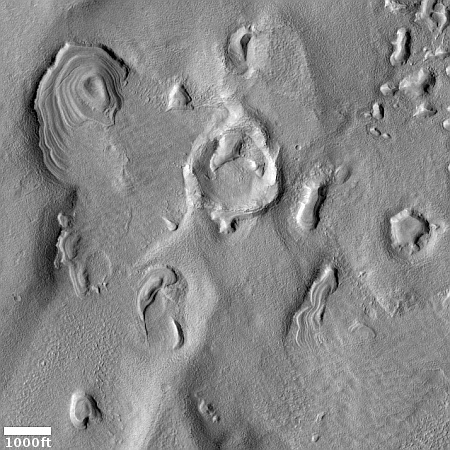
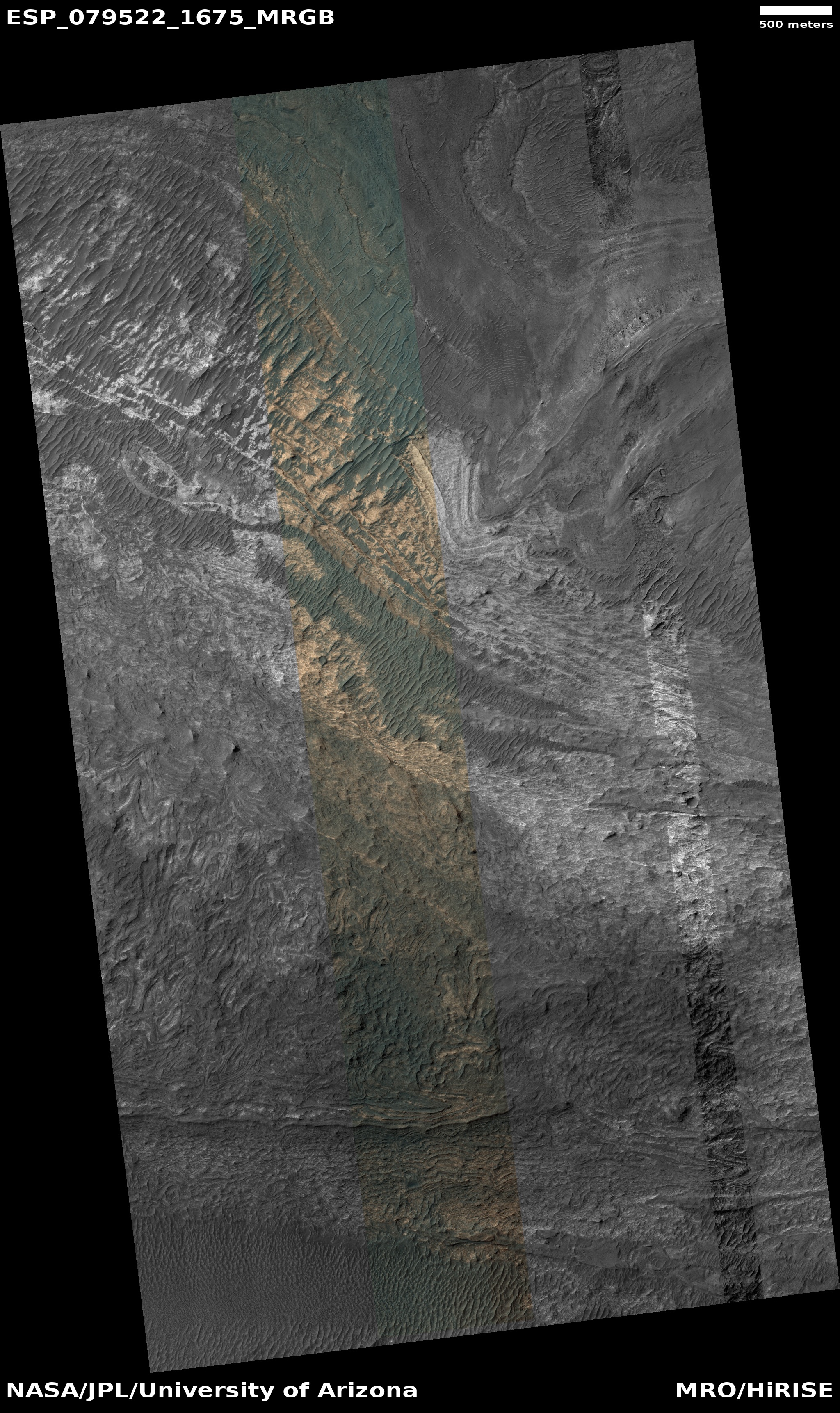
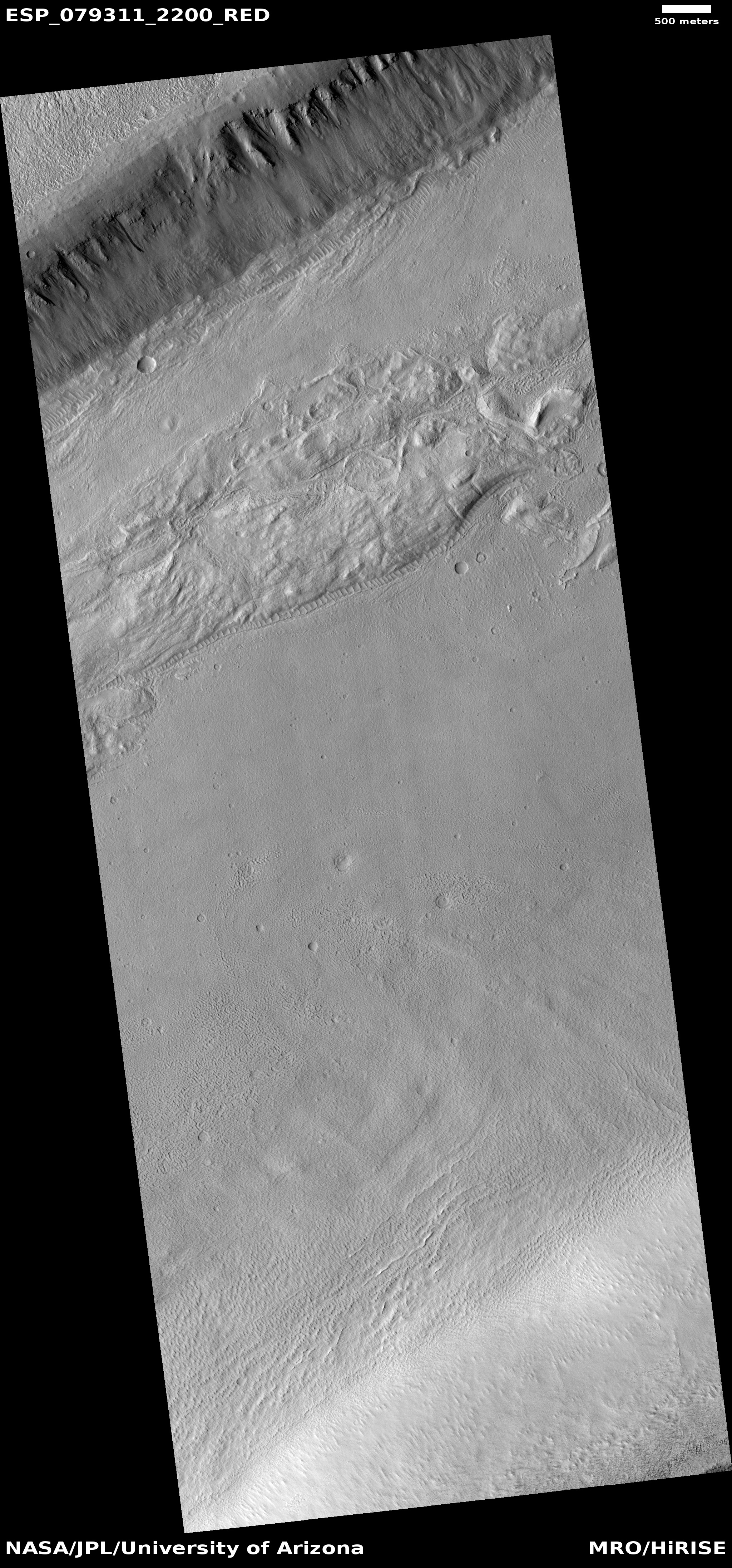
Cool image time! The picture to the right, cropped and enhanced to post here, was taken on July 17, 2024 by the high resolution camera on Mars Reconnaissance Orbiter (MRO). It shows what the scientists label as boxwork, a pattern of intersecting straight ridges criss-crossing each other in a generally random manner.

The ridges themselves are very small, only a few feet high. To make them more visible I have purposely cropped this section without reducing its resolution. I have also increased the contrast.

What caused them? According to this paper [pdf] about similar boxwork found on Mount Sharp in Gale Crater, the boxwork “formed when cements filled existing pore spaces and fractures in fractured rock, and these cements were left as topographic ridges after erosion.”

In other words, the surface hardened, then fractured. Later more resistent material, likely lava, filled the cracks. When erosion later stripped the top surface away, the lava was more resistent and so became the ridges we now see.
» Read more

0 comments

Another cool hiking location on Mars

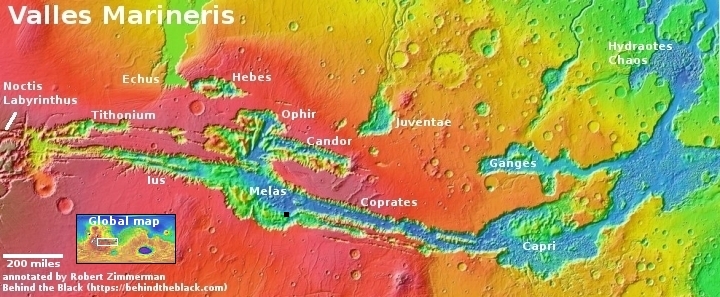
Overview map

Another cool hiking location on Mars
Click for original image.

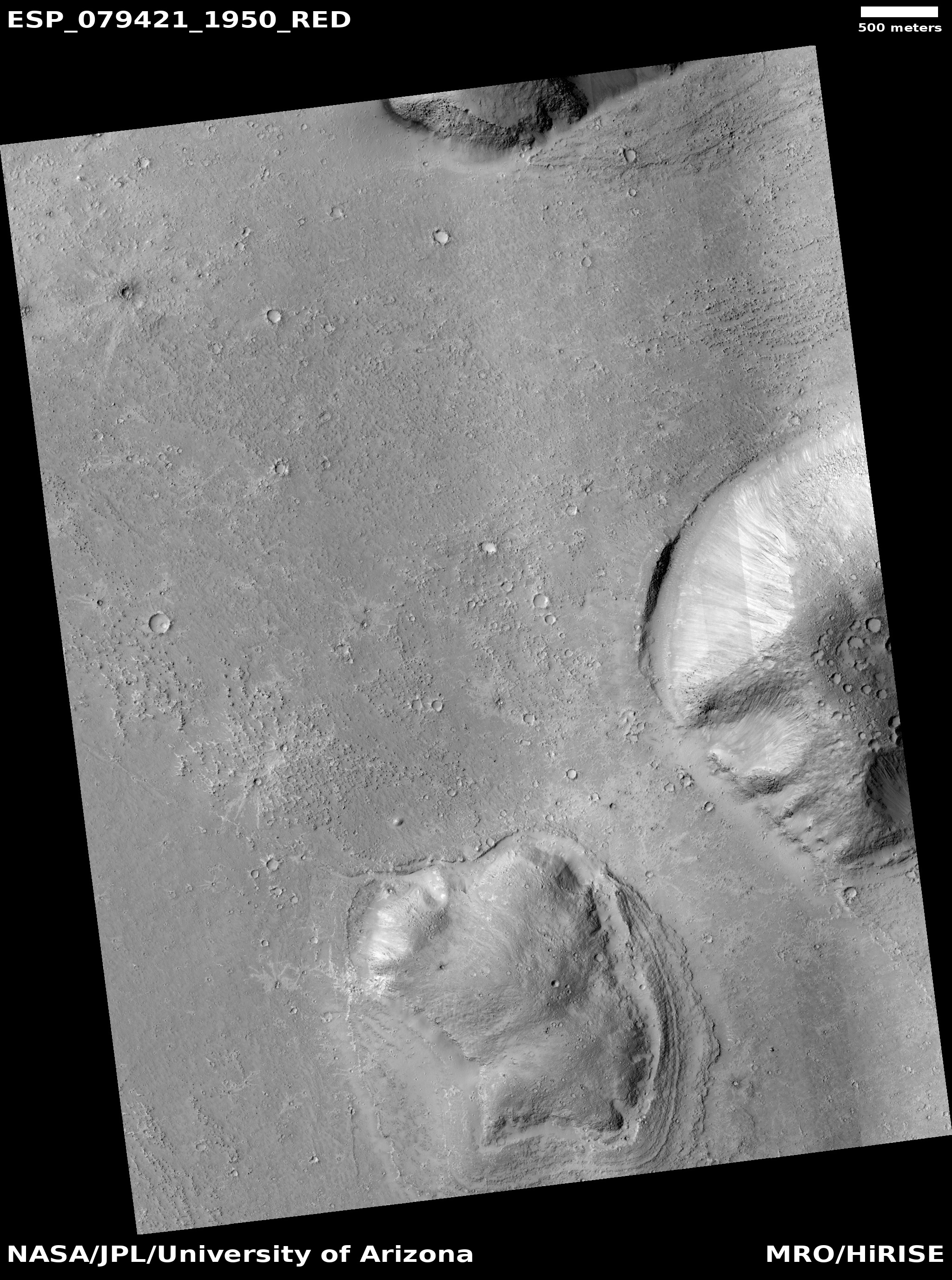
Cool image time! The picture to the right, cropped, reduced, and sharpened to post here, was taken on August 10, 2024 by the high resolution camera on Mars Reconnaissance Orbiter (MRO).

My reason to posting this I admit is selfish and tourist-oriented. This narrow ridge, about a mile long and about 300 to 600 feet high, appeals directly to my hiking passions. A trail along its length would provide any hiker some really spectactular views.

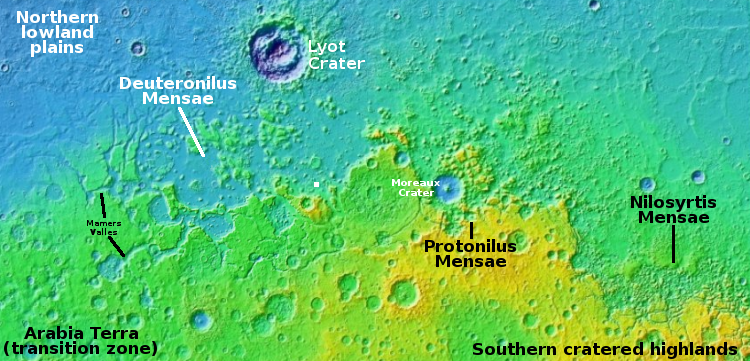
The scientists took the picture because of the geology. The white dot on the overview map above marks the location, a short channel dubbed Daga Vallis that connects two major canyons in the eastern part of Valles Marineris, the largest known canyon system in the solar system. This ridge and several nearby parallel ridges were apparently made of something, possibly lava, that was resistent to the theorized ancient catastrophic floods that scientists presently believe carved out these channels and canyons.

In the inset the dotted line indicates one possible hiking trail route that travels the full length of the ridge but then heads south to continue along the rim of a 1,200-foot-high cliff face. For future Martian colonists, I offer this site as a great place to set up a bed-and-breakfast, surrounded by many potential hikes of incredible stark beauty.

0 comments

Giant dunes in a dune sea inside a Martian crater

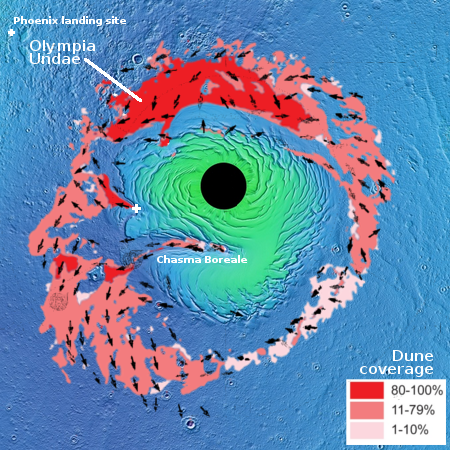
Overview map

Giant dunes in a Martian crater

Cool image time! The picture to the right, cropped, reduced, and sharpened to post here, was taken on July 17, 2024 by the high resolution camera on Mars Reconnaissance Orbiter (MRO).

The white dot on the overview map above marks the location, inside a thirty-mile-wide dune sea, or erg, that sits in the center of the floor of 80-mile-wide Russell Crater.

That erg is interesting in that it appears the dunes get larger and larger as you move from the perimeter to its center. Thus, the dunes in the picture are called mega-dunes, about 200-feet-high. They dwarf the smaller dunes at the erg’s edge.

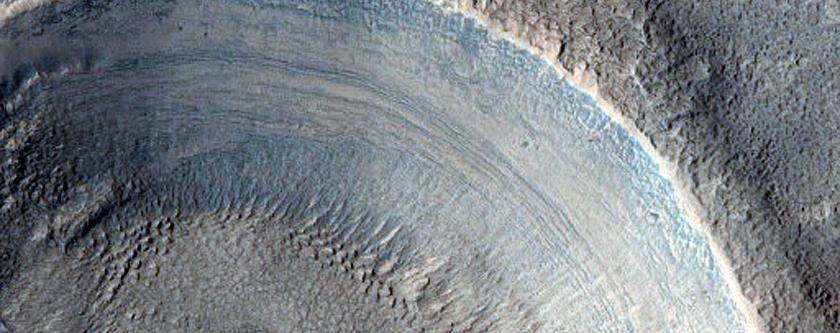
This picture was taken as part of a long term monitoring program to track the coming and going of seasonal dry ice frost on these dunes. It is summer when this picture was taken, so there is relatively little visible frost, though the bright blue areas in the color strip could possibly be the last remnants from winter. In winter, data suggests the entire surface of these dunes is covered by dry ice frost.

As the location is at 54 degrees south latitude, it likely sits at the northernmost edge of the southern dry ice mantle that in winter covers each of the Martian poles, down to about 60 degrees latitude.

1 comment

Meandering channels on Mars

Meandering channels on Mars
Click for original image.

Cool image time! The picture to the right, rotated, cropped, reduced, and sharpened to post here, was taken on August 2, 2024 by the high resolution camera on Mars Reconnaissance Orbiter (MRO).

The scientists describe this as “meandering channels,” which seems appropriate. The downhill grade here is to the southeast. In wider views these channels extend from the northwest to the southeast about 31 miles total (with this location near the center), with the total elevation loss about 3,000 feet.

Note the splash apron around the 4,500-foot-wide unnamed crater as well as how the largest channel seems to terminate suddenly at the crater. Though at first glance it appears this impact occurred after the channels, that some of the channels cut into that splash apron suggests otherwise.
» Read more

0 comments

A somewhat typical but strange crater in Mars’ Death Valley

A somewhat typical crater in Mars' death valley
Click for original image.

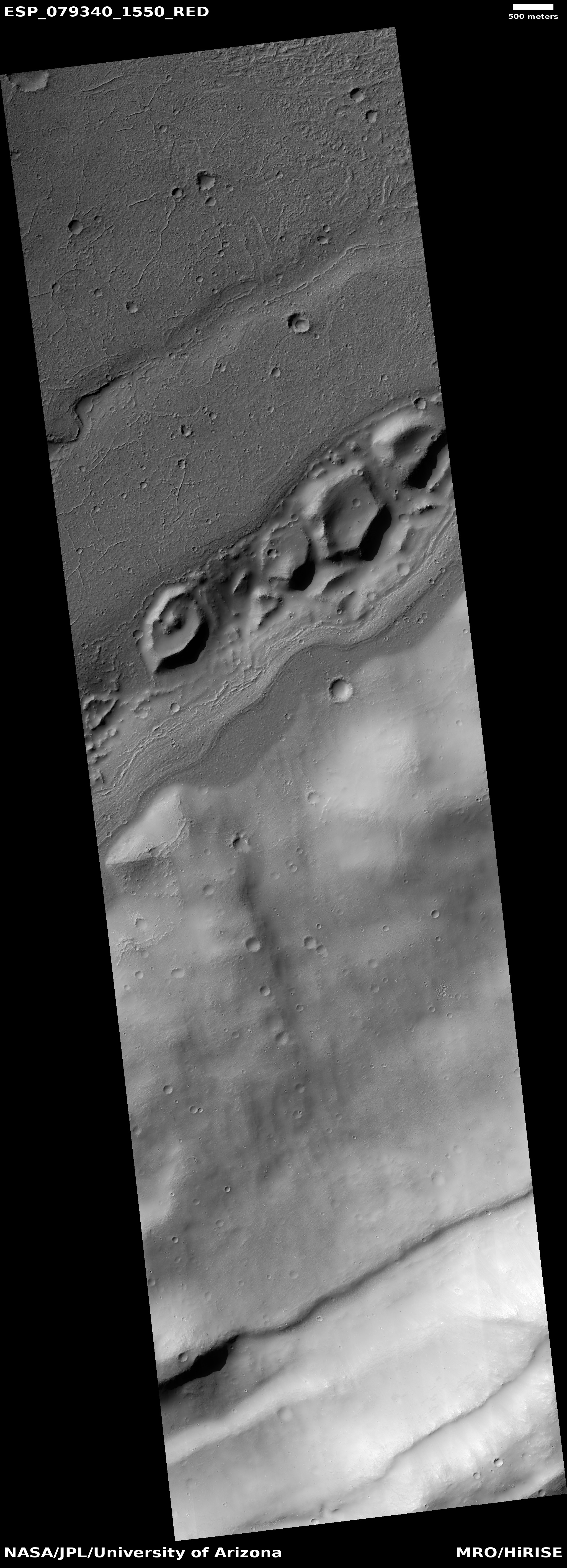
Cool image time! The picture to the right, rotated, cropped, reduced, and sharpened to post here, was taken on August 29, 2024 by the high resolution camera on Mars Reconnaissance Orbiter (MRO).

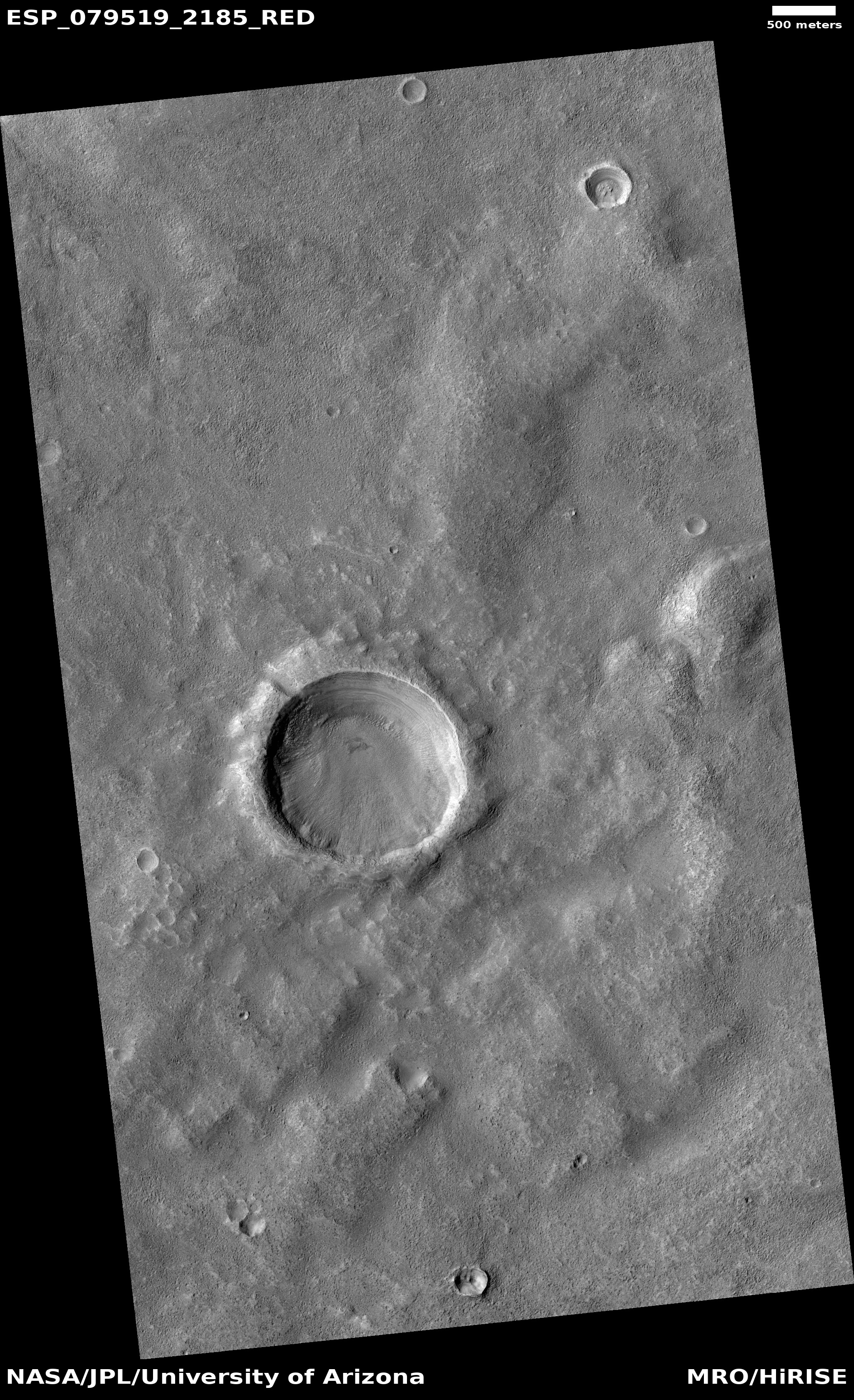
The camera team labels the primary feature in this picture as “ridges,” but what I see is a strange crater that at first glance appears to be impact-caused, but at closer inspection might be something else entirely.

This unnamed crater is about one mile wide. It is only about fifty feet deep, but sits above the surround landscape by about 200 feet. That high position suggests strongly that this crater was not formed by an impact by is instead a caldera from some sort of volcanic activity, with the splash apron around it simply examples of past magma flows erupting from within.

The ridges inside the crater might be glacial debris, as this location is at 35 degrees south latitude, making near surface ice possible.
» Read more

1 comment

Weird ring-mounds in one of Mars’ largest craters

Weird ring mounds on Mars
Click for original image.

Cool image time! The picture to the right, cropped, reduced, and sharpened to post here, was taken on August 16, 2024 by the high resolution camera on Mars Reconnaissance Orbiter (MRO). The science team labels these strange features “ring-mound landforms,” a term that has been used to describe [pdf] only vaguely similar features previously found in the Athabasca flood lava plain almost on the other side of Mars. That paper suggested that those ring mounds formed on the “thin, brittle crust of an active fluid flow” created by an explosive event. Since Athabasca is considered Mars’s most recent major flood lava event, the fluid was likely lava, which on Mars flows more quickly and thinly in the lower gravity.

Thus, in Athabasca the ring-mounds formed when a pimple of molten lava from below popped the surface.

But what about the ring mounds in the picture to the right?
» Read more

1 comment

“What the heck?” lava on Mars


Click for original image.

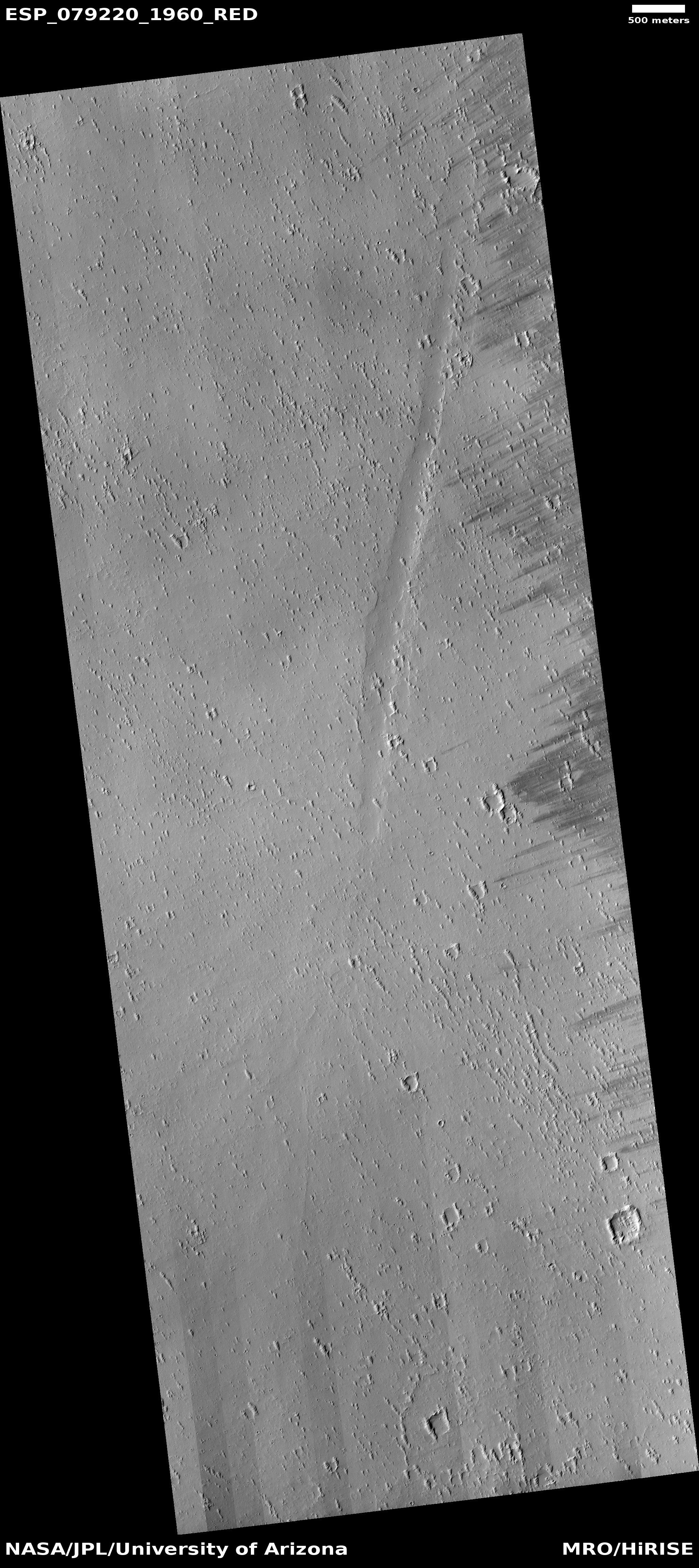
Cool image time! The picture to the right, cropped, reduced, and sharpened to post here, was taken on August 19, 2024 by the high resolution camera on Mars Reconnaissance Orbiter (MRO). Labeled merely as a “terrain sample,” it was likely snapped not for any specific research project, but to fill a gap in the camera schedule in order to maintain its proper temperature.

When the science team does this they try to pick interesting locations. Sometimes the picture is relatively boring. Sometimes, like the picture to the right, it reveals weird geology that is somewhat difficult to explain. The picture covers the transition from the smooth featureless plain to the north, and the twisting and complex ridges to the south, all of which are less than a few feet high.

Note the gaps. The downgrade here is to the west, and the gaps appear to vaguely indicate places where flows had occurred.
» Read more

0 comments

Lab tests suggest water brines could also exist on large asteroids

Gullies in crater on Vesta
Click for original image.

In attempting to explain the existence of flow features that have been found on the interior walls of craters on the asteroids Ceres and Vesta — as shown in the image above — scientists recently performed a laboratory experiment which determined that a mixture of water and salt could produce those gullies.

The team modified a test chamber at the Jet Propulsion Laboratory to rapidly decrease pressure over a liquid sample to simulate the dramatic drop in pressure as the temporary atmosphere created after an impact on an airless body like Vesta dissipates. According to Poston, the pressure drop was so fast that test liquids immediately and dramatically expanded, ejecting material from the sample containers.

โ€œThrough our simulated impacts, we found that the pure water froze too quickly in a vacuum to effect meaningful change, but salt and water mixtures, or brines, stayed liquid and flowing for a minimum of one hour,โ€ said Poston. โ€œThis is sufficient for the brine to destabilize slopes on crater walls on rocky bodies, cause erosion and landslides, and potentially form other unique geological features found on icy moons.โ€

The press release makes it sound as if this result makes the existence of subsurface water ice more likely on such asteroids as Ceres and Vesta, but previous research from the Dawn asteroid probe made that fact very clear, especially for Ceres, years ago. All this does is provide some evidence of what might be one process by which these erosion gullies form.

Hat tip to reader Milt.

1 comment

Perseverance looks across Jezero Crater from on high

Panorama of Jezero Crater
Click for full resolution annotated image. Click here for unannotated full resolution image.

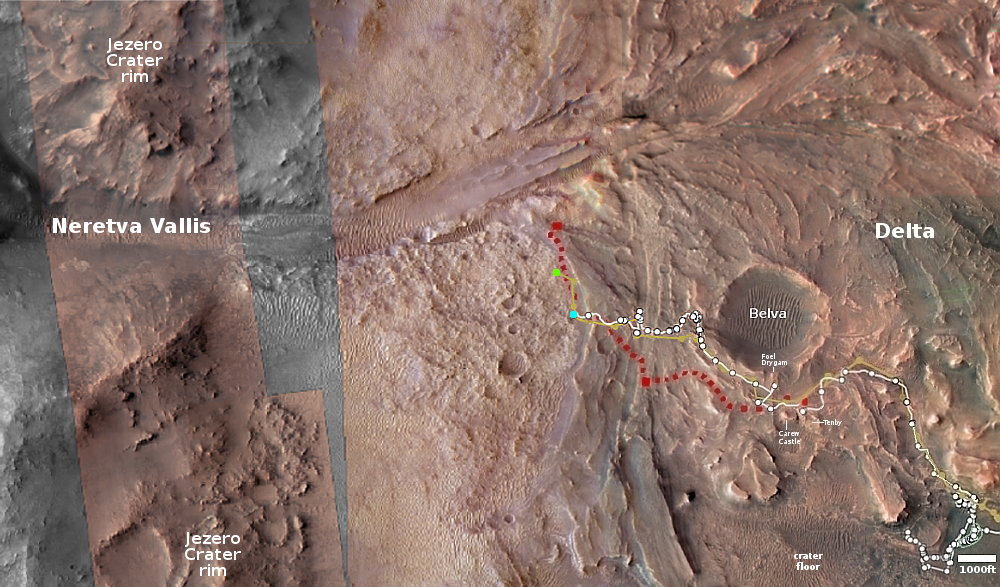
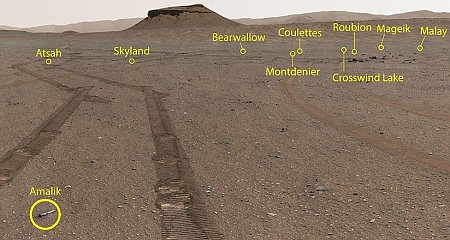
Cool image time! The panorama above, cropped, reduced, and sharpened to post here, was assembled from 44 pictures taken by the rover Perseverance on September 27, 2024 as it began its climb up the rim of Jezero Crater. If you click on it you can see the full resolution image that is also annotated to identify features within the crater as well as places where Perseverance has traveled.

The overview map below, with the blue dot showing the rover’s location when this panorama was taken. The yellow lines indicate the area covered by the panorama, with the arrow indicating the direction.

Overview map
Click for interactive map.

According to the information at the link, the rover has been experiencing some slippery sandy ground as it has been climbing.
» Read more

0 comments

Two cubesats on Hera signal home

Engineers on the ground have now established good communications with the two cubesats that are being carried by the European probe Hera on its way to the binary asteroids Didymos and Dimorphos.

โ€œEach CubeSat was activated for about an hour in turn, in live sessions with the ground to perform commissioning โ€“ what we call โ€˜are you alive?โ€™ and โ€˜stowed checkoutโ€™ tests,โ€ explains ESAโ€™s Hera CubeSats Engineer Franco Perez Lissi.

…Travelling with Hera are two shoebox-sized โ€˜CubeSatsโ€™ built up from standardised 10-cm boxes. These miniature spacecraft will fly closer to the asteroid than their mothership, taking additional risks to acquire valuable bonus data.

Juventas, produced for ESA by GOMspace in Luxembourg will make the first radar probe within an asteroid, while Milani, produced for ESA by Tyvak International in Italy, will perform multispectral mineral prospecting.

This use of small cubesats in conjunction with a larger interplanetary probe is becoming increasingly routine, and provides a cheap and efficient way to increase the data and information obtained. Note too that both cubesats were apparently built entirely by private companies, thus establishing their creditionals as providers of interplanetary probes.

0 comments

Using spectroscopic data, astronomers create 3D map of ancient supernova remnant

Supernova 1181
Click for original image.

Astronomers have now createdsdft a 3D map of the remnant formed by a supernova that occurred in 1181, using detailed spectroscopic data to determing which remnant filaments are moving towards us and which are moving away.

The picture to the right is from figure 1 of their paper, and shows how the filaments radiate out from the center in straight lines, something that is unusual for such remnants. It was taken in 2023 by a ground-based telescope at Kitt Peak in Hawaii. From simple optical data it is impossible however to determine which filaments are in the rear, expanding away from us, and which are in the front, expanding towards us.

To probe the three-dimensional structure of the supernova remnant, the astronomers turned to KCWI, an instrument that can capture multiwavelength, or spectral, information for every pixel in an image. This is like breaking apart the light captured in every pixel into a rainbow of colors. The spectral information enabled the team to measure the motions of the filaments poking out from the center of the explosion and ultimately create a 3D map of the structure. The filament material that is flying toward us shifted toward the blue higher-energy portion end of the visible spectrum (blue-shifted), while light from material moving away from us shifted toward the red end of the spectrum (red-shifted).

…The results showed that the filament material in the supernova is flying outward from the site of the explosion at approximately 1,000 kilometers per second. โ€œWe find the material in the filaments is expanding ballistically,โ€ says Cunningham. โ€œThis means that the material has not been slowed down nor sped up since the explosion. From the measured velocities, looking back in time, you can pinpoint the explosion to almost exactly the year 1181.โ€

The 3D information also revealed a large cavity inside the spindly, spherical structure in addition to some evidence that the supernova explosion of 1181 occurred asymmetrically.

Using this data, they were able to create that 3D map, shown below in a coarse animation video.
» Read more

3 comments

A pointy mesa once washed by theorized Martian ocean

A pointy mesa on Mars
Click for original image.

Today’s cool image returns to the same region yesterday’s cool image visited. The picture to the right, cropped, reduced, and sharpened to post here, was taken on July 21, 2024 by the high resolution camera on Mars Reconnaissance Orbiter (MRO). It was clearly taken to get a close look at this unusual pointy mesa.

MRO elevation data says this mesa is about 800 feet height. The color difference between the north and south flanks suggests the accumulated presence of dust on the north, suggesting the prevailing winds here come from the northeast and blow to the southwest. This conclusion is reinforced by the dark accumulated dust found in the southwest quadrants of all the crater floors in the full image. The wind blows this dust into the craters, where it gets trapped against the southwest crater wall.

Note the mesa’s wide base, with one crater partly eaten away on its eastern edge. The overall shape of this base suggests that it was carved by some flow coming from the southwest, as indicated by the arrow.
» Read more

0 comments
1 35 36 37 38 39 89