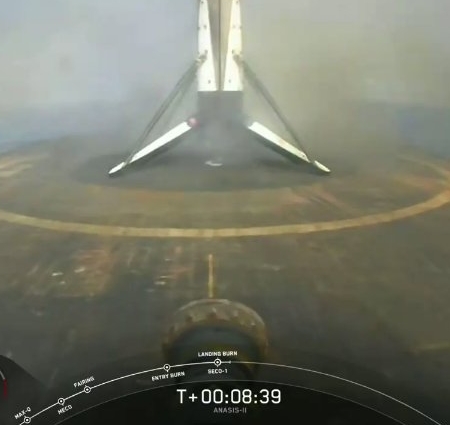
SpaceX about to set reuse record for fastest turnaround ever

Capitalism in space: If tomorrow’s launch of a South Korean military satellite by SpaceX’s Falcon 9 rocket succeeds, it will set a new all-time record for the fastest turnaround of a used rocket, 44 days.

The previous record was 54 days, set by the space shuttle Atlantis in 1984. The article notes however the spectacular differences:

By far the most impressive aspect of Falcon 9’s imminent record is the comparison between the resources behind Space Shuttle Atlantis’ 54-day turnaround and Falcon 9 booster B1058’s ~44-day turnaround. Around the time NASA and Atlantis set the Shuttle’s longstanding record, some 5000-10000 full-time employees were tasked with refurbishing Space Shuttles and the facilities (and launch pads) that supported them. Based on retrospective analyses done after the STS program’s end in 2011, the average Space Shuttle launch (accounting for the vast infrastructure behind the scenes) ultimately wound up costing more than $1.5 billion per launch – more than the Saturn V rocket the Shuttle theoretically replaced.

According to a uniquely detailed May 2020 AviationWeek interview with SpaceX CEO Elon Musk, Falcon 9 booster turnaround may cost as little as $1 million apiece and can be managed from start to finish by several dozen employees at most. In other words, even though SpaceX boosters are suborbital and stressed quite a bit less than orbital Space Shuttles, Falcon 9 reuse is approximately a thousandfold more efficient that Space Shuttle reuse. [emphasis in original]

I should add that SpaceX also has three more launches on tap for the rest of July. If all lift off, the company will have launched four rockets in only three weeks, which in itself will be a record. No private rocket company has ever launched so frequently and so routinely. And only Russia during its Soviet Union heydays has come close to launching with this frequency.

1 comment

Falcon 9 landing leg falls during retraction

Capitalism in space: During the processing to bring a used Falcon 9 first stage back to its hanger after its June 30th launch, one of the landing legs unexpectedly fell back to the ground during retraction.

I have embedded the video of the incident, cued to the event, below the fold. No one was hurt, and it appeared that nothing was damaged. It appears it happened because a cable holding the leg vertical snapped just before the leg got latched in place on the side of the rocket.
» Read more

5 comments

SpaceX’s reusable first stages and their dramatic impact on the bottom line

This article by Eric Berger at Ars Technica outlining the status of SpaceX’s fleet of reusable first stages contained this incredible fact:

On May 11, 2018, the company launched the first of its new “Block 5” version of its Falcon 9 rocket. This new version of the first stage incorporated all of the company’s previous performance upgrades to the Falcon 9 rocket while also maximizing its reuse. It worked—SpaceX has now flown two different Falcon 9 cores five times, and it may fly a first stage for the sixth time later this summer.

The success of the Block 5 rocket means that SpaceX has had to devote less time and resources to building Falcon 9 first stages. Since May 2018, it has launched 31 times on a Block 5 version of the Falcon 9 rocket—while using just 10 cores. Put another way, reuse has saved SpaceX the cost of 189 Merlin rocket engines, dozens of fuel tanks, and many complex avionics systems. [emphasis mine]

That is a lot of cost savings, which the company is not only using to cut its prices but also to reduce the cost of its Starlink launches. It appears SpaceX wants those launches, as much as possible, to use reused boosters in order to lower the overall cost of getting that internet constellation into orbit. This in turn will make it possible for them to charge less for the service, once they begin offering it.

0 comments

SpaceX successfully launches GPS satellite for Space Force

Capitalism in space: SpaceX today successfully launched its first satellite for the Space Force, a GPS satellite.

It also successfully landed the first stage, which was on its first flight. This was also the 88th flight of the Falcon 9 since its inception in 2010, which now makes it the rocket with the most launches of any U.S. operational rocket, bypassing ULA’s Atlas 5, and doing it in about half the time.

The leaders in the 2020 launch race:

13 China
10 SpaceX
7 Russia
3 ULA

The U.S. now leads China 16 to 13 in the national rankings.

3 comments

SpaceX recovers both reused fairings from most recent launch

Capitalism in space: SpaceX has successfully recovered both of the reused fairings that were used in its June 13th Starlink launch.

This sets the stage for the first reuse of a fairing for the third time. The article at the link notes this important detail about these used fairings, both of which were not caught prior to landing in the ocean:

Preventing a vast majority of seawater exposure, a catch with [the ships] Ms. Tree or Ms. Chief may always be preferable for fairing reuse but the fact remains that all three successful reuses up to this point have been achieved with fairing halves that landed in the ocean. That success means that SpaceX has found a way to fully prevent or mitigate any potential corrosion that might result from seawater immersion. Given that that problem must have been a showstopper for the ~2.5 years SpaceX was able to recover – but not reuse – intact fairings, it’s safe to say that the company’s engineers have more or less solved the problem of corrosion. [emphasis mine]

In a sense we should not be surprised that the fairings were not seriously damaged by their short exposure to salt water. As designed, the shape of the fairings is essentially that of a boat hull. By landing them controlled by parachute, SpaceX guarantees that the sensitive electronics and equipment inside the fairings remains dry and untouched by salt water.

21 comments

Successful SpaceX launch

Falcon 9 shortly after launch

Capitalism in space: SpaceX tonight successfully launched 58 Starlink satellites as well as three Planet earth observation satellites. The image to the right looks up at the exhaust from the nine firing Merlin engines of Falcon 9 rocket, about two minutes after launch.

That first stage also successfully landed, the third time this stage has completed a launch. The fairing halves were also reused.

The leaders in the 2020 launch race:

11 China
9 SpaceX
7 Russia
3 ULA

The U.S. now leads China 15 to 11 in the national rankings.

5 comments

NASA aiming for late July/early August Dragon crew return

According to statements made by NASA officials today, the agency is now targeting a late July to early August return date for the first manned Dragon.

Bob Behnken, one of the two Dragon astronauts, will likely do two spacewalks while on ISS to replace batteries on the stations main truss. In addition, they will do a number of tests of Dragon to check out its in-space long term operation.

Mission controllers planned to place the Dragon capsule into a hibernation mode, then wake up the ship’s systems to verify the spacecraft can perform its role as a quick-response lifeboat to scurry astronauts back to Earth in the event of an emergency. Mission managers are also checking data to monitor the status of the solar arrays.

It appears however that the biggest factor for determining the launch date will be weather conditions in the Gulf of Mexico. If they are good in late July mission managers might decide to return the astronauts earlier to take advantage of those conditions.

The next Dragon manned flight, carrying four astronauts, is planned in late August, thus giving NASA time to do a full assessment of this first demo flight before its launch.

1 comment

NASA endorsement allows SpaceX to shift focus to Starship

Capitalism in space: Three different news stories today about SpaceX point out strongly the direction in which the company is heading, both in its design focus and in where it will be doing it.

First, SpaceX has informed the Port of Los Angeles that it is now definitely abandoning all plans to establish a Starship manufacturing facility there.

The company made this announcement on March 27th, which means it is not directly related to the tiff that Musk had with Alameda County officials about keeping his Tesla factory open during the California Wuhan panic lock down, which occurred in early May. Nonetheless, this decision, combined with Musk’s May 9th statement that he was going to move Tesla from California, suggests strongly that he and SpaceX is losing patience with California politics, and is likely to increasingly minimize the presence of Musk’s companies there.

This also means that the company will be expanding its Starship operations in both Texas and Florida.

In a second related story, it appears that — with the success of the first manned Dragon mission — Musk now wants SpaceX to shift its development focus entirely to Starship. Prior to that successful Dragon launch, NASA had made it clear that it did not want the company distracted by Starship, and instead stay focused on fixing any issue that might delay Dragon. As NASA is SpaceX’s biggest customer, the company was obliged to comply.

With the Dragon success however SpaceX has completed the job, so Musk now feels free to shift the company’s development teams over to Starship. And NASA is even helping him do this (today’s third SpaceX story) by agreeing at last to permit the company to use reused Falcon 9 rockets and Dragon capsules for future manned missions.

In a wholly unexpected turn of events, a modification to SpaceX’s ~$3.1 billion NASA Commercial Crew Program (CCP) contract was spotted on June 3rd. Without leaving much room for interpretation, the contract tweak states that SpaceX is now “[allowed to reuse] the Falcon 9 launch vehicle and Crew Dragon spacecraft beginning with” its second operational astronaut launch, known as Post Certification Mission-2 (PCM-2) or Crew-2.

NASA in the past was very slow to accept the use of reused capsules and rockets. It now appears they have abandoned this reluctance entirely, so much so that we could even see American astronauts flying into space on a reused rocket and in a reused capsule before the end of the year.

I want to pause to let this fact sink in. SpaceX has turned what what was considered only a few years ago as an absurd, dangerous, and wholly insane idea into the only and right way to do things.

This big endorsement of reusability by NASA also means that the agency is now willing to let SpaceX make its shift to Starship, since refurbishing rockets and capsules does not take the manpower as building new equipment.

Expect the action in Boca Chica to ramp up quite spectacularly this summer.

13 comments

A detailed update on SpaceX’s Starlink satellite constellation

Link here. With yesterday’s launch, SpaceX now has put 420 satellites in orbit.

In a recent interview with Aviation Week, SpaceX President Gwynne Shotwell said that they should begin beta testing the network this year and would want to complete around 14 launches before publicly promoting Starlink service. That could allow service to begin as soon as early 2021 depending on how fast launches can be performed.

In a recent ITU filing, SpaceX laid out a very aggressive schedule for continuing the Starlink deployment, with 13 launches in the May to September time period. This schedule is likely to spread out a bit as they run into normal launch cadence issues such as weather, range coordination, booster recovery operations, and booster refurbishment.

The first launch in that group (June 3 in Florida) has been delayed nearly a month for the above reasons. Regardless of exactly how long those launches end up taking, Ms. Shotwell’s comments indicate SpaceX doesn’t think satellite production will be a gating factor for their deployments in the near future.

An interesting feature of the schedule is that after this frenzy of launches, there would be a gap with only one launch in four months, followed by a period of twice-monthly launches to finish out the initial 1584 satellite shell of the constellation. SpaceX may have options to make changes to the satellites during that pause in the deployments, such as adding the optical inter-satellite links that have been mentioned as debuting later in 2020.

The article then provides a great deal of information about the system’s design and status for beginning operations in the U.S. Well worth a close read.

5 comments

Live feed of tonight’s SpaceX Falcon 9 Starlink launch

UPDATE: A successfully launch, with a successful landing of the first stage, the fifth time this particular stage has completed a mission.

10 China
8 SpaceX
7 Russia
3 ULA

The U.S. now leads China 13 to 10 in the national rankings.

Original post:
——————————
Since there was such a positive response to the embedded live feed of SpaceX’s first manned Dragon launch a few days go, I’ve decided to embed below the live feed of their next launch tonight of 60 Starlink satellites. The launch is set for 9:25 pm (Eastern), with the live feed starting fifteen minutes before that.

Enjoy. Watching that first stage land never gets old.

5 comments

Dragon docks with ISS; astronauts reveal its name is Endeavour

Capitalism in space: SpaceX’s first manned Dragon capsule successfully docked today with ISS.

A few hours after launch the two American astronauts, Doug Hurley and Bob Behnken, also revealed that they had named the capsule “Endeavour.”

I know this is really old news from late last night and early this morning, but I was out on a cave trip (taking a work break to have some fun underground for the first time in three months). I post it for completion. I also know that the live stream of these events was active here all day for my readers to follow things, as they happened.

Prepare for even more increasing space excitement in the coming years. The Trump administration increasingly is shifting NASA’s gears to have private companies build its spaceships and rockets and science instruments. The more they do this, the less expensive and the more capabilities we shall have as a nation. This success will be a challenge for other nations to match, which in turn will raise the stakes and increase the competition, the excitement, and the action in space.

Yes, the 20s I hope are going to roar, at least in space.

6 comments

SpaceX’s first manned SUCCESSFUL Dragon launch

UPDATE: I am off on a caving trip on Sunday, May 31st, so I will not be doing any updates to this post. The live feeds however will still be here and, though they are presently showing a replay of the launch today, should be covering Dragon’s rendezvous and docking with ISS on Sunday..

UPDATE: Dragon is in orbit. SpaceX has successfully used its Falcon 9 rocket to place to Americans into space, the first American launch from American soil in an American spacecraft on an American rocket in nine years.

The leaders in the 2020 launch race:

9 China
7 Russia
7 SpaceX
3 ULA

The U.S. now leads China 12 to 9 in the national rankings.

UPDATE: I have added NASA’s media live feed to the one provided on SpaceX’s website. There will be some hype on SpaceX’s feed, but the media feed had no commentary. Pick which you prefer.

UPDATE: NASA and SpaceX have decided to attempt a launch today. The weather remains at 50-50 for launch.

Capitalism in space: Below are the live streams of SpaceX’s first manned Dragon launch, presently scheduled for launch at 3:22 pm (Eastern) tomorrow, May 30, 2020.

First, the feed from SpaceX’s website:

Second, the media feed from NASA, with no narration:

The live coverage will begin at 11 am (Eastern), and because this presentation is a partnership of NASA and SpaceX, will be filled with a lot of hype that one normally does not see during a SpaceX live feed, though I will note that during the live feed of the May 27th scrubbed launch, the NASA hype was kept relatively tame, compared to previous events. It seemed they accepted some guidance from SpaceX on how to do this in a way that seemed less fake or propagandistic.

This time I am embedding the media feed, which might have even less hype.

This post is also set to remain at the top of the page until after the launch, or after the launch is scrubbed, whichever happens. At the moment the weather says there is a 50-50 chance of launching, so we might end up having a scrub again, like on May 27th. In fact, NASA and SpaceX have already said in the evening of May 29th that they will reassess the weather in the AM on May 30th and decide whether to continue with the countdown or scrub. If so, this link and live feed will remain for the Sunday, May 31st, launch attempt.

As I did during the first launch attempt on May 27th, I will also periodically post below the fold images captured from the live feed, with some commentary. Comments from readers are of course welcome, as always.

NOTE: You will need to refresh the post periodically to see new images and commentary.

For other news updates, scroll down.
» Read more

32 comments

SpaceX and NASA will reassess weather for launch in morning

Because of the 50-50 weather conditions for launching the first manned Dragon mission to ISS tomorrow at 3:22 pm (Eastern), managers at both SpaceX and NASA have decided to maintain the schedule but reassess whether they will proceed come morning.

Thus, it is possible they might scrub the launch attempt very early in the countdown, and instead focus on the Sunday, May 31st launch opportunity. We shall have to wait.

In the meantime the embed of the live stream will appear here at Behind the Black at around midnight (Eastern). If the launch proceeds, the feed begins officially at 11:00 am (Eastern) tomorrow.

1 comment

Weather for Saturday’s SpaceX launch is presently poor

The weather for Saturday’s SpaceX launch presently gives only a 40% chance of launch.

Forecasters from the 45th Weather Squadron have issued a slightly more pessimistic outlook for the next two Crew Dragon launch opportunities Saturday and Sunday.

There’s now a 60 percent probability of weather conditions at the launch site violating one of the criteria for liftoff for launch opportunities at 3:22 p.m. EDT (1922 GMT) Saturday and at 3:00 p.m. EDT (1900 GMT) Sunday, according to the weather team.

The worst part is that the weather doesn’t look good for either day.

5 comments

SpaceX’s first manned Dragon launch scrubbed due to weather

UPDATE: They were forced to scrub at T-16:54 because of weather. They will try again in three days on May 30th, at 3:22 pm (Eastern). I will post the live stream here on Behind the Black late Friday night.

Original post:
—————————-
I have embedded below SpaceX’s live stream of the first manned Dragon mission, set to launch at 4:33 pm (Eastern). The stream begins at about 12:15 pm (Eastern). Feel free to watch as the day unfolds. Sadly, it is being managed by NASA, not SpaceX, and thus is filled with a lot of the agency’s fake hype.

I have also set it to remain at the top of the page until after the launch, or if it is scrubbed.

On a side note, NASA is now aiming for an August 30 launch of SpaceX’s next manned Dragon mission, the first official operational flight.

Below the fold I am also posting images captured, with some commentary.


» Read more

28 comments

Weather improves for tomorrow’s manned Dragon launch

Capitalism in space: The weather outlook has brightened tomorrow, increasing the chances that the SpaceX’s manned Dragon capsule will launch as scheduled.

No major technical issues of any significance were under discussion Monday, but the weather could be a factor. Forecasters initially predicted a 60% chance of a weather-related launch rule violation, but Mike McAleenan, launch weather officer with the 45th Weather Squadron, said conditions appeared to be improving somewhat. “If I was to issue the forecast today, right now we would probably be down to 40% chance of violation,” he said. “We have a bit more rain to go here and maybe another round of afternoon thunderstorms tomorrow, but … it looks like much less (cloud) coverage. So we have some hope for launch day.”

But McAleenan’s forecast does not include downrange conditions in the Atlantic Ocean along the Crew Dragon’s trajectory where Hurley and Behnken could be forced to ditch in the unlikely event of a catastrophic booster failure during the climb to space.

SpaceX managers will assess a complicated mix of weather models, high-altitude balloon data and actual wind, rain and wave data from multiple buoys along the ground track to determine whether conditions, on average, are acceptable for launch.

The launch is set for 4:33 pm. I will embed SpaceX’s live stream here on Behind the Black tomorrow earlier in the day, when things begin..

1 comment

In space exploration, freedom wins again

Douglas Hurley and Robert Behnken, with Falcon 9 in background
Dragon astronauts Douglas Hurley and Robert Behnken
with their Falcon 9/Dragon in the background

This week we shall once again see a demonstration of the power of freedom, and it will not be a demonstration by protesters in Hong Kong or Michigan or New York against the petty dictators who rule them.

No, it will simply be the launch of an American rocket, owned by an American company, putting two Americans in space. While most reports of the manned Dragon launch on SpaceX’s Falcon 9 rocket will properly focus on the new engineering and the specific achievement — the first American manned space mission in almost a decade — few will recognize how it is freedom, that forgotten word, that more than anything made it possible.

And it has always been this way, since the very beginnings of the space age. As John Kennedy expounded in his 1961 speech committing the U.S. to a lunar landing, that commitment was to demonstrate that a free people and nation could do it better:
» Read more

38 comments
1 40 41 42 43 44 76