Curiosity looks forward and back

Panorama looking north
Click for original image.

Overview map
Click for interactive map

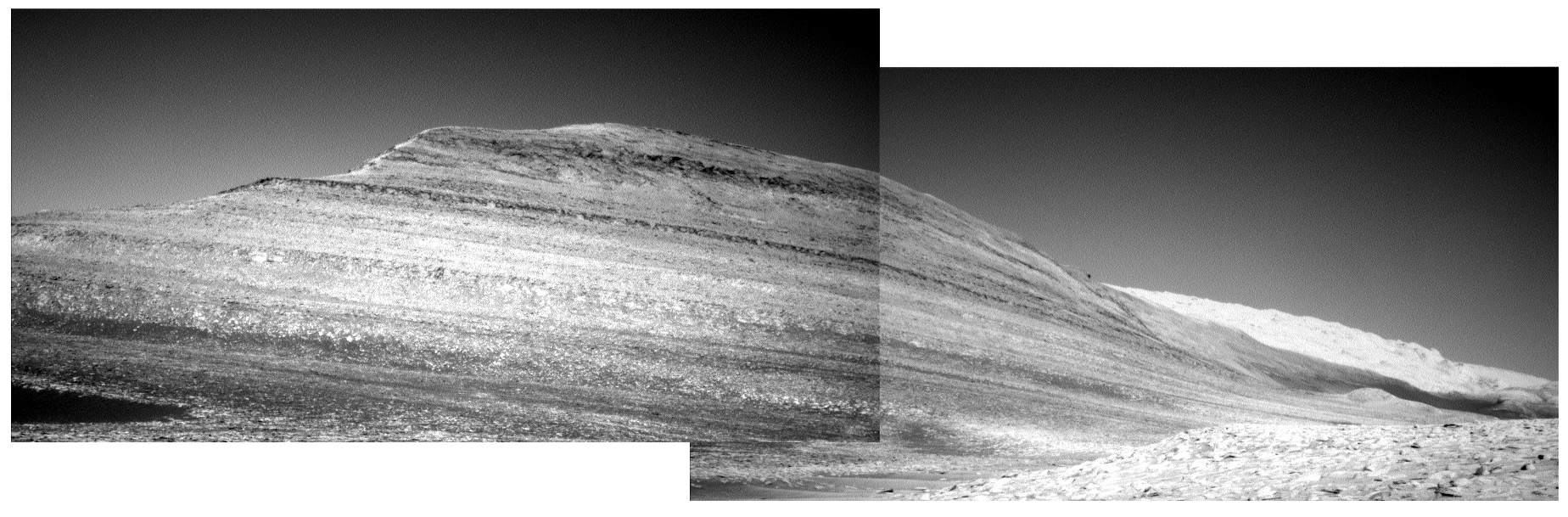
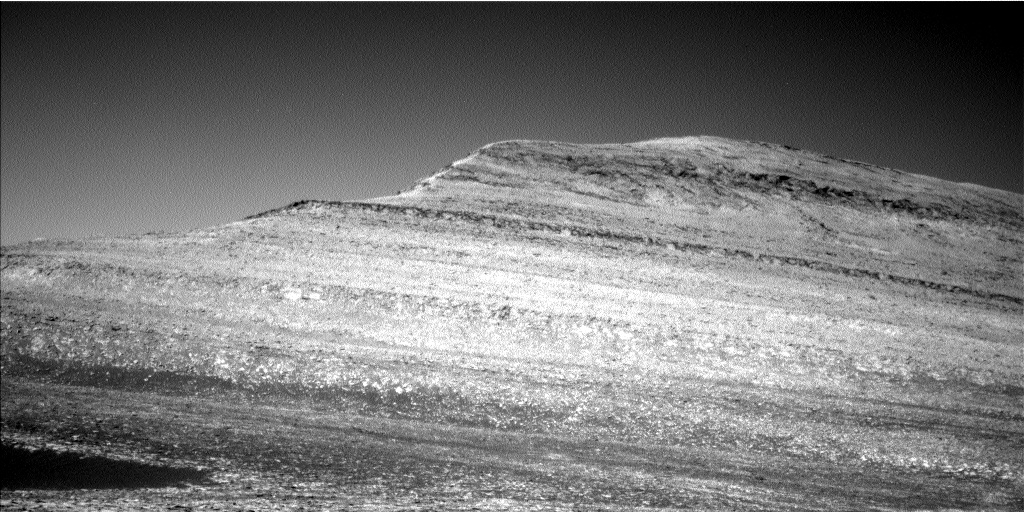
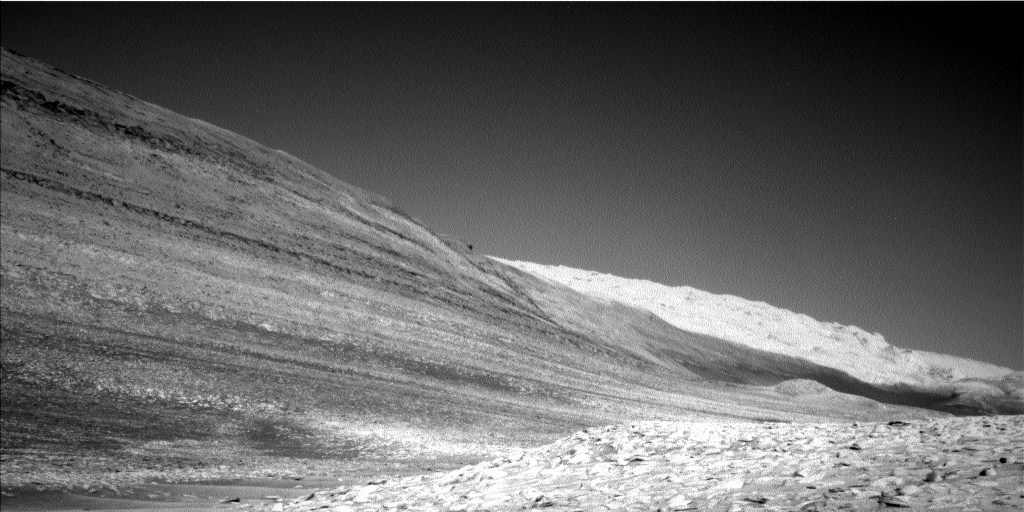
The images above and below are small sections from 360 degree panorama created on May 13, 2024 from 31 photos taken by the right navigation camera on the Mars rover Curiosity.

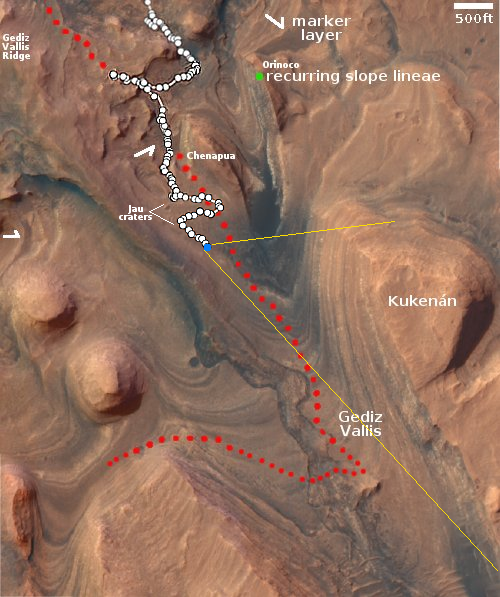
The overview map to the right provides the context. The red dotted line indicates Curiosity’s planned route, while the white dotted line its actual route. The rover’s present position is marked by the blue dot. The yellow lines indicate the area covered by the picture above, while the green lines indicate the area covered by the picture below.

The image above looks north, back down Gediz Vallis and across to the north rim of Gale Crater, about 20-25 miles away. The red dotted line marks the rover’s path to get up to this point. All told, Curiosity has climbed about 2,500 feet in elevation since it left the floor of Gale Crater about nine years ago.

The image below looks south, up Gediz Vallis and towards the peak of Mount Sharp (not visible), about 26 miles away and about 16,000 feet higher up. Curiosity might move forward about 500 feet to the small hill on the left (indicated by the red dot), or it might turn west from this point, as indicated by the red dotted line on the overview map.

Panorama looking south
Click for original image.

0 comments

Perseverance looks ahead, out of Jezero Crater

Panorama May 9, 2024, low resolution
Click for high resolution. Go here and here for original images.

Cool image time! The panorama above, recropped, reduced, and annotated to post here, was created from two pictures taken by Perseverance’s right navigation camera on May 9, 2024 (here and here). It looks almost due west, out the gap in the rim of Jezero Crater to the mountains beyond.

The blue dot in the overview map below marks Perseverance’s location when these photos were taken. The yellow lines indicate the approximate area covered by the panorama. The red dots indicate the rover’s planned route.

It is obvious this panorama was taken as part of the science team’s planning for Perseverance’s upcoming traverse across Neretva Vallis. The picture also gives us a nice view of the barren terrain found here in the dry tropics of Mars. There is no ice or water present anywhere, though the geology strongly suggests H2O in one form or another once shaped this landscape.

Nor is there any visible life. As much as NASA and many others devoutly wish to find some, I doubt any will be found. There is a very tiny chance the remains of long-gone microbiotic life might be found, but I wouldn’t bet much money on that either.
Overview map
Click for interactive map.

1 comment

The edge of a vast frozen lava sea on Mars

The edge of a vast frozen lava sea on Mars
Click for original image.

Cool image time! The picture to the right, rotated, cropped, reduced, and sharpened to post here, was taken on February 10, 2024 by the high resolution camera on Mars Reconnaissance Orbiter (MRO). It shows what the scientists label boringly “Lava Interactions with Landscape.”

What is the lava, and what is the landscape? Here’s is my initial guess, based simply on looking at this image alone. The mound in the middle is the landscape, the rounded top of a very ancient mountain or hill. The flat plain that surrounds it is flood lava, that in the far past poured in and mostly buried the mountain.

Everything here signals a very old terrain. To get this mountain worn so smooth from the thin Martian atmosphere has to have taken more than a billion years. And that flood lava has to also be as old, because of the number of craters on its surface. I don’t know the impact rate, but I know it takes time to accumulate this number of impacts.

The sense of age is further underlined by the moat that surrounds the hill. When that lava poured in, it would have flooded right up to the mountain slope. Over time the weakest section of lava, most prone to erosion, would be that contact point. To wear it away as we now see it must have taken many eons.

All these speculations are a very unreliable guesses. To get a better understanding of this terrain it is essential we look at more than this picture alone.
» Read more

0 comments

Taffy terrain in Mars’ death valley

Taffy terrain in Mars' death valley
Click for original image.

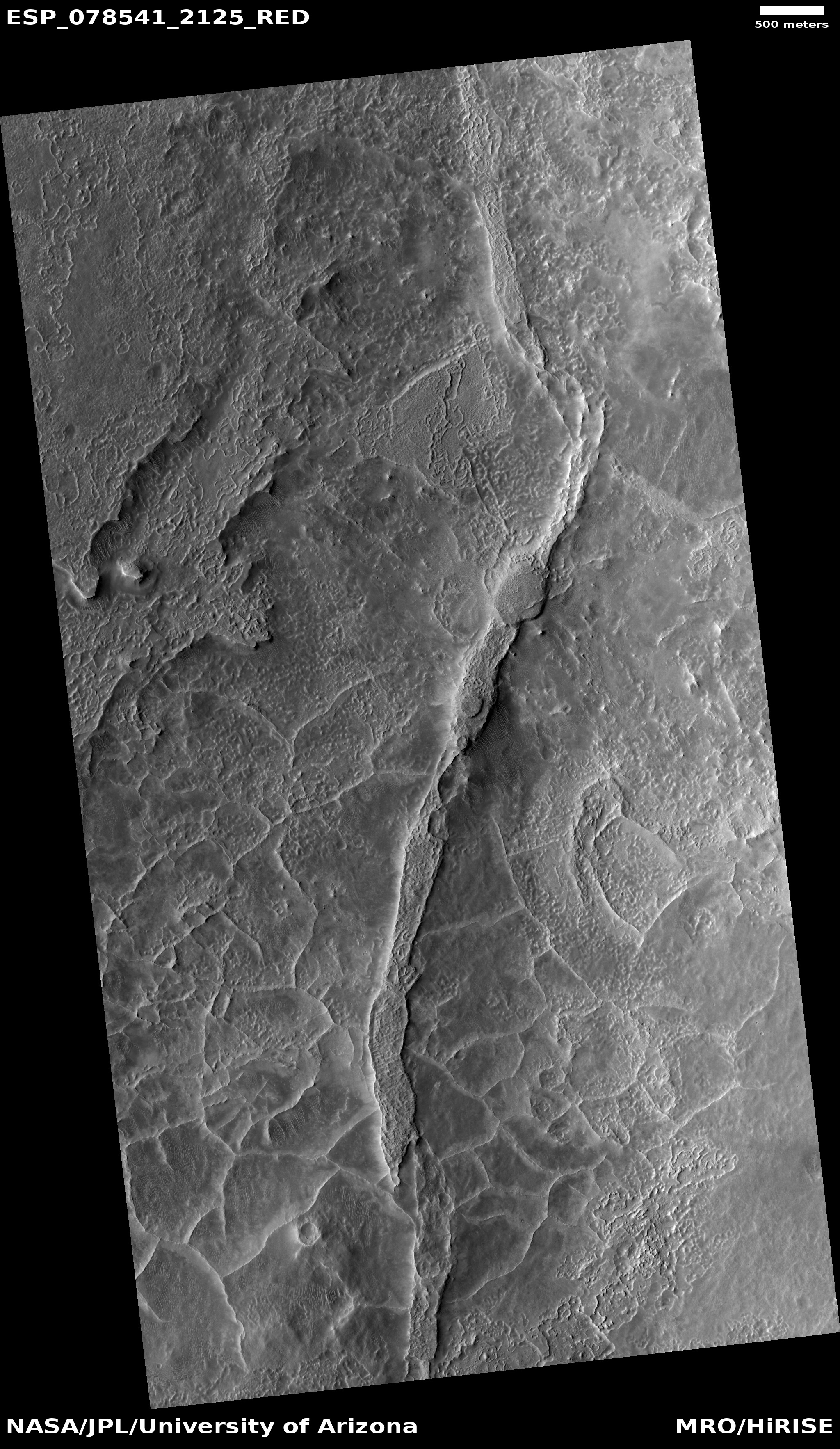
Cool image time! The picture to the right, rotated, cropped, and enhanced to post here, was taken on December 17, 2023 by the high resolution camera on Mars Reconnaissance Orbiter (MRO). It shows what the scientists label “banded terrain and possible breached crater.”

Banded terrain is another name for a geological feature dubbed “taffy terrain” and only found on Mars, and furthermore only found there in Hellas Basin, the deepest giant impact basin on the red planet. This taffy terrain is considered very young, no than 3 billion years old, and formed from the flow of some form of viscous material, though what that material is remains unsolved.

This image however may help solve that mystery. The breached crater is just off frame to the upper right. The two-fingered flow coming down from the picture’s top is the flow coming out of the crater’s gap.
» Read more

0 comments

Swirls of layers and dunes at the bottom of Valles Marineris

Overview map

Swirls of layers and dunes
Click for original image.

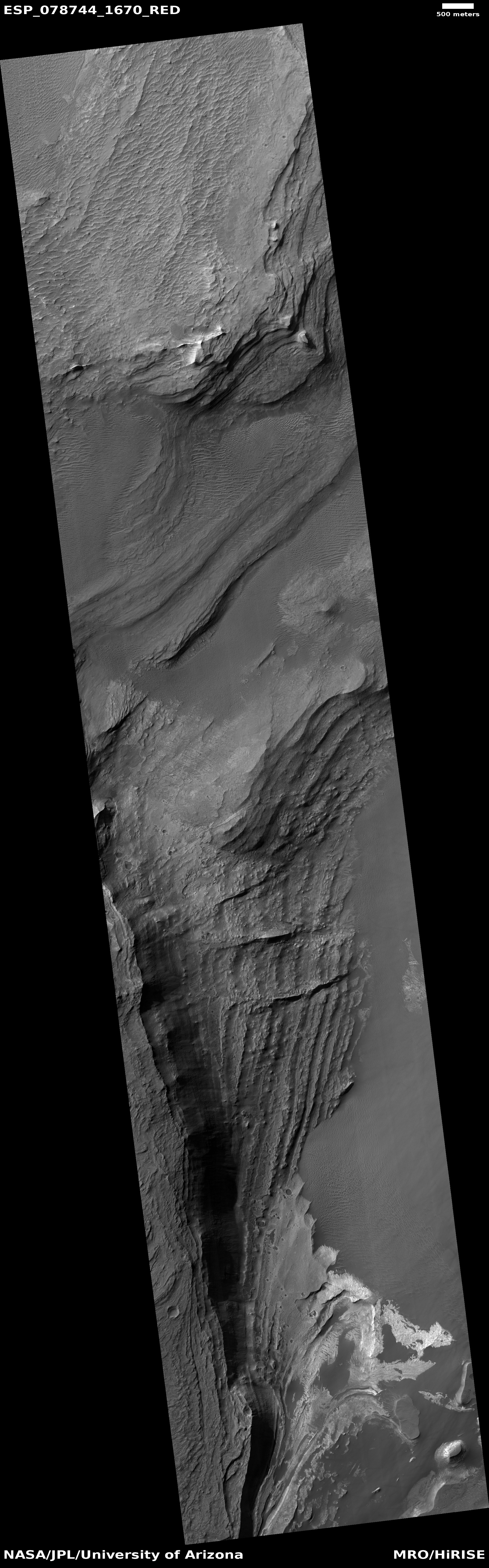
Cool image time! The picture to the right, cropped, reduced, and sharpened to post here, was taken on February 25, 2024 by the high resolution camera on Mars Reconnaissance Orbiter (MRO). It shows a small spot of the floor of Mars’ giant canyon Valles Marineris, the largest such canyon known in the solar system, as indicated by the white dot on the overview map above.

This location is not actually at the very bottom of the canyon, but on a very large mountainous bench extending out about 20 miles from the canyon’s south rim. It seems there is a lot of dust and sand on this bench, producing many miles of swirling dunes. It also appears there are many terraced layers in the region as well, which also swirl in curves going in many different directions. Though it appears that most of the swirls in this picture are from layers in the bedrock, this conclusion is not certain. For example, are the curves on the top of the mesa dunes or bedrock layers? The answer is hardly clear.

For scale, the canyon at this location is about 80 to 90 miles wide. The northern rim rises five miles from the bottom to the top, while the south rises seven miles. And yet, though five to ten times larger than Earth’s Grand Canyon, this is only a small side spur of Valles Marineris.

0 comments

Curiosity’s journey in Gediz Vallis approaching its end

Panorama taken on May 1, 2024
Click for original image.

Overview map
Click for interactive map.

Cool image time! The panorama above, cropped, reduced, enhanced, and annotated to post here, was created using 31 pictures taken by Curiosity’s right navigation camera on May 1, 2024. It looks uphill into Gediz Vallis, the slot canyon that the rover has been traversing since August 2022.

The overview map to the right gives the context. The blue dot marks Curiosity’s present position. The red dotted line, on both the panorama and the overview indicate the rover’s planned route, with the white dotted line marking the route it actually traveled. The yellow lines indicate approximate the area covered by the panorama.

Coming into view inside Gediz Vallis is that small outcrop in the center of the canyon that the science team has targeted for inspection for years. It will be the last spot the rover visits in Gediz Vallis before turning west to head uphill in a parallel canyon. To see that route look at the map in this September 2023 post. Curiosity will travel west past two canyons before turning uphill again in the third.

Even then, Curiosity will still be in the low foothills at the base of Mount Sharp. The peak, blocked from view by the mountain’s lower flanks, is still 26 miles away and about 16,000 feet higher up. The journey to get there has really only begun, even after a dozen years exploring Gale Crater.

0 comments

Another Mars location being considered for future helicopter mission

Global overview of potential Mars helicopter missions

Floor of Degana Crater
Click for original picture.

In today’s May download of new photos from Mars Reconnaissnce Orbiter (MRO) I came across the picture to the right, reduced and sharpened to post here, and taken on April 2, 2024 by MRO’s high resolution camera. The scientists labeled it “Sample Rim Traverse Hazards at Possible Mars Helicopter Landing Site.” It was clearly taken as part of preliminary research to determine some potential landing sites for a future Mars helicopter mission.

Nor is this the first such location or region on Mars targeted for such a mission. As shown in the global map above of Mars, colored by the elevation data from MRO (blue is low and orange is high), two other candidate sites are being looked at as well. About a half dozen pictures have been taken inside the eastern end of Valles Marineris, exploring a helicopter mission there. In addition, MRO took for the same purpose a recent photo of the floor of Terby Crater, on the northern interior slope of Hellas Basin.
» Read more

0 comments

Lava land on Mars

Lava land on Mars
Click for original image.

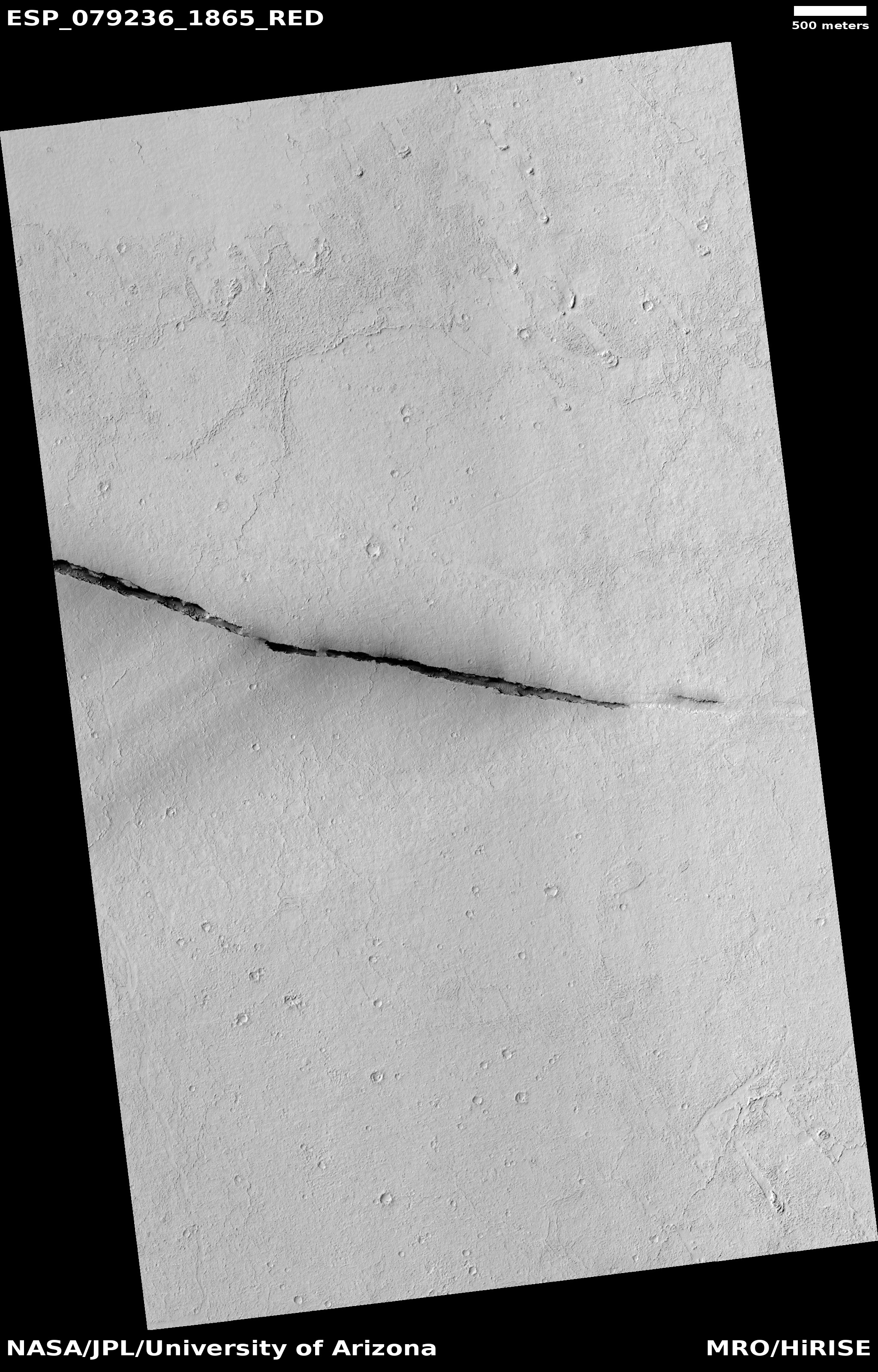
Cool image time! The picture to the right, cropped, reduced, and sharpened to post here, was taken on March 2, 2024 by the high resolution camera on Mars Reconnaissance Orbiter (MRO). It shows what the scientists label as “platy fractures.”

The ridges likely align with cracks that developed over time on this lava field, which then formed the ridges when magma oozed up from below. It is also possible that these events were closely linked, that the pressure from the magma below cracked this lava field, with the magma immediately oozing out. Because the pressure was evenly applied across the whole surface, it caused a network of cracks and plates, not a single vent or caldera. The even distribution of the pressure also caused only a small amount of lava to leak out to form the ridges.
» Read more

0 comments

Martian dunes with frost and a sublimating dry ice mantle

Martian dunes surrounded by frost
Click for original image.

Cool image time! The picture to the right, cropped to post here, was taken on March 16, 2024 by the high resolution camera of Mars Reconnaissance Orbiter (MRO). It was released today as a captioned picture from MRO’s camera team. As noted in the caption, written by the camera’s principal investigator Alfred McEwen:

This image shows a field a sand dunes in the Martian springtime while the seasonal carbon dioxide frost is sublimating into the air. This sublimation process is not at all uniform, instead creating a pattern of dark spots.

In addition, the inter-dune areas are also striking, with bright frost persisting in the troughs of polygons. Our enhanced-color cutout is centered on a brownish-colored inter-dune area.

Each winter the carbon dioxide in the Martian atmosphere falls as snow, mantling the surface in the latitudes above 60 degrees with a clear coat of dry ice. When spring arrives the sunlight passes through the mantle to heat the ground below, which in turn causes the base of the dry ice mantle to sublimate into gas. When the pressure builds enough, the gas breaks through the mantle at its weak points, spewing out and bringing with it dust from below, which stains the mantle with the dark spots.
» Read more

0 comments

Numerous layers in the interior slopes of Argyre Basin on Mars

Numerous layers on Mars
Click for original image.

The cool image to the right, cropped, reduced, and enhanced to post here, was taken on February 22, 2024 by the high resolution camera on Mars Reconnaissance Orbiter (MRO). It gives us another example the many-layered geological history of Mars, seen in numerous locations across the entire Martian surface.

This example shows many thin layers, going downhill about 450 feet from the mesa near the bottom of the picture to the low point near the picture’s top. At this resolution there appear to be roughly two dozen prominent layers in that descent, but a closer look suggests many more layers within those large layers. Like the terrain that Curiosity is traversing on Mount Sharp, the closer one gets the more layers one sees. And each layer signifies a different geological event, possibly even marking the annual seasons, each either adding or removing a layer of dust or ice, or placing down a new layer of lava.
» Read more

0 comments

Flat tadpole depression in ancient Martian crater

Flat tadpole depression in ancient Martian crater
Click for original image.

Cool image time! The picture to the right, rotated, cropped, reducedl, and enhanced to post here, was taken on February 24, 2024 by the high resolution camera on Mars Reconnaissance Orbiter (MRO). Dubbed a โ€œterrain sampleโ€ by the camera team, it was likely taken not as part of any specific research project but to fill a gap in the cameraโ€™s schedule so as to maintain that cameraโ€™s proper temperature. When they have to do this, they try to pick interesting targets, though there is no guarantee the result will be very interesting.

In this case the camera team already knew this location would have intriguing geology, based on an earlier terrain sample taken a year ago only eight miles to the south. The landscape here is a flat plateaus surrounding flat depressions, some of which appear connected by drainage channels. Today’s picture shows one flat depression with a short tail-like channel flowing into it.

Note the pockmarked surface. The many holes could be impact craters, but they also could be holes caused when the near-surface ice at this location sublimated into gas and bubbled upward to escape. Now all we see is dry bedrock, the flat ground riddled with holes.
» Read more

0 comments

Infeeder to a Martian paleolake

Infeeder to a Martian paleolake
Click for original image.

Cool image time! The picture to the right, rotated, cropped, and reduced to post here, was taken on December 21, 2023 by the high resolution camera on Mars Reconnaissance Orbiter (MRO). It shows what the scientists label as an “inlet to a paleolake.” I have used this context camera lower resolution image taken January 14, 2023 to fill in the blank central strip caused by a failed filter on the high resolution camera.

The elevation difference between the plateau on the lower left and the lake bottom on the upper right is about 700 feet. The inlet channel floor is about 200 feet below the plateau. We know it is ancient because of the number of small craters within it as well as on the lakebed below. It has been a very long time since any water or ice flowed down this channel to drain into the lake to the north.

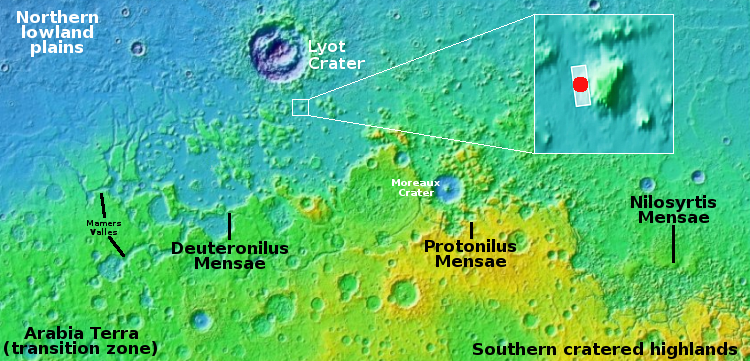
While a lot of analysis of orbital data has found numerous examples of paleolakes in the dry equatoral regions of Mars (see here, here, here, here, and here , this particular example is so obvious not much analysis is needed, as shown in the overview map below.
» Read more

1 comment
1 25 26 27 28 29 157