An example why scientists think there were catastrophic floods on Mars

Broken mesas on Mars
Click for full image.

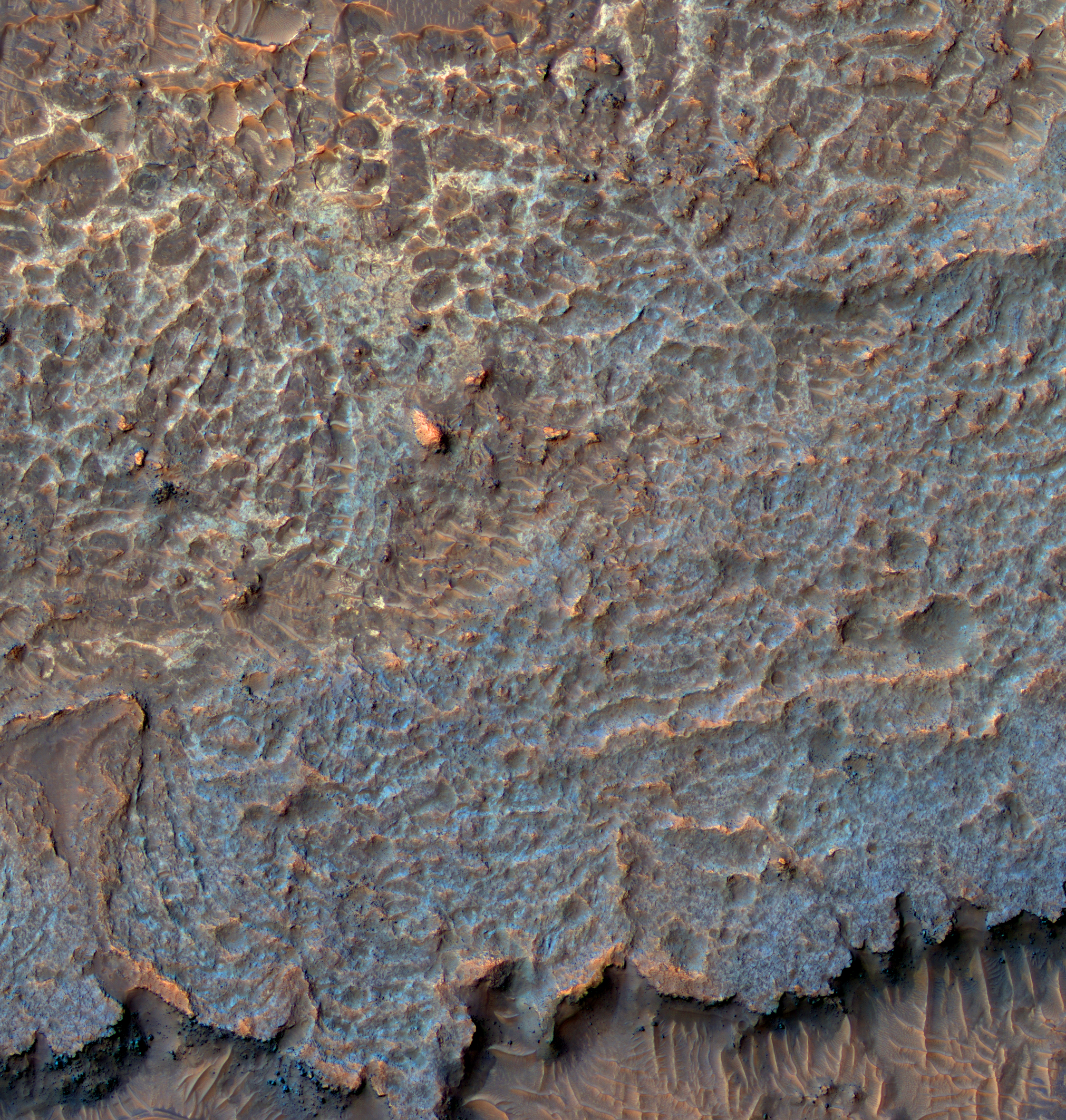
Today’s cool image provides a nice illustration why scientists have long assumed that in the distance past there had been catastrophic floods of liquid water on Mars. The photo to the right, rotated, cropped, and reduced to post here, was taken on July 6, 2021 by the high resolution camera on Mars Reconnaissance Orbiter (MRO). It shows an east-west gully cutting between mesas to the north and south.

Because the highest mesas seem to be aligned, this suggests they were once part of the same formation, and something came along to carve that gap and gully between them.

What made the break? The overview map below as usual provides some context, which also provides a possible explanation.
» Read more

4 comments

Data from Opportunity suggests surface dew periodically appears even in the dry equatorial regions

Using data from the rover Opportunity, scientists now think that the renewal of Martian salt crusts on rock surfaces on the rim of Endeavour Crater could possibly by caused by the appearance of rare thin wetting events, and that such events could have even occurred very recently and be on-going..

The scientists looked at the rate of erosion and renewal of the salt crusts, and found them to be in a steady state. The erosion is slow, taking from 200,000 to 2,000,000 years to remove 1 to 2 millimeters. However, periodically a thin film of water or wetting occurs, not unlike dew on Earth, which quickly acts to renew the crust. As David Mittlefehldt of the Astromaterials Research Office at the Johnson Space Center and the lead author of the paper explained to me,

Taken together, the data leaves open the possibility the salt mobilization has occurred within the last few thousand years. It could be ongoing in the sense that over a period of thousands? or hundreds? of years it might happen again.

In other words, the evidence suggests that every few hundred or thousand years the surface of these rocks gets wet, which results in the placement of a new thin layer of salt crusts.

Mittlefehldt also emphasized to me that these wetting events are rare, and “there is also the case that such an event may never come again because of changing conditions.”

The situation is essentially like on Earth, where in some places hydrologists measure the size of floods by how rare they are. A 1,000 year flood is big, but it happens very rarely. At Endeavour Crater these wetting events are comparably rare, but they do not involve big floods, but a mere moistening of the ground.

The location of Endeavour Crater is about 2 degrees south latitude, so it sits in the dry equatorial regions where no surface or near surface ice has so far been found. However, the cyclic nature of Mars’ orbit and obliquity could have changed this in the past, and could change this again in the future. At this time we simply don’t have enough information to know.

0 comments

On the edge of Mars’ glacier country

Color dry mesas on Mars
Click for full image.

Today’s cool image sits right on the southern edge of Mars’ northern glacier country, at 29 degrees north latitude. The picture to the right, cropped and reduced to post here, was taken of this location on June 4, 2021 by the high resolution camera on Mars Reconnaissance Orbiter (MRO). It shows what appears to be the exposed and scraped bedrock and mesas on the floor of an unnamed 60-mile-wide crater.

That scraped bedrock is quite beautiful, reminiscent of the bare carved mesas and bedrock one sees throughout the southwest of the United States. To hike from that central valley to the top of the bright mesa would be a fine experience, especially because of the suggested change in colors in the color strip.

The overview map below gives more context.
» Read more

0 comments

Glaciers and mesas on Mars

Overview map

Cool image time! Today we return to glacier country on Mars, that band of mensae mesas and glaciers that stretches more than 2,000 miles in the northern mid-latitudes, as shown on the overview map above.

No rovers or landers have yet visited this region, nor are any planned. To the west just beyond the map’s left edge is the planned landing site of Europe’s Franklin rover. To the east and south and just beyond the map’s right edge is where America’s Perseverance rover presently travels in Jezero Crater.

Our journey today begins from afar, and will steadily zoom into the area of the red cross and a most intriguing feature seen in a recent picture taken by the high resolution camera on Mars Reconnaissance Orbiter (MRO).

Before we look at that high resolution image, it is better to view the area using MRO’s context camera, as what it shows helps make sense of the features in the close-up.
» Read more

4 comments

Ingenuity completes 13th flight

Ingenuity landing on September 5, 2021
Click for full image.

Though the full slate of images taken has not yet been released, it appears from the five images available that the thirteenth flight of Ingenuity on September 5, 2021 ended successfully. The photo to the right is the last available, and shows the helicopter’s shadow on the ground mere seconds before touch down. The landing legs’ shadows suggest it is oriented properly for that landing.

No word yet on how successful the flight itself was. The goal had been to fly back over the South Seitah area from a different angle and lower altitude, getting different perspectives of the ridges there to help plan Perseverance’s coming travels across that terrain.

The second picture below, cropped, reduced, and enhanced to post here, was taken about forty minutes before take-off by Perseverance and captures Ingenuity in the lower left, as indicated by the arrow.
» Read more

3 comments

Perseverance’s 2nd drill attempt to get sample appears successful

It appears that Perseverance’s second drill attempt on Mars has successfully obtained sample material in its core.

Data received late Sept. 1 from NASAโ€™s Perseverance rover indicate the team has achieved its goal of successfully coring a Mars rock. The initial images downlinked after the historic event show an intact sample present in the tube after coring. However, additional images taken after the arm completed sample acquisition were inconclusive due to poor sunlight conditions. Another round of images with better lighting will be taken before the sample processing continues.

Once they know for sure if they have a sample, they will store it and then move on, heading to the area that Ingenuity scouted for them in mid-August.

Posted halfway to Las Vegas.

4 comments

A peanut-shaped crater in the northern plains of Mars

Context camera image of peanut-shaped crater
Click for full image.

Cool image time! The photo to the right, rotated, cropped and reduced to post here, was taken in May 2008 by the wide angle context camera on Mars Reconnaissance Orbiter (MRO). It shows what the scientists have since labeled a “peanut-shaped crater.”

What caused this unusual shape? The obvious and most likely explanation is that this was a double impact that occurred simultaneously. Imagine the ground being hit either by an asteroid with two lobes or by two similar-sized asteroids falling side-by-side.

Fast forward thirteen years to 2021. In the fifteen years since 2006 when MRO begin science operations in orbit around Mars no high resolution images were taken of this crater. Finally, on July 30, 2021, scientists finally decided to take a high resolution image of this crater’s western half. You can see that image below, rotated, cropped, and reduced to post here.
» Read more

3 comments

Stucco on Mars!

Stucco on Mars
Click for full image.

Cool image time! The picture to the right, cropped to post here, was taken on June 8, 2021 by the high resolution camera on Mars Reconnaissance Orbiter (MRO). It shows a strangely flat plain with a complex stucco-type surface of ridges and depressions. The sunlight is coming from the west, which makes the smoother flat areas depressions.

What are we looking at? What causes this strange surface? Make sure you look at the full image, because the section I cropped out doesn’t give a true sense of the terrain’s vastness.

The MRO science team labeled the photo “volcanic terrain,” but that tells only part of the story, since this volcanic terrain is actually part of Mars’ most interesting lava plains, as the overview map below shows.
» Read more

2 comments

Zhurong completes 100 days on Mars

Zhurong's loaction, August 31, 2021

The new colonial movement: In announcing today that its Mars rover Zhurong has completed 100 days on the Martian surface, the state-run Chinese press released one very low-resolution panorama taken at the rover’s new position, and a map showing its full route since landing.

The map to the right, created by placing that route on a high resolution Mars Reconnaissance Orbiter image, shows us where Zhurong presently sits as well as where it might travel next. It still appears that they are attempting to reach the heat shield used during landing, which also suggests that they are giving high priority to the engineering aspects of this mission, possibly ranking that component higher than any science they get.

If high resolution versions of that panorama are available, they are probably only available on the Chinese language sites, which makes it very difficult for a non-Chinese-speaker to find.

According to the release, the rover has now traveled just under 3,500 feet, which means it is maintaining a pace greater than 1,000 feet per month. The release also noted this fact about the rover’s upcoming travels, as well as the Tianwen-1 orbiter being used as a communications relay satellite:

The probes will experience a sun outage in mid-to-late September when the Sun is aligned with Earth and Mars, with the solar radiation interfering with the communication between the probes and ground stations. The orbiter and rover will stop working until the sun outage comes to an end.

This conjunction occurs every two years. It means there will also be a pause in data from the American rovers and orbiters. When the last conjunction occurred in September 2019, the communications shutdown lasted about two weeks.

3 comments

An ancient curving channel on Mars

Context image of curving channels
Click for full image.

Cool image time! The photo to the right, rotated, cropped, and reduced to post here, was taken by the wide angle context camera on Mars Reconnaissance Orbiter (MRO) in April 2019. It shows an area on Mars where a number of meandering curving channels flow downhill from the west to the east.

Earlier MRO images had already spotted these channels, so when this context image was taken the scientists also took a high resolution image of the same channels, with the white box indicating the area covered by the rotated, cropped, and reduced image below.

Both images are today’s MRO image of the day, where the MRO team notes that “The objective of this observation is to examine a complex network of channels. Some parts of the channels are quite curved.”
» Read more

1 comment

Another mountain view from Curiosity

Low resolution panorama
Click for full resolution panorama. The original images can be found here, here, here, here, here, and here.

I hope my readers won’t get tired of seeing these mountain views from Curiosity, but I can’t get enough of them.

The image above is a panorama I’ve created from six photos taken by Curiosity’s right navigation camera yesterday. The box marks the location of that spectacular outcrop I highlighted in the previous mountain view five days ago. The red dotted line shows the rover’s upcoming planned route. The white cross indicates the pavement bedrock where the science team hopes to next drill.

For scale, Navarro Mountain is rises about 400 feet from where the rover presently sits. The peak of Mount Sharp is actually not visible, blocked by its near white flank on the panorama’s left edge. That peak is still 13,000 feet higher up from where the rover presently sits.

The rise of rocks next to the words “entering Gediz Vallis” is actually only probably five to ten feet high, as it is very close to the rover.

Curiosity’s travels continue to get more and more exciting to follow.

5 comments

Perseverance’s upcoming targets: sand ripples, rocks, and a lot of dust

Ingenuity's view during 12th flight

Cool image time! The photo to the right was one of ten color images taken by Ingenuity on its twelfth flight on August 15, 2021. This photo is one of two images looking the same area from slightly different positions in order to create a stereoscopic view, with the other image found here.

The ground the helicopter was scouting, dubbed South Seitah, is an area that the Perseverance team hopes to send the rover. Ingenuity’s images from this flight will not only tell them whether the terrain is safe to traverse, it will allow them to map out a route that will avoid problems while effectively targeting the most interesting rocks.

The photo shows a lot of Martian dust, with a good portion forming small sand dune ripples. The rocks appear to be bedrock pavement stones, which because these are on the floor of the crater and the lowest elevation, likely hold the oldest geology that Perseverance will see on its journey in Jezero Crater. For this reason the science team is spending a lot of time studying that floor, and will make probably several drilling attempts to obtain samples.

The terrain in general looks entirely safe for the rover to travel. I expect the science team will thus continue north, crossing to North Seitah, rather than backtrack and travel over already traversed ground. Initially they had decided to avoid this ground because they feared it might be too rough for the rover. I suspect they were just being overly cautious at the start of the mission, and will now work past that fear.

1 comment
1 87 88 89 90 91 157