Secondary impacts in water ice on Mars

Secondary impact in water ice on Mars
Click for full resolution image.

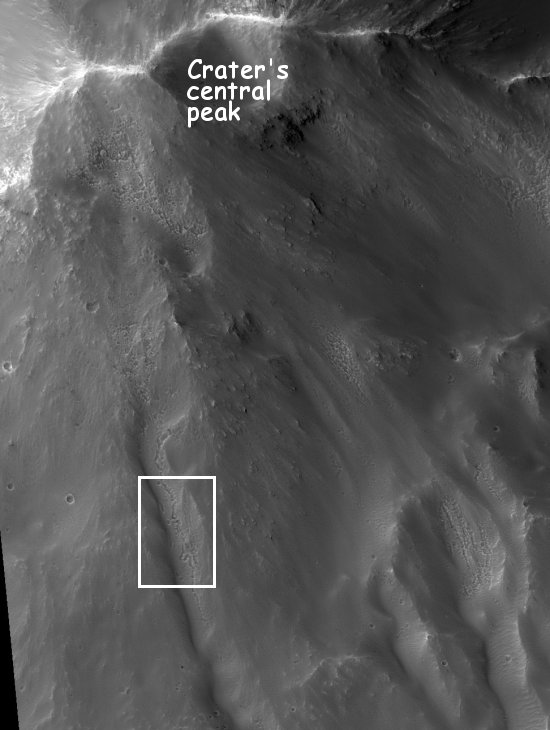
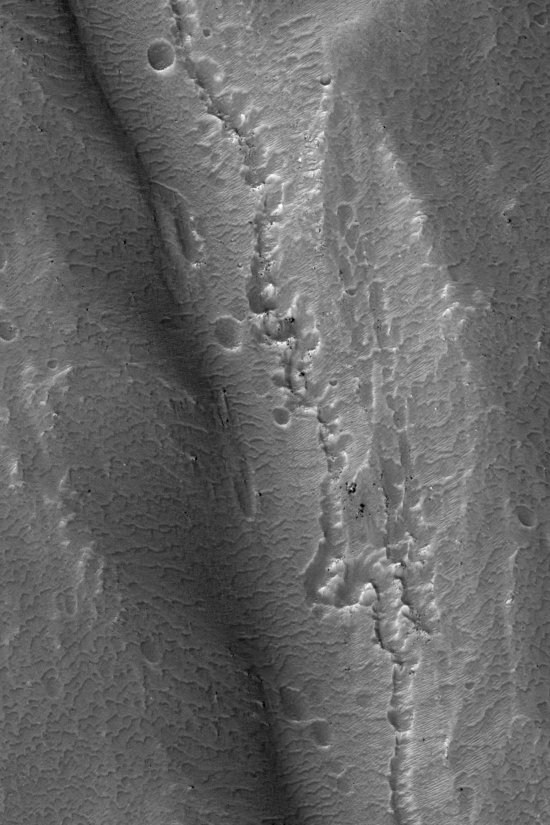
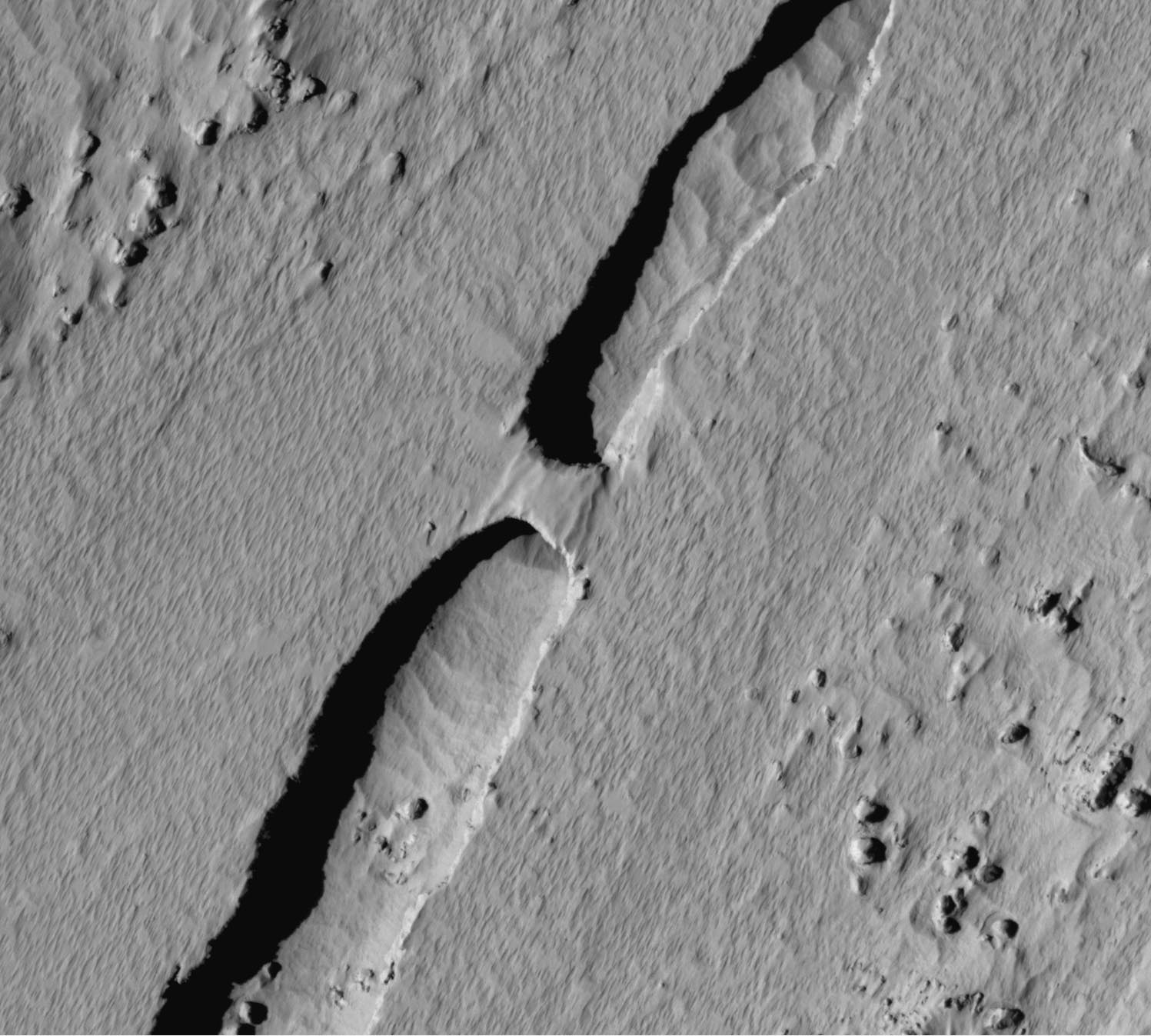
Cool image time! Today the science team for the high resolution camera on Mars Reconnaissance Orbiter (MRO) released a beautiful captioned image of a secondary impact of an object into the icy plains of Utopia Planitia, the northern lowlands northeast of where the rover Perseverance will land in 2021. The image to the right, cropped and reduced to post here, shows one of several secondary craters in the full image. As planetary scientist Alfred McEwen explains in the caption,

One interpretation [for the crater’s unusual appearance] is that the impact crater exposed nearly pure water ice, which then sublimated away where exposed by the slopes of the crater, expanding the craterโ€™s diameter and producing a scalloped appearance. The small polygons are another indicator of shallow ice.

Note the dunes at the bottom of the crater. This has become a trap of wind-blown sand and dust. Note also how this secondary impact gives us a rough idea of the thickness of this ice, based on the area sublimated away.

There is a lot of relatively accessible ice in those northern lowlands, which is why SpaceX likes them for its possible landing site for Starship. That candidate site is in Arcadia Planitia, on the other side of Mars, but it is still in these same northern lowlands, where scientists have found lots of evidence of buried ice.

0 comments

Tuesday at the non-existent Lunar & Planetary Science Conference

Boulder on Bennu with changes in layered texture changes

Today was supposed to have been the second day of the week-long 51st annual Lunar & Planetary Conference, sadly cancelled due to fear of the Wuhan virus. As I had planned to attend, I am now spending each day this week reviewing the abstracts of the planned presentations, and giving my readers a review of what scientists had hoped to present. Because I am not in the room with these scientists, however, I cannot quickly get answers to any questions I might have, so for these daily reports my reporting must be more superficial than I would like.

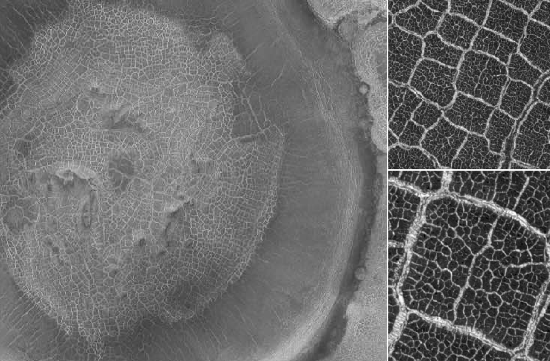
On this day the most significant reports came from scientists working on the probes to the asteroids Bennu and Ryugu as well as the probes to the Moon. The image to right for example is from one abstract [pdf] that studied the texture differences found fourteen boulders on Bennu. The arrows point to the contacts between the different textures, suggesting the existence of layers. Such layers could not have been created on Bennu. Instead, these rocks must have formed on a parent body large enough and existing long enough for such geological processes to take place. At some point that parent body was hit, flinging debris into space that eventually reassembled into the rubble pile of boulders that is Bennu.

Other abstracts from scientists from both the Hayabusa-2 mission to Ryugu and the OSIRIS-REx mission to Bennu covered a whole range of topics:
» Read more

0 comments

Monday at the non-existent Lunar & Planetary Science Conference

Today I had planned on attending the first day of the 51st annual Lunar & Planetary Science Conference in the suburbs of Houston, Texas. Sadly, for the generally foolish and panicky reasons that is gripping America these days, the people in charge, all scientists, decided to cancel out of fear of a virus that so far appears generally only slightly more dangerous than the flu, though affecting far far far fewer people.

Anyway, below are some of the interesting tidbits that I have gleaned from the abstracts posted for each of Monday’s planned presentations. Unfortunately, because I am not in the room with these scientists, I cannot get my questions answered quickly, or at all. My readers must therefore be satisfied with a somewhat superficial description.
» Read more

24 comments

China on track for Mars launch in July?

Two stories today, one from Nature and the second from space.com, pushed the idea that China’s Mars orbiter/lander/rover mission is still on schedule to meet the July launch window.

A close read of both stories however revealed very little information to support that idea.

The Nature article provided some details about how the project is working around travel restrictions put in place because of the COVID-19 virus epidemic. For example, it told a story about how employees drove six scientific instruments by car to the assembly point rather than fly or take a train, thereby avoiding crowds.

What struck me however was that this supposedly occurred “several days ago,” and involved six science payloads that had not yet been installed on the spacecraft. To be installing such instrumentation at this date, only four months from launch, does not inspire confidence. It leaves them almost no time for thermal and vibration testing of the spacecraft.

The article also provided little information about the status of the entire project.

The space.com article was similar. Lots of information about how China’s space program is dealing with the epidemic, but little concrete information about the mission itself, noting “the lack of official comment on the mission.” Even more puzzling was the statement in this article that the rover “underwent its space environment testing in late January.”

I wonder how that is possible if those six instruments above had not yet been installed. Maybe the instruments were for the lander or orbiter, but if so that means the entire package is not yet assembled and has not been thoroughly tested as a unit. Very worrisome.

Posting today has been light because I was up most of the night dealing with a family health issue, meaning that I ended up sleeping for several hours during the day. All is well, nothing serious (it is NOT coronavirus), but it has left my brain and schedule very confused. Will likely take a good night’s sleep to get back to normal.

6 comments

Black dunes and weird hills on Mars

Black dunes and weird hills on Mars
Click for full image.

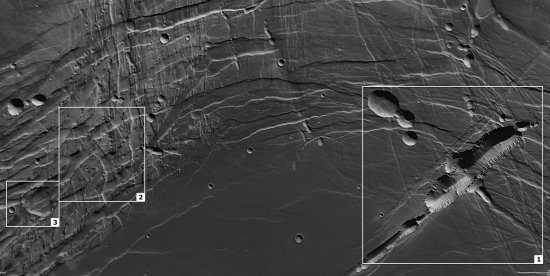
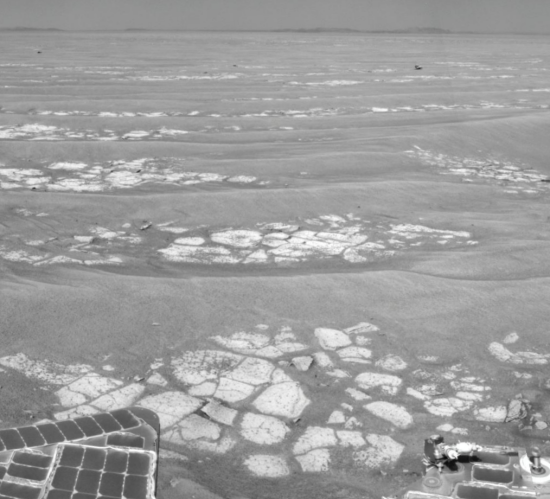
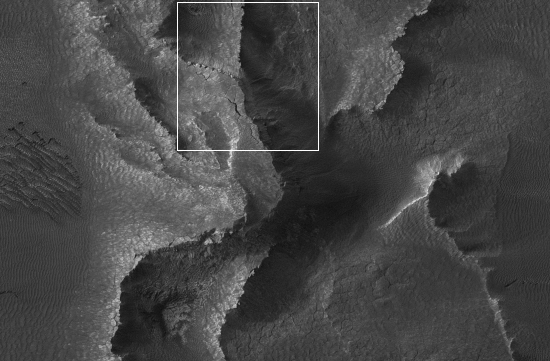
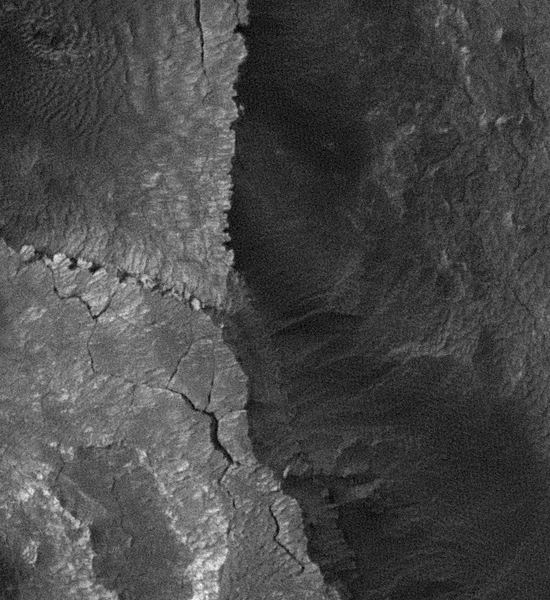
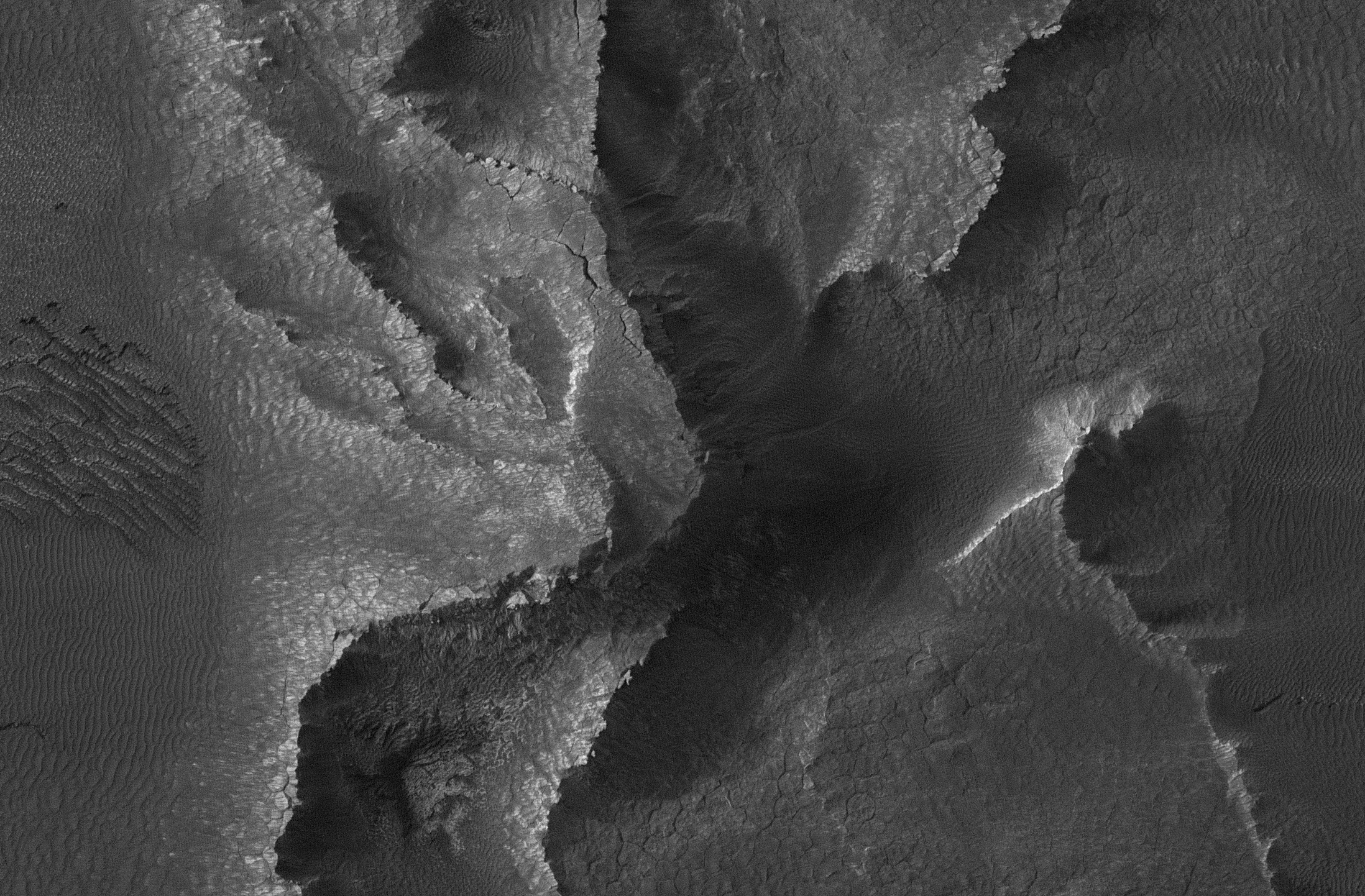
Cool image time! Or I should say a bunch of cool images! The photo on the right, rotated, cropped, reduced, and annotated by me, was taken by the high resolution camera on Mars Reconnaissance Orbiter (MRO) on February 3, 2020. An uncaptioned image, it was entitled “Arabia Terra with Stair-Stepped Hills and Dark Dunes.” Arabia Terra is one of the largest regions of the transition zone on Mars between the northern lowland plains and the southern cratered highlands. It is also where Opportunity landed, and where Europe’s Rosalind Franklin rover will land, in 2022.

This image has so many weird and strange features, I decided to show them all, Below are the three areas indicated by the white boxes, at full resolution. One shows the black dunes, almost certainly made up of sand ground from volcanic ash spewed from a long ago volcanic eruption on Mars.
» Read more

1 comment

ExoMars2020 rover delayed until 2022

The European Space Agency (ESA) today announced that they are delaying the launch of their ExoMars2020 rover mission until the next launch window in 2022

The press release says this will give them the time “necessary to make all components of the spacecraft fit for the Mars adventure.” Considering that the spacecraft’s parachutes have yet to have a successful high altitude test, that the entire spacecraft is not yet assembled, and that when they did the first thermal test of the rover the glue for the solar panel hinges failed, this seems that they need to do a lot of testing.

Overall the decision is smart. Better to give them the time to get this right then launch on time and have a failure.

At the same time, there appears to be something fundamentally wrong within the management of this project at ESA. This project was first proposed in 2001, and has gone through repeated restructurings and redesigns. Moreover, they began planning the rover for this 2020 launch in 2011, and after ten years were not ready for launch.

0 comments

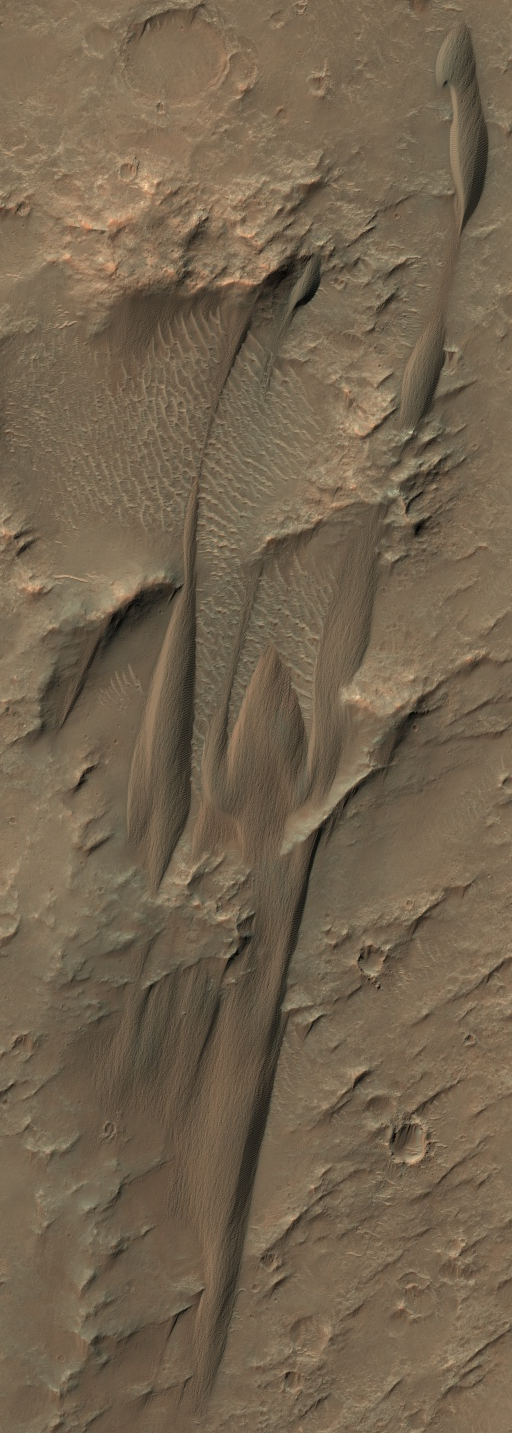
Martian dust devil tracks come and go

The changing surface of dunes on Mars
Click for full image.

Earlier image of the same dunes
Click for full image.

Cool image time! To understand what created the vastly strange and alien Martian surface, it will be necessary for scientists to monitor that surface closely for decades, if not centuries. To the right is one small example. Taken by the high resolution camera of Mars Reconnaissance Orbiter (MRO) and rotated, cropped, and reduced to post here, it shows a dune field inside a crater in the southern cratered highlands of Mars. Craters have been found to be great traps for dust and sand on Mars. Once the material is blown inside, the winds are not strong enough to lift the material out above the surrounding rims. Thus you often get giant dunes inside craters, as we see here.

What makes this location of interest to planetary scientists is the changing surface of these dunes. They have been monitoring the location since 2009. In 2013, the MRO science team released a captioned photograph, the second image to the right, also rotated, cropped, and reduced by me to match the same area in the top image. In that caption planetary scientist Corwin Atwood-Stone of the Lunar and Planetary Laboratory in Arizona wrote,

This area was previously imaged in August 2009, about two Mars years ago, and in that image dust devil tracks were also visible. However the tracks visible now are completely different from the earlier ones. This tells us that there has been at least one dust storm since then to erase the old tracks, and lots of dust devil activity to create the new ones.

Since then the MRO science team has taken repeated images of this location to monitor how the dust devil tracks change, as well as monitor possible changes to the dunes themselves, including avalanches. The newest image above shows the result of the global dust storm last year. It wiped out the dust devil tracks entirely.

The newer image was entitled, “Monitor Dune Avalanche Slopes,” but I couldn’t find any examples. Based on published research, I am sure there is something there, even if I couldn’t find them. Maybe my readers have a better eye than I.

0 comments

China completes remote communications test of Mars rover

The new colonial movement: Though the report today in China’s state-run press is remarkably vague and lacking in details, it appears that they have successfully completed a remote communications test between their planned Mars rover and their ground control center.

The report also said that this will be the “only” such test before the summer launch of their orbiter/lander/rover to Mars.

China has been exceedingly closed-mouthed about this Mars project. Except for one landing test (which I found far from impressive), they have provided very little information about their progress.
While this does not mean they are having problems, it also does not engender confidence, especially because the launch window is only about four months away.

0 comments

Martian badlands

The Tyrrhena Terra badlands
Click for full image.

The photo to the right is a small section cropped from an image taken by the high resolution camera on Mars Reconnaissance Orbiter (MRO) on January 2, 2020. It shows the rough, cratered southern highlands dubbed Tyrrhena Terra that lie between the low Isidis Basin to the north and Mars’ deepest basin, Hellas, to the south.

The image was taken not because any specific scientific request, but because MRO was doing spectroscopy over this area and it made sense to also take a photograph. Comparing the photograph with the spectroscopic data allows scientists to better understand that spectroscopy.

The white cross in the map below shows the location of this image. The map itself covers latitudes from 40 degrees north to 55 degrees south.
» Read more

5 comments

Curiosity reaches highest point yet on Mars

Curiosity looking north across Gale Crater
Click for full resolution version.

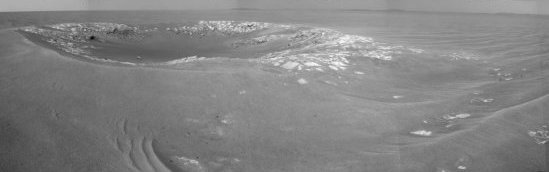
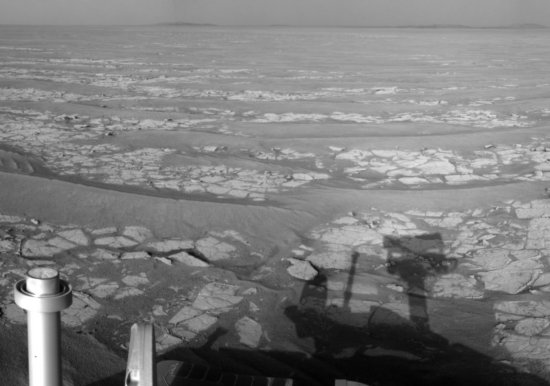
Time for some more cool images! The panorama above, cropped and reduced to post here, was assembled from images taken by Curiosity on March 6, 2020 by its left navigation camera, just after it topped the slope and settled on the very rocky plateau of what the scientists have dubbed the Greenheugh Piedmont, the highest point on Mars that Curiosity has so far traveled. It looks north, across Gale Crater to its far rim, about thirty miles away. That rim rises about a mile higher than where Curiosity sits today.

To quote Michelle Minitti, the planetary geologist who wrote the update describing this achievement:

Kudos to our rover drivers for making it up the steep, sandy slope below the โ€œGreenheugh pedimentโ€ (visible in the [right] side of the above image) and delivering us to a stretch of geology we had our eyes on even before we landed in Gale crater!

The panorama below is also assembled from photos taken by the left navigation camera, but this time it looks south, across the piedmont toward Mt. Sharp. Its view of the the piedmont’s very very rough terrain I think proves that once the scientists have gathered their data from this point, the rover will descend back down and resume its original route, circling the piedmont to skirt its southern edge where orbital data suggests the going will be smoother.
» Read more

1 comment

Rolling boulders on Mars

Boulder tracks on Mars
Click for full image.

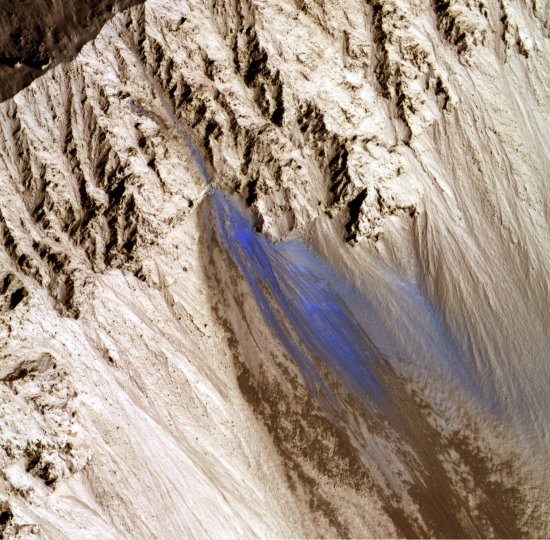
Cool image time! The photo to the left, cropped to post here, was taken by the high resolution camera on Mars Reconnaissance Orbiter (MRO) on January 21, 2020, and shows several boulders at the bottom of a slope, along with the tracks those boulders made as they rolled downhill sometime in the far past.

Uphill is to the south. We know the dark spots at the end of these tracks are large boulders partly because of the wind streaks emanating away from them to the north. As the wind goes around each rock it produces eddies that produce the tracks. Based on the scale and the image resolution (about 10 inches per pixel), these boulders range in size from about one to five feet in diameter.

This image has two points of interest. First, the tracks left by the boulders seem to have a repeating pattern. My guess is that the pattern most likely formed because the boulders are not spherical in shape, and as they rolled each roll repeated a certain pattern reflecting that shape. This theory is reinforced by a close look at each boulder. Though the resolution is insufficient to resolve the boulders themselves, the pixel distribution for each strongly suggests an asymmetric shape.

Second, this image, when compared with an earlier MRO image of the same spot, taken fourteen years ago in December 2006, shows no obvious change. These tracks, and their boulders, have therefore probably sat here, as we see them, for a long time. Since there appear to be two sets of tracks, with one overlying the other, this suggests that two separate events (an earthquake or nearby impact) each time caused a bunch of boulders to break free and roll downward together, with the second set of boulder tracks crossing over the earlier set.

Establishing when those two events occurred, however, will require some on-site data, something that will likely not occur until humans roam the surface of Mars in large numbers.

0 comments

NASA dubs next Mars rover “Perseverance”

NASA today announced that they have named their next Mars rover, due to launch in July, “Perseverance.”

The name was announced Thursday by Thomas Zurbuchen, associate administrator of the Science Mission Directorate, during a celebration at Lake Braddock Secondary School in Burke, Virginia. Zurbuchen was at the school to congratulate seventh grader Alexander Mather, who submitted the winning entry to the agency’s “Name the Rover” essay contest, which received 28,000 entries fromK-12 students from every U.S. state and territory.

“Alex’s entry captured the spirit of exploration,” said Zurbuchen. “Like every exploration mission before, our rover is going to face challenges, and it’s going to make amazing discoveries. It’s already surmounted many obstacles to get us to the point where we are today – processing for launch. Alex and his classmates are the Artemis Generation, and they’re going to be taking the next steps into space that lead to Mars. That inspiring work will always require perseverance. We can’t wait to see that nameplate on Mars.”

I truly hope that the rover is well-named, and lives a very long life on Mars, long enough that it is still in use the day an human arrives to touch it again.

6 comments
1 125 126 127 128 129 212