Dried mud cracks on Mars?

Mud cracks on Mars?

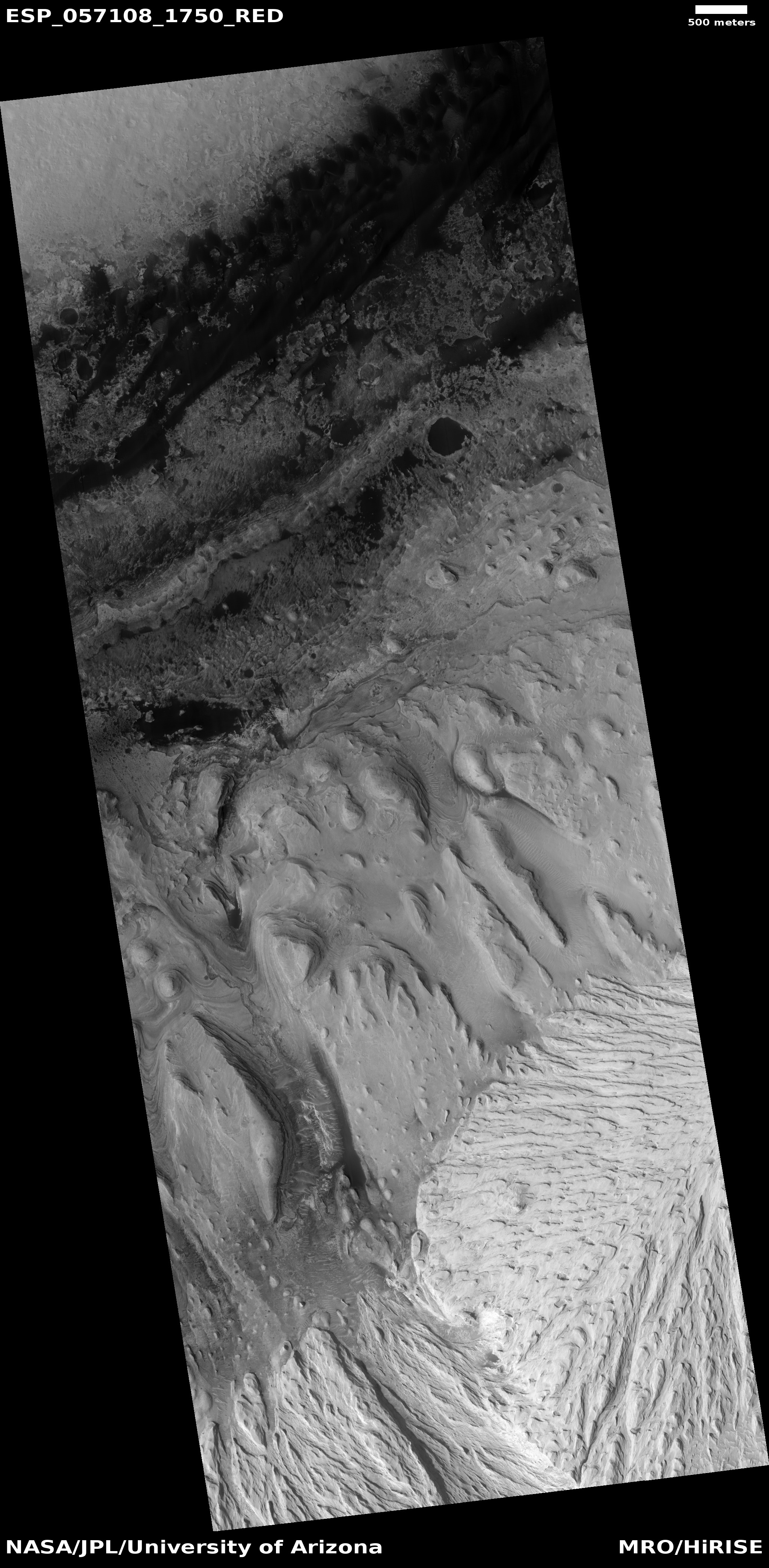
Cool image time! The image to the right, cropped and rotated to post here, was one of the uncaptioned photographs in the December Mars Reconnaissance Orbiter (MRO) image release. If you click on the image you can see the entire photograph. I have cropped the most interesting area, though cracks can be seen in other areas in the image.

What we appear to have here is a darker lower valley filled with dried mud, which over time has cracked as it dried. At its edges there appear to be ripples, almost like one sees on the beach as waves wash the shore. The perimeter slopes even show darker streaks as if the water in some places lapped up the slopes, and in others flowed downward into the valley.

Later, several meteorite impacts occurred, the largest of which produced concentric dried cracks on its outside perimeter. This impact also provides a rough idea of the depth of the mud in this valley.

Mud of course suggests that this lower valley once was filled with water. Was it? It is not possible now to come to a firm conclusion, but this image’s location shown by the red dot in the overview map below and to the right, provides a clue that strengthens this hypothesis.
» Read more

0 comments

InSight installs seismometer on Martian surface

InSight has successfully placed its first instrument, its seismometer, on Martian surface.

They aren’t yet ready to start gathering data, however.

In the coming days, the InSight team will work on leveling the seismometer, which is sitting on ground that is tilted 2 to 3 degrees. The first seismometer science data should begin to flow back to Earth after the seismometer is in the right position.

But engineers and scientists at JPL, the French national space agency Centre National d’Études Spatiales (CNES) and other institutions affiliated with the SEIS team will need several additional weeks to make sure the returned data are as clear as possible. For one thing, they will check and possibly adjust the seismometer’s long, wire-lined tether to minimize noise that could travel along it to the seismometer. Then, in early January, engineers expect to command the robotic arm to place the Wind and Thermal Shield over the seismometer to stabilize the environment around the sensors.

They plan on deploying the heat probe (which will drill down about 16 feet) in January.

3 comments

Curiosity’s future travels

MRO image of Curiosity's future travels

In the December release of images from the high resolution camera on Mars Reconnaissance Orbiter (MRO), there was one image entitled “Monitor Region Near Curiosity Rover.” To the right is a reduced, cropped, and rotated section of that image, annotated by me to show Curiosity’s future planned route (indicated by the yellow line). If you click on the image you can see the untouched full resolution version.

Curiosity’s journey has not yet brought it onto the terrain shown in this image. (For the overall context of Curiosity’s travels, see Pinpointing Curiosity’s location in Gale Crater.) The rover is right now just off the left edge of the photograph, on the white ridge dubbed Vera Rubin Ridge visible in the uppermost left. This week it completed the last planned drill sampling on that ridge, and it will soon descend off the ridge and begin heading along the yellow route up the mountain. The white dots along its future route are the locations of recurring slope lines, believed to be seasonal seeps of brine coming from below and causing gentle landslides that darken the surface. As you can see, they hope to get very close to the first seep, and will observe the second from across the canyon from a distance of about 1,200 feet.

The peak of Mount Sharp is quite a distance to the south, far beyond the bottom of the photograph. Even in these proposed travels the rover will remain in the mountain’s lowest foothills, though the terrain will be getting considerably more dramatic.

Below is a full resolution section of the image showing the spectacular canyon to the south of that second seep. This is where Curiosity will be going, a deep canyon about 1,500 feet across and probably as deep, its floor a smooth series of curved layers, reminiscent of The Wave in northern Arizona. The canyon appears to show evidence of water flow down its slopes, but that is unproven.
» Read more

0 comments

Dark dunes, wedding cake mesas, and dust-filled gullies

Dark dunes, wedding cake mesas, and dust-filled gullies

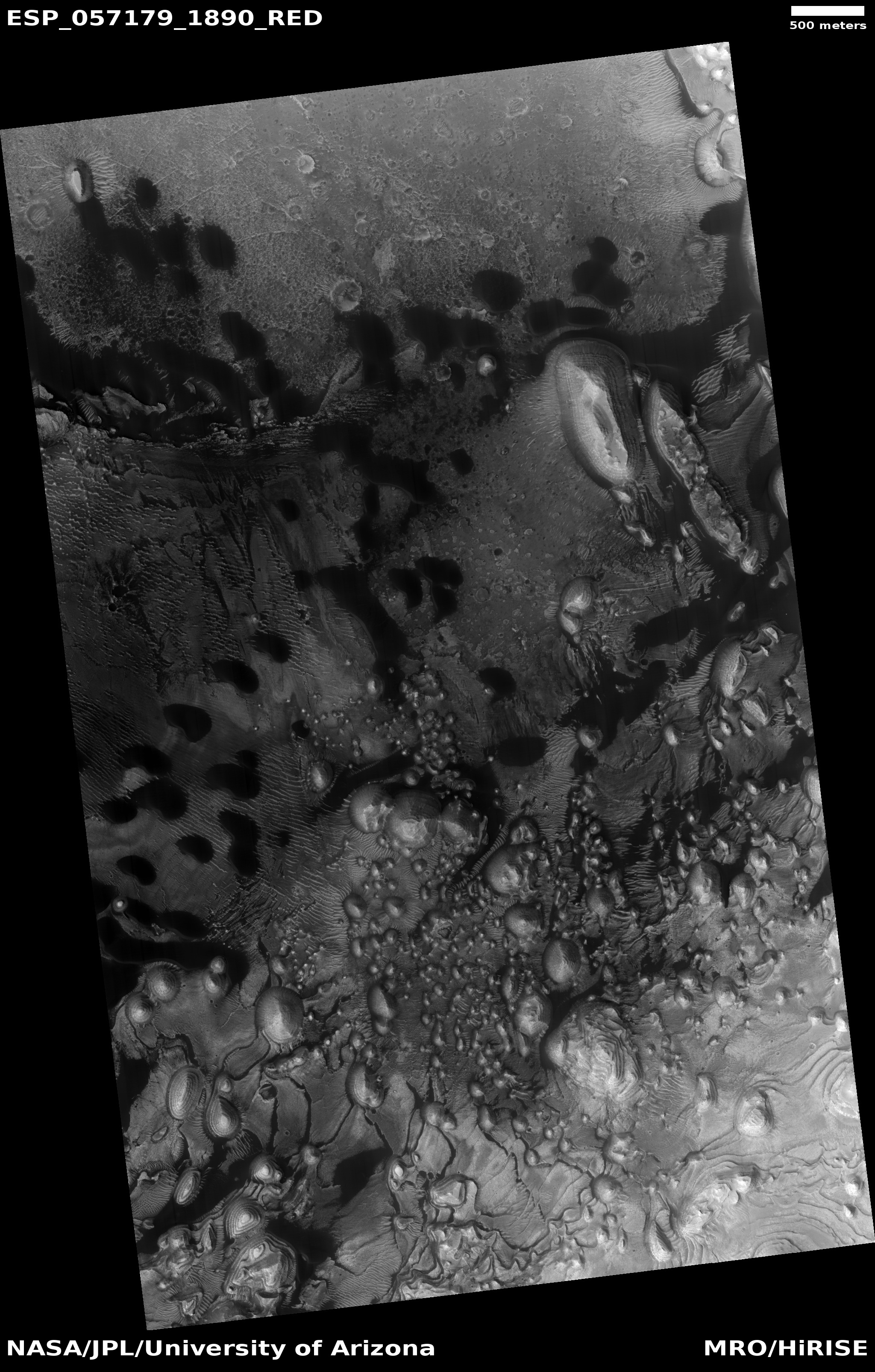
Cool image time! The photo on the right, reduced, rotated, and cropped slightly to post here, was taken by the high resolution camera on Mars Reconnaissance Orbiter (MRO) and issued by the spacecraft science team in its December image release.

They didn’t give this image a caption. The release title, “Arabia Terra with Stair-Stepped Hills and Dark Dunes,” significantly understates the wild variety of strange features throughout this terrain. Normally I crop out one section of the photographs I highlight to focus on the most interesting feature, but I couldn’t do it this time. Click on the image to see the full resolution version. Take a look at the complex wedding cake mesas in the lower left. Look also at the streaks of dust that I think are filling the gullies between these hills. In the image’s upper left are those dark dunes, scattered between dust ripples and small indistinct rises and what appears to be a drainage pattern descending to the north. Interspersed with these dunes near the center of the image are several perched crater floors, indicating that the crater impacts happened so long ago that the surrounding terrain had time to erode away, leaving the crater floor hanging like a small plateau.

On the right the two largest mesas rise in even stair-stepped layers that would do the mesas in the Grand Canyon proud.

This could very well be the coolest image I have ever posted. Everywhere you look you see something different, intriguing, and entirely baffling.

Arabia Terra covers the largest section of the transition zone between Mars’s high cratered south and its low flat northern plains, where some scientists believe an intermittent ocean might have once existed. It lies to the east of Valles Marineris, and is crater-filled with numerous intriguing geology, as this image most decidedly illustrates. In this particular case it shows the floor of one of the region’s mid-sized craters.

2 comments

Trace Gas Orbiter finds no methane on Mars

The uncertainty of science: Europe’s Trace Gas Orbiter (TGO) has failed to detect any methane in Mars’ atmosphere, even though data from Mars Express in 2004 had said it should see some.

The Mars Express orbiter first detected hints of methane in the martian atmosphere in 2004. But some scientists said the orbiter’s instruments that found it—at a level of 10 parts per billion (ppb)—weren’t sensitive enough to produce reliable results. Ten years later, NASA’s Curiosity rover detected a methane spike of 7 ppb from its base in Gale crater, which lasted several months. Several years later, Curiosity’s scientists then discovered a minute seasonal cycle, with methane levels peaking at 0.7 ppb in the late northern summer.

To settle this mystery, the European Space Agency’s Trace Gas Orbiter (TGO), which arrived at Mars in 2016, this year began to scan the atmosphere for methane. Two of the TGO’s spectrometers—a Belgian instrument called NOMAD and a Russian one called ACS—were designed to detect methane in such low concentrations that researchers were sure they would. Both instruments, which analyze horizontal slices of the martian atmosphere backlit by the sun, are working well, scientists on the team said today at a semiannual meeting of the American Geophysical Union in Washington, D.C. There’s still some noise to clean up, said Ann Carine Vandaele, NOMAD’s principal investigator and a planetary scientist at the Royal Belgian Institute for Space Aeronomy in Brussels, in her talk. “But we already know we can’t see any methane.”

The team’s initial results show no detection of methane down to a minute level of 50 parts per trillion, with their observations going down nearly all the way to the martian surface.

The data says that any methane seen on the surface (such as by Curiosity) must be coming from below, not from off world, which in itself is a surprise since the scientists expected some methane to be coming from interplanetary dust. TGO has found none..

There are a lot of uncertainties still, so stay tuned.

0 comments

InSight tests its robot arm

InSight has unfolded its robot arm and is beginning to use it to photograph the surrounding area to figure out where to place the spacecraft’s ground-sensing instruments.

With a reach of nearly 6 feet (2 meters), the arm will be used to pick up science instruments from the lander’s deck, gently setting them on the Martian surface at Elysium Planitia, the lava plain where InSight touched down on Nov. 26.

But first, the arm will use its Instrument Deployment Camera, located on its elbow, to take photos of the terrain in front of the lander. These images will help mission team members determine where to set InSight’s seismometer and heat flow probe – the only instruments ever to be robotically placed on the surface of another planet.

They are proceeding carefully, so actually deployment might not occur for several months, just make everything goes well.

0 comments

The vast southern highlands of Mars

Small section of Rocky Highlands

Rocky highlands

Cool image time! This week the Mars Reconnaissance Orbiter (MRO) science team made available its monthly release of new images taken by the high resolution camera on Mars Reconnaissance Orbiter (MRO). The image above is just a small cropped section from one of those new images, released under the name “Rocky Highlands.” The image on the right is a cropped and reduced section of the full photograph, with the white box indicating the small section above. If you click on either you can see the full resolution uncropped photograph and explore its complex and rough terrain.

What should immediately strike you looking at the small inset section above is the difficulty anyone is going to have traversing this country. There are no flat areas. Every inch seems to be a broken and shattered collection of ridges, pits, craters, or rippled dunes. And the inset above is only a tiny representation of the entire image, all of which shows the same kind of badlands.

This forbidding place is located in the southern highlands of Mars, north of Hellas Basin and south of the transition zone that drops down to the northern lowland plains. The white cross on the map below indicates the image location, with green representing the transition zone, blue the northern plains, and red/orange the southern highlands..
» Read more

4 comments

The basement of Mars

Hellas Basin ripples

Cool image time! The photo on the right, cropped and reduced to post here, was taken by the high resolution camera of Mars Reconnaissance Orbiter (MRO) on May 2, 2018, and shows some very strange ripples and erosion features in one of the lowest elevation locations on Mars, inside Hellas Basin. If you click on the image you can see the full photograph, at full resolution. There are a lot of strange features here, so make sure you take a look at it. The ripples highlighted in the image are between what appear to be three lower basins, and seem to my eye to be ridges created as liquid ebbed and flowed in the basins, depositing material at the shoreline at repeatedly higher and lower levels.
hellas basin

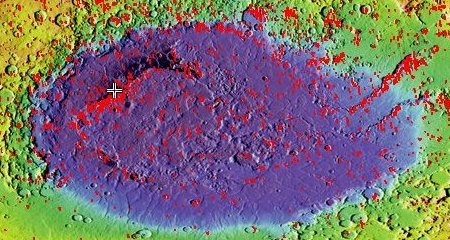
This particular location is not only in Hellas Basin, but it is also located in the deepest part of Hellas, a curved valley located in the basin’s northwest quadrant, as shown by the darker areas in the overview image to the right. The red boxes are other MRO high resolution images, with the cross indicating where this image is located.

This is the basement of Mars, what could be called its own Death Valley. The difference however is that unlike Death Valley, conditions here could be more amendable to life, as the lower elevation means the atmosphere is thicker. The ripples also suggest that liquid water might have once been here, a supposition supported by other low area images of Hellas Basin, most of which show a flattish dappled surface that to me resembles what one would think a dry seafloor bed would look like. The image in this second link also shows what looks like ghost craters that over time became partly buried, something one would also expect to happen if they were at the bottom of a lake, though this could also happen over time on Mars with wind erosion and the movement of dust.

It is also possible that these features come from lava events, so please take my theorizing here with a great big grain of salt. At the same time, recent results have found evidence of paleo lakes scattered all along the eastern rim of the basin, reinforcing the possibility that these were water filled lakes once as well.

Nonetheless, the ripples in the first image above are truly fascinating, as it is clear that at the highest peaks erosion has ripped those peaks away, leaving behind a hollow shaped by the ripples themselves. These features remind me of some cave features I have seen, where mud gets piled but by water flow, and then is over time covered with a crust of harder calcite flowstone. Later, water then washes out the mud underneath, leaving the curved flowstone blanket hanging in the air.

Here in Hellas Basin it looks like something similar has happened, except that at these peaks the outside crust got broken away, allowing wind to slowly suck out the material underneath, leaving these ripple-shaped pits. Whether it was liquid water or lava that helped create these features, the geology left behind is both beautiful and intriguing. I wonder at the chemical make-up of the crust as well as the materials below. And I especially wonder if there are water sources buried within Hellas Basin.

0 comments

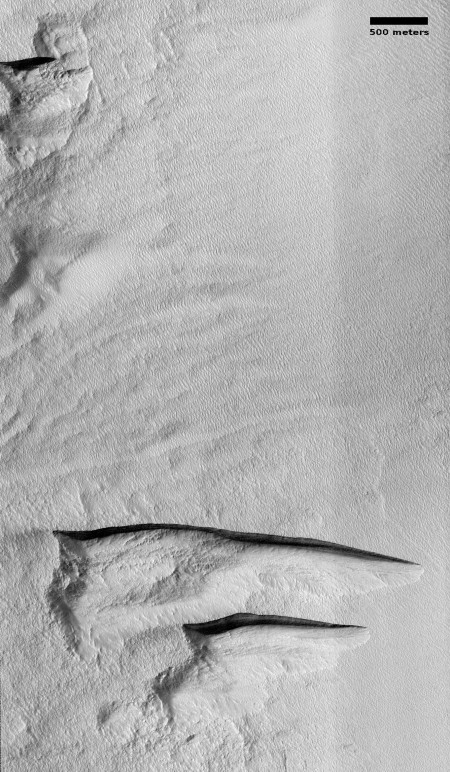
More ice cliffs found on Mars!

Another ice cliff

In my review of the November image download from the high resolution camera on Mars Reconnaissance Orbiter (MRO), I am, as a cave explorer and cartographer, naturally attracted to any image with “pit” in the title. The image to the right, cropped, rotated and reduced to post here, was released with the title “Pit in Mid-Latitude Mantle”. That immediately caught my eye, and in looking at it I was at first unimpressed. The three apparent collapses are interesting in that they all have south-facing sharp cliffs, but other than that I wasn’t sure why they were of interest.

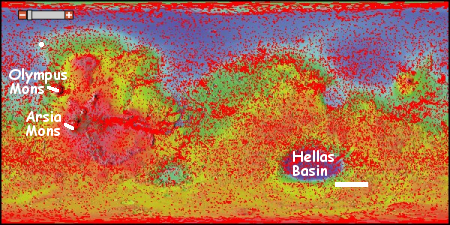
Then I took at look at this image’s location. It is somewhat far south on Mars, at latitude -60 degrees, sitting south of Hellas Basin, the deepest basin on Mars. This location is in the same general area where scientists announced in January the discovery of eight cliffs with visible exposed ice layers. The white horizontal bar below Hellas Basin on the map below and to the right shows the region where seven of those ice cliffs were located. To quote the January press release:

The location of known ice scarps on Mars

These eight scarps, with slopes as steep as 55 degrees, reveal new information about the internal layered structure of previously detected underground ice sheets in Mars’ middle latitudes.

The ice was likely deposited as snow long ago. The deposits are exposed in cross section as relatively pure water ice, capped by a layer one to two yards (or meters) thick of ice-cemented rock and dust. They hold clues about Mars’ climate history. They also may make frozen water more accessible than previously thought to future robotic or human exploration missions.

Researchers who located and studied the scarp sites with the High Resolution Imaging Science Experiment (HiRISE) camera on MRO reported the findings today in the journal Science. The sites are in both northern and southern hemispheres of Mars, at latitudes from about 55 to 58 degrees, equivalent on Earth to Scotland or the tip of South America. “There is shallow ground ice under roughly a third of the Martian surface, which records the recent history of Mars,” said the study’s lead author, Colin Dundas of the U.S. Geological Survey’s Astrogeology Science Center in Flagstaff, Arizona. “What we’ve seen here are cross-sections through the ice that give us a 3-D view with more detail than ever before.”

In an email correspondence today with Dr. Dundas, he confirmed that the image to the right was of ice cliffs not included in the January paper. The image was a follow-up of an earlier MRO image and was taken to confirm the ice cliff’s existence.

What I noticed in reviewing the January paper was that these three new ice scarps were actually outside the white bar on the map above, located at -60.7 degrees latitude, 83.5 degrees longitude.
» Read more

0 comments

Analysis of InSight’s landing site

Link here. It appears they landed within a small crater filled with sand.

InSight landed in what’s called a hollow, a crater that has been filled in with soil and leveled flat. In images taken from the elbow of the lander’s stowed robotic arm, the edge of the crater is visible. Once the team determines the diameter of the crater—it could be meters, maybe tens of meters—researchers can infer its depth and the amount of sand blown into it. Either way, this bodes well for the heat probe instrument, called HP3, which should penetrate the material with ease. “This is about as good news for HP3 as you could possibly hope,” he says.

Landing in the hollow was fortunate for another reason. InSight didn’t quite hit the bull’s-eye of its target landing zone, and ended up in terrain that, overall, is rockier than desired. But the hollow is mostly devoid of rocks. One, about 20 centimeters across, sits close to the lander’s feet, whereas three smaller ones lie farther away—but none poses a threat to placing the instruments. The hollow is flat and lacks sand dunes, and small pebbles indicate a surface dense enough to support the weight of the instruments. “We won’t have any trouble whatsoever,” Golombek says.

They still need to pin down exactly where the lander is, on the surface. They know, within a few kilometers, but it will take more work to narrow that down to a precise location.

0 comments

The lava tubes and canyons of Cerberus Fossae

Cerberus Fossae rock falls

Cool image time! In the November image release from the high resolution camera on Mars Reconnaissance Orbiter (MRO) I found the image on the right (cropped to post here), dubbed “Possible Rock Falls on Steep Slopes in Cerberus Fossae.” You can see the full image by clicking on the photo on the right.

The cropped section focuses on the steep cliffs of this deep canyon, formed when lava flowed down from the giant volcano Elysium Mons almost like water, following the faults created by the bulging volcanoes to carve a long series of parallel canyons more seven hundred miles in length. Not only can individual boulders be seen piled up on the base of the canyon, you can see on the lower right a large section of cliff that has broken off and partly fallen, propped now precariously on the cliff’s steep slope. I would not want to be hiking below it at the base of this canyon.

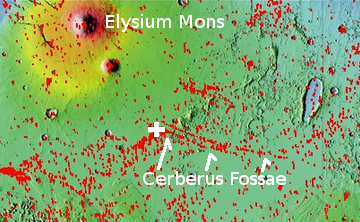
Elysium Mons and Cereberus Fossae

This photograph itself made me more interested in looking at other MRO images of Cerberus Fossae. The context map on the right shows that MRO has taken numerous images along the length of these faults, indicated by the red boxes. The location of the above image is shown by the white cross, at the western end where the canyons tend to be steep, deep, and pronounced. In taking a look at the many images of Cerberus Fossae, I found a variety of canyons, plus pit chains, lava tube skylights, and one especially intriguing image, posted below, that shows what appears to be an extended collapse along the length of what was once an underground lava tube.
» Read more

0 comments
1 145 146 147 148 149 212