Strange crescent-shaped pit near Martian south pole
crescent-shaped pit near Martian south pole

Cool image time! The south polar cap of Mars is a strange place. It is largely ice, with a seasonal cap of frozen carbon dioxide, or dry ice. Because the dry ice sublimates away during the summer months, the cap undergoes regular changes that reshape it, producing alien features that are not seen on Earth.

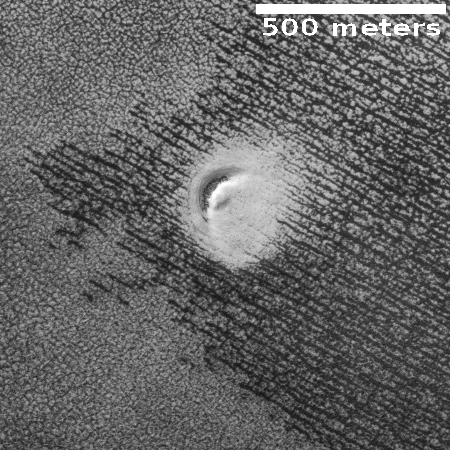
The image on the right is another example of these alien features. I found it in the February image release from the high resolution camera on Mars Reconnaissance Orbiter. I have merely cropped the full image to focus at full resolution on its primary feature, a region of stippled-like surface surrounding an area of black striping that in turn surrounds a crescent-shaped pit outlined by whiter material.

Why is there a pit here? Why is it crescent-shaped? Why is it surrounded by that whiter material? I could guess and say that the pit is a vent from which water vapor from the lower cap of water sprays out onto the upper cap of frozen carbon dioxide, staining it with white ice, but I am most likely wrong.

Moreover, what causes the black striping, as well as the stippled material surrounding it? The black stripes are probably related to a similar process that forms the spider formations found in the polar regions, except that these are not spiders. Why the parallel straight lines?

A lot of questions with no answers. While many features on Mars are strange, the features near the poles are probably stranger still, as they form in a place with chemistry, temperatures, gravity, and materials in a combination and scale that we on Earth have no experience with.
3 comments

MAVAN shifts priorities to communications

The Mars orbiter MAVAN, designed primarily to study Mars’s atmosphere, is now lowering its orbit as it shifts its primary function from science to communications between the Earth and the rovers on the surface.

A strong telecommunications antenna signal is not the only benefit of a tighter orbit. Coming in nearly 1,000 miles (about 1,500 kilometers) closer also will allow the MAVEN orbiter to circle Mars more frequently – 6.8 orbits per Earth day versus 5.3 previously – and thus communicate with the Mars rovers more frequently. While not conducting relay communications, MAVEN will continue to study the structure and composition of the upper atmosphere of Mars. “We’re planning a vigorous science mission far into the future,” Jakosky said.

In a sense, NASA here is finding a way to replace the Mars communications satellite that it wanted but was not able to get funded.

0 comments

Mysterious dark-toned Martian terrain

Dark toned ridge in Martian southern highlands
Click for full resolution image

Cool image time! The picture on the right, cropped and reduced to post here, was part of the January image release from the high resolution camera of Mars Reconnaissance Orbiter (MRO). It shows an area in the Martian southern highlands where the surface suddenly gets darker, for no obvious reason.

The uncaptioned release image is titled “Dark-Toned Ridge at Junction with Dark-Toned Plain.” From the image itself it is hard to understand this title. In the full image the darkest terrain is a strip in the center, with slightly lighter dark terrain on either side, and the lightest terrain to the north or south. The photograph however does not show us how far this dark terrain extends to the west or east.

Two Mars Odyssey image strips of less resolution, here and here, show that this region is filled with several large patches of dark-tone surface. With this particular patch the center dark ridge is surrounded by that slightly lighter dark area.

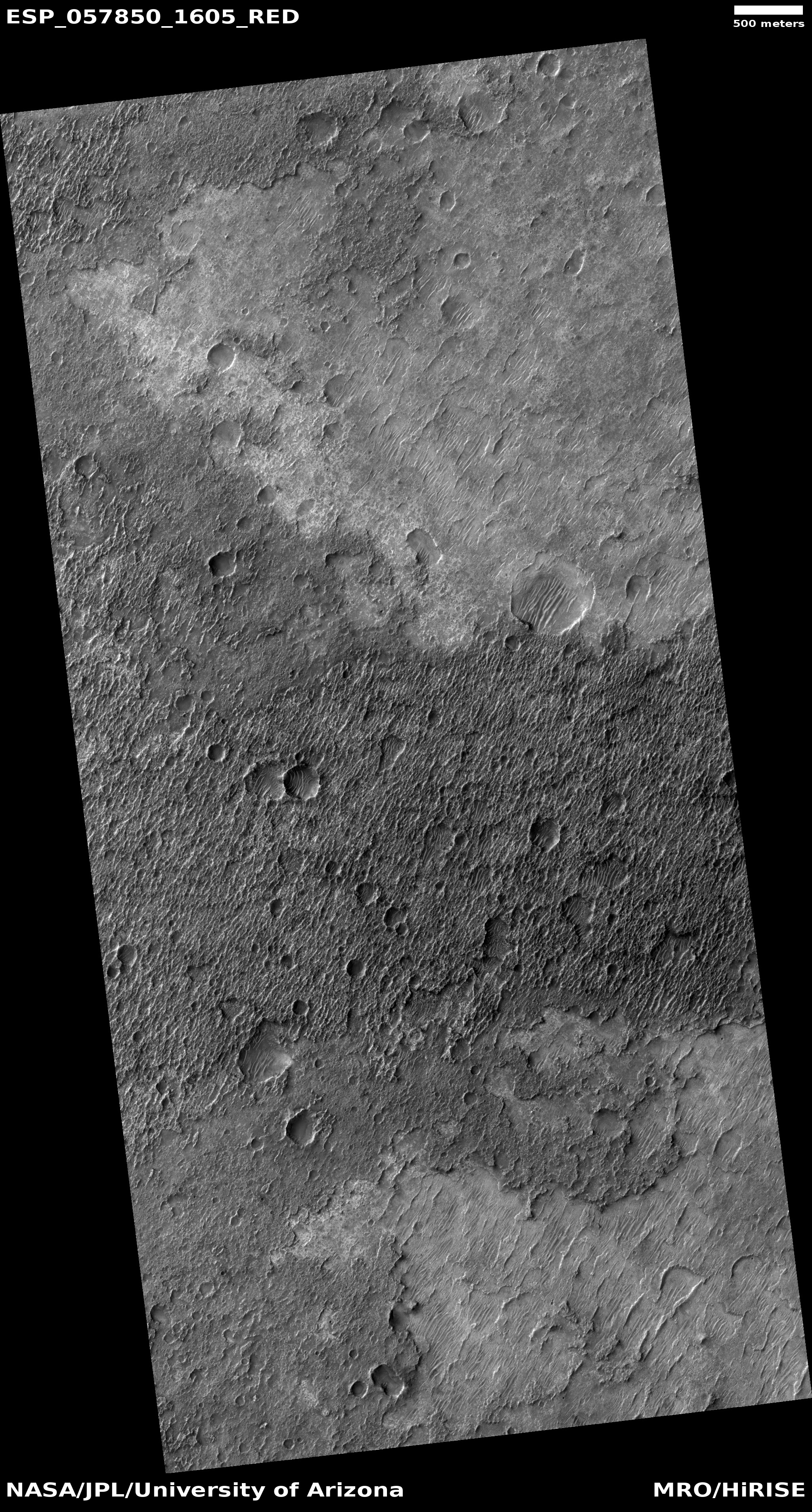
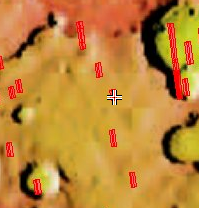
MRO itself has not taken many images of this region, as shown in the overview image below. The red rectangles indicate MRO’s high resolution photographs, with this image indicated by the cross. At this low resolution this region seems somewhat nondescript. The Mars Odyssey image strips show that there many features here, but with little significant relief.

Location of dark toned ridge

At high resolution there does not appear to be much difference between the darker and lighter areas. The lighter areas in general seem less rough and at a slightly lower elevation, but both areas are dominated by ridges and dunes trending southwest-to-northeast.

Why is this slightly higher region darker? Let’s assume that this darker material was a lava flow overlaying the surface. Over eons wind erosion, trending southwest-to-northwest, roughly eroded both it and the lower layers around it, leaving behind this rough corroded terrain. The different make-up of the darker material allows it to erode in a rougher manner.

While possibly correct, I would not bet much money on this guess. It is not clear it is lava. It is not clear that it is a flow. It does not explain why there are two areas of different darkness. And it certainly not clear what the make-up of any of this stuff is.

This is simply another cool mystery on the Martian surface.

1 comment

Curiosity has left Vera Rubin Ridge

The Curiosity science team today released an update on their results from the rover’s year-plus exploration of Vera Rubin Ridge, even as the rover has descended off the ridge into the lower clay-bearing area between the ridge and Mount Sharp.

Even though the rover has left the ridge, Curiosity’s team is still piecing together the story of its formation. While there have been a number of clues so far, none fully explains why the ridge has resisted erosion compared with the bedrock around it. But the rover’s investigation did find that the rocks of the ridge formed as sediment settled in an ancient lake, similar to rock layers below the ridge.

,,,A NASA orbiter studying the ridge had previously identified a strong signal from hematite, an iron-rich mineral that often forms in water. Curiosity confirmed the presence of hematite, along with other signs of ancient water, like crystals. These signs appeared in patches, leading the team to suspect that over time groundwater affected certain parts of the ridge differently than others. Another discovery was that the hematite signatures Curiosity mapped didn’t always match the view from space.

The link also includes a neat 360 degree video that allows you to scan around the rover, as it sat on Vera Rubin Ridge.

The journey into the clay unit below the ridge has been most interesting. I plan to post a rover update with some details next week.

0 comments

UK names rover for 2020 ExMars mission

The United Kingdom has named its rover for 2020 ExMars mission in honor of Rosalind Franklin, one of the scientists who contributed to the discovery of the helix structure of DNA.

Franklin is best known for her work on the X-ray diffraction images of DNA. Her data was a part of the data used to formulate Crick and Watson’s 1953 hypothesis regarding the structure of DNA. Unpublished drafts of her papers show that she had determined the overall B-form of the DNA helix. Her work supported the hypothesis of Watson and Crick and was published third in the series of three DNA Nature articles. After finishing her portion of the DNA work, Franklin led pioneering work on the tobacco mosaic and polio viruses. Franklin died from ovarian cancer at the age of 37, four years before Crick, Watson and Wilkins were awarded the Nobel Prize in 1962 for their work on DNA.

Though this isn’t entire clear from the press release, it appears that they will refer to the rover as either “Rosalind Franklin” or “Rosalind.”

1 comment

MarCO interplanetary cubesats likely dead

More than two months after they provided relay communications for the landing of InSight on Mars, and more than a month since any contact has been heard from them, engineers now consider the two MarCO cubesats to likely be dead.

Now well past Mars, the daring twins seem to have reached their limit. It’s been over a month since engineers have heard from MarCO, which followed NASA’s InSight to the Red Planet. At this time, the mission team considers it unlikely they’ll be heard from again.

MarCO, short for Mars Cube One, was the first interplanetary mission to use a class of mini-spacecraft called CubeSats. The MarCOs – nicknamed EVE and WALL-E, after characters from a Pixar film – served as communications relays during InSight’s landing, beaming back data at each stage of its descent to the Martian surface in near-real time, along with InSight’s first image. WALL-E sent back stunning images of Mars as well, while EVE performed some simple radio science.

All of this was achieved with experimental technology that cost a fraction of what most space missions do: $18.5 million provided by NASA’s Jet Propulsion Laboratory in Pasadena, California, which built the CubeSats.

WALL-E was last heard from on Dec. 29; EVE, on Jan. 4. Based on trajectory calculations, WALL-E is currently more than 1 million miles (1.6 million kilometers) past Mars; EVE is farther, almost 2 million miles (3.2 million kilometers) past Mars.

Their loss of contact more than a month after the November landing of InSight actually shows their incredible success. Both MarCO cubesats functions well past Mars, demonstrating that these tiny satellites can do much of the same things bigger satellites costing billions do.

1 comment

The location for a future Martian colony?

Pit draining into Kasei Valles

Regular readers of this webpage will know that I am a caver, and am fascinated with the pits and caves that have so far been identified on Mars, as illustrated by an essay I wrote only last week.

Some of the cave research I have cited has being led by planetary scientist Glen Cushing of the U.S. Geological Survey. Two weeks ago Dr. Cushing sent me a slew of pictures of caves/pits that he has accumulated over the years, many of which he has not yet been able to highlight in a paper. At least two were images that I had already featured on Behind the Black, here and here.

One pit image however I had never seen. A cropped and reduced close-up is shown on the right, with the full photograph viewable by clicking on the image. In many ways this pit is reminiscent of many pits on Mars. Its northern rim appears to be an overhang several hundred feet deep that might have an underground passage continuing to the north. The southern lip is inviting in that its slope appears to be very accessible for vehicles, meaning this pit/cave might be a good location to build a first colony.

Because of that accessible southern lip, I decided to do more digging about this particular pit. I was quickly able to find the uncaptioned release of the complete image by doing a quick search through the image catalog of Mars Reconnaissance Orbiter’s (MRO) high resolution camera. That image, reduced and cropped to post here, is shown below, on the right.
» Read more

4 comments

Strange fernlike ridges on Mars

Fernlike ridges on Mars

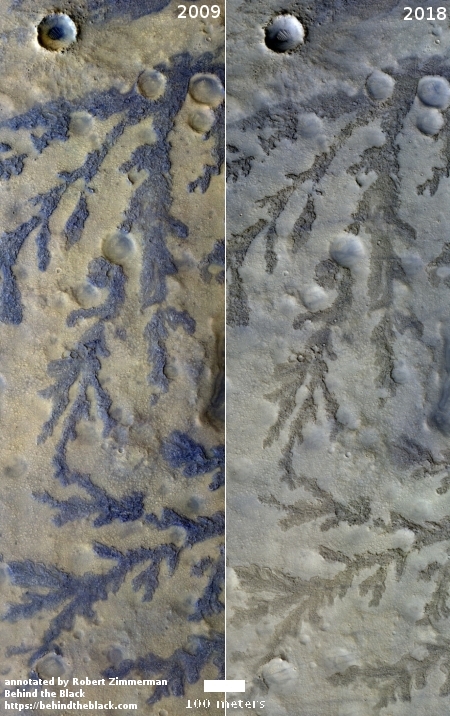
Cool image time! The two images on the right, cropped, rotated, and reduced in resolution to post here, were both taken by the high resolution camera on Mars Reconnaissance Orbiter (MRO). To see the full resolution version of each, go to the 2009 and 2018 releases.

The 2009 release was a captioned release, whereby scientist Alfred McEwen of the science team provided his explanation of these strange features.

The dark branched features in the floor of Antoniadi Crater look like giant ferns, or fern casts. However, these ferns would be several miles in size and are composed of rough rocky materials.

A more likely hypothesis is that this represents a channel network that now stands in inverted relief. The channels may have been lined or filled by indurated materials, making the channel fill more resistant to erosion by the wind than surrounding materials. After probably billions of years of wind erosion the resistant channels are now relatively high-standing. The material between the branched ridges has a fracture pattern and color similar to deposits elsewhere on Mars that are known to be rich in hydrated minerals such as clays.

These strange fernlike features do not appear to be very common on Mars. In fact, I suspect that while Mars does have many inverted channels like this, the fernlike nature of these particular channels is unique on Mars. They are located on the floor of Antoniadi Crater, a large 240-mile-wide very ancient and eroded crater located in the Martian southern highlands but near the edge down to the northern lowlands.

In seeing the new 2018 image, I was immediately compelled to place it side by side with 2009 image to see if anything had changed in the ensuring near-decade. There are color differences, but I suspect these are mostly caused by different lighting conditions or post-processing differences. Still, the dark center to the crater in the upper left of both images suggests a change in the dust dunes there, with the possibility that some of the dust has been blown from the crater over time. Also, you can see two horizontal tracks cutting across the center of the 2018 image, which I would guess are dust devil tracks, with one more pronounced.

I can imagine some planetary geologists have spent the last few months, since the second image was taken, pouring over both photographs, and have might even located other interesting changes. And if they find no significant changes, that in itself is revealing, as it gives us a sense of the pace at which the Martian surfaces evolves.

3 comments

InSight’s seismometer now fully operational

The InSight science team has completed the deployment of the spacecraft’s seismometer by the placement of its protective domed shield over it.

The Wind and Thermal Shield helps protect the supersensitive instrument from being shaken by passing winds, which can add “noise” to its data. The dome’s aerodynamic shape causes the wind to press it toward the planet’s surface, ensuring it won’t flip over. A skirt made of chain mail and thermal blankets rings the bottom, allowing it to settle easily over any rocks, though there are few at InSight’s location.

The shield also helps protect the instrument from temperature changes.

With this deployment completed they will next deploy the heat flow package to the surface, where it will begin to drill its probe sixteen feet into the ground.

0 comments

The base of Mt Sharp is less compacted than expected

The uncertainty of science: Using data from Curiosity in Gale Crater on Mars, scientists have found that the material making up the lower layers of Mount Sharp is less compacted that they would have expected.

Scientists still aren’t sure how this mountain grew inside of the crater, which has been a longstanding mystery.

One idea is that sediment once filled Gale Crater and was then worn away by millions of years of wind and erosion, excavating the mountain. However, if the crater had been filled to the brim, the material on the bottom, which now makes up the crater’s surface, would have been pressed down. But the new Science paper suggests Mount Sharp’s lower layers have much less compacted than this theory predicts, reigniting the debate about how full the crater once was.

“The lower levels of Mount Sharp are surprisingly porous,” said lead author Kevin Lewis of Johns Hopkins University. “We know the bottom layers of the mountain were buried over time. That compacts them, making them denser. But this finding suggests they weren’t buried by as much material as we thought.”

I can’t help wonder whether we don’t yet really understand the influence of Mars’ lower gravity on geology, and that might explain the porosity.

1 comment

The many pits/caves of Mars

Sinkhole in Martian northern lowlands with dark seep

Time for many cool images! Over the years I have written frequently about the pits/caves on Mars, in both magazine articles and the many posts here at Behind the Black. The following posts are the most significant, with the June 9, 2015 providing the best geological background to many of these pits, especially the many located near the giant volcanoes of Mars.

As I wrote in that June 9, 2015 post:
» Read more

1 comment

Well water likely available across Mars

Conceptual model of Martian deep basin evolution

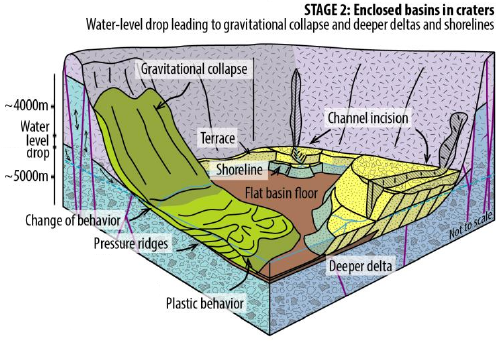
A science paper released today and available for download [pdf] cites evidence from about two dozen deep impact craters located from the equator to 37 degrees north latitude that Mars has a ground ice table at an elevation that also corresponds to other shoreline features. From the abstract:

Observations in the northern hemisphere show evidence of a planet‐wide groundwater system on Mars. The elevations of these water‐related morphologies in all studied basins lie within the same narrow range of depths below Mars datum and notably coincide with the elevation of some ocean shorelines proposed by previous authors.

The image above and on the right shows the middle stage of their conceptual model for the evolution of these deep basins and how that evolution results in many of the geological features seen in many places on Mars, such as the features I have highlighted on Behind the Black previously here and here.

From their conclusion:
» Read more

1 comment
1 143 144 145 146 147 212