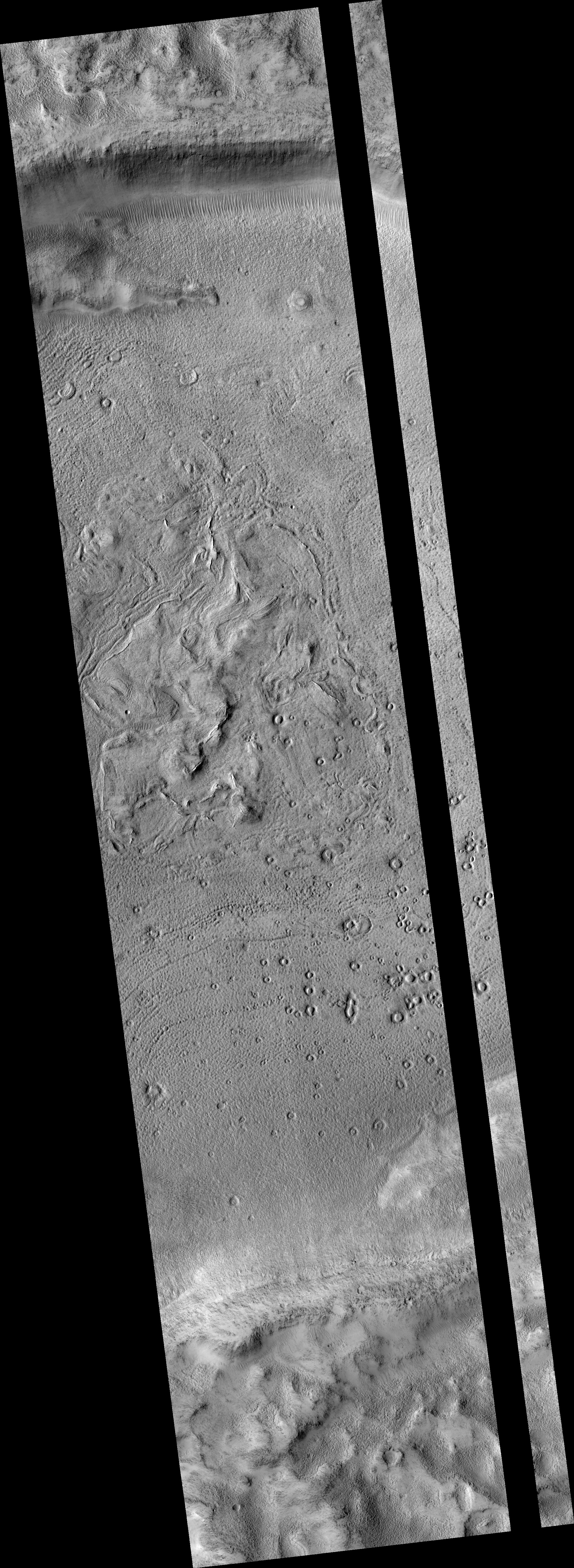
Cracks, chaos, and maybe caves in one place on Mars

Mosaic of Avernus Cavi fissures
Click for higher resolution. Original images found here and here.

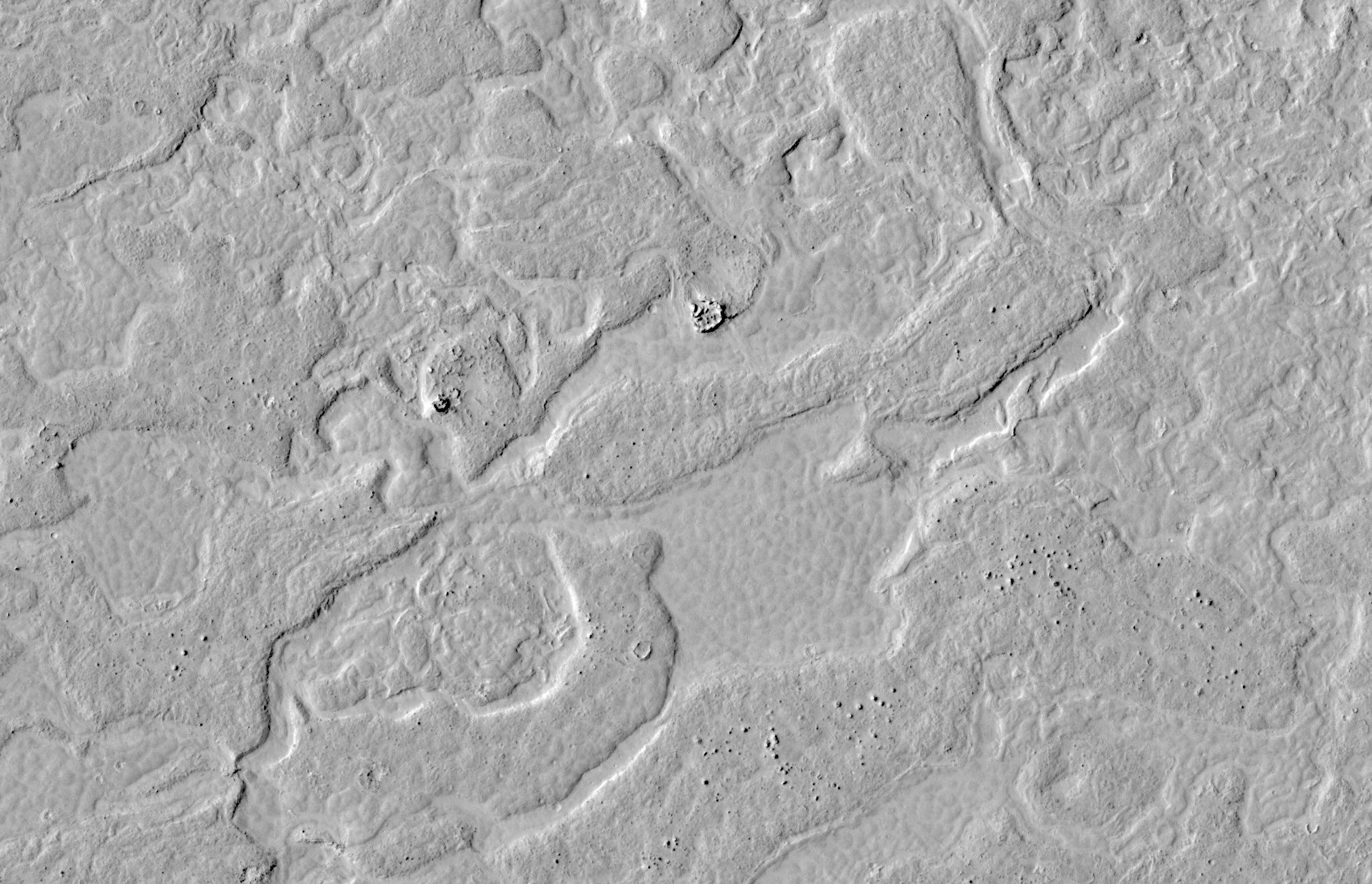
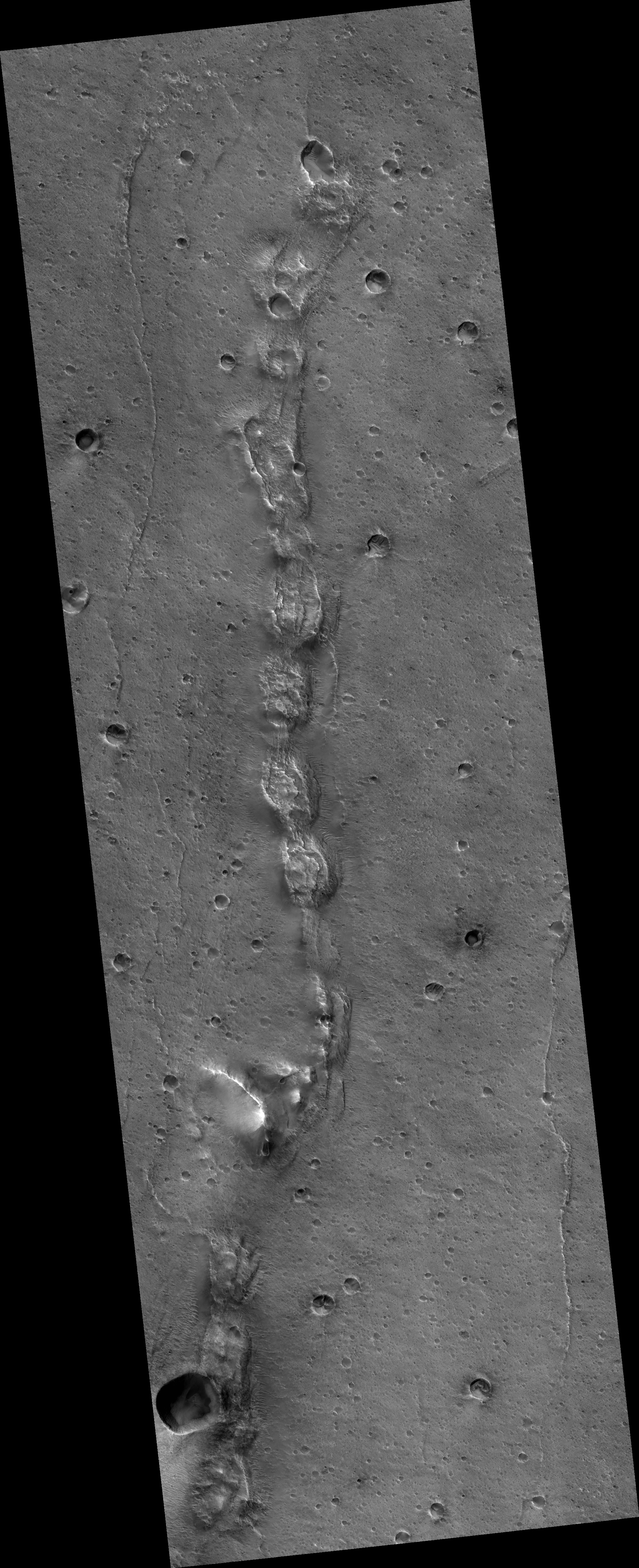
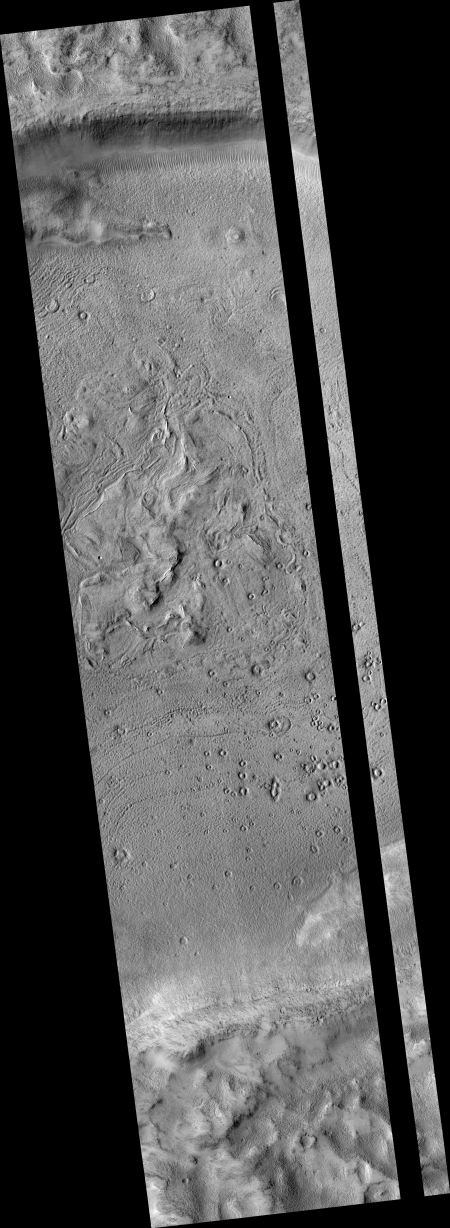
Today’s cool image to the right is a mosaic I have made from two images taken by the context camera on Mars Reconnaissance Orbiter (MRO), showing a most intriguing region on Mars dubbed Avernus Cavi, located in the large volcanic plain called Elysium Planitia between the giant volcanoes Elysium Mons and Olympus Mons, a region I like to call Mars’ volcano country.

The mosaic shows in one picture much of the typical terrain in Avernus Cavi. We see many linear depressions or cracks, created when the ground stretched and cracked at weak points. We also see many depressions that suggest sinkholes, places where the surface sagged down because of a void below ground.

The area of knobs and mesas in the picture’s southeast quadrant is very typical Martian chaos terrain, the later result of long term erosion of these cracks and depressions.

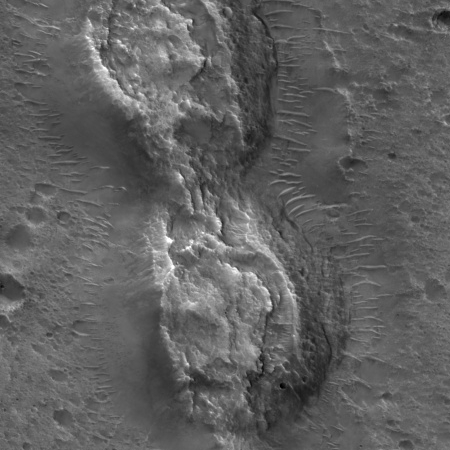
The white box shows the area covered by the image below.
» Read more

2 comments

The lacy rocks of Mars

Lacy rocks on Mars
Click for full image.

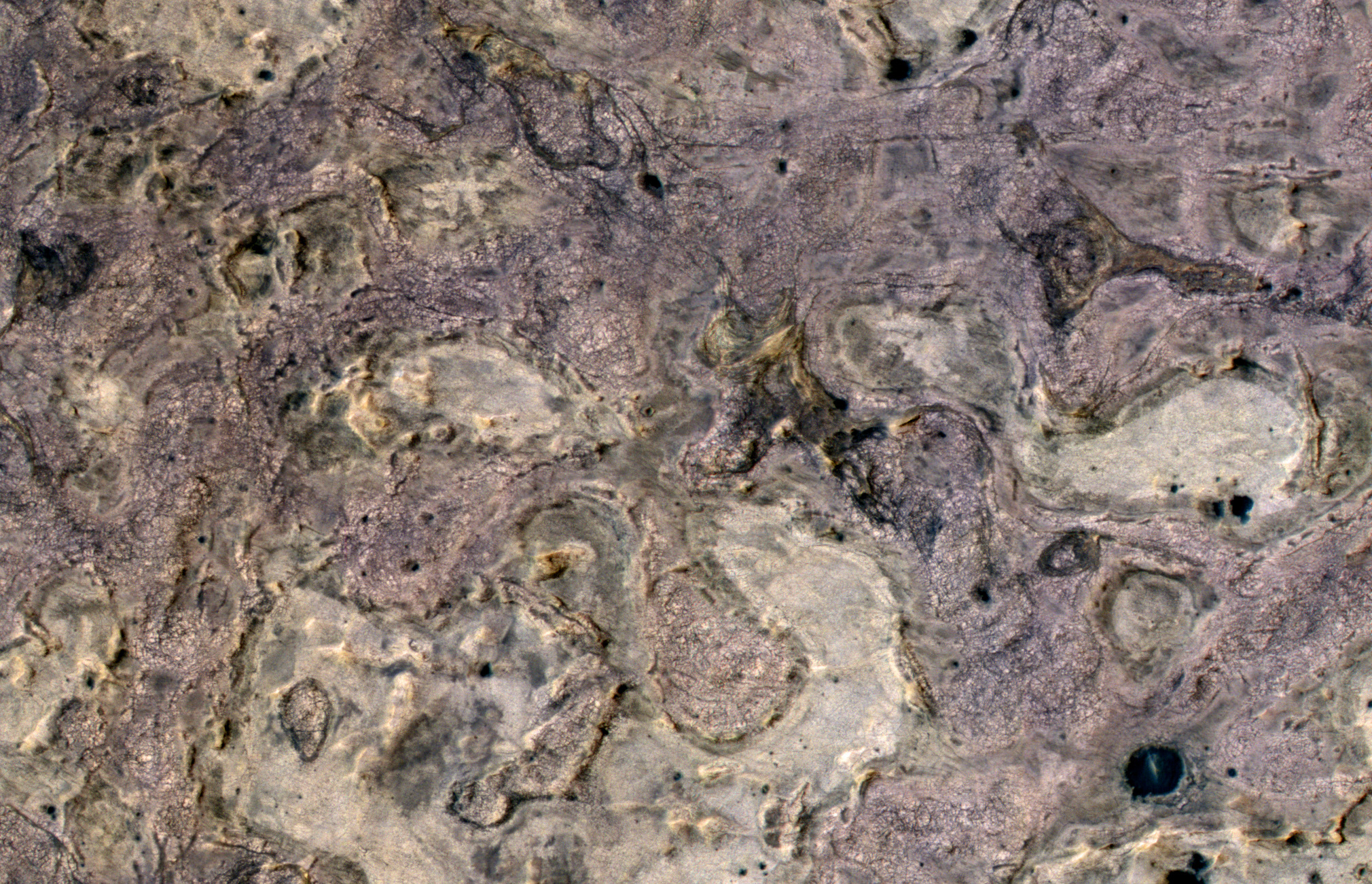
Cool image time! The image to the right, cropped and reduced to post here, was taken on July 16, 2021 by the Mars rover Curiosity, using its high resolution mast camera.

There isn’t much to say. These are alien rocks, created in a place with a gravity only about a third that of Earth’s in a climate that is very different. Their delicate nature suggests we are looking at something that was once more substantial and has since been undergoing erosion.

Nor has it been that unusual to find rocks so dainty on Mars. In fact, the more Curiosity has climbed, the more such things have been visible. And similar things were seen by the rovers Spirit and Opportunity.

How such rocks formed initially in the far past, under what climate conditions, remains the number one mystery on Mars. What is now causing it to flake away into such a finespun gossamer of complexity is as much a mystery, tied more to the climate and geology of Mars today.

This rock sits on the bottom flank of Mt Sharp in Gale Crater, at the highest elevation Curiosity has yet climbed. At this point the rover has just entered a new geological unit, what scientists have dubbed the sulfate unit. The evidence gathered from a distance (that so far appears confirmed by recent observations) suggest that this unit was formed under a fluctuating environment that laid down many layers of sediment as conditions ebbed and flowed.

4 comments

First attempts to map the layered geology of Mars

layers in Jiji Crater on Mars
Click for full image.

Today’s cool image illustrates well the central task of much of today’s geological research on Mars, using the orbital images to try to map out the visible geological layers seen, and figure out if those layers mark over wide regions specific geological epochs, as they do on Earth.

The photo to the right, cropped and reduced to post here, was taken on May 4, 2021 by the high resolution camera on Mars Reconnaissance Orbiter (MRO), and featured on July 12th as a captioned image entitled “Layers Blanket a Crater Floor.” From the caption:

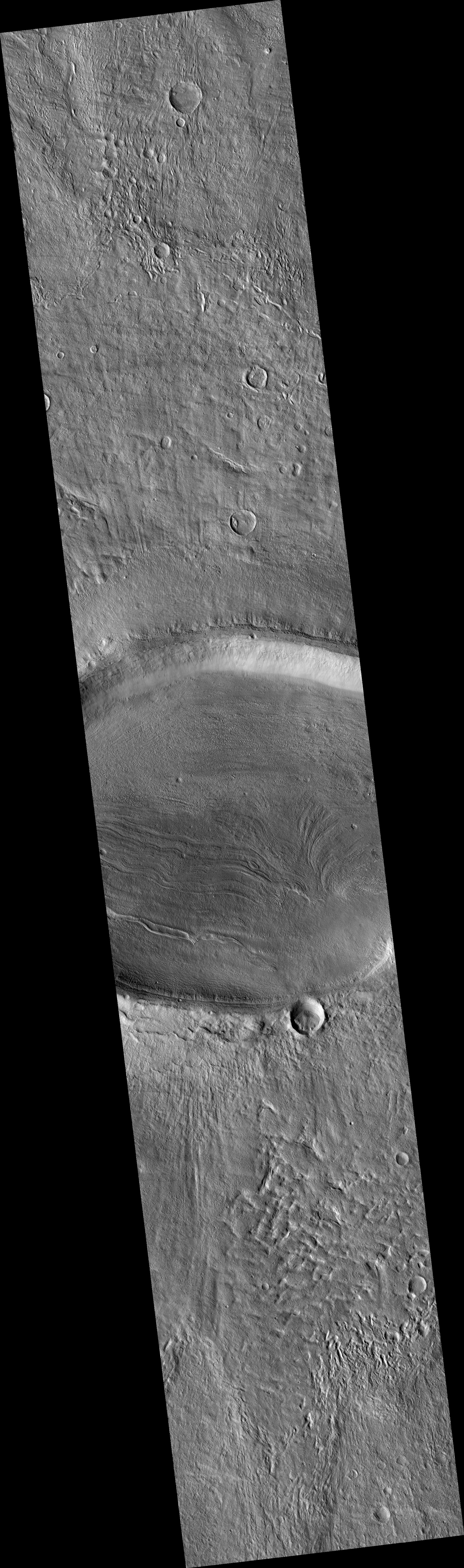
This image shows a layered rock formation within Jiji Crater that has eroded into buttes and stair-like layers.

This formation extends west and east. Similar layered rocks are within several craters in Arabia Terra and Meridiani Planum, including [nearby] Sera and Banes craters. The similarities suggest that the same process was forming deposits over a large geographic area long ago. Our image also indicates that much of the formation has eroded away relative to what has remained.

As you can see in the photo, the layers form a neat staircase of terraces descending from the south crater rim to the crater floor. They suggest that once the crater was filled with this material, which over time eroded away.

An image of similar layered buttes and mesas in Sera crater, only about 20 miles away, was featured here on Behind the Black in December 2020 The overview map below shows the relationship between Jiji, Sera, and Banes craters.
» Read more

0 comments

New images from Zhurong on Mars

Zhurong's view north
Click for full image.

China today released three new images from its Zhurong Mars rover, showing that since their last release in late June the rover has traveled about 1,000 feet to the south to reach the parachute and backshell (or entry capsule), both released just before landing.

The image to the right, cropped and reduced to post here, is the color panorama from that release, looking north. According to a translation of the Chinese press release, provided at this Space.com report, the image shows:

“The complete back cover structure after aerodynamic ablation, the attitude control engine diversion hole on the back cover is clearly identifiable,”

Below is an annotated orbital picture of this location taken by Mars Reconnaissance Orbiter (MRO) in mid-June.
» Read more

8 comments

Clashing layers in Mars’ largest canyon

Clashing layers on a mountain slope on Mars
Click for full image.

Cool image time! The photo to the right, rotated, cropped, and reduced to post here, was taken on May 27, 2021 by the high resolution camera on Mars Reconnaissance Orbiter (MRO), and shows the clash of different layers on the western slope of a mountain within Mars’ largest canyon, Valles Marineris.

The scientist have labeled this a “possible angular unconformity.” In geology an unconformity generally refers to a gap in a series of layers, a period when instead of the layers being deposited they are being eroded away, leaving no record for that time period. An angular unconformity adds tilting to the older layers, which after erosion are then covered by new layers that are oriented somewhat differently.

Based on these definitions, what the scientists suspect is that the brighter layers to the left and lower down the mountain are older. After a period of erosion new layers were deposited on top at a different angle, forming the stripe of layers going from center left up to center right.

The swirly nature of the material on the top of the ridge suggests to me that these layers might be volcanic in nature, but that’s a pure uneducated guess. What some scientists do believe (but have not yet conclusively proven) is that the lower older layers are sediments laid down by an ancient lake that once filled the canyon here.

The overview map below provides a wider view and some context.
» Read more

1 comment

Ingenuity’s view of Jezero Crater during its 9th flight

Ingenuity looks across Jezero Crater
Click for full image.

Overview map
Click for interactive map.

Cool image time! The photo above, cropped, enhanced, and reduced to post here, was taken on July 5, 2021, about thirty seconds after Ingenuity had taken off on its 9th flight on Mars. I have increased the contrast slightly to bring out the features. This is a raw image, so I do not think the colors are accurate, and I also do not know why the middle of the image is brighter than the edges.

The red lines on the map to the right indicates the general area this image captures. Essentially, once the helicopter reached its flying altitude after liftoff the engineers had it tilt so that it could see the route it was about to take to the southwest. As they noted in their description of this flight,

We began by dipping into what looks like a heavily eroded crater, then continued to descend over sloped and undulating terrain before climbing again to emerge on a flat plain to the southwest.

I think that crater is visible on the left edge of this picture.

So far 180 raw images from Ingenuity have arrived at JPL. There might be a few more, but I think this is the bulk from the flight. Of these, all but nine are black and white and point straight down. The nine color images seem tilted up towards the horizon to various degrees, though the image above is the only one that captures the horizon itself and the distance mountains of Jezero Crater’s rim.

8 comments

Curiosity looks across at the alien landscape of Gale Crater

Curiosity's view across Gale Crater
Click for full image.

Most of the images from Curiosity that I have posted recently have been of the spectacular mountain scenery looking south at Mount Sharp itself. Today’s cool image, taken on July 6, 2021 by the rover’s right navigation camera and cropped to post here, instead looks north, out across the floor of Gale Crater to its distant rim about twenty miles away.

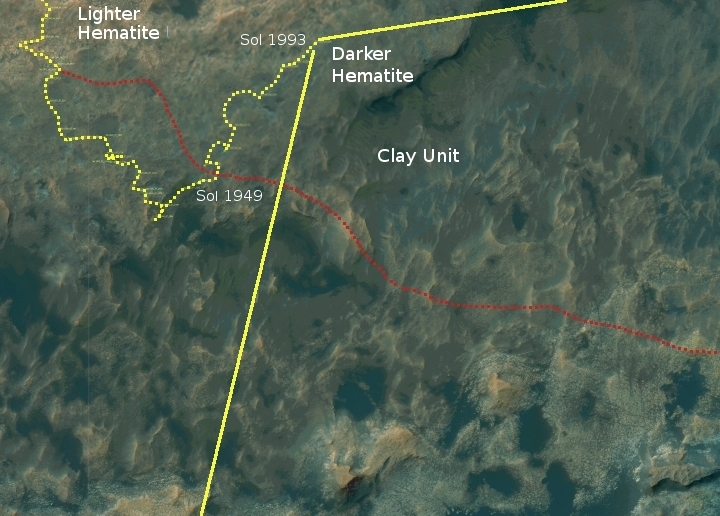
The rover is likely not to move for a week or so, as it has just completed drilling its first drillhole since it moved up into the next geological layer, dubbed the sulfate unit. Because of this they have been using the rover’s cameras to take a lot of pictures of the surrounding terrain, including several high resolution mosaics.

The two overview maps below show what the cool image above is looking at.
» Read more

2 comments

Springtime on Martian dunes near the north pole

Dunes near the Martian north pole, in the spring

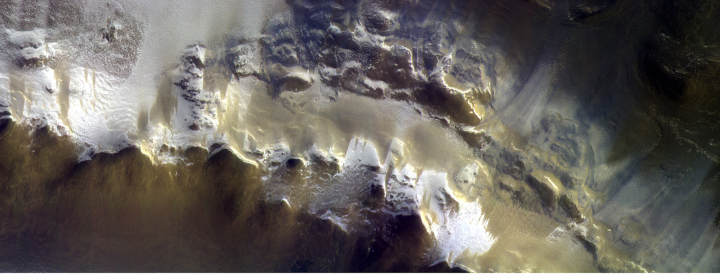
Cool image time! The photo to the right, rotated and cropped to post here, was taken by the high resolution camera on Mars Reconnaissance Orbiter (MRO) on April 27, 2021. It shows a strange scattering of dunes on a flat plain. The red at the top of each dune probably indicates exposed dust and sand. The white fringe is likely either water frost or the leftover mantle of dry ice that is deposited in the polar regions each winter down to 60 degrees latitude, and disappears with the coming of spring, sublimating back into carbon dioxide gas.

There are a lot of puzzles here. The overview map below provides some context, but only some.
» Read more

0 comments

Sublimating scallops on Mars

Giant scallop on Mars
Click for full image.

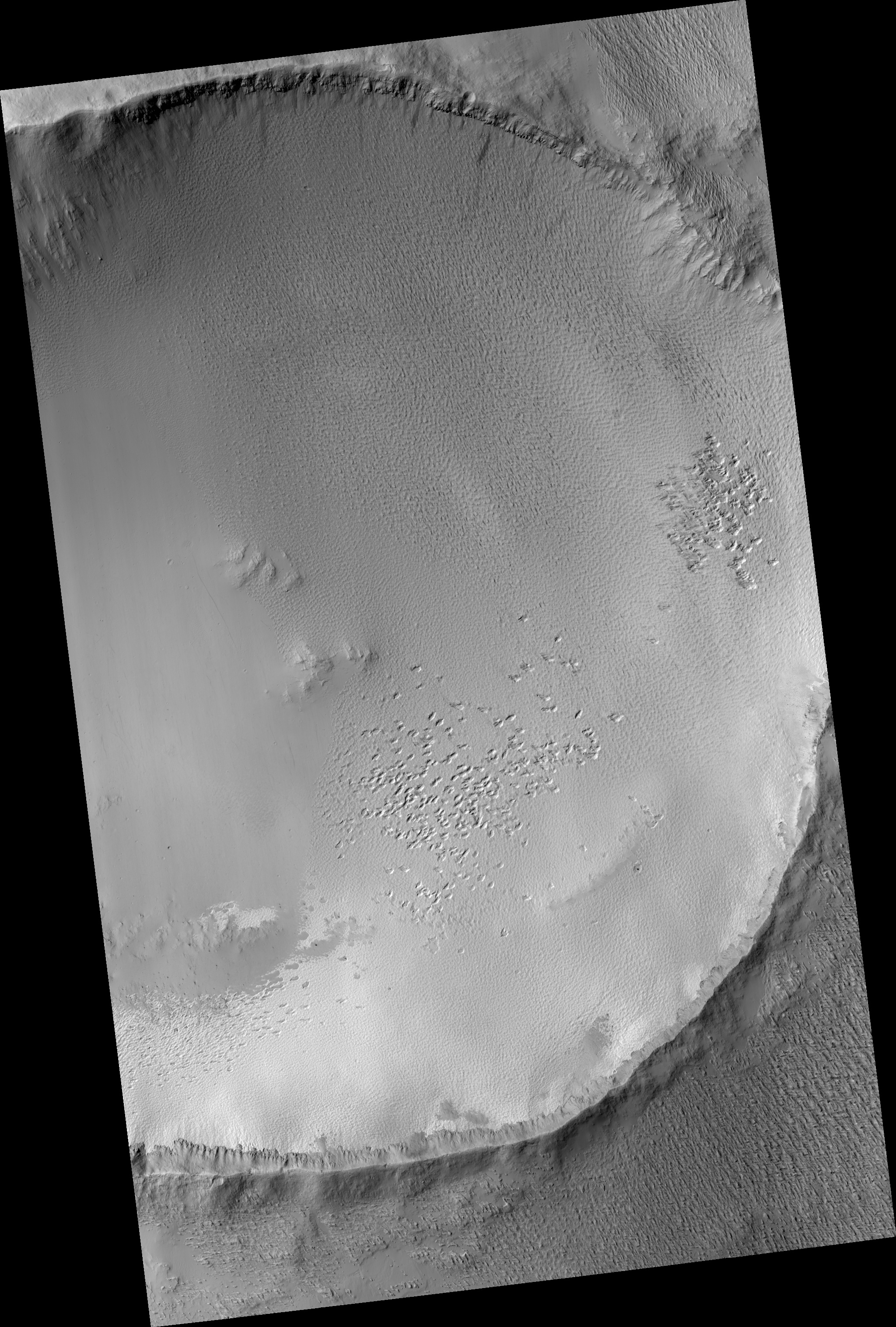
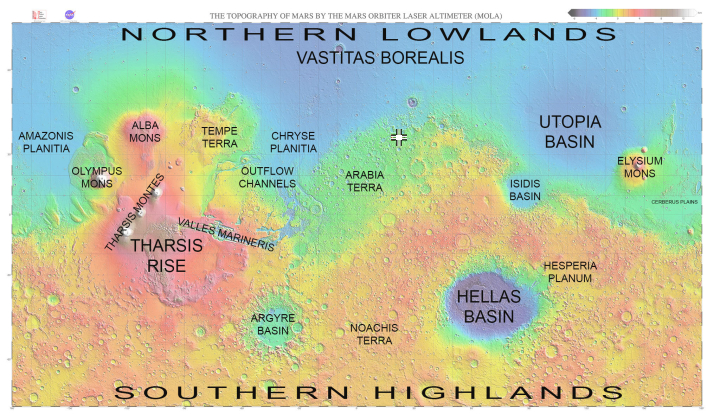
Today’s cool image, shown in a rotated, cropped, and reduced version to the right, gives us a close-up look at one of the giant scallops found in the high mid-latitudes of the northern lowland plains of Mars, specifically in Utopia Basin north of the landing sites of both Perseverance and Zhurong. In fact, this particular image is only a few miles north of one of my previous cool images, Giant scallops on Mars, posted in December 2019.

The image was taken on February 3, 2021 by the high resolution camera on Mars Reconnaissance Orbiter (MRO). While such scallops are not unusual in the mid-latitudes, their formation process is not well understood. As I noted in the 2019 post, ” scientists believe [pdf] the formation process is related to the sublimation of underground ice.”

According to [one hypothesis] scallop formation should be ongoing at the present time. Sublimation of interstitial ice could induce a collapse of material, initially as a small pit, then growing [away from the equator] because of greater solar heating on [that] side. Nearby scallops would coalesce together as can be seen to have occurred.

This hypothesis is not proven, and today’s cool image raises questions about it. Though the bright material at its center suggests exposed ice, supporting the idea that sublimation of ice near the surface created the scallop, the scallop scarps seem more extended and distinct to the south, not the north as this hypothesis proposes. Sunlight should hit the northern scarps more, which suggests they should retreat more instead of the southern scarp.

The overview map below provides the context.
» Read more

1 comment

First images from Ingenuity’s 9th flight today

Ingenuity landing, July 5, 2021

Ingenuity has apparently completed its 9th flight on Mars, its most challenging yet attempted. Based on the six images so far released from that flight, all taking during its landing, it appears the flight was successful. Or at least, the helicopter landed without incident or damage.

The photo to the right was the last picture taken just before touch down. From the caption:

NASA’s Ingenuity Mars Helicopter acquired this image using its navigation camera. This camera is mounted in the helicopter’s fuselage and pointed directly downward to track the ground during flight.

The dark shadow of the helicopter is clearly visible. If you want to see the entire sequence of six images, go to the Ingenuity raw image website and pick the “latest images” filter in the right column. At present it shows this sequence, though I am certain as the day passes images from the entire flight will start appearing.

As noted at the first link above, the flight was to be more than twice as long as any previous flight while flying over the roughest terrain. There was the real risk that its software would become confused by that terrain.

1 comment

Next Ingenuity flight to push envelope significantly

Ingenuity's 9th flight plan
Click for full image.

The engineers running the Mars helicopter Ingenuity revealed today that they will be attempting their most ambitious flight for the helicopter’s ninth flight, presently scheduled for no earlier than July 4th.

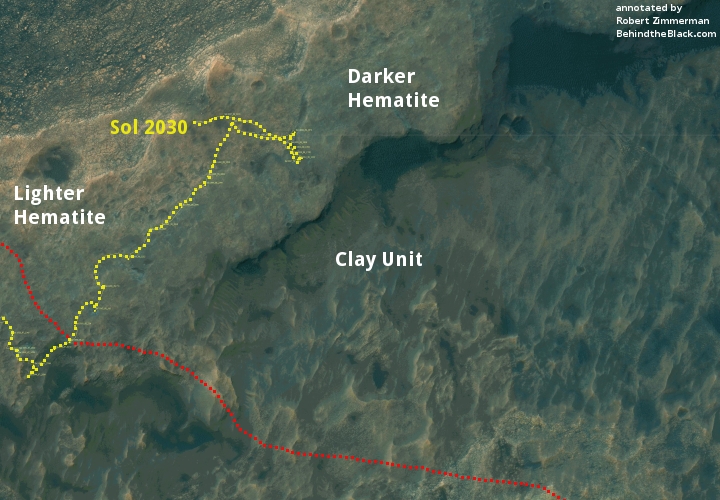
I have annotated the map to the right to show Ingenuity’s present position and its approximate landing area.

Without question this flight will be the riskiest taken by Ingenuity so far, more than doubling the flight distance achieved on any previous flight. More important, it will be flying over terrain far rougher than it was initially designed for.
» Read more

9 comments

More parachute problems for Europe’s Franklin Mars rover

During a parachute drop test in late June, following a redesign of the parachute with U.S. help, engineers for the ExoMars Rosalind Franklin Mars rover found the chute still experienced problems that tore it during deployment.

They actually performed two drop tests, a day apart, using two different parachutes, with the first test apparently going off without a hitch. However, according to the press release:

โ€œThe performance of the second main parachute was not perfect but much improved thanks to the adjustments made to the bag and canopy. After a smooth extraction from the bag, we experienced an unexpected detachment of the pilot chute during final inflation. This likely means that the main parachute canopy suffered extra pressure in certain parts. This created a tear that was contained by a Kevlar reinforcement ring. Despite that, it fulfilled its expected deceleration and the descent module was recovered in good state.โ€

I have embedded below the fold the only video released by the European Space Agency. It is not clear whether this is from the first or second test. Near the end it appears that the pilot chute above the main chute might be separated, but the video ends before that can be confirmed.

Though ESA has apparently improved the chute’s performance significantly since its earlier failures that contributed to the delay of ExoMars from last year to 2022, they still haven’t gotten the chute completely right. Fortunately they still have time to get it fixed before that ’22 launch.
» Read more

5 comments
1 93 94 95 96 97 212