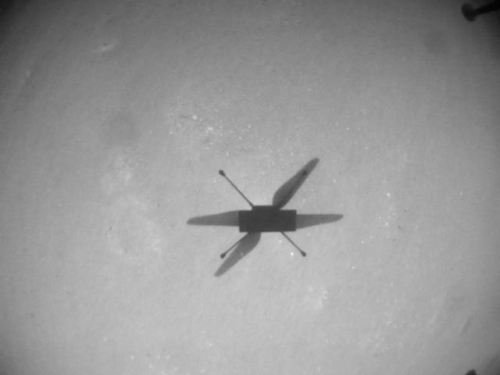
Ingenuity successfully completes 11th flight

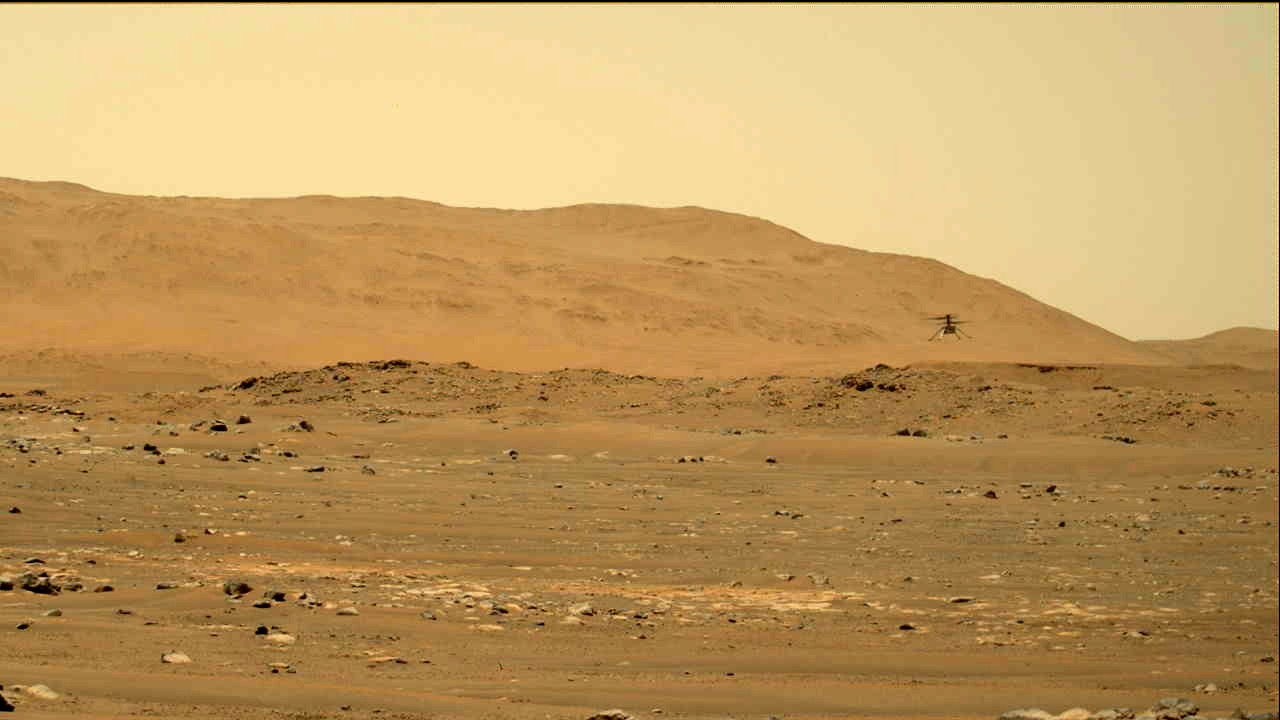
Ingenuity about to land
Click for full image.

Ingenuity has successfully completed its 11th flight, safely touching down at approximately its planned landing spot. From the science team’s tweet:

[Ingenuity] has safely flown to a new location! Ingenuity flew for 130.9 seconds and traveled about 380 meters before landing.

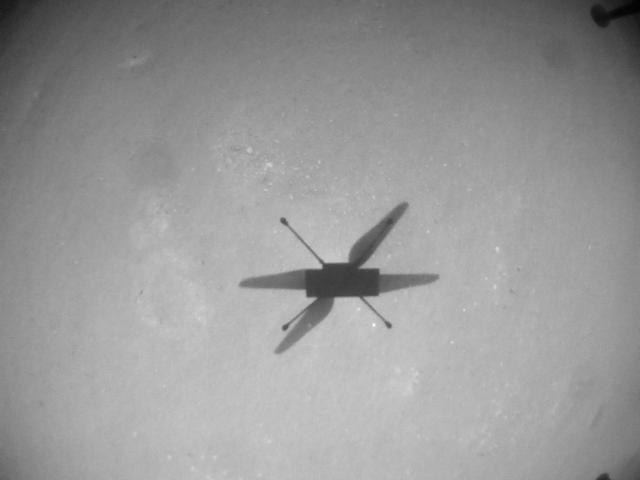
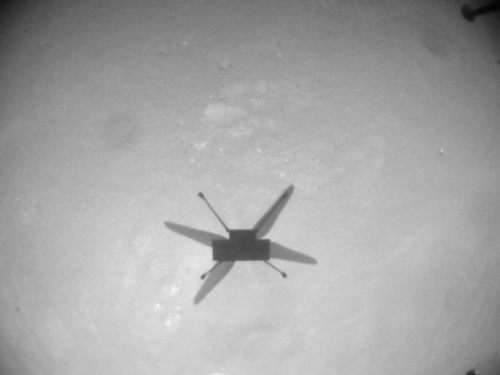
The image to the right, reduced to post here, was taken mere seconds before landing, and shows the helicopter’s shadow directly below it on the ground.

This particular flight was the first that did not push Ingenuity’s abilities, merely flying in a straight line to put it in a good position for later flights and to keep it ahead of Perseverance.

So far they have only released five images from the flight. Expect the rest to be downloaded from Perseverance in the next few days.

1 comment

Ingenuity’s 11th flight scheduled for tonight

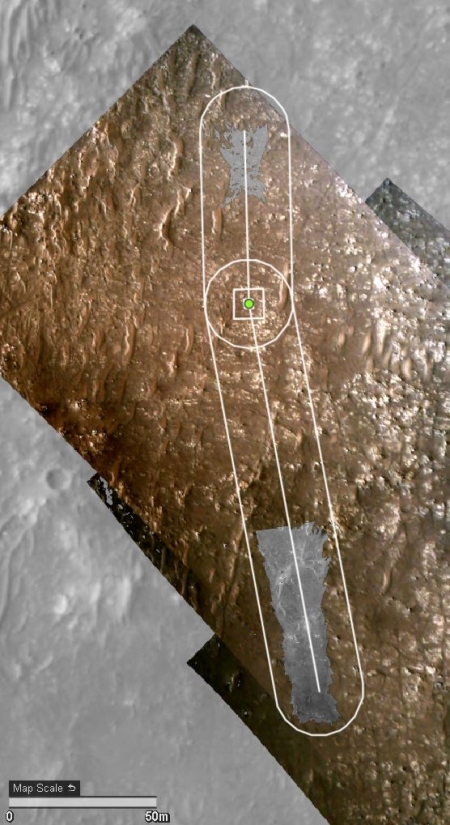
Ingenuity's 11th flight plan
Click for interactive map.

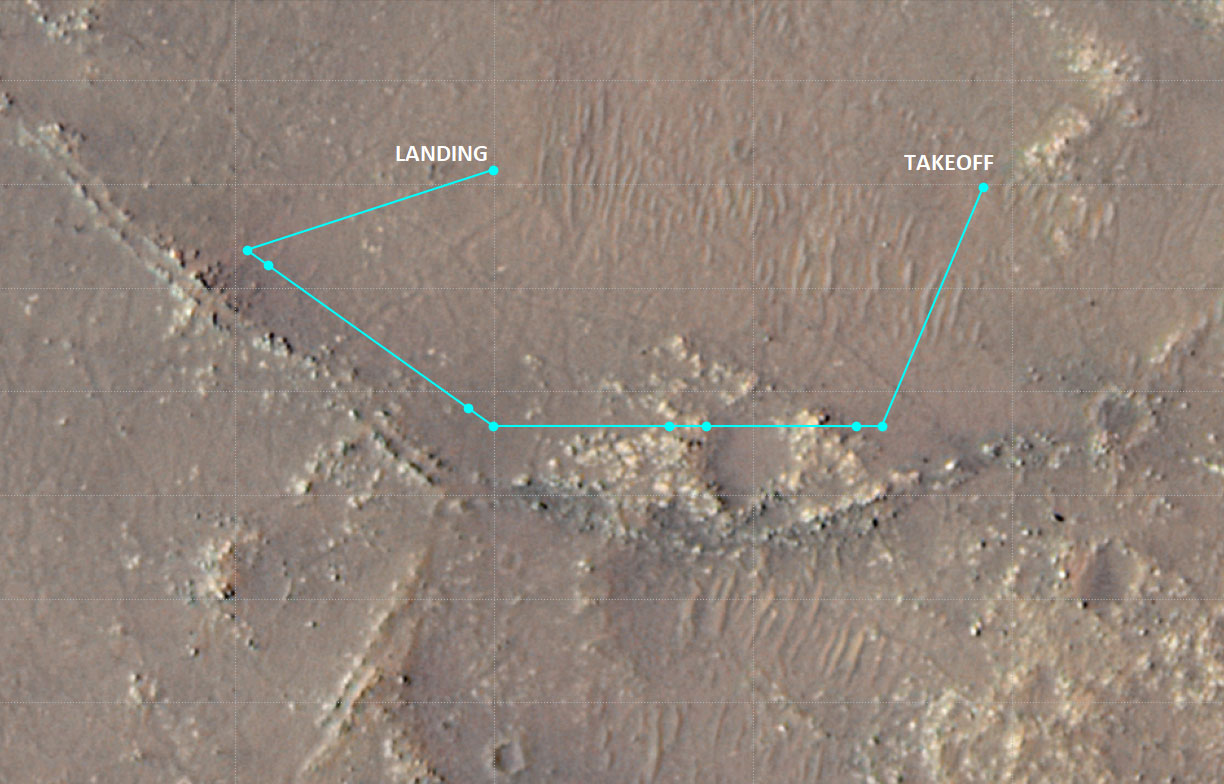
The next flight of Ingenuity on Mars is now scheduled for this evening, and will be a much simpler flight than the helicopter’s previous trip.

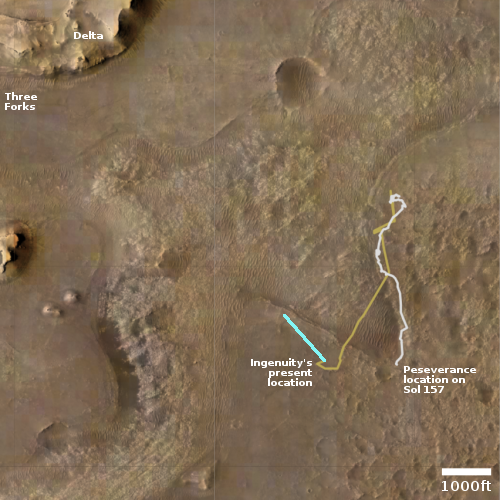
The map to the right shows the route in blue. The flight is mainly a transfer flight, intended to keep the copter ahead of the rover as they leapfrog from point to point in Jezero Crater. It will actually be the first flight by Ingenuity that does not push its engineering in any major way.

This map, the most up-to-date available, is at this moment about five sols out of date. Perseverance is likely slightly south and to the west of the location shown.

The present plan is for Perseverance to travel to the northwest along the dark ridgeline that Ingenuity will land next to. The rover will then retreat, returning more or less to its landing area and then north to circle around the largest crater on the map and then to head west to the base of the delta to the area labeled “Three Forks”, which is their entrance to the delta’s geology.

0 comments

The view of Jezero Crater, from both Ingenuity and Perseverance

The view from Ingenuity during 10th flight
Click for full image.

Cool image time! Today the Perseverance science team released the 200 images that Ingeniuty took during its 10th flight on July 24, 2021.

The photo to the right was taken about 25 seconds before the helicopter landed, and looks to the southwest. In the foreground can be seen the ridge of rocks and pebbles that the scientists sent Ingeniuty to photograph. In the distance can be seen the rim of Jezero Crater, about 7.5 miles away, with some rounded hills that sit in the crater floor about 5.5 miles away.

The white box indicates the area covered by two high resolution images taken by Perseverance on July 28th that I have combined into the panorama below.
» Read more

15 comments

Update on Ingenuity’s 10th flight and Perseverance’s first sample drilling

Ingenuity landing at end of 10th flight

The news coming from the Perseverance and Ingeniuty science teams has been sparse this past weekend, even though Perseverance had begun drilling its first core sample that it will stored for pickup by a later unmanned robot, and Ingenuity had attempted its 10th and most challenging flight yet.

We do have images however, and the two to the right give us hints about what has happened.

First, the top picture on the right was taken by Ingenuity’s navigation camera just prior to landing. The camera looks straight down and is used by the helicopter to adjust its flight. The dark area is the helicopter’s shadow. Based on this picture and the four preceding images (taken over an eleven second period), it appears the helicopter was landing safely. No other images have yet been downloaded, nor has the Ingenuity team announced any results, so we do not yet know if the flight proceeded as planned.

UPDATE: The flight was a success, as per this JPL announcement:

With the #MarsHelicopter’s #flight success today, we crossed its 1-mile total distance flown to date. It targeted an area called “Raised Ridges,” named for its #geographic features. Flight 10 is #Ingenuity’s most complex flight profile yet, with 10 distinct waypoints and a new #record height of 40 feet (12 meters).
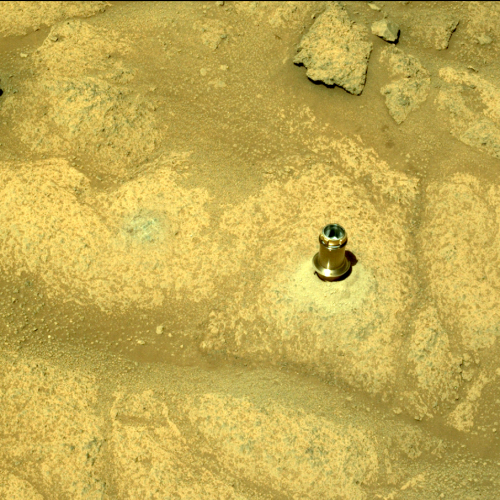
Drill and core sample in the ground

The second image, taken by Perseverance’s left navigation camera and cropped and reduced to post here, is more puzzling. It shows what appears to be the core sample still in the ground after drilling. While this could be entirely as planned, it seems very surprising. Most of what I can find online describing the operation for obtaining these samples implies that the robot arm would drill the hole, and then retract the sample immediately to place it in storage. Nothing suggests the arm would be retracted with the sample still in the ground.

I think however the odds of this picture revealing a problem are low. This JPL press release from February 2021 implies vaguely that the core sample will be released in this manner before retraction. After the core sample, with bit, is separated from the arm, the release suggests they will lift the arm away to inspect the drilling process, then return the arm to retract the core sample for storage. This does make some sense, though grabbing that sample again will be quite challenging.

If this was not supposed to happen as described, then there is a problem that must be resolved. I expect more details in the next day or so to clarify this situation.

5 comments

Ingenuity’s next flight set for today

Flight plan for Ingenuity's 10th flight
Click for full image.

Though circumstances can obviously change, the Ingenuity/Perseverance science teams have scheduled Ingenuity’s 10th Martian flight for sometime later today, with a flight plan, shown to the right, that is even more ambitious.

Flight 10 will allow us to reap the benefits of our previous flight. Scheduled for no earlier than this Saturday (July 24), Flight 10 will target an area called the “Raised Ridges” (RR), named for the geographic features that start approximately 164 feet (50 meters) south-by-southwest of our current location. We will be imaging Raised Ridges because it’s an area that Perseverance scientists find intriguing and are considering visiting sometime in the future.

From navigation and performance perspectives, Flight 10 will be our most complex flight to date, with 10 distinct waypoints and a nominal altitude of 40 feet (12 meters). It begins with Ingenuity taking off from its sixth airfield and climbing to the new record height. It will then head south-by-southwest about 165 feet (50 meters), where upon hitting our second waypoint, take our first Return to Earth (RTE) camera image of the Raised Ridges, looking south. Next, we’ll translate sideways to waypoint 3 and take our next RTE image – again looking south at Raised Ridges.

Imagery experts at JPL hope to combine the overlapping data from these two images to generate one stereo image. Flying farther to the west, we’ll try for another stereo pair of images (waypoints 4 and 5), then head northwest for two more sets of stereo pairs at waypoints 6 and 7 as well as 8 and 9. Then, Ingenuity will turn northeast, landing at its seventh airfield – about 310 feet (95 meters) west of airfield 6. Total time in the air is expected to be about 165 second.

Unlike the previous flights, this one will involve several turns while in the air. The engineers are definitely pushing the envelope with each flight, thus not only gathering scientific data about Jezero Crater but also advancing their engineering knowledge on the art of robotic flying on Mars.

3 comments

It’s drill time for Perseverance!

The Perservance science team is preparing the rover for its first drill hole and the first collection of a sample to cache so that a future spacecraft can return it to Earth.

They are presently at the general location where they wish to drill, and are looking for the exact right spot.

The sampling sequence begins with the rover placing everything necessary for sampling within reach of its 7-foot (2-meter) long robotic arm. It will then perform an imagery survey, so NASA’s science team can determine the exact location for taking the first sample, and a separate target site in the same area for “proximity science.”

“The idea is to get valuable data on the rock we are about to sample by finding its geologic twin and performing detailed in-situ analysis,” said science campaign co-lead Vivian Sun, from NASA’s Jet Propulsion Laboratory in Southern California. “On the geologic double, first we use an abrading bit to scrape off the top layers of rock and dust to expose fresh, unweathered surfaces, blow it clean with our Gas Dust Removal Tool, and then get up close and personal with our turret-mounted proximity science instruments SHERLOC, PIXL, and WATSON.”

“After our pre-coring science is complete, we will limit rover tasks for a sol, or a Martian day,” said Sun. “This will allow the rover to fully charge its battery for the events of the following day.”

Sampling day kicks off with the sample-handling arm within the Adaptive Caching Assembly retrieving a sample tube, heating it, and then inserting it into a coring bit. A device called the bit carousel transports the tube and bit to a rotary-percussive drill on Perseverance’s robotic arm, which will then drill the untouched geologic “twin” of the rock studied the previous sol, filling the tube with a core sample roughly the size of a piece of chalk.

Perseverance’s arm will then move the bit-and-tube combination back into bit carousel, which will transfer it back into the Adaptive Caching Assembly, where the sample will be measured for volume, photographed, hermetically sealed, and stored. The next time the sample tube contents are seen, they will be in a clean room facility on Earth, for analysis using scientific instruments much too large to send to Mars.

Not all drill samples will be cached in this manner.

With this press release and press conference NASA continued to push the fiction to the press that Perservance’s prime mission is to search for life. That is a lie designed to catch the interest of ignorant journalists who don’t know anything. The rover’s real mission is to study the overall Martian geology in Jezero Crater in order to better under the planet’s present geology as well as the geological history that made it look like it does today.

If the scientists using Perseverance find evidence of life, wonderful, but that is not their prime goal.

6 comments

Ingenuity’s view of Jezero Crater during its 9th flight

Ingenuity looks across Jezero Crater
Click for full image.

Overview map
Click for interactive map.

Cool image time! The photo above, cropped, enhanced, and reduced to post here, was taken on July 5, 2021, about thirty seconds after Ingenuity had taken off on its 9th flight on Mars. I have increased the contrast slightly to bring out the features. This is a raw image, so I do not think the colors are accurate, and I also do not know why the middle of the image is brighter than the edges.

The red lines on the map to the right indicates the general area this image captures. Essentially, once the helicopter reached its flying altitude after liftoff the engineers had it tilt so that it could see the route it was about to take to the southwest. As they noted in their description of this flight,

We began by dipping into what looks like a heavily eroded crater, then continued to descend over sloped and undulating terrain before climbing again to emerge on a flat plain to the southwest.

I think that crater is visible on the left edge of this picture.

So far 180 raw images from Ingenuity have arrived at JPL. There might be a few more, but I think this is the bulk from the flight. Of these, all but nine are black and white and point straight down. The nine color images seem tilted up towards the horizon to various degrees, though the image above is the only one that captures the horizon itself and the distance mountains of Jezero Crater’s rim.

8 comments

Update on Ingenuity’s 9th flight

Ingenuity's 9th flight
Click for interactive map

Ingenuity’s engineering team late yesterday posted an update on the helicopter’s successful 9th flight on July 5th, describing in detail the changes they made to their software that made the challenging flight possible.

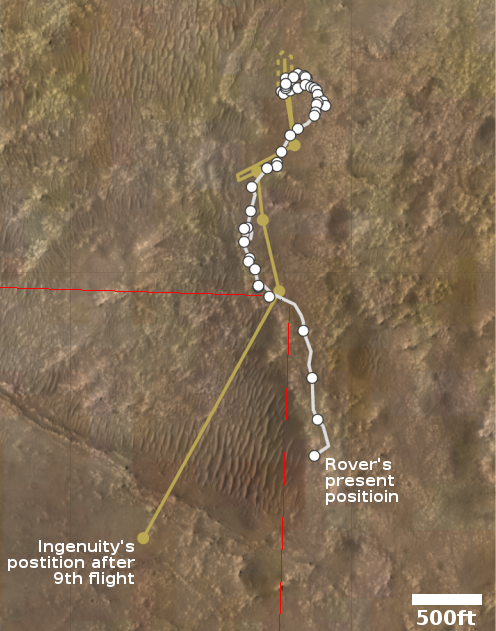
The changes were required because the helicopter flew for the first time over much rougher terrain then initially planned, as shown by the map to the right.

Flight 9 was not like the flights that came before it. It broke our records for flight duration and cruise speed, and it nearly quadrupled the distance flown between two airfields. But what really set the flight apart was the terrain that Ingenuity had to negotiate during its 2 minutes and 46 seconds in the air – an area called “Séítah” that would be difficult to traverse with a ground vehicle like the Perseverance rover. This flight was also explicitly designed to have science value by providing the first close view of major science targets that the rover will not reach for quite some time.

In other words, Ingenuity flew for the first time over terrain that Perseverance cannot drive to, recording images from above of surface features beyond the rover’s range.

We began by dipping into what looks like a heavily eroded crater, then continued to descend over sloped and undulating terrain before climbing again to emerge on a flat plain to the southwest.

The images of that rough terrain have not yet been downloaded to Earth, but will be in the next week.

0 comments

Sublimating scallops on Mars

Giant scallop on Mars
Click for full image.

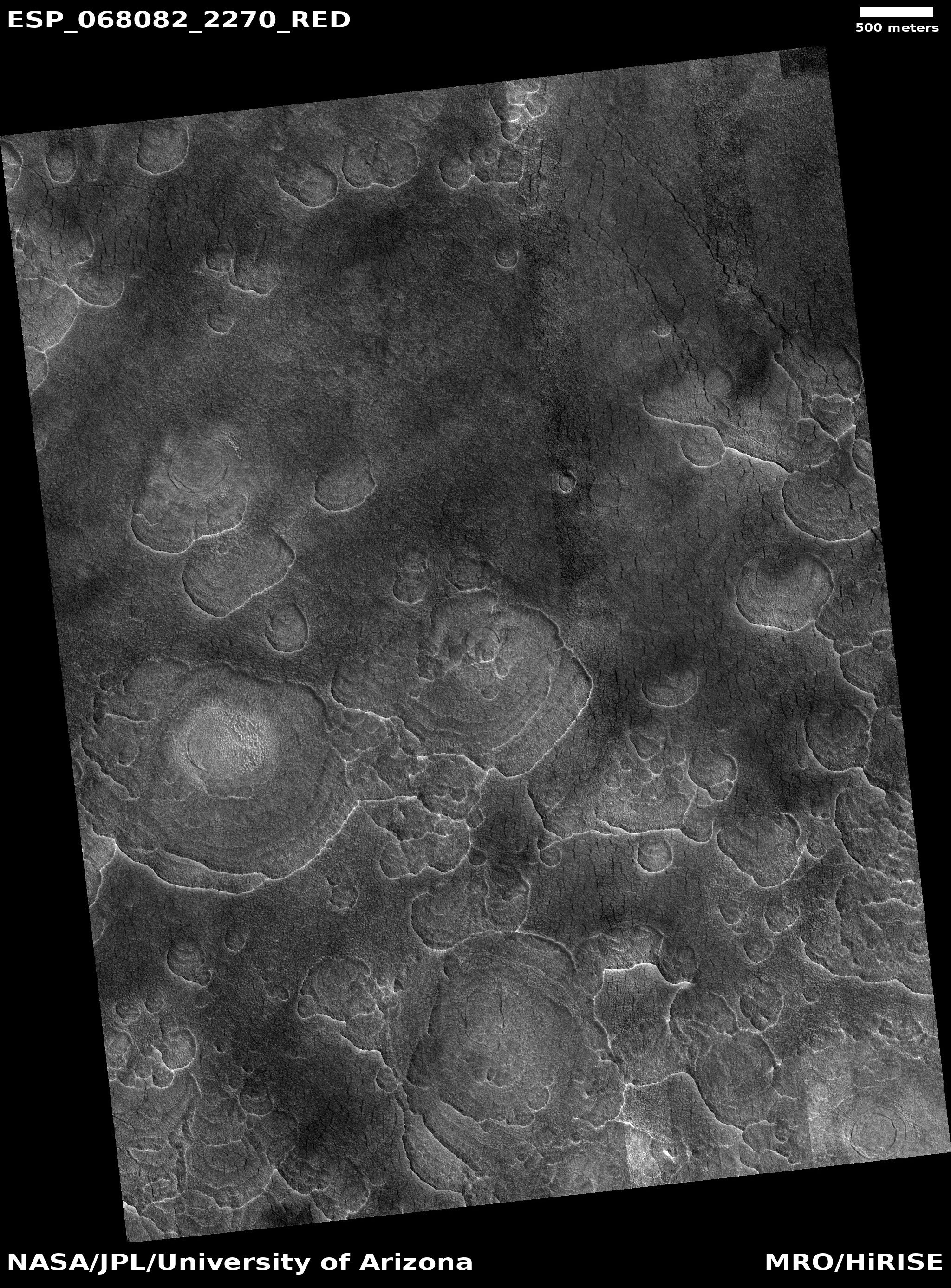
Today’s cool image, shown in a rotated, cropped, and reduced version to the right, gives us a close-up look at one of the giant scallops found in the high mid-latitudes of the northern lowland plains of Mars, specifically in Utopia Basin north of the landing sites of both Perseverance and Zhurong. In fact, this particular image is only a few miles north of one of my previous cool images, Giant scallops on Mars, posted in December 2019.

The image was taken on February 3, 2021 by the high resolution camera on Mars Reconnaissance Orbiter (MRO). While such scallops are not unusual in the mid-latitudes, their formation process is not well understood. As I noted in the 2019 post, ” scientists believe [pdf] the formation process is related to the sublimation of underground ice.”

According to [one hypothesis] scallop formation should be ongoing at the present time. Sublimation of interstitial ice could induce a collapse of material, initially as a small pit, then growing [away from the equator] because of greater solar heating on [that] side. Nearby scallops would coalesce together as can be seen to have occurred.

This hypothesis is not proven, and today’s cool image raises questions about it. Though the bright material at its center suggests exposed ice, supporting the idea that sublimation of ice near the surface created the scallop, the scallop scarps seem more extended and distinct to the south, not the north as this hypothesis proposes. Sunlight should hit the northern scarps more, which suggests they should retreat more instead of the southern scarp.

The overview map below provides the context.
» Read more

1 comment

First images from Ingenuity’s 9th flight today

Ingenuity landing, July 5, 2021

Ingenuity has apparently completed its 9th flight on Mars, its most challenging yet attempted. Based on the six images so far released from that flight, all taking during its landing, it appears the flight was successful. Or at least, the helicopter landed without incident or damage.

The photo to the right was the last picture taken just before touch down. From the caption:

NASA’s Ingenuity Mars Helicopter acquired this image using its navigation camera. This camera is mounted in the helicopter’s fuselage and pointed directly downward to track the ground during flight.

The dark shadow of the helicopter is clearly visible. If you want to see the entire sequence of six images, go to the Ingenuity raw image website and pick the “latest images” filter in the right column. At present it shows this sequence, though I am certain as the day passes images from the entire flight will start appearing.

As noted at the first link above, the flight was to be more than twice as long as any previous flight while flying over the roughest terrain. There was the real risk that its software would become confused by that terrain.

1 comment

Next Ingenuity flight to push envelope significantly

Ingenuity's 9th flight plan
Click for full image.

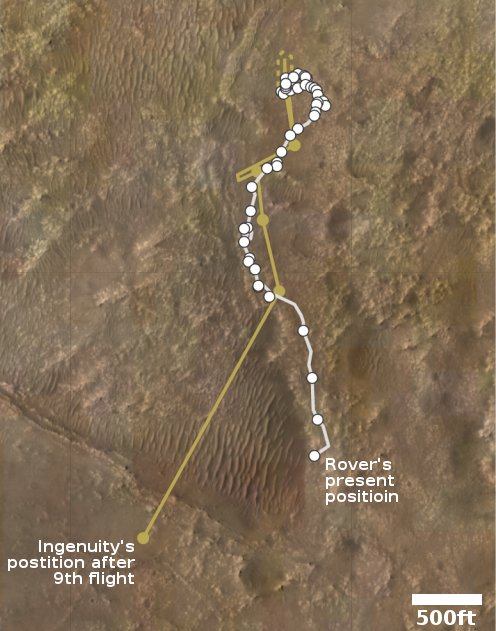
The engineers running the Mars helicopter Ingenuity revealed today that they will be attempting their most ambitious flight for the helicopter’s ninth flight, presently scheduled for no earlier than July 4th.

I have annotated the map to the right to show Ingenuity’s present position and its approximate landing area.

Without question this flight will be the riskiest taken by Ingenuity so far, more than doubling the flight distance achieved on any previous flight. More important, it will be flying over terrain far rougher than it was initially designed for.
» Read more

9 comments

Perseverance’s most recent view of Jezero Crater

Panorama by Perseverance, Sol 130, July 2, 2021
Click for full resolution.

Overview map
Click for interactive map.

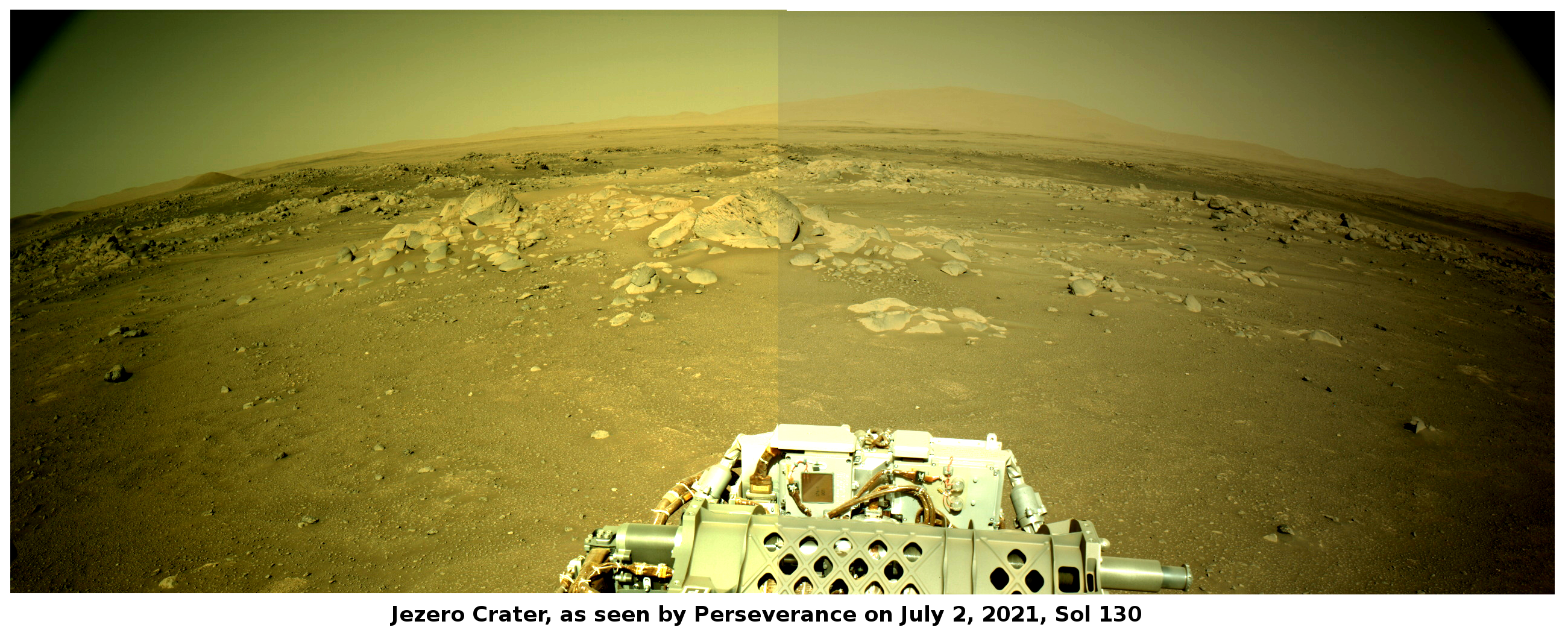
Cool image time! The panorama above, reduced to post here, is made from two navigation camera images on the Mars rover Perseverance, found here and here.

The map to the right, taken from the “Where is Perseverance?” website and annotated further by me, shows with the yellow lines what I think (but am not sure) is the area seen in the panorama.

The navigation cameras on Perseverance are more wide angle than the navigation cameras on Curiosity, in order to cover a larger area. They thus produce a slight fisheye distortion, illustrated by the curve of the horizon.

The large mountain in the center right is likely the crater rim. You can also see the knobs to the left as indicated on the overview map. The rover is now about halfway to the southernmost planned spot it is expected to reach within the floor of Jezero Crater, which is about a half to three quarters of a mile further south.

The terrain seems quite desolate and barren, which of course is no surprise, because that is what it is like on all of the surface of Mars. No plant life, just rocks and dirt. While Curiosity is now in the mountains, Perseverance remains on the crater floor, so the points of interest (from the mere tourist’s perspective) are small or far away.

1 comment

Ingenuity completes 8th flight, moving south with Perseverance

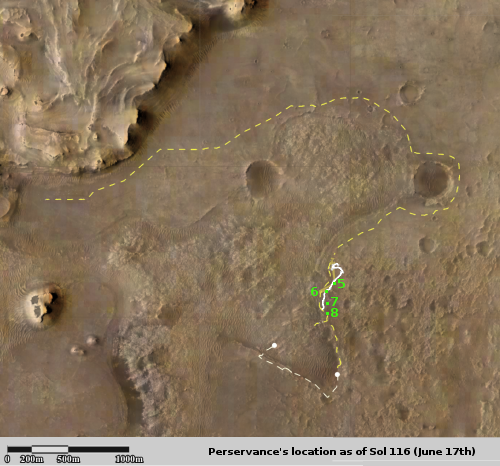
Perservance's location, June 17, 2021
Click for interactive map.

On June 21, 2021 the Mars helicopter Ingenuity successfully completed its eighth flight, leapfrogging south past the rover Perseverance.

During the flight, Ingenuity remained aloft for 77.4 seconds, flew 525 feet (160 meters), and landed about 440 feet (133.5 m) away from its companion, the Perseverance rover, according to a tweet from NASA’s Jet Propulsion Laboratory in California, which operates the helicopter.

The map to the right, annotated by me from the interactive map provided by the Perseverance team, shows the helicopter’s approximate new position, labeled #8 in green. The other green numbers show its previous landing spots after earlier flights.

The white line shows Perseverance’s travels through June 17th. The yellow dashed line shows their planned route over the next few months. Perseverance was just slightly north of Ingenuity on that date. It has likely traveled further south since then.

0 comments

Update on Perseverance’s future travel plans

Perseverance's future travels
Click for full image.

The science team for the rover Perseverance yesterday released a revised map of where they intend over the next few months to send the rover on the floor of Jezero Crater.

The map to the right, cropped and reduced to post here, shows that route.

The first science campaign (depicted with yellow hash marks) begins with the rover performing an arching drive southward from its landing site to Séítah-North (Séítah-N). At that point the rover will travel west a short distance to an overlook where it can view much of the Séítah unit. The “Séítah-N Overlook” could also become an area of scientific interest – with Perseverance performing a “toe dip” into the unit to collect remote-sensing measurements of geologic targets.

Once its time at the Séítah-N Overlook is complete, Perseverance will head east, then south toward a spot where the science team can study the Crater Floor Fractured Rough in greater detail. The first core sample collected by the mission will also take place at this location. After Cratered Floor Fractured Rough, the Perseverance rover team will evaluate whether additional exploration (depicted with light-yellow hash marks) farther south – and then west – is warranted.

Whether Perseverance travels beyond the Cratered Floor Fractured Rough during this first science campaign, the rover will eventually retrace its steps. As Perseverance passes the Octavia B. Butler landing site, the first science campaign will conclude. At that point, several months of travel lay ahead as Perseverance makes its way to “Three Forks,” where the second science campaign will begin.

At that point the rover will begin studying the base of the delta of material that in the far past poured through a gap in the western rim of Jezero Crater.

0 comments

Ingenuity completes 7th flight on Mars

Locations of Perseverance and Ingenuity on Mars
Click for interactive map.

Ingenuity yesterday successfully completed its 7th flight on Mars, heading south and landing exactly as planned.

Ingenuity lifted off around 12:34 local mean solar time on Tuesday, which corresponds to 11:54 a.m. EDT (1554 GMT). As planned, the chopper then traveled 348 feet (106 meters) south from its previous location on the floor of Mars’ Jezero Crater, staying aloft for nearly 63 seconds, JPL officials wrote in another tweet. The solar-powered rotorcraft set down at a new airfield, the fourth one it has reached since landing on the Red Planet with NASA’s Perseverance rover on Feb. 18.

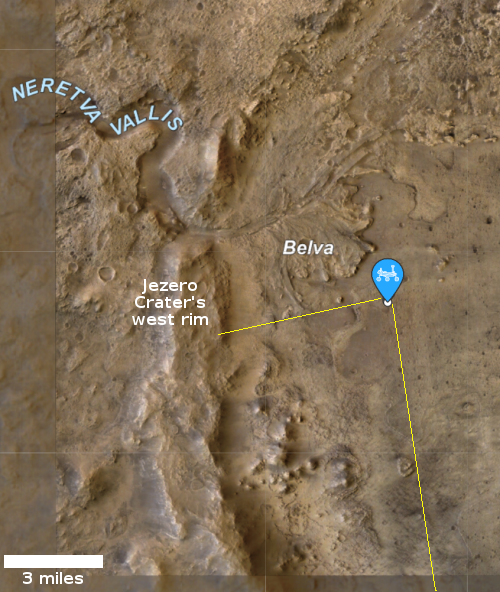
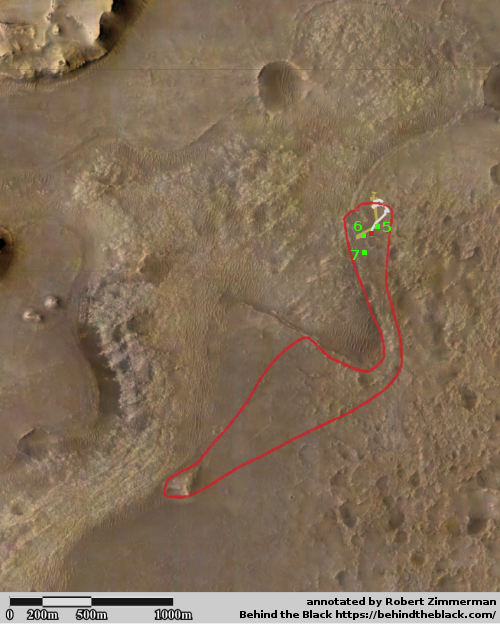
Both the rover Perseverance and Ingenuity are traveling south on the floor of Jezero Crater, with the helicopter leapfrogging ahead every few weeks. On the map the red dot indicates Perseverance location, with the green dots Ingenuity’s last three landing sites. They have not yet added to the map exactly where Ingenuity landed yesterday (#7), so I have estimated it based on the information above.

The red outline indicates the region they are planning to explore over the next few months in order to gather a very thorough understanding of the geology of the floor of Jezero Crater. They will eventually head to the northwest towards the cliffs in the upper left, which is the foot of the large delta that flowed in the past into the crater through a gap in its western rim. The route they will take to get there however remains undetermined.

0 comments

Ingenuity to make sixth flight next week

Future travels for Perseverance and Ingenuity

The Ingenuity engineering team announced today that the Mars helicopter will make its sixth flight next week, flying to a new landing spot while taking images for the Perseverance science team.

Ingenuity’s flight plan begins with the helicopter ascending to 33 feet (10 meters), then heading southwest for about 492 feet (150 meters). When it achieves that distance, the rotorcraft will begin acquiring color imagery of an area of interest as it translates to the south about 50-66 feet (15-20 meters). Stereo imagery of the sand ripples and outcrops of bright rocks at the site will help demonstrate the value of an aerial perspective for future missions. After completing its image collection, Ingenuity will fly about 164 feet (50 meters) northeast where it will touch down at its new base of operations (known as “Field C”).

The flight will attempt a new speed record of 9 mph, and will also land for the first time in a spot that the helicopter has not scouted beforehand. It will instead be using data from high resolution images from Mars Reconnaissance Orbiter (MRO) combined with its own hazard avoidance system.

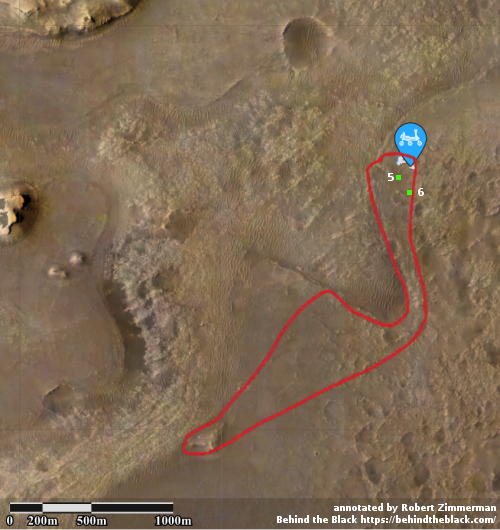
Ingenuity will essentially place itself over and in an area where Perseverance plans to go, leapfrogging ahead flight by flight, as shown by the map above (annotated by me from the map available here). The green dot numbered 5 shows the helicopter’s present position, while #6 shows its approximate landing spot after its sixth flight. Perseverance, whose present location is indicated by the blue marker, is generally heading south within the area outlined by the red line, as described during the science team’s an April 30th press conference. The goal in exploring this region is to gain a very robust geological baseline of the floor of Jezero Crater, which scientists believe will be the oldest material the rover should see in its travels.

2 comments

Ingenuity completes fifth flight; lands in new location

On May 7th, 2021 Ingenuity completed its fifth flight on Mars, this time landing at a new location for the first time.

The robot craft took off at ‘Wright Brothers Field’ – the same spot where the it had risen and landed on all its other flights – but landed at an airfield 423 feet (129 metres) to the south. Landing in a new place is another first for the rotorcraft.

This new landing site places the helicopter in a good position to leap frog along with Perseverance as it moves south in this general area studying the floor of Jezero Crater.

27 comments

Ingenuity’s fifth flight later today

The flight path of Ingenuity's fourth flight
The flight path of Ingenuity’s 3rd and 4th flights.
Click for original image.

According to Ingenuity’s engineering team, the helicopter will make its fifth flight today, and unlike the previous flights, it will not return to is initial take-off point, but will instead land to the south, putting it in a better position to tag along with Perseverance. As noted by Josh Ravitch, Ingenuity’s mechanical engineering lead at JPL,

We are traveling to a new base because this is the direction Perseverance is going, and if we want to continue to demonstrate what can be done from an aerial perspective, we have to go where the rover goes.

The map to the right show’s the flight paths of Ingenuity’s third and fourth flights, with the fourth heading south. Based on the data obtained they scouted out its likely landing place for the fifth flight.

[The] targeted takeoff time is 12:33 p.m. local Mars time (3:26 p.m. EDT, or 12:26 p.m. PDT), with data coming down at 7:31 p.m. EDT (4:31 p.m. PDT). Ingenuity will take off at Wright Brothers Field – the same spot where the helicopter took off and touched back down on all the other flights – but it will land elsewhere, which is another first for our rotorcraft. Ingenuity will climb to 16 feet (5 meters), then retrace its course from flight four, heading south 423 feet (129 meters).

This April 30th Ingenuity update by Håvard Grip, Ingenuity’s chief pilot, provides a very detailed explanation of what they are learning about flight on Mars, describing issues of take-off, landing, dust, and maneuvering. Engineers (or any geeks in general) will find Grip’s commentary most interesting.

3 comments

Ingenuity’s fourth flight today a success

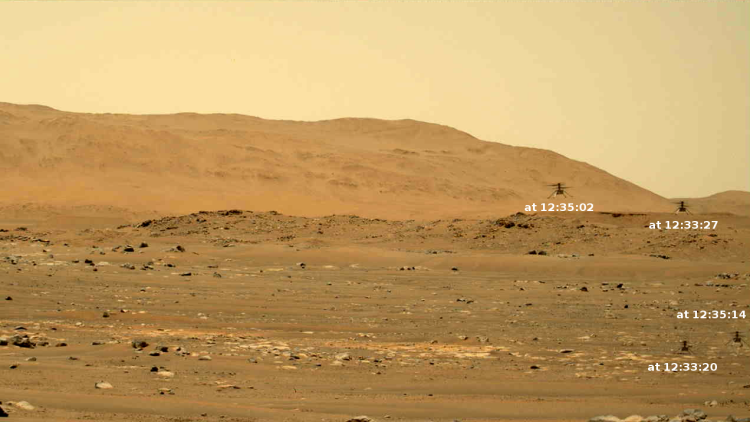
Ingenuity's 4th flight
For original images, go here, here, here, and here.

As planned, Ingenuity took off early today on Mars at 12:33:20 pm (local Mars time). Data from the full flight has now arrived on Earth, with images that show the helicopter rising, moving about, and then landing. The montage above captures the part of the flight visible from one of Perservance’s cameras.

Apparently Ingenuity was in the air for about two minutes, and landed a bit to the right of its take-off point. We will have to wait for an update from the engineering team to find out exactly what happened.

UPDATE: Mimi Aung, the Ingenuity project manager, posted a report later today:

The helicopter took off at 10:49 a.m. EDT (7:49 a.m. PDT, or 12:33 local Mars time), climbing to an altitude of 16 feet (5 meters) before flying south approximately 436 feet (133 meters) and then back, for an 872-foot (266-meter) round trip. In total, we were in the air for 117 seconds.

The helicopter also took a lot of images, which they are presently in the process of downloading and reviewing.

1 comment

Fourth flight of Ingenuity set for today; shifting to operational phase

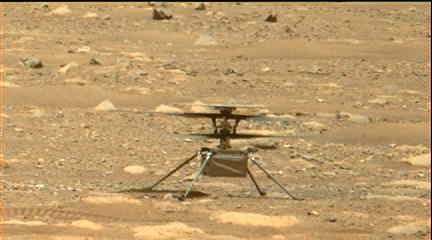
Ingenuity close-up taken by Perseverance April 28th

Even as the Ingenuity engineering team will attempt a fourth flight of Ingenuity, JPL announced today that they and NASA have decided to now shift to operational flights, attempting to duplicate the kind of scouting missions that such helicopters will do on future rovers.

The second link takes you to the live stream of the press conference. The press release is here.

Essentially, they will send Ingenuity on a series of scouting missions after this fourth flight, extending its 30 day test program another 30 days. Its engineers will be working with the Perseverance science team to go where those scientists want to send it. After the fourth and fifth test flights they will fly Ingenuity only periodically, separated by weeks, and send it to scout places Perseverance can’t reach, and have it land at new sites that Perseverance scouted out as it travels.

They have decided to do this because they want to spend more time in this area on the floor of Jezero Crater, for several reasons. First, they are still testing the rover to get it to full working operations. Second, they want to obtain some samples for future pickup at this location. Third, they want to spend an extensive amount of time exploring the floor up to a mile south of their present location.

Finally, the relatively flat terrain is perfect for testing and actually using the helicopter as a scout.

Though the extension is for 30 days, and though the helicopter was not built for long term survival, there is no reason it cannot continue indefinitely until something finally breaks.

Right now they are awaiting the data from the fourth flight, which will arrive at 1:39 pm (Eastern) and will be used to determine what the fifth flight will do, probably a week from now.

1 comment
1 8 9 10 11 12 13