Scientists increasingly put politics over uncertainty in their research papers

The modern scientific method

The death of uncertainty in science: According to a paper published this week in the peer-review journal Science, scientists in recent years are increasingly abandoning uncertainty in their research papers and are instead more willing to make claims of absolute certainty without hesitation or even proof.

If this trend holds across the scientific literature, it suggests a worrisome rise of unreliable, exaggerated claims, some observers say. Hedging and avoiding overconfidence “are vital to communicating what one’s data can actually say and what it merely implies,” says Melissa Wheeler, a social psychologist at the Swinburne University of Technology who was not involved in the study. “If academic writing becomes more about the rhetoric … it will become more difficult for readers to decipher what is groundbreaking and truly novel.”

The new analysis, one of the largest of its kind, examined more than 2600 research articles published from 1997 to 2021 in Science, which the team chose because it publishes articles from multiple disciplines. (Science’s news team is independent from the editorial side.) The team searched the papers for about 50 terms such as “could,” “appear to,” “approximately,” and “seem.” The frequency of these hedging words dropped from 115.8 instances per 10,000 words in 1997 to 67.42 per 10,000 words in 2021.

Those numbers represent a 40% decline, a trend that has been clear for decades, first becoming obvious in the climate field. » Read more

9 comments

Euclid’s first images look good

Scientists have determined that the first test images from the two cameras on the recently launched orbiting Euclid space telescope are sharp and as expected.

Both VIS and NISP provided these unprocessed raw images. Compared to commercial products, the cameras are immensely more complex. VIS comprises 36 individual CCDs with a total of 609 megapixels and produces high-resolution images of billions of galaxies in visible light. This is how astronomers determine their shape. The first images already give an impression of the abundance that the data will provide.

NISP’s detector consists of 16 chips with a total of 64 megapixels. It operates in the near-infrared at wavelengths between 1 and 2 microns. In addition, NISP serves as a spectrograph, which splits the light of the captured objects similar to a rainbow and allows for a finer analysis. These data will allow the mapping of the three-dimensional distribution of galaxies.

Knowing that 3D distribution will allow scientists to better determine the nature of both dark energy (related to the acceleration of the universe’s expansion) and dark matter (related to an undiscovered mass that affects the formation and shape of galaxies).

1 comment

Meandering ridge exiting glacier on Mars

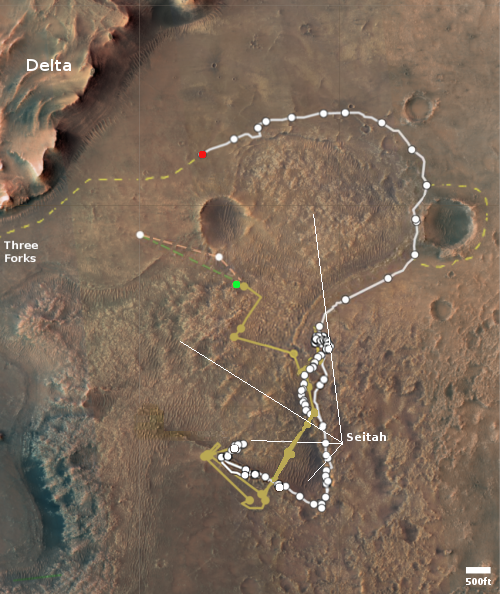
Overview map

Meandering ridge exiting glacier on Mars
Click for original image.

Today’s cool image illustrates the complex explanations scientists sometimes have to come up with explain the strange geology seen on Mars. The picture to the right, cropped, reduced, and sharpened to post here, was taken on May 30, 2023 by the high resolution camera on Mars Reconnaissance Orbiter (MRO). It shows what the scientists label as a whitish “ridged flow-like feature” that appears to exit out of the massive hill to the west.

The white dot on the overview map above as well as in the inset marks this location, smack dab inside the 2,000-mile-long strip of glacier country in the Martian northern mid-latitudes. As you can see from the inset, that massive hill is actual the foot of a large apron of material, likely ice-infused, that has sagged down from the large 5,400-foot high mesa to the west.

The white material is likely what the scientists call an inverted river. Once it was a channel in which either water or ice flowed. With time the weight of that material compacted the riverbed so that it was denser than the surrounding terrain, much of which was likely soft anyway because of a high ice content. When that surrounding terrain eroded away, the riverbed resisted that erosion, and instead became the raised ridge we now see.

0 comments

Trial operations begin for China’s new radio array for observing the Sun

Engineers have begun trial operations for a almost two-mile diameter antenna array in China designed to observe the Sun.

The Daocheng Solar Radio Telescope (DSRT) consists of 313 dishes, each with a diameter of 19.7 feet (6 meters), forming a circle with a circumference of 1.95 miles (3.14 kilometers). A 328-feet-high (100 m) calibration tower stands in the center of the ring. The array has undergone half a year of debugging and testing, demonstrating the capability to consistently and reliably monitor solar activity with high precision. Trial operations officially started July 14, according to CCTV News.

This design is a variation of the VLA radio antenna in New Mexico, which has 28 antennas arranged not in a circle but in a Y-configuration that can be extended or shortened. That additional capability is probably why VLA is focused on astronomical observations, not just the Sun.

0 comments

Contact lost with Voyager 2, hopefully temporarily

New but planned commands to Voyager 2, presently flying beyond the solar system, caused the spacecraft to point its antenna incorrectly so that communications with Earth have been lost.

A series of planned commands sent to NASA’s Voyager 2 spacecraft on July 21 inadvertently caused the antenna to point 2 degrees away from Earth. As a result, Voyager 2 is currently unable to receive commands or transmit data back to Earth.

Voyager 2 is located almost 12.4 billion miles (19.9 billion kilometers) from Earth and this change has interrupted communication between Voyager 2 and the ground antennas of the Deep Space Network (DSN). Data being sent by the spacecraft is no longer reaching the DSN, and the spacecraft is not receiving commands from ground controllers.

The spacecraft is also programmed to periodically reset its orientation so that its antenna points to Earth, with the next reset scheduled for October 15th. Engineers hope that at that point contact will be recovered.

If not, this incident will mark the end of the mission, which launched in 1977 and has been functioning for 46 years as it has made close fly-bys of Jupiter, Saturn, Uranus, and Neptune, and then eventually entering interstellar space.

4 comments

Endless dunes in the dry Martian equatorial region

Endless dunes in the dry Martian equatorial region
Click for original image.

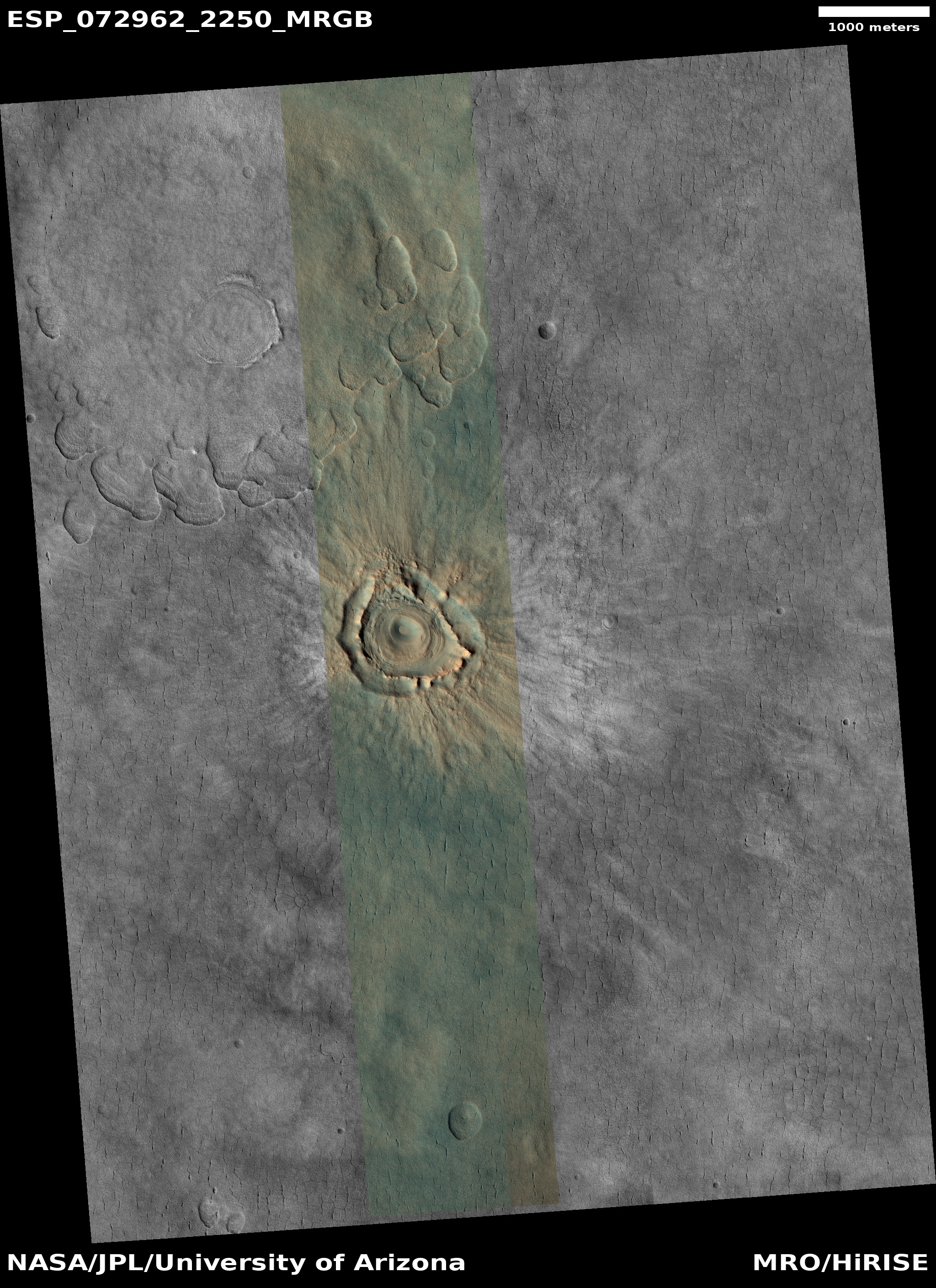
Cool image time! The picture to the right, rotated, cropped, and sharpened to post here, was taken on May 14, 2023 by the high resolution camera on Mars Reconnaissance Orbiter (MRO). It shows a small section of a vast dune field, 50 miles square, that sits about 225 miles south of the southern foothills of Mars’ biggest volcano, Olympus Mons.

The dunes are probably less than 20 feet high, with that one small hill only slightly higher. Their similar orientation, which extends across the entire 50-mile-square dune field, indicates the direction of the prevailing winds, which I think (but will not swear to it) is from the southeast to the northwest, which also happens to also follow the grade downhill to the northwest.

It is also possible that wind direction is the reverse, and goes uphill to the southwest.
» Read more

1 comment

Scientists think they have finally discovered what makes the Sun’s corona so hot

Using data from Europe’s Solar Orbiter spacecraft, scientists now think they have finally pinpointed the process that causes the Sun’s corona — its atmosphere — to be many times hotter than its surface.

For decades, scientists have been struggling to explain why temperatures in the sun’s outer atmosphere, the corona, reach mind-boggling temperatures of over 1.8 million degrees Fahrenheit (one million degrees Celsius). The sun’s surface has only about 10,000 degrees F (6,000 degrees C), and with the corona farther away from the source of the heat inside the star, the outer atmosphere should, in fact, be cooler.

New observations made by the Europe-led Solar Orbiter spacecraft have now provided hints to what might be behind this mysterious heating. Using images taken by the spacecraft’s Extreme Ultraviolet Imager (EUI), a camera that detects the high-energy extreme ultraviolet light emitted by the sun, scientists have discovered small-scale fast-moving magnetic waves that whirl on the sun’s surface. These fast-oscillating waves produce so much energy, according to latest calculations, that they could explain the coronal heating.

You can read the paper here [pdf]. The results have not yet been confirmed, but if so it will solve one of the space age’s oldest scientific mysteries.

5 comments

Astronomers chemically map a significant portion of the Milky Way

The chemistry of the Milky Way's nearby spiral arms
Red indicates areas with lots of heavier elements, blue indicates
areas dominated by hydrogen and helium. Click for original image.

Astronomers have now used today’s modern survey telescopes — on Earth and in space — to map the chemistry of a large portion of the Milky Way’s nearby spiral arms, revealing that the arms themselves are rich in heavier elements, indicating greater age and the right materials to produce new stars and solar systems like our own.

If the Milky Way’s spiral arms trigger star births as predicted, then they should be marked by young stars, aka metal-rich stars. Conversely, spaces between the arms should be marked by metal-poor stars.

To confirm this theory, as well as create his overall map of metalicity, Hawkins first looked at our solar system’s galactic backyard, which include stars about 32,000 light years from the sun. In cosmic terms, that represents our stellar neighborhood’s immediate vicinity.

Taking the resultant map, the researcher compared it to others of the same area of the Milky Way created by different techniques, finding that the positions of the spiral arms lined up. And, because he used metalicity to chart the spiral arms, hitherto unseen regions of the Milky Way’s spiral arms showed up in Hawkins’ map. “A big takeaway is that the spiral arms are indeed richer in metals,” Hawkins explained. “This illustrates the value of chemical cartography in identifying the Milky Way’s structure and formation. It has the potential to fully transform our view of the Galaxy.”

You can read the science paper here [pdf]. Based on this initial mapping effort, it appears that it will not be long before a large percentage of our own galaxy will be mapped in this manner.

5 comments

Juno’s next fly-by of Io coming on July 30

Io as seen by Juno
An image of Io from the March fly-by

The Juno science team is gearing up for the spacecraft’s next fly-by of the Jupiter moon Io, scheduled for July 30, 2023.

When NASA’s Juno mission flies by Jupiter’s fiery moon Io on Sunday, July 30, the spacecraft will be making its closest approach yet, coming within 13,700 miles (22,000 kilometers) of it. Data collected by the Italian-built JIRAM (Jovian InfraRed Auroral Mapper) and other science instruments is expected to provide a wealth of information on the hundreds of erupting volcanoes pouring out molten lava and sulfurous gases all over the volcano-festooned moon.

The image to the right was taken from 33,000 miles during the March fly-by, almost three times farther away. The dark spots are volcanoes, and some showed significant change from earlier images.

0 comments

OSIRIS-REx completes last major mid-course correction before sending its sample capsule back to Earth

OSIRIS-REx yesterday completed a 63 second engine burn, successfully aiming the spacecraft so that its September 24th drop off of its sample capsule will hit the Earth as planned.

Preliminary tracking data indicates OSIRIS-REx changed its velocity, which includes speed and direction, by 1.3 miles, or 2 kilometers, per hour. It’s a tiny but critical shift; without course adjustments like this one the spacecraft would not get close enough to Earth on Sept. 24 to drop off its sample of asteroid Bennu. The spacecraft is currently 24 million miles, or 38.6 million kilometers, from Earth, traveling at about 22,000 miles, or about 35,000 kilometers, per hour.

In the two weeks prior to that drop-off the spacecraft will do two more short burns to refine its aim so that the sample capsule will land precisely as planned on the Defense Department’s Utah Test and Training Range near Salt Lake City.

1 comment

Giant glaciers in the northern Martian mid-latitudes

Overview map

Giant glaciers in the northern Martian mid-latitudes
Click for original image.

It is time for two cool images! The picture to the right, cropped, reduced, and sharpened to post here, was taken on May 10, 2023 by the high resolution camera on Mars Reconnaissance Orbiter (MRO), and is one of two glaciers imaged by MRO in May that are among a whole series of glaciers flowing down the south wall of the same mesa.

The red dot in the inset and on the overview map above marks the location of the picture to the right. The white dot marks the location of the May 27, 2023 picture, which can be seen here.

The unnamed 10,000-foot-high mesa from which these glaciers flow, located in the middle of the 2,000-mile-long northern mid-latitude strip I dub glacier glacier country, is about 41 miles long and 18 miles wide at its widest point. The glacier to the right falls about 6,000 feet in about four miles, making the grade steep, ranging from 15 to 23 degrees. That steepness explains the split in the glacier, as it flowed around a huge piece of higher bedrock in the middle of this descending hollow.

Both images provide further evidence of the dominance of glaciers in this mid-latitude region. While the glaciers are all covered with dust and debris to protect the ice, and are also thought at present to all be inactive, they also all suggest a very dynamic Martian geological and climate history, one that will likely come alive again as the planet’s rotational tilt naturally shifts back and forth from its present 25 degree tilt to 11 to 60 degrees.

The glaciers also show us again that Mars is not a dry desert, but above 30 degrees latitude it is an icy desert much like Antarctica. Colonists will have no trouble finding water.

0 comments

Optical image of accretion disk around baby star, taken by ground-based VLT

Stellar accretion disk
Click for original image.

Scientists today released an optical image of the accretion disk that surrounds a baby star about 5,000 light years away, taken by ground-based Very Large Telescope (VLT) in Chile and enhanced by data from the Atacama Large Millimeter/submillimeter Array (ALMA), also in Chile.

That image, reduced to post here, is to the right. The bright blue spot in the center is the main star, with the smaller dot to the lower left a companion star. From the press release:

The VLT observations probe the surface of the dusty material around the star, while ALMA can peer deeper into its structure. “With ALMA, it became apparent that the spiral arms are undergoing fragmentation, resulting in the formation of clumps with masses akin to those of planets,” says Zurlo.

Astronomers believe that giant planets form either by ‘core accretion’, when dust grains come together, or by ‘gravitational instability’, when large fragments of the material around a star contract and collapse. While researchers have previously found evidence for the first of these scenarios, support for the latter has been scant.

This data suggests that the latter is being observed, the first time gravitational instability has been identified as it is happening. You can read the scientist’s research paper here [pdf].

1 comment
1 117 118 119 120 121 729