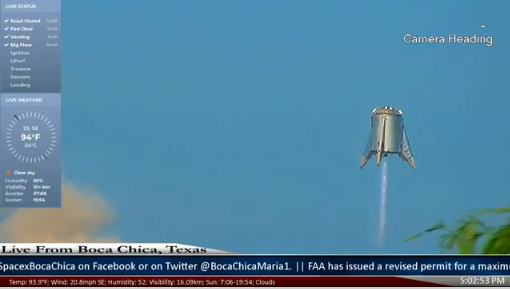
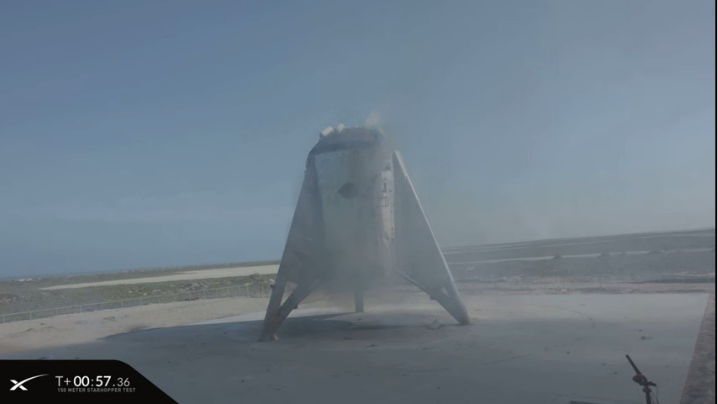
Starhopper static engine test engulfs vehicle in flames

Capitalism in space: A Starhopper static engine test yesterday testing the newly installed Raptor engine resulted in the vehicle being engulfed in flames.

While the test itself appeared to fire for its full duration, events relating to this test appeared to cause some issues with Hopper, later seen when a secondary fire rose up to engulf the test vehicle. This is understood to have been related to two small fires โ€“ one on the vehicle and one on the pad.

A discharge of methane โ€“ during the safing of the vehicle, which involved a fire hose being directed at the small fires โ€“ ignited and caused a fireball to rise from the aft of the vehicle.

However, the vehicle survived and photos show it is suffering from no obvious damage from external views. This was backed up by a successful detanking and power down overnight.

I have embedded a slow motion video of the test below the fold, with that secondary fire occurring at about 50 seconds in, at about the moment it appears a stream of water hits a smaller fire.

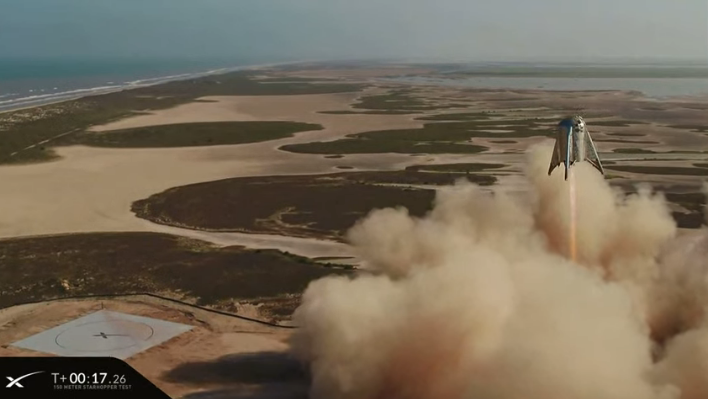
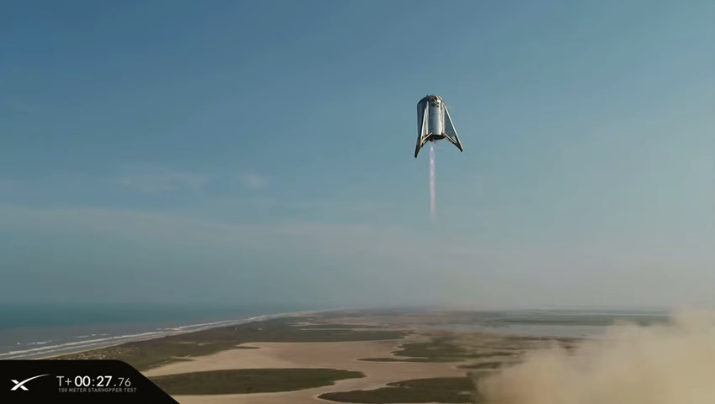
Their plans had been to follow this static test with a 20 meter vertical flight of Starhopper, unattached. When this will occur is now unclear.
» Read more

3 comments

SpaceX pinpoints cause of Dragon explosion during test

SpaceX today revealed that it has pinpointed the cause of the explosion that destroyed a Dragon manned capsule during an engine test in April.

The company believes that the problem originated with the Crew Dragonโ€™s emergency abort system, which consists of a series of small thrusters embedded within the capsule. If all goes well during a mission, these tiny thrusters are never really meant to be used. But if there is some kind of failure during a future launch, the thrusters can ignite and carry the Crew Dragon safely away from a disintegrating rocket.

SpaceX says that a leaky valve caused the propellant needed for these thrusters to cross into another system โ€” one of really high pressure. When this contamination occurred, the high forces slammed the liquid around, causing valuable components to fail and leading to the ultimate loss of the capsule.

Koenigsman said that this contamination definitely was not anticipated, though the kind of valve that leaked has been known to have some internal leakage problem. Ultimately, he acknowledged that, to some extent, this was a design issue. โ€œItโ€™s something that the components should not have done,โ€ Koenigsman said. โ€œBut at the same time, we learned a very valuable lesson on something going forward, one that makes the Crew Dragon a safer vehicle.โ€
“โ€œit was a huge gift for us.โ€ ”

SpaceX will replace all of these types of valves with another component known as a burst disk, which is supposed to be much more reliable, according to Koenigsman.

The company is still hoping to fly before the end of the year, but admits that this may not be possible. Right now they have a tentative launch date in November.

4 comments

Fire at SpaceX Starhopper facility in Florida

A fire in SpaceX’s Florida facility yesterday, where it is building a Starship prototype, caused between $50,000 to $100,000 damages.

City spokesperson Yvonne Martinez confirmed a small fire broke out at the facility on Cidco Road around noon and that the Cocoa Fire Department was able to quickly extinguish it. She said crews suspected an electrical fault as the source of the fire.

โ€œThis afternoon, a small fire occurred at a SpaceX facility in Cocoa,” SpaceX spokesperson James Gleeson told FLORIDA TODAY. “The fire was contained to a sea van on site and extinguished thanks to the Cocoa Fire Department, which responded within minutes.”

“There were no injuries as a result of the fire, and the cause is under investigation,” he said.

Martinez said the fire department estimates about $50,000 to $100,000 in damages were sustained by the shipping container and equipment inside, as well as the adjacent building.

This will be a blow to the Florida SpaceX unit that is competing with the Boca Chica unit on the construction of Starship.

1 comment

Reused Falcon 9 wins NASA launch contract instead of Pegasus

Captalism in space: NASA has awarded SpaceX a Falcon 9 launch contract using a reused first stage for its next X-ray telescope, the Imaging X-ray Polarimetry Explorer (IXPE)..

SpaceX will charge NASA just over $50 million, its normal price for a reused Falcon 9 and significantly less than NASA has previously paid for this kind of launch. More important, the telescope had been designed with the expectation that it would be launched using Northrop Grumman’s Pegasus rocket. It appears NASA had instead decided to bypass Pegasus, partly because it probably costs more, and partly because there is some issue with Pegasus that has delayed the launch of NASA’s ICON since 2017.

In fact, that ICON launch is the only contract that Pegasus presently has, and it is charging NASA $56 million for that launch, with NASA also having to bear the additional costs associated with the delays caused by Pegasus. All these issues, plus the loss of the IXPE launch, strongly suggests that Pegasus is in big trouble. It does not appear that, as it is presently being marketed, it is able to garner any business.

0 comments

Comparing today’s modern rocket engines

For the geeks among us, below the fold is a really really good video describing the engineering designs and considerations that have gone into the launch industry’s most important rocket engines, both now and in the future, with the goal of understanding the design choices SpaceX made for its Raptor engine.

The video is almost 50 minutes long, but if you set the speed at 1.25 you can still understand it and save some time.

Hat tip reader Michael Nelson.
» Read more

1 comment

SpaceX seeking more investment capital

Capitalism in space: SpaceX has begun its third round of private fund-raising this year, this time seeking more than $300 million.

The latest round, filed on Monday, seeks to raise $314.2 million at a price of $214 a share, according to a document seen by CNBC. The new equity would bring SpaceXโ€™s total 2019 fundraising to $1.33 billion once completed.

The block of this new round appears to already be funded from the Ontario Teachersโ€™ Pension Plan.

4 comments

SpaceX catches a fairing

Capitalism in space: During last night’s Falcon Heavy launch SpaceX was for the first time able to catch one of the rocket’s fairings using its ship, GO Ms. Tree (formerly called Mr. Steven).

As noted at the link, SpaceX now has in its hands a fairing untouched by salt water that it can analyze for future reuse, something no other rocket company has been able to do. Moreover, that the ship was able to make the net catch at night bodes well for future fairing recoveries.

Hat tip commenter geoffc.

5 comments

Falcon Heavy launches successfully

Capitalism in space: The Falcon Heavy successfully launched tonight, and is presently deploying the 24 satellites on board.

They successfully landed the two first stage side boosters, but the core stage apparently just missed hitting the drone ship in the Atlantic. You could see it come down, but not on the pad. While SpaceX has now successfully recovered all six side boosters on all three Falcon Heavy launches, they have not yet succeeded in recovering the core stage.

The mission’s full success will not be known for several hours, as the satellite deployments unfold. So far the first two satellites have been deployed successfully.

The leaders in the 2019 launch race:

8 China
8 SpaceX
5 Russia
5 Europe (Arianespace)
3 India

The U.S. has now widened its lead over China in the national rankings, 13 to 8.

10 comments

Falcon Heavy launch a go for 2:30 am (Eastern) tonight

Capitalism in space: SpaceX’s third Falcon Heavy launch is now a go for launch at 2:30 am (Eastern) tonight.

You can watch it live at SpaceX’s website here or at the embedded video below the fold.

This launch should be especially spectacular, as it will be at night, and the sky is clear. Moreover, they will once again be trying to land all three first stage boosters, with the side boosters flying for the second time only two months after their first flight on the last Falcon Heavy launch.
» Read more

0 comments

Schedule for Dragon/Starliner manned flights revised

Capitalism in space: NASA has released a new updated planning schedule for the manned flights of both SpaceX’s Dragon and Boeing’s Starliner manned capsules.

Boeing’s first unmanned demo flight of Starliner is now set for September 17, 2019. This will be followed by SpaceX’s first manned Dragon flight, scheduled for November 15, 2019. Boeing will then follow with its first manned Starliner flight on November 30, 2019.

These are considered target dates. I have great doubts that the Starliner schedule will proceed as described, while SpaceX’s schedule is more likely.

The article also had this interesting tidbit about the upcoming launch schedule of Sierra Nevada’s unmanned reusable cargo ship Dream Chaser:

According to the document, the first flight of Dream Chaser will take place in a planned September 2021 timeframe and will see the vehicle remain berthed to the International Space Station for up to 75 days before returning to Earth to land on a runway for reuse.

There are clearly issues with all these commercial projects. For example, the GAO today released a new report citing the numerous delays in this commercial manned program and calling for NASA to come up with a more complete back-up plan.

Nonetheless, the 2020s have the potential to be the most exciting decade in space exploration since the 1960s. If all goes even close to these plans, the U.S. will have three operating manned spacecraft (Dragon, Starliner, Orion), two reusable cargo spacecraft (Dragon, Dream Chaser), one non-reusable (Cygnus), and a plethora of launch companies putting up payloads of all kinds, from planetary missions to basic commercial satellites numbering in the thousands.

Much could happen to prevent all this. Keep your fingers crossed that nothing will.

3 comments

SpaceX reschedules manned Dragon demo flight to November

Capitalism in space: SpaceX has now apparently rescheduled its first manned Dragon demo flight to ISS to no earlier than November 1, 2019.

The information comes from a SpaceX application with the FCC, listing the launch window as sometime between November 1, 2019 and April 30, 2020.

This now gives us the time frame when both NASA and SpaceX expect to complete their investigation into the Dragon test explosion in March as well as institute changes as a result. It also suggests they now have a much better idea what happened and what they need to do, thus allowing them to create this time frame.

0 comments

Bigelow announces four tourist bookings to ISS using Dragon

Capitalism in space: The private space station company Bigelow Aerospace announced yesterday that it has booked four tourists to spend from one to two months on ISS.

The bookings will fly to ISS using SpaceX’s Falcon 9 rocket and Dragon capsule. Though the company did not say how much these tourists have agreed to pay, it said that it intends to charge $52 million per ticket.

This announcement follows directly from NASA’s announcement last week that it will allow commercial tourist flights to ISS. Previously Bigelow had said it would fly tourists to its own space station using Boeing’s Starliner capsule. Now it is going to take advantage of NASA’s new policy to send the tourists to ISS, and it will use Dragon, probably because Dragon is closer to becoming operational.

I also suspect that Bigelow’s long term plans are to add its own hotel modules to ISS for these flights, and then later follow-up by building its own independent space station.

1 comment

Astronomers call for regulations to stop commercial satellite constellations

The astronomical community is now calling for new regulations to restrict the number of satellites that can be launched as part of the coming wave of new commercial constellations due to a fear these satellites will interfere with their observations.

Not surprising to me, it is the International Astronomical Union (IAU) that is taking the lead here.

The IAU statement urges satellite designers and policymakers to take a closer look at the potential impacts of satellite constellations on astronomy and how to mitigate them.

โ€œWe also urge appropriate agencies to devise a regulatory framework to mitigate or eliminate the detrimental impacts on scientific exploration as soon as practical,โ€ the statement says. โ€œWe strongly recommend that all stakeholders in this new and largely unregulated frontier of space utilisation work collaboratively to their mutual advantage.โ€

When it comes to naming objects in space, the IAU likes to tell everyone else what to do. That top-down approach is now reflected in its demand that these commercial enterprises, with the potential to increase the wealth and knowledge of every human on Earth, be shut down.

The astronomy community has a solution, one that it has been avoiding since they launched Hubble in 1990, and that is to build more space-telescopes. Such telescopes would not only leap-frog the commercial constellations, it would routinely get them better results, far better than anything they get on Earth.

But no, they’d rather squelch the efforts of everyone else so they can maintain the status quo. They should be ashamed.

13 comments

Dragon cargo capsule successfully returns to Earth

Capitalism in space: After a month docked to ISS SpaceX’s seventeenth Dragon cargo freighter successfully splashed down yesterday.

I think that makes eighteen successful splashdowns. While NASA keeps demanding SpaceX do more tests of its manned Dragon parachute system, which has been made even more robust than the cargo capsule in that it includes four chutes, not three, for greater redundancy, the company keeps demonstrating that they already know how to do this.

2 comments

SpaceX investigation into test explosion ongoing

A NASA update yesterday into SpaceX’s investigation into the test explosion that destroyed a manned Dragon capsule revealed that while the company is still working to launch humans by the end of the year, this schedule remains tentative until the investigation is completed.

The update included two important details. First, SpaceX is going to use for its launch abort test the Dragon capsule it had previously planned to fly on its first manned demo mission, and for that mission will use the capsule intended for the first operational manned flight. That first operational flight will then use a new capsule from their assembly line.

Second, the update confirmed that the anomaly that caused the explosion occurred as they were activating the SuperDraco thruster system, but prior to the firing of the thrusters. While this suggests once again that the failure might have not have involved the capsule but the test procedures, we will not know for sure until they release their investigation conclusions.

2 comments

Super Heavy/Starship construction now in SpaceX facilities in Texas and Florida

Capitalism in space: Even as it prepares for more Starhopper vertical test flights next month, SpaceX has now initiated Super Heavy/Starship construction in its facilities in both Boca Chica, Texas, and Cape Canaveral, Florida.

SpaceX is working a dual test flow for its new Super Heavy and Starship systems, with construction ongoing in Florida while Starhopper prepares to restart test operations in Texas. Two orbital Starship prototypes are now in staggered stages of production while the first Super Heavy booster is set to begin construction in the next three months. However, the focus will soon return to Starhopper, as it prepares for an incremental series of untethered test hops.

Earlier this month it came to light that SpaceX crews at Cocoa Beach in Florida were starting to assemble a second orbital Starship prototype vehicle, similar to the first of such articles that are currently located at the companyโ€™s launch and testing facility in Boca Chica, Texas.

According to SpaceX CEO Elon Musk, these two builds were going to be the center of a cooperative/competitive effort between the two sites and their respective team members, in which they would share insights and lessons learned during development โ€“ although they were not required to put them to use.

There is another aspect to this that must be emphasized. Super Heavy and Starship are not rockets as we have come to think of them. They are the names for a class of vehicle, each of which is intended to fly many times. SpaceX is therefore not building the first version of a throwaway rocket, but a ship it will use over and over. Because of this, they are not going to be building many of these ships, as you would with an expendable rocket. Instead, they are going to build only a handful, like a ship company that builds luxury ocean liners.

Building two ships simultaneously thus allows them to hone the engineering more quickly and efficiently. It also means that when they are done, SpaceX will have two giant space liners for getting people and cargo into orbit, literally a small fleet that will give them redundancy and make quick flight turnarounds possible.

7 comments

SpaceX raises more than a billion in investment capital

Capitalism in space: SpaceX announced this week that it has raised more than a billion dollars in investment capital.

The launch provider turned satellite operator raised $486.2 million in one round, and $535.7 million in another, the company said in May 24 filings to the U.S. Securities and Exchange Commission.

The filings show SpaceX sold all but $18.8 million of the shares available between the two rounds. The company raised $1.022 billion in total.

It appears the money will be used to finance the construction of both Super Heavy/Starship and their Starlink satellite constellation. The article also notes that SpaceX generated $2 billion in revenues last year. All told, the company seems to be in very healthy shape financially.

3 comments

SpaceX successfully launches 60 prototype Starlink satellites

Capitalsm in space: SpaceX this morning successfully launched 60 prototype Starlink satellites as the first part of their planned constellation of thousands of satellites designed to provide worldwide internet access.

The first stage, already used twice before, landing successfully on their drone ship. You can watch the launch here.

The leaders in the 2019 launch race:

7 China
6 SpaceX
4 Europe (Arianespace)
3 Russia
3 India

The U.S. now leads China 11 to 7 in the national rankiings.

4 comments

Justice charges man with falsifying inspection reports for rocket parts

The Justice Department has charged an employee of a company now out of business for falsifying inspection reports of rocket parts intended for use on both the Falcon 9 and Falcon Heavy rocket.

The complaint states that in January 2018, an internal audit by SQA Services, Inc. (SQA), at the direction of SpaceX, revealed multiple falsified source inspection reports and non-destructive testing (NDT) certifications from PMI Industries, LLC, for Falcon 9 and Falcon Heavy flight critical parts. SpaceX notified PMI of the anomalies. Source inspections and NDT are key tools used in the aerospace industry to ensure manufactured parts comply with quality and safety standards. Specifically, the signed source inspection report had a forged signature of the SQA inspector. SpaceX and SQA officials believed the signature of the inspector was photocopied and cut and pasted onto the source inspection report with a computer.

On February 16, 2018, the NASA Launch Services Program alerted the NASA Office of Inspector General (OIG), and Kennedy Space Center (KSC) Resident Agency, regarding the falsified source inspection reports and false NDT certifications created by PMI. Some of the false source inspection reports and false NDT certifications were related to space launch vehicle components that, at the time of discovery, were to be used for the upcoming Transiting Exoplanet Survey Satellite (TESS) mission, which launched from a SpaceX Falcon 9 rocket on April 18, 2018.

Based on this report, it appears that SpaceX identified the problem before launch and that none of the questionable parts ever flew.

8 comments
1 90 91 92 93 94 142