A realistic plan to send a spacecraft to interstellar Comet 3I/Atlas

Scientists have devised a mission profile that could actually get a spacecraft close to Comet 3I/Atlas sometime around 2085.

…the team found that an intercept could be achieved via a Solar Oberth maneuver, but the launch would have to occur in 2035 to achieve optimal alignment between Earth, Jupiter and 3I/ATLAS. The flight duration would be 50 years (though Hibberd notes that this could be reduced marginally). “2035 is optimal because the alignments of the celestial bodies involved (i.e. the Earth, Jupiter, Sun, and 3I/ATLAS) are the most propitious to reach 3I/ATLAS with a minimum Solar Oberth propulsion requirement from the probe, a minimum performance requirement for the launch vehicle, and a minimum flight time to the target,” he said.

The Solar Oberth maneuver has the spacecraft fire its engines at the moment it is zipping past the Sun at its closest and fastest, taking full advantage of that gravitational velocity.

You can read their paper here [pdf] As they note in their conclusion, this entire mission is based on using “a Starship Block 3 upper stage fully-refuelled in Low Earth Orbit.” It assumes that by 2035 Starship will be flying routinely and cheaply, and could be purchased at a reasonable cost for such a mission.

Or maybe donated in the name of science by some billionaire who happens to care about making the human race multi-planetary. Know anyone?

Personally, I wonder it this mission profile could be adapted to reach the first known interstellar object, Oumuamua. 3I/Atlas appears to simply be a comet. Though a visit would be of value it would not Earth-shaking. Oumuamua however was not a comet, but more importantly it was strange in every way. Though astronomers in 2019 declared based on the available data that it was definitely not an alien spaceship, that conclusion remains very uncertain. As I wrote at the time:

…for anyone to assume there is any certainty to this conclusion would be a grave mistake. It is merely the best guess, based on the available but somewhat limited data. The data however does not preclude more exotic explanations. Nothing is certain.

To me this object should get top priority.

Hat tip BtB’s stringer Jay.

11 comments

FAA confirms “no significant impact” to environment for Starship/Superheavy at Boca Chica

The FAA today released [pdf] its final environmental assessment reviewing SpaceX’s request to expand operations of Starship/Superheavy at Boca Chica, confirming that it has determined there will be “no significant impact” to environment.

The 2022 PEA and April 2025 Tiered EA examined the potential for significant environmental impacts from Starship-Super Heavy launch operations at the Boca Chica Launch Site and defined the regulatory setting for impacts associated with Starship-Super Heavy. The areas evaluated for environmental impacts in this Tiered EA include noise and noise‐compatible land use; aviation emissions and air quality; hazardous materials, solid waste, and pollution prevention; and socioeconomics. In each of these areas, the FAA has concluded that no significant impacts would occur as a result of the Proposed Action.

The approval will allow SpaceX to do 25 launches per year (three of which are at night). The approval also appears to lay the groundwork for bringing Superheavy back not only to Boca Chica, but to Florida. It also lays the groundwork for bringing Starship back to Boca Chica after completing an orbital flight, to be caught by the tower chopsticks.

6 comments

SpaceX completes extensive tank tests on next Superheavy booster

Link here. The story details the repeated tank tests just completed on Superheavy booster prototype #19, intended to fly on the 12th Superheavy/Starship test flight now targeting a mid-March launch.

The article also describes the extensive repairs and upgrades to the Massey test stand facility following the explosion during a static fire test in 2025.

It does appear that the issues that caused the two recent blow-outs of Superheavy boosters in the past few months have been fixed, and that flight testing will resume in about a month.

2 comments

Has the FAA officially approved Starship launches for Kennedy Space Center in Florida?

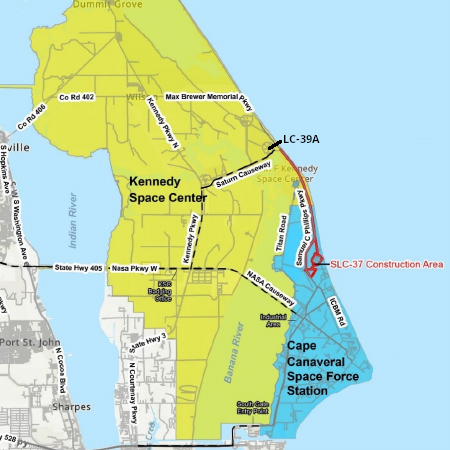
Proposed Starship/Superheavy launchsites at Kennedy and Cape Canaveral
Proposed Starship/Superheavy launchsites at
Kennedy (LC-39A) and Cape Canaveral (SLC-37)

It appears that though the FAA’s preliminary summary that it issued on January 30, 2026 only suggested it was leaning to approve Starship/Superheavy launches at SpaceX’s LC-39A launchpad at the Kennedy Space Center in Florida, it now appears that SpaceX is treating it as an official approval, and has begun work re-configuring LC-39A from the launchpad used for manned Falcon 9 launches to a facility for launching both Falcon Heavy and Starship/Superheavy.

The launch pad has seen a pause in action due to SpaceX working to finalize the Starship tower and launch pad on the site. Then on Wednesday, Feb. 4, a crane appeared next to the Falcon 9 launch tower, attaching to the crew access arm.

“For our manifest going forward, we’re planning to launch most of our Falcon 9 launches off of Space Launch Complex 40. That will include all Dragon missions going forward,” said Lee Echerd, senior mission manager of Human Spaceflight Mission Management at SpaceX during the Crew-12 prelaunch press briefing. “That will allow our Cape team to focus 39A on Falcon Heavy launches and hopefully our first Starship launches later this year.”

This Space News article today claims the FAA has issued a final approval for Starship/Superheavy at LC-39A, but it links to that preliminary summary from January 30th, which as far as I can tell is still preliminary and does not include an official approval.

Not that it matters. The FAA appears quite prepared to okay Starship/Superheavy launches at LC-39A, and it now appears SpaceX is proceeding under that assumption.

2 comments

FAA moves forward on its environmental assessment of SpaceX’s proposal to launch Starship/Superheavy from Kennedy Space Center

Proposed Starship/Superheavy launchsites at Kennedy and Cape Canaveral
Proposed Starship/Superheavy launchsites at
Kennedy (LC-39A) and Cape Canaveral (SLC-37)

While NASA has already determined that Starship/Superheavy launches from the Kennedy Space Center in Florida will have no significant impact on the environment, the FAA has not yet completed its own environmental impact statement.

Last week it released a preliminary summary [pdf] of its impact statement, revealing that it has reduced its final options to either approving SpaceX’s request to do as many as 44 launches per year, or to reject any changes — the “no action alternative” — which would block all Starship/Superheavy launches at Kennedy.

The overall tone of this summary suggests strongly that the FAA is almost certainly going to approve SpaceX’s request, allowing as many as 44 launches per year from launchpad LC-39A, as shown on the map to the right. As it notes in describing the “no action alternative”:

SpaceX would not launch Starship-Super Heavy from LC-39A. NASA would not develop, implement, or approve agreements with SpaceX associated with Starship-Super Heavy operations at LC-39A. The No Action Alternative would not meet the purpose and need. [emphasis mine]

In other words, rejecting SpaceX’s request would not fulfill the FAA’s obligation to serve the public. It would also not fulfill the FAA’s obligation to serve a fellow government agency, NASA, which has already approved this SpaceX request in a 2019 environmental assessment.

It appears a final decision by the FAA is imminent. A nice summary of this FAA document can be found here, which notes that if approved, it will give SpaceX license approval to launch Starship/Superheavy as much as 146 times per year, from its launchpads at Boca Chica, Kennedy, and Cape Canaveral. Note too that this FAA assessment is independent of the Air Force’s environment assessment, which has already approved 76 launches per year at the SLC-37 launchpad.

6 comments

Musk: Next Starship/Superheavy test launch in mid-March

According to a recent tweet by Elon Musk , the next Starship/Superheavy test launch will occur “in 6 weeks,” placing that launch sometime in mid-March.

Musk provided no other information, but this announcement suggests the company’s engineers now understand and have corrected the issues that caused two Superheavy ruptures during two different tank tests in recent weeks. It also suggests that the launchpad repairs and upgrades will soon be completed, and that a new version 3 Superheavy prototype is ready to go, replacing one that was damaged during those tank tests.

The mission specifics however remain unclear. SpaceX could repeat the flight path of the last few tests, in an orbit low enough so that the atmosphere will bring Starship down over the Indian Ocean. In such a flight the company would test refueling within Starship, restarts of its Raptor engines, and deployment of dummy or even real Starlink satellites.

It is possible however that this next test flight will go into a full orbit, and circle the Earth once or several times. SpaceX has said that in 2026 it intends to do a Starship refueling test using two Starships, launched several weeks apart. To do this more ambitious mission however it first needs to do at least one full orbital flight of Starship. Since the company has already tested on previous orbital test flights the restart of Starship’s Raptor engines — proving its capability to do a controlled re-entry — there really is no reason it can’t go for a full orbit on the next flight. There is even the possibility that Starship will come back to Boca Chica and be caught the company’s tower chopsticks, though this remains unconfirmed.

5 comments

The first preliminary research into landing a Mars helicopter in the Starship landing zone

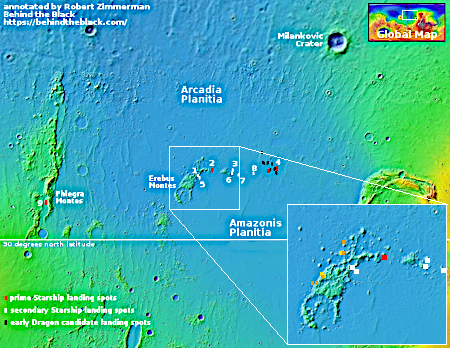
Map of rotorcraft images in Starship landing zone

In early November 2025 I posted a cool image from Mars Reconnaissance Orbiter (MRO) that had the very provocative label “Characterize Possible Rotorcraft Landing Site”. While this was not the first such image taken by scientists using MRO to scout out potential landing zones for future Mars helicopter missions (see here and here), this particular image was one of several taken recently that were all within the candidate landing zone for SpaceX’s Starship spacecraft, focused specifically on the low Erebus mountain chain that sits within this part of Mars’ northern lowland plains.

In the January image download from MRO, I found another such image, taken on December 1, 2025. The map to the right shows that Starship candidate landing zone, with all the images taken for SpaceX indicated. The inset adds all the recent images taken for this “possible rotorcraft” mission, including the December image and the previous four (here, here, here, and here), with orange representing images already obtained and yellow those requested but pending.

I decided I needed to find out more, and tracked down the scientist who had requested the images, Eldar Dobrea of the Planetary Science Institute in Arizona. In response to my email, he explained:
» Read more

7 comments

Review of SpaceX’s 2026 Superheavy/Starship test flights

Link here. The article begins by reviewing the work SpaceX is doing at both Boca Chica in Texas and Cape Canaveral in Florida. In the end, the company is aiming to have two Starship launchpads at Boca Chica and three launchpads in Florida, with both locations have extensive manufacturing facilities capable of building ships and boosters almost continually.

It then provides a nice review of all five Superheavy/Starship test flights that took place in 2025, a review that makes it very clear how much was accomplished, and indicates the possibilities for ’26. If SpaceX could manage almost one flight every two and a half months last year, despite two test stand explosions, the odds are excellent it will exceed that pace this year.

8 comments

SpaceX doing trial runs of specialized barge for transporting Starship/Superheavy from Boca Chica to Florida

SpaceX has now confirmed that it is doing trial runs of a barge specifically designed for transporting Starship/Superheavy from the manufacturing facility in Boca Chica to its Florida launchpads.

[SpaceX’s Vice President of Launch, Kiko] Dontchev also clarified that both the Super Heavy booster and Starship upper stage would be tilted to a horizontal position for maritime transit, in response to an artist’s rendering of a Starship traveling vertically aboard a vessel. “Initial deliveries are a single booster or ship per trip, with the plan to move to multiple vehicles per transit sooner than later,” he wrote. “You’ll thank me later.”

These barge trials, combined with the fact that SpaceX has already shipped significant Starship/Superheavy components to Florida even as it builds rocket manufacturing facility there, strongly suggest the first Florida launches are not too far in the future, possibly even this year.

10 comments

Next Starship/Superheavy launch in March?

According to this detailed update on SpaceX’s work at Boca Chica by NASASpaceflight.com, we should expect the next orbital test flight of Starship/Superheavy some time in March 2026.

As far as the launch date for this first flight of Block 3, sources point to March as the most likely viable timeframe. This launch will mark numerous firsts, from the vehicle, its Raptor 3 engines, and the first use of the upgraded Pad 2 architecture that will be mirrored at Pad 1, along with 39A and SLC-37 on the East Coast.

Block 3 refers to a major upgrade in Starship, which will fly prototype #39. Meanwhile, work getting Superheavy prototype #19 prepped has moved fast, following the loss of #18 from an explosion during ground fueling tests.

Recent observations show significant milestones: after welding the liquid oxygen (LOX) tank to the engine section (including pre-installed landing tanks and transfer tube), teams added methane tank barrels and the forward dome with its integrated hot staging ring. By December 20, all barrel sections were delivered and stacked, achieving this in just 25 days from November 25 — half the 42 days required for Booster 17, the final Version 1 booster.

The report also said that a February launch is a possibility, but is less likely.

Meanwhile, news outlets are reporting that the Trump administration is considering giving SpaceX about 775 acres in a wildlife preserve adjacent to Starbase in exchange for 692 acres SpaceX owns elsewhere. If confirmed, this deal would be similar to the land swap Texas had wished to do with SpaceX the company scrapped last year.

12 comments

SpaceX official confirms it is considering an IPO

In a message to employees on December 12, 2025, SpaceX’s chief financial officer, Bret Johnson, confirmed the company is considering issuing an initial public offering of stock sometime in 2026, but that nothing has been decided in any way.

His announcement also indicated the reason to do so would be to raise enough funds to “ramp Starship to an insane flight rate, deploy AI data centers in space, build Moonbase Alpha and send uncrewed and crewed missions to Mars.”

I think the question is whether the company is raising enough revenue from Starlink to do what it wants, or whether it now sees a need for more investment capital that it cannot get from either that revenue or private stock sales. If it finds in the coming months the former is sufficient, the stock sale will be put off, probably for several years. If it finds the latter, than we shall see this IPO sometime in 2026.

13 comments

Academia makes its first comprehensive attempt to plan science missions to Mars using Starship

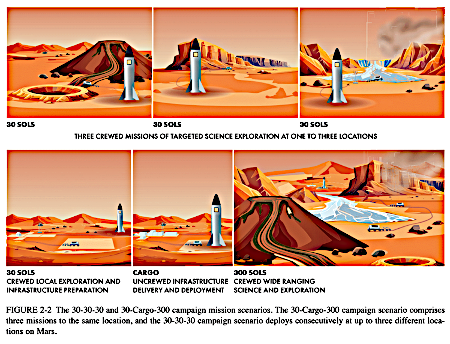
Figure 2-2 from the NAS report
Figure 2-2 from the National Academies
of Science report

A new report released today by the National Academies of Science, entitled “Highest Priority Science for the First Human Missions to Mars,” is essentially the first attempt by the planetary science community to plan its future science missions to Mars using the gigantic capabilities that SpaceX’s Starship is expected to provide them.

You can download the report here.

Even though the report made the search for life on Mars its big priority — a bugaboo that NASA and the science community trots out repeatedly to garner clicks from the ignorant propaganda press — this report is radically different then all previous similar NASA studies proposing future Mars exploration, as indicated by the graphics from figure 2-2 of the report to the right. Unlike those past studies, which were badly limited by the inadequate capabilities of any spacecraft NASA could send to Mars, this new report recognizes how much the game is changed by SpaceX’s Starship.

First, the new panel did not attempt to place any limit on any landing zones. Earlier reports had forbidden landings in the high latitudes or high altitudes because of the risks to NASA’s proposed landers. Starship overcomes much of those risks, giving researchers much greater flexibility.

Second, the focus of the missions will not be solely devoted to scientific or geological research, as had been the case for all previous similar reports by NASA and the academic community. Instead, the proposed research goals includes important engineering and human exploration requirements outside of science, including efforts to use the resources on Mars itself as well as find locations better suited for human habitation. Once again, the vastly greater capabilities of Starship influenced this change.

Even more important, the study doesn’t assume the future missions will be unmanned, as all previous NASA reports have done. In fact, it does the opposite, proposing multiple 30-day manned missions, as shown in the graphic. One set of three missions would go to three different locations, while another set of three missions would focus on one place in particular.

Much of this shift towards manned flight I think stemmed from the presence on the panel of representatives from the private companies SpaceX and The Exploration Company (a French startup), as well as an engineer from the National Academy of Engineering. Previously studies were almost always entirely dominated by planetary scientists, so the goals outlined were always focused on their interests. Now the idea of human exploration has become prevalent.

The panel’s work was clearly also influenced by the realization that SpaceX’s Starship is not only far more capable, its first flights are just around the corner. SpaceX plans sending it numerous times to Mars in the very near future, as shown in the graphic below that Elon Musk released during a presentation in May 2025.
» Read more

22 comments

SpaceX issues 1st statement regarding Superheavy test explosion

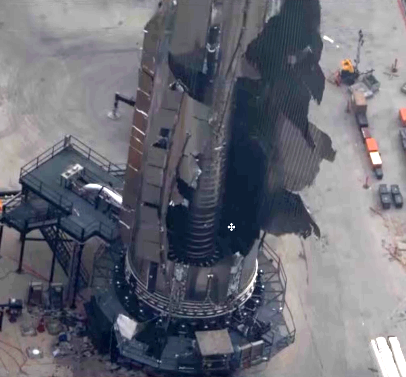
Damaged Superheavy
Click for original image.

SpaceX yesterday issued its first update regarding the explosion in the lower half of the Superheavy booster that it had planned to fly on the next orbital test flight.

Booster 18 suffered an anomaly during gas system pressure testing that we were conducting in advance of structural proof testing. No propellant was on the vehicle, and engines were not yet installed. The teams need time to investigate before we are confident of the cause. No one was injured as we maintain a safe distance for personnel during this type of testing. The site remains clear and we are working plans to safely reenter the site.

That no propellant was involved explains why the booster and test pad experienced relatively little damage. They were likely pumping nitrogen through the system to test it, and while something exploded, the gases were not volatile.

The picture to the right is a screen capture from aerial drone flights performed by RGV Aerial Photography and posted on nasaspaceflight.com. I have enhanced it to bring out the details. Note the lack of damage on all sides of the booster at its base. The explosion was clearly confined to the booster, and appears to have occurred from within.

22 comments

SpaceX and Arianespace make launch predictions for ’25 and ’26

In separate announcements this week, officials from Arianespace and SpaceX revealed their launch plans for the rest of this year and next.

First, Arianespace officials revealed yesterday that it is hoping to do six to eight Ariane-6 launches in 2026.

During a post-flight conference following the launch of Sentinel-1D, Arianespace CEO David Cavaillès stated that while the company preferred to wait until next year to reveal details about its 2026 launch manifest, it was aiming to double its launch cadence. He added that a cadence of between six and eight next year “will be great.”

If the company does manage eight Ariane 6 flights in 2026, it will already be close to reaching the stated maximum launch cadence of between nine and ten flights per year. When asked if this cadence could be increased, Cavaillès explained that the decision would be driven by customer demand.

Since customer demand for Ariane-6 has been quite low, because of its high cost, don’t expect this launch rate to rise much higher. Arianespace’s only big contract is 18 launches for Amazon’s Kuiper constellation. Once that is completed it is not clear where much future business will be coming from, even with some bureaucrats lobbying the European Space Agency to require its members to use it. There are too many cheaper options available now, with many more coming on line, both in America and Europe.

Next, a SpaceX official noted at a conference this week that the company hopes to complete another 25 to 30 Falcon 9 launches before the end of the year.

“We’re aiming for around 170 — between 165 and 170 — which means 25 to 30 more launches to go,” Kiko Dontchev, the company’s vice president of launch, said during a Wednesday session at the Space Economy Summit 2025.

…All together, “we’ll get to 2,400, 2,200 [metric tons launched] or something like that, which is absurd in the grand scheme of where things have been,” he added. Historically, that is close to the global record for metric tons launched to space by all companies and nations — about 2,500 metric tons in 2024, according to Jonathan’s Space Report, compiled by astronomer Jonathan McDowell.

In other words, SpaceX hopes its Falcon 9 rocket will this year alone place in orbit almost the same tonnage launched previously by everyone in the three-quarters of a century since Sputnik.

Cavaillès’ forecast means the company is likely to get very close to its prediction for launches at the beginning of the year, 180, that also included its Superheavy/Starship test launches. Quite an amazing achievement.

And as Al Jolson once said, “You ain’t seen nothin’ yet!”

9 comments

Someone is apparently considering putting a helicopter on Starship when it goes to Mars

Potential Starship helicopter location

In my regular trolling through the images sent down from Mars Reconnaissance Orbiter (MRO), I sometimes come across things that imply truly exciting future missions. That happened when in 2019 I found a bunch of photos each labeled as a “candidate landing site for SpaceX Starship”. Without fanfare SpaceX had begun researching locations for where it intended to land Starship on Mars, in the northern lowland plains, research that it later solidified considerably.

Similarly, I have found MRO images in 2022 suggesting scientists were thinking of running a helicopter mission inside Valles Marineris, the largest canyon in the solar system. Another image in 2024 suggested that a helicopter mission might go to another region in Mars’s southern cratered highlands.

The image to the right, cropped, reduced, and sharpened to post here, is another new example of a potential Martian helicopter mission. It was taken on August 19, 2025 and is labeled provocatively “Characterize Possible Rotorcraft Landing Site.” Unlike the previous two proposed helicopter locations, however — which appeared to be aimed at uncertain NASA funding — this image’s location suggests it is far more certain, and might launch far sooner than you can imagine.
» Read more

11 comments

Two former NASA administrators express wildly different opinions on NASA’s Artemis lunar program

At a symposium yesterday in Alabama, former NASA administrators Charles Bolden and Jim Bridenstine expressed strong opinions about the state of NASA’s Artemis lunar program and the chances of it getting humans back to Moon before the end of Trump’s term in office and before China.

What was surprising was how different those opinions were, and who said what. Strangely, the two men took positions that appeared to be fundamentally different than the presidents they represented.

Charles Bolden
Charles Bolden

Charles Bolden was administrator during Barack Obama’s presidency. Though that administration supported the transition to capitalism, it also was generally unenthusiastic about space exploration. Obama tasked Bolden with making NASA a Muslim outreach program, and in proposing a new goal for NASA he picked going to an asteroid, something no one in NASA or the space industry thought sensible. Not surprisingly, it never happened.

Bolden’s comments about Artemis however was surprisingly in line with what I have been proposing since December 2024, de-emphasize any effort to get back to the Moon and instead work to build up a thriving and very robust competitive space industry in low Earth orbit:

Duffy’s current messaging is insisting it’ll be accomplished before Trump’s term ends in January 2029, but Bolden isn’t buying it. “We cannot make it if we say we’ve got to do it by the end of the term or we’re going to do it before the Chinese. That doesn’t help industry.

Instead the focus needs to be on what we’re trying to accomplish. “We may not make it by 2030, but that’s okay with me as long as we get there in 2031 better than they are with what they have. That’s what’s most important. That we live up to what we said we were going to do and we deliver for the rest of the world. Because the Chinese are not going to bring the rest of the world with them to the Moon. They don’t operate that way.” [emphasis mine]

In other words, the federal government should focus on helping that space industry grow, because a vibrant space industry will make colonizing the Moon and Mars far easier. And forget about fake deadlines. They don’t happen, and only act to distort what you are trying to accomplish.

Meanwhile, Jim Bridenstine, NASA administrator during Trump’s first term, continued to lambast SpaceX’s Starship lunar lander contract, saying it wasn’t getting the job done on time, and in order to beat the Chinese he demanded instead that the government begin a big government-controlled project to build a lander instead.
» Read more

25 comments

New orbital radar data confirms large ice deposits in Phelgra Mountains near Starship landing zone

Overview map

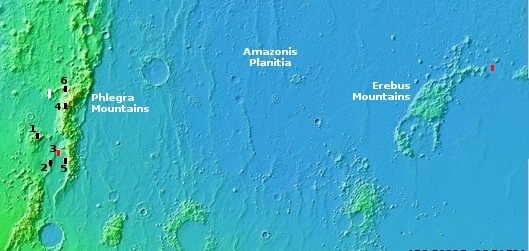
A new paper published this week used the SHARAD radar instrument on Mars Reconnaissance Orbiter (MRO) to confirm that the glacial features found everywhere within the Phlegra Mountains where one of Starship’s four prime landing sites is located contains significant quantities of very accessible pure water ice.

The red dots on the map to the right mark two of those prime landing sites, with one inside the Phelgra Mountains in a region directly studied by this paper. The numbered black dots were other images taken by MRO for SpaceX, reported here in 2020. From the paper’s abstract:

We examined mid-latitude landforms on Mars that resemble Earth’s debris-covered glaciers in a region called Phlegra Montes. Our study site is a 1,400-km-long mountain range in the northern hemisphere of Mars that houses numerous debris-covered glaciers also called Viscous Flow Features (VFFs). Using data from the SHallow Radar (SHARAD) instrument, we detected eight new glaciers and estimated the thickness and volume of ice within them as well as the thickness of the debris on top insulating the ice. Our findings suggest that the region holds around 1.2 trillion cubic meters of ice below the surface. We detected two notable types of glaciers for the first time on Mars using SHARAD: (a) a glacier system with terrace-like steps and (b) a perched “hanging” glacier on the eastern side of the mountains

The study also found that the layer of dust and debris that covers these glaciers and protects them from sublimating away ranges from 6 to 25 feet in thickness, well within reach of any future colonists.

This study only confirms what all the orbital data for the past two decades has suggested, that Mars is an icy world like Antarctica, not a dry desert like the Sahara. As the researchers themselves note in the very first line of their paper, “Mars is a frozen world where water ice is abundant above, at, and under the surface.”

Their research also confirms that SpaceX has made a good choice for its Starship prime landing sites. Though it will likely not make its first landing at site #3, because it is inside the mountains and thus more risky, expect a landing there not long thereafter.

7 comments

Fake blather from NASA administrator Sean Duffy to hide more Artemis delays

Sean Duffy
Sean Duffy: “Look at the shiny object!”

During a press interview yesterday, interim NASA administrator Sean Duffy revealed almost as an aside that NASA’s mid-2027 launch for the first Artemis manned lunar landing is no longer realistic, and that NASA is now targeting a 2028 launch date instead.

Duffy managed to hide this revelation by also announcing that he is re-opening the bidding for the manned lunar lander NASA will use on that third Artemis mission. To quote Duffy:

Now, SpaceX had the contract for Artemis III. By the way, I love SpaceX and it’s an amazing company, but the problem is, they are behind. They pushed their timelines out and we are in a race against China. The president and I want to get to the moon in this president’s term. So, I’m going to open up the contract and I’m going let other space companies compete with SpaceX, like Blue Origin. Whatever one gets us there first to the moon, we are going to take. If SpaceX is behind and Blue Origin can do it before them, good on Blue Origin.

By the way we might have two companies that can get us back to the Moon in 2028.

The propaganda press of course is going wild about this SpaceX announcement, making believe it signifies something of importance. “SpaceX is behind! Elon Musk can’t do it! Duffy is giving Jeff Bezos the job!” And as I think Duffy intended, everyone is ignoring the fact that NASA has now admitted it won’t meet that 2027 launch target.

The irony is that Duffy’s decision to re-open bidding on that manned mission is utterly meaningless. » Read more

34 comments
1 2 3 4 27