
NASA rejects Blue Origin’s proposed SLS upper stage

After considering an alternative bid by Blue Origin to build a less expensive upper stage for NASA’s SLS rocket, replacing the stage that Boeing is building, NASA has decided to reject that bid and stick with Boeing.

NASA sets out three reasons for not opening the competition to Blue Origin. In the document, signed by various agency officials including the acting director for human spaceflight, Ken Bowersox, NASA says Blue Origin’s “alternate” stage cannot fly 10 tons of cargo along with the Orion spacecraft.

Moreover, NASA says, the total height of the SLS rocket’s core stage with Blue Origin’s upper stage exceeds the height of the Vertical Assembly Building’s door, resulting in “modifications to the VAB building height and substantial cost and schedule delays.” Finally, the agency says the BE-3U engine’s higher stage thrust would result in an increase to the end-of-life acceleration of the Orion spacecraft and a significant impact to the Orion solar array design.

The article notes that there were also significant political reasons as well that pushed NASA to favor Boeing.

The article also states that SLS’s cost per launch will be about $2 billion. Though I think that number is probably low because it does not include any of the $25 billion spent for development, it does compare badly with SpaceX’s Falcon Heavy, which costs about $100 million per launch.

7 comments

NASA to fly more year-plus missions to ISS

Leaving Earth: In an effort to shift the research focus on ISS toward learning how to do interplanetary missions, NASA wants to fly more year-plus missions to the station.

Crewmembers usually spend about six months aboard the ISS before coming back down to Earth. But that’s far shorter than a Mars mission would be; the trip to the Red Planet takes eight to nine months one way with current propulsion technology. So, NASA wants more data about the effects of long-duration spaceflight on the physiological and psychological health of astronauts. (The ISS isn’t a perfect Mars analog in this respect, of course; it resides within Earth’s protective magnetosphere and is therefore exposed to less-damaging radiation than a Mars-bound craft would be.)

To date, the agency has launched just one yearlong ISS mission, sending Scott Kelly to live on the orbiting lab from March 2015 to March 2016. Russian cosmonaut Mikhail Korniyenko took part in this flight as well, spending 342 days in space, just like Kelly. NASA has also extended two other astronauts’ ISS stays into the “Mars transit” range: Peggy Whitson racked up 289 days of continuous flight in 2016 and 2017, and Christina Koch, who arrived on the orbiting lab in March, is now scheduled to come down in February 2020.

But these three data points aren’t enough, said [Julie Robinson, NASA’s chief scientist for the ISS Program],. “What we’re saying now is we want to really bump that up a notch and add 10 more subjects to that U.S. database,” she said.

The ISS Program has approved that plan, which NASA can start implementing once a private astronaut taxi is up and running, Robinson added.

NASA should have been doing this from the beginning, The Russians have always wanted to do longer missions, and have been frustrated by NASA’s resistance. That the agency is now pushing to focus ISS research on learning how to do interplanetary travel is wonderful news. It means that we will finally be using ISS properly.

3 comments

Boeing proposes manned lunar lander that bypasses Gateway

Capitalism in space: Boeing today announced its bid to build a manned lunar lander for NASA’s Artemis program, with its lander launched to go directly to the Moon rather than stopping at the proposed Lunar Gateway lunar space station.

The company said its “Fewest Steps to the Moon” proposal, submitted for NASA’s Human Landing Services program, minimized the number of launches and other “mission critical events” needed to get astronauts to the surface of the moon. “Using the lift capability of NASA’s Space Launch System Block 1B, we have developed a ‘Fewest Steps to the Moon’ approach that minimizes mission complexity, while offering the safest and most direct path to the lunar surface,” Jim Chilton, senior vice president for space and launch at Boeing Defense, Space and Security, said in a company statement.

The two-stage launched would launch on the enhanced Block 1B version of the rocket, which uses the more powerful Exploration Upper Stage (EUS), and go into lunar orbit. It would either rendezvous with the lunar Gateway or directly with an Orion spacecraft, where astronauts would board it for a trip to the lunar surface. The lander is designed to be launched as a single unit, rather than in separate modules that would be aggregated at the Gateway. The lander also doesn’t require a separate transfer stage to maneuver from a near-rectilinear halo orbit to low lunar orbit, as some other designs have proposed.

This approach, the company said in a statement, reduces the number of mission critical events, such as launches and dockings, to as few as five. Alternative approaches, Boeing claims, require 11 or more such events. [emphasis mine]

Boeing is essentially proposing a plan that makes Gateway unnecessary, a bidding ploy that very well might work with the Trump administration, which has already reduced Gateway’s initial construction to speed up its attempt to get to the Moon by 2024.

More important, Boeing’s proposal makes it very clear how unnecessary Gateway is, and how that boondoggle actually slows down our effort to return to the Moon. This is great news, for several reasons. First it shows that Boeing, one of the old big contractors that historically has depended on government dollars, is now publicly stating that it is not in favor of Gateway. This in turn makes it more politically acceptable for politicians to take this position. Expect more public advocacy against building Gateway.

Second, it shows that Boeing is trying to sell SLS. It wants Congress to appropriate more launches, and by showing Congress a cheaper way to use it the company is hoping legislators will buy into their proposal. SLS might be an exceedingly expensive rocket, but Gateway only makes it worse. Boeing is showing the world that there is a better and cheaper way to do things.

This also suggests that Boeing is recognizing the competition coming from SpaceX and others that might kill SLS, and is now trying to make SLS more competitive. While I am not a fan of SLS, if this proposal indicates an effort by Boeing is finally to make SLS more efficient and affordable I can only celebrate. The rocket has capabilities that are unique, and if its cost can be reduced in any way that can only benefit the U.S. effort to compete in the exploration and settlement of the solar system.

6 comments

TESS completes 1st survey of southern sky

The TESS science team today released its first full panorama of the southern sky, revealing everything the space telescope has imaged since launch in one image.

The glow of the Milky Way — our galaxy seen edgewise — arcs across a sea of stars in a new mosaic of the southern sky produced from a year of observations by NASA’s Transiting Exoplanet Survey Satellite (TESS). Constructed from 208 TESS images taken during the mission’s first year of science operations, completed on July 18, the southern panorama reveals both the beauty of the cosmic landscape and the reach of TESS’s cameras. “Analysis of TESS data focuses on individual stars and planets one at a time, but I wanted to step back and highlight everything at once, really emphasizing the spectacular view TESS gives us of the entire sky,” said Ethan Kruse, a NASA Postdoctoral Program Fellow who assembled the mosaic at NASA’s Goddard Space Flight Center in Greenbelt, Maryland.

Within this scene, TESS has discovered 29 exoplanets, or worlds beyond our solar system, and more than 1,000 candidate planets astronomers are now investigating.

A reduced version of this image wouldn’t show anyone its beauty or significance. I have embedded below the fold the short video at the link which shows it quite nicely. The video also summarized the mission quite well.
» Read more

1 comment

U.S. formally begins exit from Paris climate agreement

On Monday the Trump administration fulfilled one of Trump’s campaign promises and formally began the year-long process to exit the Paris climate agreement.

Secretary of State Mike Pompeo announced the move in a statement. “President Trump made the decision to withdraw from the Paris Agreement because of the unfair economic burden imposed on American workers, businesses, and taxpayers by U.S. pledges made under the Agreement,” Pompeo said. “The United States has reduced all types of emissions, even as we grow our economy and ensure our citizens’ access to affordable energy….The U.S. approach incorporates the reality of the global energy mix,” he added, arguing “innovation and open markets” will drive emissions reductions.

There is ample data that indicates the U.S. is beating the targets of the Paris accord, even though Trump made it clear very shortly after taking office that the government would no longer require its implementation.

The article is amusing in its biased effort to provide a soapbox for every special interest (from environmentalists to Democrats) to express their horror at Trump’s decision. Like most
mainstream outlets, it devotes practically no effort to give the whole story.

2 comments

China uses Long March 3B to launch GPS-type satellite

China yesterday successfully launched another Beidou GPS-type satellite, using its Long March 3B rocket.

The leaders in the 2019 launch race:

22 China
17 Russia
10 SpaceX
6 Europe (Arianespace)
4 ULA
4 India

China has now tied the U.S. 22 each in the national rankings, surging in launches to come from behind in the last few weeks. This is not surprising, in that China tends to concentrate its launches in the fall.

0 comments

Boeing & NASA declare pad abort test a success

According to the NASA press release for yesterday pad abort test of Boeing’s Starliner capsule, the test was a success even though one of three main parachutes did not deploy successfully.

A pitcharound maneuver rotated the spacecraft into position for landing as it neared its peak altitude of approximately 4,500 feet. Two of three Starliner’s main parachutes deployed just under half a minute into the test, and the service module separated from the crew module a few seconds later. Although designed with three parachutes, two opening successfully is acceptable for the test parameters and crew safety. After one minute, the heat shield was released and airbags inflated, and the Starliner eased to the ground beneath its parachutes.

All reports say that this parachute issue will not effect the December 17 planned launch of the first unmanned orbital flight to ISS.

I find NASA’s reaction to this anomaly fascinating. Previously the agency repeatedly made a very big deal about the slightest anomaly by both Boeing and SpaceX on any test or procedure. While the agency’s response to these problems could have been reasonably justified, the caution it sometimes exhibited, often causing significant delays that might have been avoidable, was somewhat disturbing, especially when contrasted with the agency’s willingness to accept far more serious issues in connection with SLS and Orion.

Now however, the agency has no problem with the failure of one parachute to deploy during this test. While I actually agree with this response, the contrast is interesting and suggests to me that politics and deadlines (with the Russian Soyuz contract running out) are finally exerting some influence over NASA’s safety people. I suspect it has been made clear to them that unless something really seriously goes wrong, as long as the tests would have resulted in living astronauts, the safety bureaucrats had better not stand in the way of progress.

If so, this is very good news. It means that, assuming nothing really goes wrong with the remaining tests, the first manned missions are finally going to occur next year, relatively early in the year.

Posted at the Hayabusa-2/OSIRIS-REx asteroid conference in Tucson this week.

8 comments

Interstellar space, as seen by both Voyager spacecraft

Today a suite of new science papers were published outlining what scientists learned when Voyager 2 joined Voyager 1 in interstellar space last November.

The Sun’s heliosphere is like a ship sailing through interstellar space. Both the heliosphere and interstellar space are filled with plasma, a gas that has had some of its atoms stripped of their electrons. The plasma inside the heliosphere is hot and sparse, while the plasma in interstellar space is colder and denser. The space between stars also contains cosmic rays, or particles accelerated by exploding stars. Voyager 1 discovered that the heliosphere protects Earth and the other planets from more than 70% of that radiation.

The data also shows that Voyager 2, which exited the heliosphere somewhat perpendicular to its direction of travel, is still in the transitional zone between the heliosphere and interstellar space. Voyager 1 exited out the head of the heliosphere, so its transitional zone was compressed and shorter.

The real achievement of these results however is that they were obtainable at all. For both spacecraft to be functioning so well after forty years in space, and able to get their data back to Earth from distances more than 11 billion miles, is a true testament to the grand engineering that went into their design and construction.

They built well in the mid-twentieth century.

4 comments

Sunspot update October 2019: Sunspot activity continues to flatline

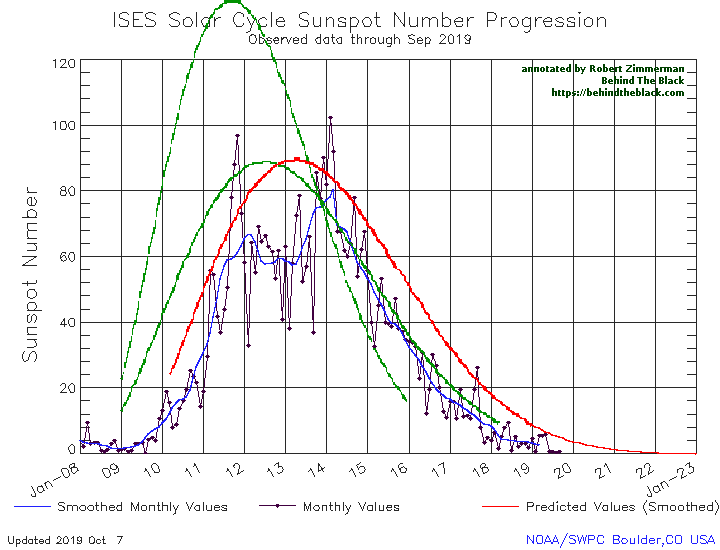
For the fifth month in a row the Sun has produced practically no sunspots, possibly the longest such stretch since astronomers began recording the sunspot cycle in the 1700s.

This flatlining is very obvious in NOAA’s October update of its graph showing the long term sunspot activity of the Sun, released yesterday, and posted below, with annotations:

October 2019 sunspot activity
The graph above has been modified to show the predictions of the solar science community for the previous solar maximum. The green curves show the community’s two original predictions from April 2007, with half the scientists predicting a very strong maximum and half predicting a weak one. The red curve is their revised May 2009 prediction, extended in November 2018 four years into the future.

SILSO October graph

As it has done in previous four months, in October the Sun produced practically no sunspots. The graph on the right, produced by Sunspot Index and Long-term Solar Observations (SILSO), shows only one weak sunspot at the beginning of October.

Even though the previous 2008-2009 solar minimum was one of the deepest and longest ever recorded, the lack of sunspots in the past five months has significantly beaten it for inactivity, as shown on the first graph above. That previous minimum never had a period of even two months with so few sunspots. Furthermore, the Sun has now been blank 74% of the time in 2019, a record of blankness that beats the yearly record of either 2008 or 2009. If the Sun continues to be as blank as it has been for the next two months, 2019 will easily set the record for the year with the fewest sunspots ever recorded.

The big question remains: Are we heading for a grand minimum with no sunspots for decades? We still do not know. Even these unprecedented trends prove nothing, as we really do not yet have a clear understanding of why the Sun undergoes these various cycles of sunspot activity/inactivity. The Sun could still come back to life in the coming years. We can only wait and see. As I noted however in last month’s sunspot update, the arrival of a new grand minumum, the first since the 1600s, could have important consequences:

During past grand minimums there is evidence that the Earth also cooled, though the link between the two phenomenon remains circumstantial and unproven. If we see another grand minimum, and the Earth once again cools, then we might be able to finally tie these two phenomenon together.

It is essential that climate scientists pursue this question. Answering it might very well defuse the fears presently expressed by leftist politicians and the leftist press of an oncoming period of global warming.

At the same time, it might also present us with the possibility of an oncoming period of significant global cooling, during which it will be so cold that we might face crop failures (as happened in the previous grand minimum in the 1600s).

We need to know what is going on with the Sun, and its consequences for Earth, as soon as possible. Whether we can find out this solar cycle is unlikely, but a cold hard look at the data would do much to answer the question.

I wonder however if there any climate scientists around willing to do so. Questioning human-caused global warming carries great career risks. In fact, taking any position counter to the prevailing wisdom on any scientific issue appears to carry risks, as demonstrated by the experience recently when a journal decided to publish a paper that questioned modern gender politics:
» Read more

23 comments
1 18 19 20 21 22 156