Curiosity looks backwards

Curiosity panorama looking southeast
Click for full resolution version. For original images go here and here.

Overview map
Click for interactive map.

Cool image time! The mosaic above was created from two photos taken on August 13, 2021 by Curiosity’s right navigation camera. It looks to the southeast, at the mountainous Martian terrain that the rover had been traveling just below for the past two months.

The overview map to the right shows with the yellow lines the approximate area covered by this mosaic. The white mountain at the top is the highest visible flank of Mount Sharp, and is beyond the right/bottom edge of the overview map. Mt. Sharp’s peak itself is not visible, as it is higher up and to the right. It is presently blocked by these mountainous foothills.

The science team probably took this image partly to provide another view of these mountains for comparison with earlier views. They can use this new data to look for changes as well as obtain better three-dimensional data.

They also took the image for the same reason I post it here. Having now climbed more than 1,500 feet from the floor of Gale Crater, Curiosity’s view is routinely spectactular. Why not enjoy it?

Mt. Sharp’s peak however is still about 13,000 feet above the rover. The climb up the mountain has just begun.

14 comments

Boeing to return Starliner to factory

Capitalism in space: According to a Wall Street Journal story today, Boeing and NASA have decided to remove the Starliner capsule from the Atlas-5 rocket and return it to Boeing’s factory in order to do a more thorough inverstigation into the capsule’s failing valves.

This decision means that the launch of the second unmanned demo test flight of Starliner will not occur in August, and will likely be delayed several more months. NASA and Boeing just held a press conference in which they made this decision official. During that conference they said they think the moist environment at Kennedy might have caused corrosion in the valves, which caused them to stick.

I once again wonder if Boeing has any quality control systems at all. For such a serious problem — the failure of 13 valves out of 24 — to suddenly pop up just hours before launch, when they have been developing this capsule for years, and even had an extra year and a half to check the capsule out after the failures during the first unmanned demo flight in December 2019, is somewhat astonishing, and very disturbing.

Others will argue that problems like this can always appear unexpectedly in space hardware. I say hogwash. Boeing is not inventing something new with Starliner. This is a capsule, using heritage engineering first invented in the late 1950s. It should not be so hard to get this right.

57 comments

South Korean company invests $300 million in OneWeb

Capitalism in space: Hanwah, a South Korean conglomerate, has now invested $300 million in private capital in the satellite communications company OneWeb.

U.K.-headquartered OneWeb expects regulatory approvals to complete the Hanwha transaction in the first half of 2022, bringing its total investment since emerging from bankruptcy protection in November to $2.7 billion. The startup has said it only needed $2.4 billion to fund its initial constellation of 648 satellites in low Earth orbit.

It reached that in June, after Indian telecom company Bharti Global doubled its investment to $1 billion to secure what would have been a 38.6% stake before Hanwha’s announcement. The U.K. government, French satellite operator Eutelsat and Japanese internet giant Softbank were each in line for just under 20% after making their own investments. U.S.-based Hughes Network Systems, which is supplying parts for OneWeb’s ground segment, also had a small stake.

Hanwha also wishes to build its own 2,000 satellite constellation, targeted for operation by 2030. This investment gives it access to OneWeb’s technology which it can later use.

For OneWeb, this new capital solidifies its full recovery from bankruptcy, and makes it a very viable competitor to SpaceX’s Starlink constellation.

0 comments

Russians accuse American astronaut of drilling hole in Soyuz

In several articles published today in the state-run Russian press, the Russians made the accusation that the hole and drilling damage that had been found on an in-orbit Soyuz capsule was put there by an American astronaut.

The first link above notes that while the Russians took a lie detector test, showing they didn’t drill the hole, the Americans refused. A second TASS link argues that their investigation proves that all the drill damage had to been done in orbit, for two reasons. First, they always test the capsule’s intergrity in a vacuum chamber before launch, and would have discovered it then. Second, the nature of the drill damage suggests it was done in zero gravity.

A third link provides an English translation of the more detailed Russian report, which made this direct accusation:

Firstly, the illness of the female astronaut, which is the first known incident of deep vein thrombosis in orbit, and the fact that Serena Maria Auñón-Chancellor had suffered the condition was published in a scientific article only after she had returned to Earth. This could have provoked ‘an acute psychological crisis’, which could have led to attempts by various means to speed up her return to the planet, according to my anonymous source. Secondly, for some reason unknown to Roscosmos, the video camera at the junction of the Russian and American segments was not working at that time. Thirdly, the Americans refused to perform a polygraph examination, while the Russian cosmonauts were polygraphed. Fourthly, Russia never had an opportunity to study the tools and the drill which are aboard the ISS to see if there are any signs of metal shavings from the hull of our ship’s orbital module.

This longer article also makes the claim that, because of the location of some of the drill attempts, whoever did drilling had no knowledge of the Soyuz’s construction.

All this may be true, but it conveniently ignores several very important facts: The one successful drillhole that caused the leak had been patched, which would have prevented any leak during the vacuum tests on the ground. The leak occurred because the patch was not designed to survive the hostile environment of space and eventually failed.

Also, the Russians’ own investigation had found that there was plenty of time on the ground for this sabotage to have occurred, so saying it had to have happened in space is incorrect.

Finally, the claim that the drill damage had to have been done in zero gravity is pure opinion, and hardly evidence.

In other words, it sounds as if the Russians are trying to shift blame from themselves (and an unknown ground worker) to an American astronaut. It is certainly possible that their claims are true, but they seem incredibly implausible. Much more likely would be sabotage on the ground by a very disgruntled Russian worker, routinely underpaid and resentful of the corruption that permeates Roscosmos and all of Russian society.

Such a conclusion however would be beyond embarrassing for the Putin government and the head of Roscosmos, Dmitry Rogozin. It is far better to place the blame on an American, especially because the end of the U.S.-Russian partnership on ISS is only a few years away.

11 comments

Branson sells more than ten million shares of Virgin Galactic

Capitalism ?in? space? Continuing his steady off-loading of Virgin Galactic stock since the company went public, Richard Branson has sold another 10.5 million shares, lowering his steadily shrinking ownership share another 4% to 18% total.

The sale garnered him $300 million in cash.

When the company went public in 2019, Branson reserved for himself 51% ownership. Since then he has periodically sold off large chunks, usually well timed to specifically planned events that worked to pump up the stock’s price. This last sale obviously was planned to take advantage of the publicity following Branson’s own suborbital flight in July.

While Virgin Galactic might have a future in suborbital space tourism, I remain very skeptical. It certainly does not have a future in the larger orbital market, as it has no experience building real rockets (Virgin Orbit was spun off this company years ago, taking with it all that experience). Thus, the company has very limited possibilities. As the orbital market grows and becomes dominant, I can’t see there being that much long term interest in short suborbital hops.

I think Branson agrees with me, which is why he is getting out when the getting is good. That he is following the classic and very corrupt method of “pump and dump” only solidifies my belief that he is an outright con-man.

That the mainstream press continues to genuflect before him only tells us how corrupt and incompetent that press has become.

2 comments

A chain of Martian sinkholes

Chain of sinkholes on Mars
Click for full image.

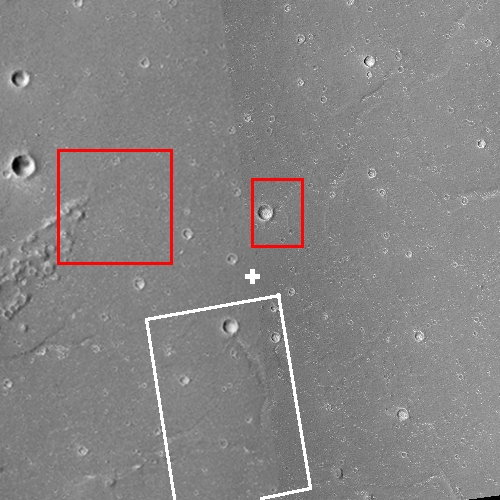
Cool image time! The photo to the right, rotated, cropped, and reduced to post here, was taken on June 17, 2021 by the high resolution camera on Mars Reconnaissance Orbiter (MRO). It shows a somewhat straight depression with several wider and deeper pits along it.

The feature immediately suggests sinkholes that exist because the ground is sagging into voids below ground. Yet, both the straight and circular depressions also appear filled, showing no evidence that they connect to any below ground cavities.

Are the sinks the result of a fissure produced by a graben, when two large blocks shift relative to each other to cause a fissure to appear? Or are they evidence of an underground lava tube? Or maybe they are the filled remains of a now mostly buried canyon carved by water or ice?

As always, a wider view helps clarify things, though whether it answers the question is uncertain.
» Read more

1 comment

Today’s blacklisted American: Leftist activist group wants Fox News banned

Fox News: Banned!

Blacklists are back and the Democrats have got ’em: A leftist activist veterans group aligned closely with the Democratic Party has begun a campaign to get Fox News banned from all military bases.

The group VoteVets, which works to elect liberal veterans to public office, took specific aim at controversial Fox News personality Tucker Carlson. Mr. Carlson has been at odds with Pentagon leaders in recent months after segments in which he seemed to suggest the U.S. military has become more concerned with diversity and political correctness than winning wars.

But the VoteVets petition steered clear of those issues. Instead, it took aim at Mr. Carlson‘s ambivalent comments about COVID-19 vaccines and specifically blasted a recent segment in which the Fox host said that Democrats want to make life difficult for the unvaccinated.

Essentially, this Democratic Party political organization wants to ban on military bases the speech of anyone who might express skepticism about any policy put forth by that party.

And why not? This tactic by Democrats and their ilk — of blacklisting and silencing their opponents — has been working like a dream. They are finding that Americans are afraid of them, and are willing to meet their every demand in order to avoid being attacked themselves.
» Read more

8 comments

The number of new smallsat rocket startups continues to grow

Capitalism in space: According to a new annual report, the number of new smallsat rocket startups that have been proposed continues to grow, though the number presently in actual development or operation declined slightly in the past year.

That total has grown to 155 vehicles, he said, ranging from 10 vehicles in operation to several dozen that have gone defunct since the survey started in 2015, when about 30 vehicles were included. “I was really expecting to see a slowdown in the number of new launch vehicles that we were seeing coming out of the woodwork in the last few years,” he said during a conference session Aug. 11. “It turns out that slowdown has not happened at all.”

There have been some changes in the industry, though. He found the number of vehicles in active development declined slightly from last year, to 48, with a decrease as well in the number of vehicle concepts on a “watch” list that have not yet entered active development. More than 40 vehicles are now classified as defunct, about 10 more than last year. “This is not surprising given the challenges of getting one of these vehicles fielded,” he said.

The U.S. has the most smallsat startups in development, 22, but China has the most that the report defines as operational, six of ten. This last number should change considerably if the planned launches of six or so American smallsat rocket startups occur as promised in the next six months.

2 comments

China to fly asteroid sample mission in ’24

The new colonial movement: Chinese scientists have revealed that China is now building an asteroid sample mission to launch in ’24 and grab samples in ’25 from the near Earth asteroid dubbed Kamoʻoalewa.

According to a correspondence in Nature Astronomy, there are two typical approaches to sampling asteroids like Kamoʻoalewa, namely anchor-and-attach and touch-and-go.

The former requires delicate and dangerous interactions with the planetary body but allows more controllable sampling and more chances for surface analysis. The latter, used by Hayabusa 2 and OSIRIS-Rex, is a quick interaction facilitated by advanced navigation, guidance and control and fine control of thrusters.

China’s mission will use both architectures in order to “guarantee that at least one works.” The paper states that there is “still no successful precedent for the anchor-and-attach architecture,” meaning a possible deep space first. A 2019 presentation reveals that China’s spacecraft will attempt to land on the asteroid using four robotic arms, with a drill on the end of each for anchoring.

The attempt to do both these approaches is audacious, especially because the evidence from both OSIRIS-REx and Hayabusa-2 is that it will be difficult to safely land and hold onto a rubble pile asteroid. The material is too loosely held together.

1 comment

Confirmed: Perseverance sample was too crumbly and poured away

Perseverance scientists have confirmed that the reason their sample container was empty once stored on the rover was because the material that they had drilled into was more crumbly than expected, and when the core was extracted from the ground the powder simply poured out of the core tube.

The team has decided to move on.

Rather than try again with the cratered floor fractured rough, Perseverance has already departed the area and is heading towards a region named South Séítah, which likely contains layered sedimentary rocks that are more similar to the Earth rocks that engineers drilled during tests before the mission’s launch. “We are going to step back and do something we are more confident of,” says Trosper. The rover will try to drill a core there, perhaps in early September. When it does, engineers will pause the automated drilling process to check whether a core has been extracted before the rover takes the next steps of sealing the tube and storing it away.

While it makes sense to find a different place to drill for a core sample, it appears that Perseverance is designed in a manner that it can do no analysis of any drill hole material:

Curiosity and Perseverance are similar in many respects — Perseverance was actually built using much of the leftover hardware from Curiosity — but there is one major difference in how they drill into the Martian surface. Curiosity intentionally grinds rock into powder, which it then places inside analytical instruments it has onboard to conduct scientific studies. NASA designed Perseverance to extract intact cores that slide into its sampling tubes. So crumbly rocks are good for Curiosity, but not for Perseverance.

If Perseverance can do no analysis of any drillholes, this limits the science it can do significantly. While putting aside samples for later return to Earth is an excellent idea, to make this the priority so that Perseverance can analyze nothing seems a terrible decision. What if that sample return mission never gets built?

If my supposition here is correct it also means NASA’s repeated claim that Perseverance is searching for ancient life on Mars is even more of a lie than I had assumed. It isn’t merely that this claim is a distortion of Perseverance’s actual research goals — to study the geology of Mars — the rover can’t look for ancient life. It has no way of looking at any samples it digs up.

I am not sure if my conclusions here are entirely correct. For example, maybe they hope to find this alien evidence by looking at the sealed core samples they store. Unfortunately, I have no idea, because I am somewhat handicapped in describing Perseverance’s day-by-day operations because, unlike Curiosity, the Perseverance team is providing no regular updates of their operations at their blog. While the Curiosity team posts something at least twice a week, the Perseverance team has posted nothing since just after landing in February. I’ve emailed NASA about this, but have gotten no response.

18 comments
1 62 63 64 65 66 167