A rock tadpole on Mars

A rock tadpole on Mars

Cool image time! The picture to the right, cropped, reduced, and sharpened to post here, was taken on January 11, 2024 by the left navigation camera of the Mars rover Curiosity.

The picture was highlighted in yesterday’s update from the rover’s science team, describing the team’s upcoming geological goals for the next few days.

We have observed resistant, polygonal fractures/ridges in many recent bedrock blocks. There is much speculation among the team as to the origin of these features. Hypotheses have different implications for past environments, and the polygonal fractures are therefore of high interest. As well as the polygonal fractures, there are more continuous linear veins. The relationship between the polygonal and linear fractures can also help to inform our interpretations

You can see the polygonal fractures in the full image. The thin line of rock sticking up from the tadpole illustrates one of these continuous linear veins. The material that fills the vein is obviously more resistent to erosion, so as the wind (and maybe ancient ice or water activity) scoured the rock into its tadpole shape, the vein material remained.
» Read more

3 comments

College professors insist all private activity in space must be regulated, by them

Now that private enterprise and free civilians are beginning to fly missions to space, independent of the government, “an international team of experts” have published a paper that demands that all future private activity in space be strictly regulated. From an article in the student newspaper of the University of Alberta:

Private citizens or corporations that collect data or research in space pose unique ethical concerns, Caulfield said. Previously, space travel was “largely funded by the public purse.” For example, the National Aeronautics and Space Administration (NASA) receives its funding from the United States government. Publicly funded research has to follow certain rules and there is a degree of oversight, Caulfield explained. But, “if space flight is funded primarily or largely by private companies like Blue Origin [and] SpaceX, what rules do they need to follow?”

Caulfield is Timothy Caulfield, the Canada Research Chair in Health Law and Policy and a professor in the University of Alberta’s faculty of law. He is also one of the twenty co-authors of this paper, the authors of which somehow think that because they teach at colleges they have better ethics that the owners of private space companies. Not only do they want to establish strict rules over what can be done in space, they want all research and data to be open source. The private data obtained by missions paid for by others must be available to everyone, even if they didn’t do a damn thing to get it.

These control freaks also insist that commercial space must follow standards of diversity, inclusion, and equity.

“This has been for too long dominated by old white men,” [Caulfield] said. “We’ve got to change that.”

O joy! We are here to help you! These idiots have ruined the entire academic community, making colleges worldwide cesspools of bigotry and race hate. They now want to impose their Marxist ideals to commercial space, probably because deep down they resent the fact that others are doing it and they are incapable of accomplishing anything on their own.

That Alberta’s student newspaper is all-in on these foolish ideas is especially disturbing. The students appear to have been brainwashed to accept such stupidity, and since they represent the future, it tells us what that future will be like.

14 comments

Next manned mission to ISS to launch tomorrow

The next manned mission to ISS, a private mission by the company Axiom carrying three European astronauts and commanded by an Axiom astronaut, is presently scheduled to launch tomorrow, January 18, 2024, at 4:49 pm (Eastern).

This is a private mission by Axiom, launched on SpaceX’s Falcon 9 and flying the astronauts in its Freedom Dragon manned capsule. This will be Freedom’s third flight to ISS. The launch was originally scheduled for today, but SpaceX scrubbed the mission today in order to give it “additional time allows teams to complete pre-launch checkouts and data analysis on the vehicle.” It appears during normal prelaunch checkouts engineers found the joints between the upper stage and the capsule were not tightened the proper amount. The company decided to replace the joints, which caused this one day delay.

The crew will spend up to fourteen days at ISS.

I have embedded a live stream of the launch below.
» Read more

0 comments

Webb confirms the unusual shape of early galaxies as seen by Hubble

Earth galaxies shapes, as seen by Webb in infrared
Click for original image.

The uncertainty of science: The infrared view of the Webb Space Telescope appears to have confirmed and even underlined the unusual shapes of many early galaxies as previously seen by the Hubble Space Telescope.

Researchers analyzing images from NASA’s James Webb Space Telescope have found that galaxies in the early universe are often flat and elongated, like surfboards and pool noodles – and are rarely round, like volleyballs or frisbees. “Roughly 50 to 80% of the galaxies we studied appear to be flattened in two dimensions,” explained lead author Viraj Pandya, a NASA Hubble Fellow at Columbia University in New York. “Galaxies that look like pool noodles or surfboards seem to be very common in the early universe, which is surprising, since they are uncommon nearby.”

The team focused on a vast field of near-infrared images delivered by Webb, known as the Cosmic Evolution Early Release Science (CEERS) Survey, plucking out galaxies that are estimated to exist when the universe was 600 million to 6 billion years old.

While most distant galaxies look like surfboards and pool noodles, others are shaped like frisbees and volleyballs. The “volleyballs,” or sphere-shaped galaxies, appear the most compact type on the cosmic “ocean” and were also the least frequently identified. The frisbees were found to be as large as the surfboard- and pool noodle-shaped galaxies along the “horizon,” but become more common closer to “shore” in the nearby universe.

The galaxies also appear generally far less massive than galaxies in the near universe, which fits with the Big Bang theory that says they had less time to grow.

The press release notes that the sample size is still very small, and further observations will be required to confirm whether these shapes are common in the early universe.

0 comments

Private satellite tracking companies track both China’s and the Pentagon’s X-37Bs

Two different commercial satellite tracking companies, LeoLabs and ExoAnalytics, are using their global network of radars and telescopes to track the movements of China’s X-37B mini-shuttle, dubbed Shenlong (“Divine Dragon” in English), as well as the Pentagon’s own X-37B, both of which launched recently.

LeoLabs activated its new radar system in Western Australia early last year. It’s now part of a 10-radar global network tracking the trajectories of satellites and debris so commercial operators can safely navigate the increasingly congested orbits. “We can see what’s happening in Low Earth Orbit because that’s where radar is dominant,” he explains. “But activity in higher orbits can be tracked with specialised optical telescopes. ExoAnalytics, a US commercial company, has 400 of these deployed worldwide, with 11 sites in Australia.”

LeoLabs’ radars are tracking Shenlong in its low Earth orbit. Since the U.S. X-37B is in a higher orbit, it is being monitored by ExoAnalytics.

Both these companies now provide satellite tracking services that were once the sole domain of the U.S. military. Not only does the military buy their information, so do private concerns in the U.S., since their networks track everything, not simply the two X-37Bs. Those unique craft however make for good press copy, and thus help both to sell their services to the world.

Note too that this is the first time I have seen a name attached to China’s X-37B. Previous reports never gave it a name.

3 comments

Military awards satellite contracts worth $2.5 billion to three companies

The Pentagon’s Space Development Agency (SDA) today announced the award of contracts to Sierra Space, Lockheed Martin, and L3Harris for the construction of 54 reconnaissance satellites, with a total value of $2.5 billion.

The 54 satellites will form part of the SDA’s Proliferated Warfighter Space Architecture, a massive missile detection and tracking constellation in low Earth orbit that’s being built and launched in “tranches.” The trio of contracts announced today is for 18 satellites each in the Tranche 2 Tracking Layer: L3Harris’s award is worth $919 million; Lockheed Martin, $890 million; and Sierra Space, $740 million.

Last week SDA had awarded Rocket Lab its own 18-satellite contract for this constellation, worth $515 million.

The contract awards signal several major changes in the Pentagon’s space strategy. First, it is farming the work out to multiple companies, two of which (Rocket Lab and Sierra Space) are new. In the past the military relied on a very limited number of companies, all well established, with most contracts going to only one vender. New companies had great difficulties getting in the door.

Second, it is building a constellation of smallsats rather than single large satellites. Smallsats are cheaper to build and replace, and are much harder military targets to hit.

Third, though it appears the military is designing these satellites, it appears it is still shifting much of the work from it to the private sector. In other words, the Pentagon is becoming a customer instead of a builder. The result will be a healthy space industry capable of doing more for itself and the military.

0 comments

January 16, 2024 Quick space links

Courtesy of BtB’s stringer Jay, who returns after his work took him away from us last week.


  • Australian activists protest proposed commercial spaceport
  • They claim rockets pose a threat to wildlife, even though we now have almost three-quarters of a century of evidence that they do exactly the opposite, help wildlife. Just shows us that leftists are proudly ignorant, and are irrationally against everything.


2 comments

Toxic and incompetent academia

Coca-Cola's bigoted company policy
Examples of the DEI materials from Coca-Cola,
developed in academia and now used in corporate America

The effort nationwide in many legislatures to end the very racist “Diversity, Equity, and Inclusion” (DEI) departments that now poison universities everywhere are not only failing, they are illustrating the emptiness of most of that effort.

In Georgia, for example, political pressure on the state’s university system forced it last year to ban DEI statements from any applicants for teaching positions. The university system was also required to “…eliminate references to ‘diversity’ and ‘diverse’ from the standards and replace them with the terms that are allegedly easier to understand.”

These mere semantic demands were quickly warped by the universities, which instead of eliminating such bigoted programs, which create quota systems that favor the hiring of some races over others, the universities simply renamed the statements and the DEI programs to meet the letter of the ban, but not its spirit.
» Read more

1 comment

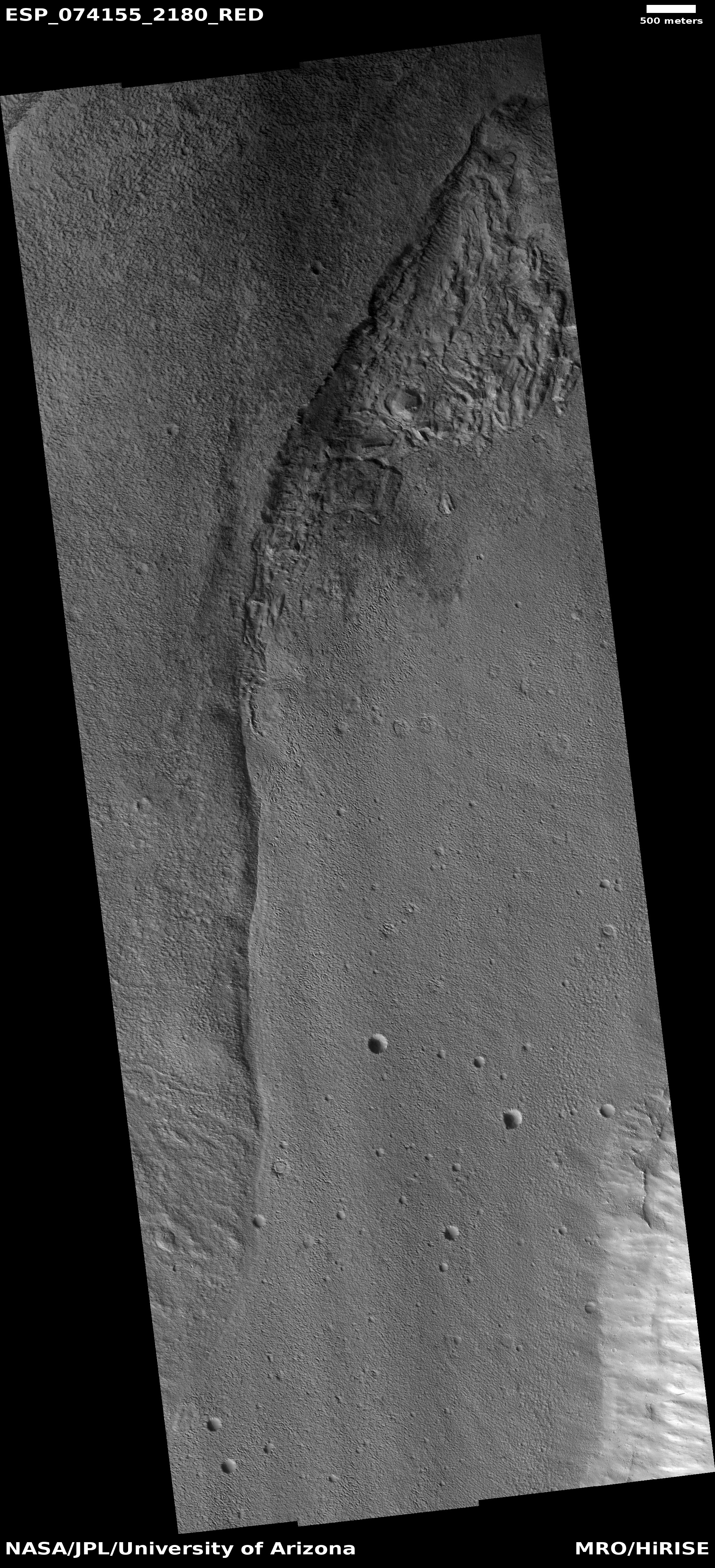
Gullies and avalanches in Martian crater

Gullies and avalanches in a Martian crater
Click for original image.

Cool image time! The picture to the right, cropped, reduced, and sharpened to post here, was taken on September 17, 2023 by the high resolution camera on Mars Reconnaissance Orbiter (MRO). It shows two significant features, both of which suggest the action of near-surface water ice to change to surface of Mars.

First are the gullies on the cliff wall, which also happens to be the interior slope of a 30-mile-wide crater. Since the first discovery of gullies on Mars, scientists have pondered their origin, with all their hypothesises always pointing to some form of water process. One popular theory [pdf] points to some form of intermittent water flow linked to long term climate cycles caused by the extreme shifts in the red planet’s rotational tilt, from 11 to 60 degrees. Another theory suggests the gullies form from the winter-summer freeze-thaw cycle and the accumulation of frost during winter.

The second feature are the three avalanche debris piles at the base of these gullies. The long extent of each suggests the avalanches flowed more like wet mud than falling rocks. If the ground here was impregnated with ice, than this look makes sense.
» Read more

0 comments

Indian satellite startup opens new satellite factory

Capitalism in space: The Indian satellite startup Pixxel has opened a new factory in Bengaluru in southern India, where it expects to ramp up satellite production in the coming years.

Bengaluru-based space data company Pixxel inaugurated its first spacecraft manufacturing facility in Bengaluru on Monday. The new facility holds significance as it targets to launch six satellites this year and 18 more by 2025, further advancing its mission of building a “health monitor” for the planet.
Spread across 30,000 square feet, the facility, at its full capacity, is equipped to handle more than 20 satellites simultaneously that can be turned around within a timeframe of six months, making possible a total of 40 large satellites per year.

The company says that its “…total customer base is divided into three divisions as of now – 40 per cent agriculture, 30 per cent resource companies, and 30 per cent government. Pixxel expects 85 per cent of the revenue to be generated from its commercial side and the rest from the government’s side by 2025.”

For India’s government and its space agency ISRO, Pixxel’s existence signals the sea-change in its policies, similar to what has been happening in the U.S. with NASA. In the past ISRO would have built the satellites. Now it is buying them from the private sector in India. That shift bodes well for India’s space industry, and will likely make it a major player in space in the coming years.

0 comments

SpaceX’s Starlink: More satellites in orbit but fewer close encounters

According to a recent filing with the FCC, SpaceX has found its Starlink constellation had to do fewer collision avoidance maneuvers in the past six months, despite having more satellites in orbit.

In that period, Starlink satellites had to perform 24,410 collision avoidance maneuvers, equivalent to six maneuvers per spacecraft. In the previous reporting period that accounted for the six months leading up to May 31, 2023, the constellation’s satellites had to move 25,299 times. The data suggests that even though the Starlink constellation has grown by about 1,000 spacecraft in the last six months, its satellites made fewer avoidance maneuvers in that period than in the prior half year.

At the moment it is not clear why the number dropped, especially as it had been doubling every six months previously as more satellites were launched. This might signal improved more precise orbital operations, or it could simply be a normal fluctuation. It will require additional reports to get a better sense.

These numbers however should rise as more larger satellites constellations (from Amazon and China) start launching as expected.

2 comments
1 438 439 440 441 442 2,916