Yamma Ensemble – Kondja mia

An evening pause: This song is an example of what the group calls the tribal music of Sephardic Jews. The title of the song means “My rose.” Leave the closed captions on to see an English translation of the lyrics, which are quite beautiful. It is all very Middle Eastern, and something the Palestinians would recognize and like, until you told them it was by their fellow Semites, the Jews.

Hat tip Judd Clark.

0 comments

Can the shift in black vote to Trump overcome the Democratic Party’s vote tampering?

The Democratic Party: Fostering election tampering everywhere
The Democratic Party

Today JJ Sefton in his daily morning report (also available here) included some excellent commentary about the growing polling evidence showing the black vote shifting rightward to Trump, in numbers that are unprecedented in more than a half century.

Whatever one thinks of polling especially this far out (or near, since elections are either light years away or right around the corner depending upon oneโ€™s perspective!) is an eye-opener. In normal, non-rigged elections, if Dem support from blacks drops below 93%, that is a major alarm bell for the former. What this aggregate poll [21.9% of blacks for Trump] shows is a potential disaster. Even if as we can all assume the key swing states which have large urban areas that will be rigged for Biden, the amount of cheating will have to be so massive that it would be even more obvious than what we witnessed four years ago. [emphasis mine]

I want to focus on the highlighted sentence, and try to bring some reality to it. Only by doing so will the Republican Party and Donald Trump have any chance of winning.
» Read more

14 comments

The divide in a giant Martian lava river

The divide in a giant Martian lava river
Click for original image.

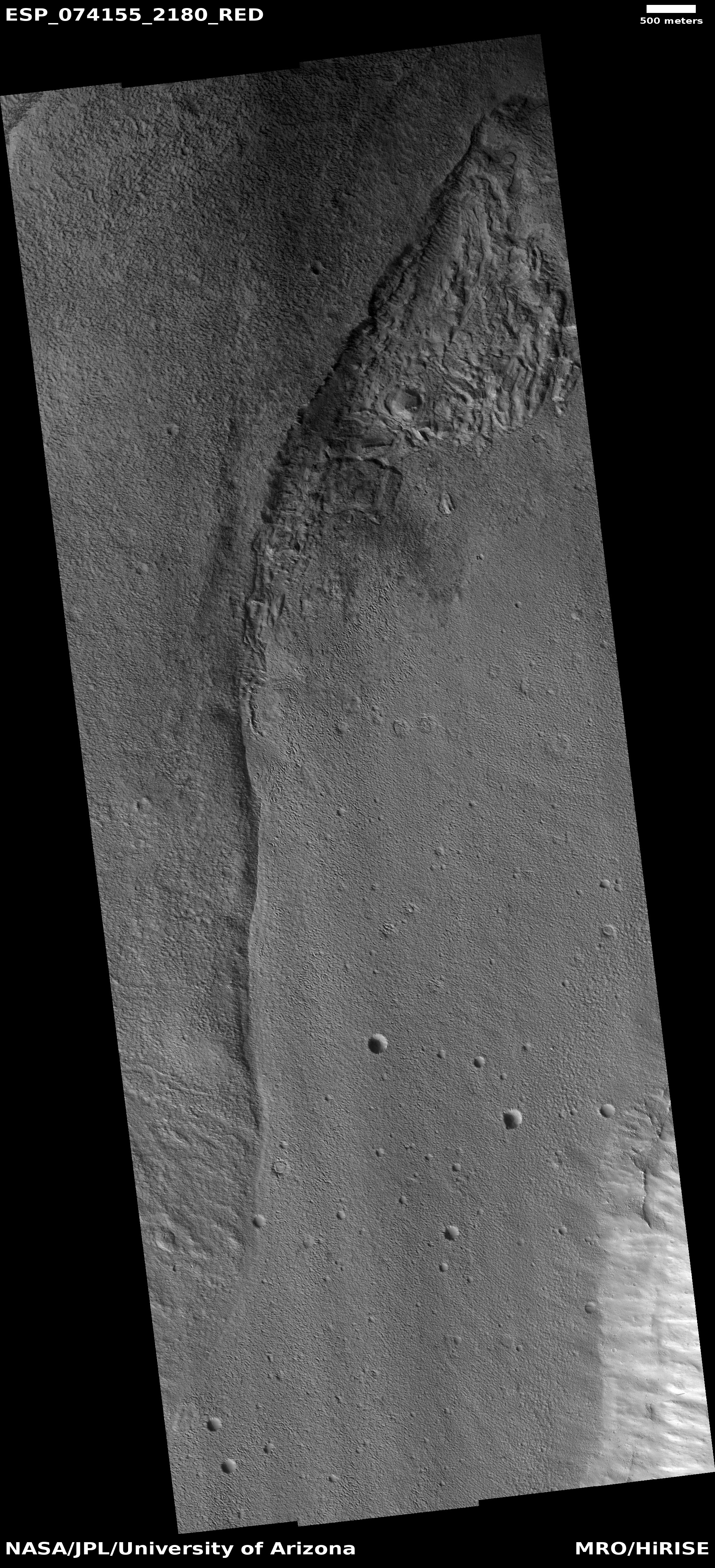
Cool image time! The photo to the right, rotated, cropped, reduced, sharpened, and annotated to post here, was taken on September 24, 2023 by the high resolution camera on Mars Reconnaissance Orbiter (MRO).

As indicated by the arrows, this is a frozen river of lava on Mars, flowing to the southwest and then splitting into two streams, one to the west and the other to the south. Being a Martian lava flow, when it was liquid it flowed much faster than lava on Earth, almost like a thick water. The flow bored into any high features, such as the two mesas in this picture, and streamlined their shapes, tearing material away as the lava moved by quickly. In the process the lava flow exposed many layers in those mesas, indicating many other previous lava flow events.

The crater in the lower mesa, where the stream splits, appears to have been more resistent to the flow, having been compacted into harder and denser material by the impact itself.
» Read more

0 comments

Elon Musk’s employee update released January 12th

I have embedded below an employee update of the status of all of SpaceX’s projects, given by Elon Musk and released publicly on January 12, 2023. The video has been edited only to remove the many enthusiastic applauses by Musk’s audience of co-workers in order to shorten it.

Though Musk provided a lot of general information about the company’s long term goals with Starlink, Starship, Mars, the Moon, and other topics, these are the most important take-aways relating to its ongoing efforts now:

  • Falcon 9: The company is now upgrading its first stage so that it will be able to fly reused forty times, not twenty. Musk also noted that they have now reused the rocket’s fairings more than 300 times.
  • They are now aiming for about 150 launches in 2024. (It appears now that the biggest obstacle to this goal will be weather, as seen by the weather delays that have stalled Falcon 9 launches this very week.)
  • The Dragon fleet has now spent more days at and flights to ISS than the NASA’s entire shuttle fleet.
  • Starlink: It is a supplement to present phone and internet service, not a replacement, serving remote areas. Its biggest obstacle now however to providing that service is government approvals. The company is blocked by regulators in many places where the service is operational.

On Starship/Superheavy, he revealed these facts:

  • They are planning to double its payload capacity to 200 tons to orbit, twice the Saturn-5.
  • Starship would have made orbit on the second orbital test if it had had a payload. To simulate the weight of payload it had carried extraoxidizer, and when it vented these as it approached orbit it caused problems that activated the self-destruct system.
  • The third orbital test flight will thus almost certainly reach orbit, and will then test engine burns, some refueling technology, payload deployment, and de-orbit procedures.

Musk emphasized that they must be able to fly these tests frequently to get Starship/Superheavy functioning, not just for SpaceX but for NASA’s Artemis program. As he said, “Time is the one true currency.” With each launch they refine the system to make it more reliable and operational. Without those launches they can’t.

He did not mention why launches might not happen frequently, probably because the last thing he needs to do is antagonize the regulators who are slowing him down. I (and other journalists) however are not under that restriction. The biggest obstacle to SpaceX’s success is the red-tape being wound around it by the Biden administration and its love of strict regulation, possibly instigated by its political hostility to Elon Musk as a person.

This government action to stymie freedom must end, and the sooner the better.
» Read more

31 comments

Peregrine still operational but expected to burn up in Earth’s atmosphere

Peregrine flight path as of January 13, 2024
Click for original image.

According to an update yesterday from Astrobotic’s engineering team, the damaged lunar lander is likely to enter the atmosphere burn up when its orbit brings it back to Earth in about a week.

In an update the day before, the company released a graph of the spacecraft’s position in relation to the Earth and Moon, shown to the right. From that update:

Peregrine remains operational at about 238,000 miles from Earth, which means that we have reached lunar distance! As we posted in Update #10, the Moon is not where the spacecraft is now (see graphic). Our original trajectory had us arriving at the Moon on day 15 post launch. Our propellant estimates currently have us running out of fuel before this 15-day mark

The plan had apparently been to circle the Earth twice in this elongated orbit, with the second orbit (after some mid-course corrections) bringing Peregrine close enough to the Moon (after it had moved further in its orbit) to be captured by its sphere of influence. With the loss of fuel due to the leak, the spacecraft doesn’t have the fuel to do any of the required engine burns, including one that would avoid the Earth’s atmosphere upon return.

11 comments

Momentus delays next orbital tug mission due to lack of funds

The orbital tug startup Momentus has now delayed its next orbital tug mission, scheduled to launch in March on a SpaceX Falcon 9 rocket, due to shortage of cash in the bank.

In a filing with the U.S. Securities and Exchange Commission Jan. 12, Momentus announced it did not plan to fly its next tug, Vigoride-7, on SpaceXโ€™s Transporter-10 rideshare launch in March. The company said it called off the flight because of its โ€œinability to support continuing operations for the expected launch date as a result of the Companyโ€™s limited liquidity and cash balance.โ€

The company said in November that it has signed up seven customers who planned to deploy satellites on Vigoride-7 and two other customers who would operate hosted payloads on the vehicle, but did not identify then. Momentus also intended to fly a rendezvous and proximity operations demonstration on the vehicle as part of its long-term plans for reusable tugs.

Momentus also announced the layoff of 20% of its full-time workforce, on top of the 30% layoffs which occurred in the third quarter in 2023. It appears from the SEC filing that these layoffs are a result of not winning the military contract to build its Tranche-2 constellation, won by Rocket Lab earlier this week.

The company is presently seeking new investment capital.

6 comments

Ed Sussman – How the Beach Boys used the Theremin

An evening pause: Some intriguing music history centered on the electronic instrument called the Theremin, which you play electronically by moving your hands through an electric field (go here to see two previous evening pause examples).

Hat tip Mike Nelson.

1 comment

Another look at the increasing regulatory burden impacting commerical space

Link here. The author does a nice job summarizing the problems now becoming evident as the administration state strives to expand its power and control. Though he gives space to both sides, allowing the defenders of that administrative state to explain why strong regulations are good, he doesn’t bow to those defenders, as do too many modern journalists.

That he quotes me extensively (and has has told me personally that he is a regular reader of Behind the Black), might have something to do with this. He isn’t parroting my positions, however, in this essay, but giving his own perspective.

Definitely worth reading.

6 comments

A cluster of strange terrain in Martian glacier country

Overview map

A cluster of strange terrain on Mars
Click for original image.

Cool image time! The picture to the right, rotated, cropped, reduced, and sharpened to post here, was taken on October 21, 2023 by the high resolution camera on Mars Reconnaissance Orbiter (MRO).

The science team labels this “patterned ground.” I see instead a whole range of inexplicable Martian geological features that, while each has been documented previously, each remains puzzling as to its formation process.

First there is the stucco-like peaks of all sizes on the upper left. This surface really looks like it had been wet plaster covered with Saran Wrap that had its peaks pulled up when that wrap was pulled off quickly.

Then there is brain terrain on the right. Always associated with glacier features on Mars, these convolutions are unique to Mars and as yet not entirely understood.

Next there is the circular arc on the middle left. It appears to be the remains of an impact crater now filled partly, but if so why has its northern rim disappeared so completely?

If you look close at the image above as well as the full image, you will find other mysterious features as well.

The location is the white dot on the overview map above. The rectangle in the inset shows the area covered by this picture, part of the floor of an unnamed eighteen-mile-wide and one-mile deep crater. The glacial material that appears to fill its interior as well as the splash apron that surrounds it all suggest the ground here is impregnated with water ice. Located as it is on the western end of the 2,000-mile-long north mid-latitude strip I dub glacier country — where practically every image shows glacial features — this conclusion is not surprising.

In fact, this photo illustrates well the alieness of Mars. We understand glaciers and ice, but on Mars, with its very cold temperatures, one-third Earth gravity, and thin atmosphere, those glaciers and ice are able to do things that we don’t yet understand. Untangling these geological processes will take decades of work, and likely will not be completed until people can walk the Martian surface and study it up close.

And won’t that be fun?

0 comments
1 439 440 441 442 443 2,916