Tan Ce Ding – The Masseuse
An evening pause: The future?
Hat tip Jim Mallamace, who added, “What is our responsibility to our devices when they become self-aware? And what will be our responsibility to each other?
An evening pause: The future?
Hat tip Jim Mallamace, who added, “What is our responsibility to our devices when they become self-aware? And what will be our responsibility to each other?

Click here and here to see full images.
Cool images from Hubble! The two photos to the right, cropped and reduced to post here, shows two different galaxies undergoing a collision with another galaxy. Both images are from of a montage of six galaxy merger images from the Hubble Space Telescope, released yesterday.
To celebrate a new year, the NASA/ESA Hubble Space Telescope has published a montage of six beautiful galaxy mergers. Each of these merging systems was studied as part of the recent HiPEEC survey to investigate the rate of new star formation within such systems. These interactions are a key aspect of galaxy evolution and are among the most spectacular events in the lifetime of a galaxy.
It is during rare merging events that galaxies undergo dramatic changes in their appearance and in their stellar content. These systems are excellent laboratories to trace the formation of star clusters under extreme physical conditions.
The first galaxy merger to the right is dubbed NGC 6052, and is located in the constellation of Hercules about 230 million light-years away. This pair of colliding galaxies, according to the caption, “were first discovered in 1784 by William Herschel and were originally classified as a single irregular galaxy because of their odd shape. However, we now know that NGC 6052 actually consists of two galaxies that are in the process of colliding.”
The second image shows two galaxies, IC 694 and NGC 3690, about 700 millions after they had completed a close pass of each other. From the caption: “As a result of this interaction, the system underwent a fierce burst of star formation. In the last fifteen years or so six supernovae have popped off in the outer reaches of the galaxy, making this system a distinguished supernova factory.”
You can see all six merger images here, though to my eye these two are the most impressive.
Cool image time! The photo on the right, rotated, cropped, reduced, and annotated to post here, was taken by the high resolution camera on Mars Reconnaissance Orbiter on October 6, 2020. It shows the northern interior rim of 42-mile-wide Greg Crater in the southern cratered highlands of Mars.
What makes it interesting is the curving ridge that appears to drape itself around several larger hilltops. That ridge is a moraine, the debris or glacial till that accumulates at the foot of glaciers as push their way down hill. As the glacier had flowed those hills became obstacles, so that the glacier (and its moraine) were forced to go around.
The overview map and wider view from the context camera on MRO below give the setting.
» Read more
Capitalism in space? Momentus, aiming to provide satellite makers a tug that can move satellites to their preferred orbit, has delayed its first mission because the many bureaucrats in the federal government need more time to review the paperwork.
In a Jan. 4 statement, Momentus said the flight of its first Vigoride tug, which was to be part of the payloads on a Falcon 9 dedicated rideshare mission launching as soon as Jan. 14, will be delayed to later in the year because it was unable to get approval from the Federal Aviation Administration for the mission. โThis move will allow for the additional time necessary to secure FAA approval of Momentusโ payloads, including completion of a standard interagency review,โ the company said in a statement.
The company did not elaborate on that review, but part of the FAA commercial launch licensing process is a review of the payload that the agency describes as intended โto determine whether its launch would jeopardize public health and safety, safety of property, U.S. national security or foreign policy interests, or international obligations of the United States.โ That process can include consultation with other government agencies.
In a Jan. 5 document filed with the Securities and Exchange Commission in the form of an interview, Fred Kennedy, president of Momentus, said there was no specific issue that was delaying that review. โThe FAA did not express any specific concerns of its own, but rather indicated that more time was needed to complete its interagency review of Momentusโ payload,โ he said. [emphasis mine]
The highlighted words reveal the truth. There is nothing wrong with the payload or its tasks. The problem is that several government agencies have not completed the paperwork, and so Momentus must wait. I imagine that there is a thick application sitting on some bureaucrat’s desk, requiring a signature, and that bureaucrat has been too busy collecting his or her paycheck at home because God forbid he or she might get the cororavirus by coming into work.
This is modern America. You don’t have the real freedom to do what you want. You must sit, twiddling your thumbs, while your betters in Washington decide whether they will allow you to do it. It doesn’t matter they know little or nothing about your goals. All that matters is that they are in charge, and can boss you around at their whim.
Embedded below the fold in two parts.
» Read more
SpaceX today successfully completed the first launch of 2021, placing a communications satellite built by Airbus for Turkey.
The first stage successfully completed its fourth flight. Both fairings were also used, having flown previously.
At the moment, SpaceX is the only one to launch in 2021, so it leads the world at the moment.
An evening pause: A taste of 1960s pop culture, at its happiest.
Hat tip Roland.
Because I have come down with a cold that has sapped my energy, I will let J.J. Sefton sum up my thoughts about what happened yesterday, as well as the last four decades. This is the key quote:
Tragically, a victim who has been identified as a Trump supporter was shot and killed in the chaos and confusion. Now the propagandists, the Democrats, and the GOP are condemning Trump as well as anyone and everyone who voted for or otherwise support him as traitors, engaging in violent treason and sedition. Given everything we have endured this past year and going back into the Obama years and beyond really, that attitude is risible in the extreme. Itโs also infuriating beyond my capacity to describe the emotion.
My rage this morning is directed in particular at the GOP. Given everything we have seen and endured, these bastards โ with the exception of the handful of patriotic members of the Senate and House who exercised their legitimate Constitutional authority and right to challenge the Electoral College votes โ including Vice President Mike Pence stabbed us in the heart. Correction, they along with the state legislatures in question as well as the majority on the Supreme Court stabbed us in the heart weeks if not months ago. Pence et al were just twisting the knife. Meh, it happened the moment President Trump said โso help me G-dโ four years ago when the GOP controlled both houses of Congress and sabotaged him at every turn for two years, until Paul Ryno delivered the House to Malig-Nancy Pelosi.
Year after year, election after election, we begged and pleaded with that party to stop what is now inevitable and imminent from happening. I blame them for what happened yesterday. For what happened nine weeks ago. For what has happened to this country for the past 60 years by not opposing the overthrow of America as founded and going along to get along, either out of denial, greed or some combination of both.
I was once in Moscow interviewing a Soviet-era scientist. She was curious about America and asked me some questions. Eventually the conversation turned to freedom, the law, and the Constitution. She, in the typical Russia way, extolled the wonders of Mother Russia. I then made it clear to her that I did not care one whit for the country I lived in. What I cared about was the principles that founded it. I said bluntly, “If the United States abandons those principles it will not be my country any longer.”
I fear we have reached that point.
Curiosity stops on the shore of a sand sea, while Yutu-2 continues its journey west away from Chang’e-2. On the way: Perseverance and China’s first Mars rover on Tianwen-1.
The photo on the right, taken in late December, shows the large sand lake the science team has labeled “the Sands of Forvie” that the rover has been working its way uphill to reach since it left the Mary Anning drill site back in November.
Since they arrived there, they have used the rover to roll across the sand, cutting into a ripple to expose its interior, followed by high resolution close-up images. They have also used the rover to analyze the chemical composition of the sand’s grains, from that interior section, from the top of several ripples, and from the troughs in between.
Once finished here, the rover will be turned east again to continue its journey around this sand sea to the very base of Mount Sharp. The overview map below shows the planned route.
» Read more
Though no details have been released, DARPA revealed yesterday that two experimental cubesats being prepared for launch on a SpaceX Falcon 9 were damaged when the payload separation system was accidently activated.
As these were military satellites not much information was revealed by DARPA, and SpaceX made no comment.
Such things do happen rarely, but for SpaceX it is still an embarrassment and a problem. They will certainly have to figure out how this could have happened by accident, and make sure it does not happen again.
Who pays the cost for repair or replacement (more likely) is a tangled question, and will be buried in the launch contracts between DARPA and SpaceX.
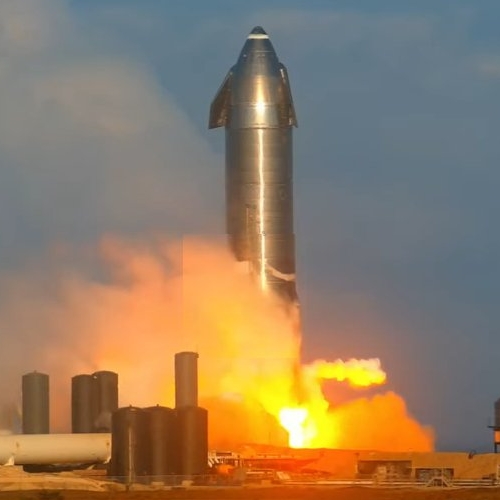
Capitalism in space: SpaceX engineers yesterday successfully completed the first static fire test of the ninth prototype of Starship, in preparation for its first 50,000 foot flight.
The SN9 vehicle’s three engines lit up for about one second today (Jan. 6) at 5:07 p.m. EST (2200 GMT) during a static-fire test at SpaceX’s South Texas facilities, near the Gulf Coast village of Boca Chica.
It is possible they will do additional static fire tests before that flight, as they did this with the eighth prototype. It is also possible that all went right in this first test, and they will proceed to launch, as soon as January 8th.
Embedded below the fold in two parts.
» Read more
An evening pause: Yes Minister was a British comedy show set within the halls of Parliament. In the past year I have posted a number of clips from the show (here, here, here and here) that illustrate how truthfully it skewed the political class.
Today we have a skit with two of the show’s stars performing with the actual prime minister at the time, Margaret Thatcher. She clearly understood the truthful humor of the show, as she explained once during an interview.
Hat tip Andrew Worth.
The photo to the right, rotated, cropped, and reduced to post here, was taken on September 9, 2020 by the high resolution camera on Mars Reconnaissance Orbiter (MRO). It shows the northern half of a 15-mile wide canyon on Mars whose floor appears to be completely filled by a glacier. The full picture shows both the north and south rims, and captures the canyon’s outlet from the southern cratered highlands into the chaotic terrain of Deuteronilus Mensae, the region of Mars I like to call glacier country. This region of canyons and mesas forms the transition zone down to the northern lowland plains, and is a region where almost every MRO image shows glacial-type features.
The size and age of this glacial feature is what makes it stand out. First, note the craters on its surface. The glacier has to be quite old and inactive for a long time for those craters to still exist as they appear. Any movement would have distorted them, and they show little distortion.
The overview map below gives a sense of this glacier’s size.
» Read more
After analyzing the data from an aborted fueling dress rehearsal, NASA engineers have decided they understand and have fixed the issue that caused the abort and have now scheduled the full static fire test of SLS’s core stage for January 17th.
NASA conducted the seventh test of the SLS core stage Green Run test series โ the wet dress rehearsal โ on Dec. 20 at NASAโs Stennis Space Center near Bay St. Louis, Mississippi and marked the first time cryogenic, or super cold, liquid propellant was fully loaded into, and drained from, the SLS core stageโs two immense tanks. The wet dress rehearsal provided structural and environmental data, verified the stageโs cryogenic storage capabilities, demonstrated software with the stageโs flight computers and avionics, and conducted functional checks of all the stageโs systems. The end of the test was automatically stopped a few minutes early due to timing on a valve closure. Subsequent analysis of the data determined the valveโs predicted closure was off by a fraction of a second, and the hardware, software, and stage controller all performed properly to stop the test. The team has corrected the timing and is ready to proceed with the final test of the Green Run series.
…The upcoming hot fire test will fire all four of the stageโs RS-25 engines simultaneously for up to eight minutes to simulate the core stageโs performance during launch. After the firing at Stennis, the core stage for SLS will be refurbished and shipped on the agency’s Pegasus barge to NASAโs Kennedy Space Center in Florida. The stage will then be assembled with the other parts of the rocket and NASAโs Orion spacecraft in preparation for Artemis I, the first integrated flight of SLS and Orion and the first mission of the agencyโs Artemis program.
The agency had been hoping to complete this test series before the end of 2020. Whether the delay will effect the planned launch date in November is unclear. I suspect they are already anticipating another postponement, in that this press release strangely makes no mention of that launch date.
An evening pause: Performed live in 1962.
Hat tip Jim Mallamace.
The new colonial movement: China’s space agency, CNSA, today announced that its first Mars orbiter/lander/rover, Tianwen-1, will arrive in Mars orbit on February 10th, with the lander/rover dropping to the surface in May.
After entering orbit, Tianwen-1 will begin to prepare for a landing attempt of the mission’s rover. The orbiter will begin imaging the main candidate landing site within the huge impact basin Utopia Planitia, to the south of NASA’s Viking 2 landing site.
Getting ready for the attempt will take time however, with CNSA stating that the landing won’t take place until May.
At the moment they say that all systems are working as planned, and that they have one more course correction, the fourth, to do before entering orbit.
Two different updates yesterday and today on the development of Starship by SpaceX suggest strongly that the company is aiming for its next test flight to about 50,000 feet as early as this coming weekend.
The second story notes how the company has apparently decided it was not worthwhile keeping much of the debris left over from the crash of the eighth Starship prototype after its successful test flight on December 9th. They have instead focused entirely on clearing the landing pad as quickly as possible, even if it meant destroying some of the prototype’s remains.
The first story outlines the ongoing pressure tests for the ninth prototype, now on the launchpad, and how those tests have so far proceeded very smoothly. All that remains is SpaceX’s standard dress rehearsal countdown ending in a static fire test of the prototype. This is presently scheduled for tomorrow. Once it is accomplished, the test flight can follow quickly, probably no more than a week later, depending on weather, the data from the static fire test, and the innumerable uncertainties that routinely occur in a robust test program such as this.
An evening pause: A cute little animated film about what we may find in our search of the heavens.
Hat tip Gary McDaniel.
The new colonial movement: China’s space agency announced today that it is aiming to complete at least 40 launches in 2021.
A terse summary of the report in a CASC press release (Chinese) stated that missions related to the Chinese Space Station complex would be among the planned 40-plus launches. Recent reports state that the space station core module will be launched in the coming months, followed by the Tianzhou-2 cargo vessel and Shenzhou-12 crewed missions. The missions will require Long March 5B and Long March 7 launches from Wenchang and a Long March 2F launch from Jiuquan in the Gobi Desert.
Other major highlighted activities include the Tianwen-1 Mars spacecraft, which is due to enter Mars orbit around Feb. 10 with a rover landing attempt to follow in May. Development work will focus on the two experiment modules for the Chinese Space Station and, notably, crewed lunar exploration. No further details on the latter were provided but earlier indications are available.
Assuming they experience no major launch failures, 2021 should be a ground-breaking year for China.