
April 1, 2022 Zimmerman/Batchelor podcast
Embedded below the fold in two parts.
To listen to all of John Batchelor’s podcasts, well worth your time, go here.
» Read more
Very brief descriptions, with appropriate links, of current or recent news items.
Embedded below the fold in two parts.
To listen to all of John Batchelor’s podcasts, well worth your time, go here.
» Read more
Embedded below the fold in two parts.
To listen to all of John Batchelor’s podcasts, well worth your time, go here.
» Read more
NASA today began the two-day-long “wet dress rehearsal” countdown of its first SLS rocket, with T-0 expected to occur at 2:40 pm (Eastern) on April 3rd.
The article at the link provides all the information you could want about this rocket, which is now about seven years behind schedule and having a cost so far about $25 billion. This quote however tells us much about the mentality at NASA:
But much of the test will happen without independent press coverage. NASA plans to provide sanctioned updates on the two-day dress rehearsal via the agency’s website and social media accounts, but news media representatives are not being permitted to listen to the countdown activities.
NASA has cited security and export control restrictions for the move. Numerous media representatives requested access to the SLS countdown audio for the wet dress rehearsal. Launch countdown audio feeds for other U.S. rockets, including those developed by private companies and hauling sensitive U.S. military satellites into orbit, are widely available to the news media and the public.
…NASA plans to release only text updates through the weekend. NASA TV will not be airing any live commentary for the final hours of the practice countdown. The agency’s television channel has previously provided live coverage of similar events, such as space shuttle tanking tests. [emphasis mine]
NASA reasons for not allowing anyone to listen to its audio feed — “security and export control restrictions” — is an utter lie. The real reason is that NASA fears the public’s reaction should anything not go exactly as planned. By blocking access to the audio feed, they can hide any faux pas.
NASA’s fear of course is misplaced. This is a test. No one will be surprised or outraged if it doesn’t go perfectly. Better to be open and up front than try to hide problems, because eventually those problems will be revealed and the cover-up will do far more harm to NASA’s reputation than the problems themselves.
The many new private rocket companies, SpaceX, Rocket Lab, Astra, Virgin Orbit, understand this, which is why they all make their primary countdown audio feeds available, though of course they almost certainly have secondary private feeds where engineers can speak more freely. Similarly, NASA did the same in the 1960s, and then during the entire shuttle program.
Now however “export control restrictions” and “security” requires them to be secretive? It is to laugh.

Click for full image.
Cool image time! The photo to the right, cropped to post here, was taken on January 29, 2022 by the high resolution camera of Mars Reconnaissance Orbiter (MRO). It shows a small portion of the floor of 41-mile-wide Tuskegee Crater, sitting at the Martian equator on the rim of the outlet to the giant canyon Valles Marineris.
I have purposely focused on a section of the color strip, because of its strange green color. Most MRO images are reddish (indicating dust) or blue (indicating coarse rocks or ice). Green seems to me to be rare, and in fact is not even mentioned in the MRO science’s team explanation [pdf] of the colors the instrument produces. Since green is neither dust nor ice, this suggests some form of hard bedrock, with a mineralogy that produces that color.
The overview map below gives some context.
» Read more

Ben Domenech and The Federalist, censored by the federal government’s
National Labor Relations Board
Blacklists are back and the Democrats have got ’em: The National Labor Relations Board (NLRB) is attempting to silence the conservative news site The Federalist for “unfair labor practice” because its publisher Ben Domenech sent out a bad Twitter joke in 2019 about unions, and two lawyers who had nothing to do with the company complained to the NLRB.
The National Labor Relations Board (NLRB) has ordered Ben Domenech—publisher of the conservative website The Federalist…—to take down a June 2019 tweet in which he joked about sending employees who wanted to unionize to work in “the salt mines.” Domenech has refused, and the case is now making its way through the courts.
Domenech’s tweet came in response to news that employees of Vox Media Inc. walked off the job in support of unionization. No one at The Federalist had publicly expressed any interest in unionizing, and two of the website’s six employees filed affidavits attesting that they viewed the tweet as a joke. As far as I know, Domenech doesn’t own any salt mines.
The complainants, leftist lawyers Matt Bruenig (a former NLRB attorney) and Joel Fleming, have never worked for or been personally harmed by the Federalist and were clearly acting to silence their political opponents by taking advantage of NLRB’s overly broad regulations, which allow total strangers to file complaints against businesses they don’t like. The NLRB then moves to harass those businesses.
» Read more
Capitalism in space: SpaceX today successfully used its Falcon 9 rocket to launch 40 smallsats into orbit.
The first stage successfully landed on a drone ship, completing its seventh flight.
The leaders in the 2022 launch race:
12 SpaceX
8 China
4 Russia
2 ULA
The U.S. now leads China 18 to 8 in the national rankings.
Capitalism in space: Wagner Star Industries, a startup that now owns the unfinished Lynx spaceplane that bankrupt XCOR had intended for suborbital tourists flights, has signed a agreement with Paso Robles Municipal Airport in California to launch from there.
Wagner’s plan is to reconfigure Lynx as an unmanned first stage that would launch smallsats into orbit. It would launch and land on a runway from Paso Robles.
Wagner Star is in the process of converting the first Lynx vehicle into a drone so it can begin tests, according to the company’s website. The work involves removing life-support systems that had been installed to support the pilot and passenger and installing equipment for remote controlled operation.
Quetzalcóatl would take off from a runway, release its payload in suborbital space, and then glide back to where it took off. The company said it would be able to launch satellites from any commercial airport runway for $5 million per flight. A suborbital flight without a satellite launch would cost $3 million.
A clever plan. I have doubts about the satellite launches, but using this plane to place drones into high altitude where they could then continue to fly for great distances will almost certainly appeal to the military.

Click for full image.
Cool map time! The map to the right, reduced to post here, is figure 1 in a new paper outlining the known geology of what appears to be a large ancient and now dry river basin with delta on Mars, found north of Valles Marineris and draining into the northern lowland plain dubbed Chryse Planitia where both Viking-1 and Mars Pathfinder landed, in 1976 and 1997 respectively.
The river basin itself is called Hypanis Valles. The white splotch at the river basin’s outlet is dubbed the Hypanis Deposit, and is thought by some scientists to be a delta of material that was placed there when the river was active 3.6 billion years ago and poured into what some scientists believe was an intermittent ocean in Chryse Planitia. From the paper’s conclusion:
As proposed in prior works, Hypanis may have formed subaqueously as a delta, and may record a water level drop of about 500 m[eters, or about 1,600 feet] as a shoreline retreated to the northeast. We identified kilometer-sized cones and mounds which appear to have erupted onto the surface. Characteristics of these features more closely resemble those of outgassing, sedimentary diapirism, and mud volcanism rather than of igneous volcanism.
The intermittent ocean theory has problems however. For this delta to have formed underwater that ocean would have to have been much much larger than estimated based on the present known data, extending out to cover almost all of Chryse Planitia, in some places to a very great depth.
Some scientists have hypothesized that the ocean need not have been that large because a land dam would have confined it to a smaller region at the river’s outlet. This research however found no evidence of such a dam. However, the paper also noted that “Further work could examine the role of ice or glaciers in the formation of Hypanis and determine if an ice dam would be plausible.”
And of course there remains the more fundamental mystery of liquid water on the Martian surface, which makes the river basin itself a puzzle. No generally accepted model allowing for surface liquid water on Mars presently exists. The possibility that ice and glaciers could have done the job comes to mind again. Though the geology in this region reveals what looks like to our Earth eyes to be a very large river system, now dry, this is not Earth but an alien planet. Tributary systems like this might form from different and as yet not understood processes on Mars, some of which might involve glaciers.
In a paper published in February, scientists determined from models and data that the thickness of Martian cave ceilings required to protect you from radiation is not that much different whether you are on top of Olympus Mons (the Mount Everest of Mars), or at the bottom of Hellas Basin (Mars’ Death Valley).
From the paper’s conclusion:
Overall, the atmospheric thickness is not a dominant parameter for the required shielding. However, at a low-altitude crater where the surface pressure is above 1,000 Pa, the required subsurface shielding is about 10–20 cm [4 to 8 inches] less than at the top of high mountains where the pressure is below 100 Pa. Moreover, solar activities which determine the GCR flux arriving at Mars play an role. To reduce the annual effective dose to be below 100 mSv, the required shielding is 1.5–1.6 m [about 5 feet] during solar minimum and 0.9–1.1 m [a little more than 3 feet] during solar maximum. For a threshold of 50 mSv, the required shielding is 2.1–2.2 m [about 7 feet] during solar minimum and 1.7–1.9 m [about 6 feet] during solar maximum.
Essentially, what this research suggests is that to properly shield any underground facility, you need to cover it with at least seven feet of material, or be in a cave where the ceiling is that thick. It really doesn’t matter how much atmosphere is above you. Even at its thickest at the lowest elevation, Mars’ atmosphere doesn’t provide much protection.

Click for full image.
The uncertainty of science: Using the Hubble Space Telescope astronomers now think they have detected the most distant single star ever located, the light of which is estimated to have come from a time only less than a billion years after the Big Bang itself.
The star, nicknamed Earendel by astronomers, emitted its light within the universe’s first billion years. It’s a significant leap beyond Hubble’s previous distance record, in 2018, when it detected a star at around 4 billion years after the big bang. Hubble got a boost by looking through space warped by the mass of the huge galaxy cluster WHL0137-08, an effect called gravitational lensing. Earendel was aligned on or very near a ripple in the fabric of space created by the cluster’s mass, which magnified its light enough to be detected by Hubble.
The arrow in the image, cropped and reduced to post here, points to the theorized star. Note the arc that tiny dot lies along. This arc is the result of the gravitational lensing, and illustrates quite bluntly the large uncertainties of this discovery. We are not seeing the star itself, but the distorted light after it passed through the strong gravitational field of the cluster of galaxies. The scientists conclusion that this dot is thus a single star, must be view with great skepticism.
Nonetheless, the data is intriguing, and will certainly be one of the early targets of the James Webb Space Telescope, which could confirm or disprove this hypothesis.
Capitalism in space: Blue Origin’s New Shepard suborbital spacecraft today successfully completed its fourth manned commercial flight, carrying six passengers to a height of about 70 miles for total flight time of a little less than eight minutes.
I have embedded the live stream below the fold, cued to just before launch. Everything went almost routinely, which is a very good thing for a rocket company.
The most interesting aspect of this flight was that one of the passengers was George Nield, who had:
…previously served as associate administrator for the US Federal Aviation Administration (FAA) Office of Commercial Space Transportation from 2008 to 2018, being responsible for launch licensing and regulation for all commercial launch activities during that time.
During Nield’s term, the government worked very hard to help get launches off the ground, which laid the groundwork for the success of both SpaceX’s orbital Falcon 9 and Falcon Heavy rockets, as well as the suborbital spacecraft of Blue Origin and Virgin Galactic. His effort also helped jumpstart the new smallsat rocket industry.
Since his retirement, the FAA’s attitude toward regulation has become more oppressive, especially since the beginning of the Biden administration in 2021.
Robert Pratt invited me to appear on his radio podcast once again, first for a short five minute segment to discuss the Biden administration’s effort to block Starship launches in Boca Chica, and second a long 40 minute discussion about some of my recent blacklist stories.
The short segment starts 13 minutes into his podcast from yesterday, available here.
The long blacklist discussion can be found here.

Elevation map of Wright Mons on Pluto
The uncertainty of science: According to new research published yesterday, scientists now posit that there might be recent volcanic activity on Pluto, based on data and images sent back by New Horizons during its fly-by of the planet in 2015.
You can read the paper here. From its abstract:
The New Horizons spacecraft returned images and compositional data showing that terrains on Pluto span a variety of ages, ranging from relatively ancient, heavily cratered areas to very young surfaces with few-to-no impact craters. One of the regions with very few impact craters is dominated by enormous rises with hummocky flanks. Similar features do not exist anywhere else in the imaged solar system. Here we analyze the geomorphology and composition of the features and conclude this region was resurfaced by cryovolcanic processes, of a type and scale so far unique to Pluto. Creation of this terrain requires multiple eruption sites and a large volume of material (>104 km3) to form what we propose are multiple, several-km-high domes, some of which merge to form more complex planforms. The existence of these massive features suggests Pluto’s interior structure and evolution allows for either enhanced retention of heat or more heat overall than was anticipated before New Horizons, which permitted mobilization of water-ice-rich materials late in Pluto’s history. [emphasis mine]
The image to above is Figure 10 in the paper’s supplementary material [pdf]. It shows the volcano-like appearance of Wright Mons on Pluto, a mound approximately 3,000 feet high with a central depression equally deep, with a volume “similar in magnitude to that of the Hawaiian volcano Mauna Loa.”
These conclusions are quite tantalizing, but the amount of data is sparse, and thus it is wise not to take them too seriously. For example, the scientists have no idea how Pluto could presently have any form of liquid or active volcanism. Another mission to Pluto — studying it over a long time from orbit — will be required to determine how active the planet really is, or if it is active at all.
The new colonial movement: Based upon a 2021 agreement, the European Space Agency (ESA) today outlined how its deep space communications network of antennas will support India’s next two missions beyond Earth orbit.
ESA’s global deep-space communication antennas will provide essential support to both missions every step of the way, tracking the spacecraft, pinpointing their locations at crucial stages, transmitting commands and receiving ‘telemetry’ and valuable science data.
In June 2021, ESA and the Indian Space Research Organisation (ISRO) signed an agreement to provide technical support to each other, including tracking and communication services to upcoming Indian space missions via ESA’s ground stations.
The first missions to benefit from this new support agreement will enable India look to the Sun and the Moon with the Aditya-L1 solar observatory and Chandrayaan-3 lunar lander and rover, both due to launch in 2022 from the Satish Dhawan Space Centre in Sriharikota Range (SDSC SHAR), India.
Though scheduled for launch this year, ISRO (India’s space agency) has not yet announced firm launch dates for either.
This arrangement signals an effort by India and Europe to remain independent of the American Artemis program, which is NASA’s central program for manned missions beyond Earth orbit. To partner with NASA for such missions the Trump administration had demanded nations sign the Artemis Accords, though that requirement might have been eased by the Biden administration for deep space communications.
Regardless, this agreement gives both India and ESA flexibility for remaining outside the accords, at least for now. Neither India nor most of the partners in the ESA have signed, with France and Germany the most notable European nations remaining outside the accords.
A Russian Soyuz capsule successfully returned three astronauts back to Earth today, thus completing Mark Vande Hei’s 355 day mission, the longest so far achieved by an American astronaut.
Vande Hei’s record is the fifth longest overall, behind four other Russians on Mir. Musa Manarov and Vladimir Titov were the first to complete a year-long flight in 1987-1988. Sergei Avdeyev’s flight of 381 days on Mir in 1998-1999 is the second longest. Valery Polyakov holds the record for the longest flight, 437 days in 1994-1995.
Now that Vande Hei is safely back on Earth, expect Dmitry Rogozin, the head of Roscosmos, to make some announcement in the next day or so further limiting cooperation at ISS. It is my expectation he will end the discussions between Roscosmos and NASA to exchange one-for-one flights on each other’s capsules. While the partnership to maintain and occupy ISS will continue, Rogozin will likely end any cooperation otherwise.
China today successfully launched what appear to be three technology test satellites using its Long March 11 rocket.
The three satellites Tianping-2A, Tianping-2B and Tianping-2C will provide services such as atmospheric space environment survey and orbital prediction model correction.
This is all we know about these satellites.
The leaders in the 2022 launch race:
11 SpaceX
8 China
4 Russia
2 ULA
The U.S. still leads China 17 to 8 in the national rankings.

The new dark age of silencing: The Miscellany News, the college newspaper at Vassar College, recently retracted an article not because it contained any errors of fact (which it did not) but because the article had simply interviewed too many white students in its reporting.
The article had been written to describe the controversy surrounding the school’s decision to have Jeh Johnson, Secretary of Homeland Security during the Obama administration, speak at the school, and his decision to withdraw because of the uproar from students demanding he be blacklisted. From the newspaper’s retraction announcement:
We would like to use this statement to both emphasize our values of diversity and inclusion, and delve deeply into our editorial process and the resulting article in question, especially since we understand that many people in the Vassar community are unaware of the article’s removal. … In this article, we attempted to include a variety of quotes from students describing why there was protest to the announcement of him as speaker in the first place, and the students’ reaction to his withdrawal.
In prioritizing urgency over thoroughness, we made misguided and insensitive oversights with whom we were representing in the article and failed to provide in-depth reporting of the issue at large. The majority of our quotations came from white students and therefore we reduced the positions of students of color to a singular, tokenized perspective. After this was brought to our attention, the paper decided to remove the article online in an attempt to prevent further harm among the communities we misrepresented. [emphasis mine]
In releasing its budget request this week to Congress for the 2023 fiscal year, NASA did what it routinely does each year, ask for more money, this time asking for an 8% increase from what Congress appropriated last year.
NASA’s FY2023 budget request is $25.974 billion versus the FY2022 appropriation of $24.041 billion. NASA had requested $24.802 billion in large part to pay for the Artemis program to return astronauts to the lunar surface, but Congress wasn’t willing to allocate that much. While supportive of Artemis and NASA’s many other science, aeronautics and technology programs, there is a limit as to how much Congress is willing to invest.
NASA is requesting not just another boost in FY2023, but in the “out years” thereafter, rising to $28 billion in FY2027, though much of that purchasing power likely will be lost to inflation.
…In essence, the agency wants more money for everything it is doing.
The budget request also asks again for Congress to terminate the SOFIA airborne telescope, which NASA contends is not producing enough science to justify its $80 million annual cost. Congress has repeatedly refused to do so in past years. As should be expected, Congress will likely not cancel SOFIA again, as it likes to spend money we don’t have.
The goal of the increased funding for Artemis is also to continue the SLS program for many years to come. Expect Congress to also fund this in the coming few years, though the long term future of SLS remains in doubt, especially if SpaceX’s Starship begins flying. Artemis won’t be cancelled by our spendthrift Congress, but Congress will likely decide to shift that spending to Starship and other private rockets rather than SLS as those private rockets come on line.
All in all, expect Congress to give NASA more cash, but not as much as the agency requests.
Capitalism in space: Five European and Canadian teams have been awarded 75K euro contracts to develop their own lunar rovers, with these winners determined during a European Space Agency (ESA) contest that tested a prototype design in a simulated lunar polar environment.
“The competing rovers had to navigate and map the whole test environment to prospect for useable resources – meaning first of all to track down their location, identify the best and safest passages to access them, then to gather information about the characteristics and the composition of the rocks they find,” explains Massimo Sabbatini, overseeing the contest’s first phase for ESA.
“The various teams took various approaches in terms of locomotion – we had wheeled, tracked and also walking vehicles – as well as visual and multi-spectral instrumentation, and in a few cases multiple instead of single rovers. The five out of 12 teams who move forward to the next stage receive a development grant to increase their technology readiness ahead of the second stage challenge, hosted by ESRIC in Luxembourg this autumn.”
This contest mimics the American effort to transition from government-built space probes to privately-built. The goal is to encourage private development of lunar rovers, capable of providing this service to future ESA projects at a lower cost and much more quickly. The contest is also designed to encourage such private companies outside the U.S., so as to compete with the emerging American industry of lunar rover companies.
Click for full image.
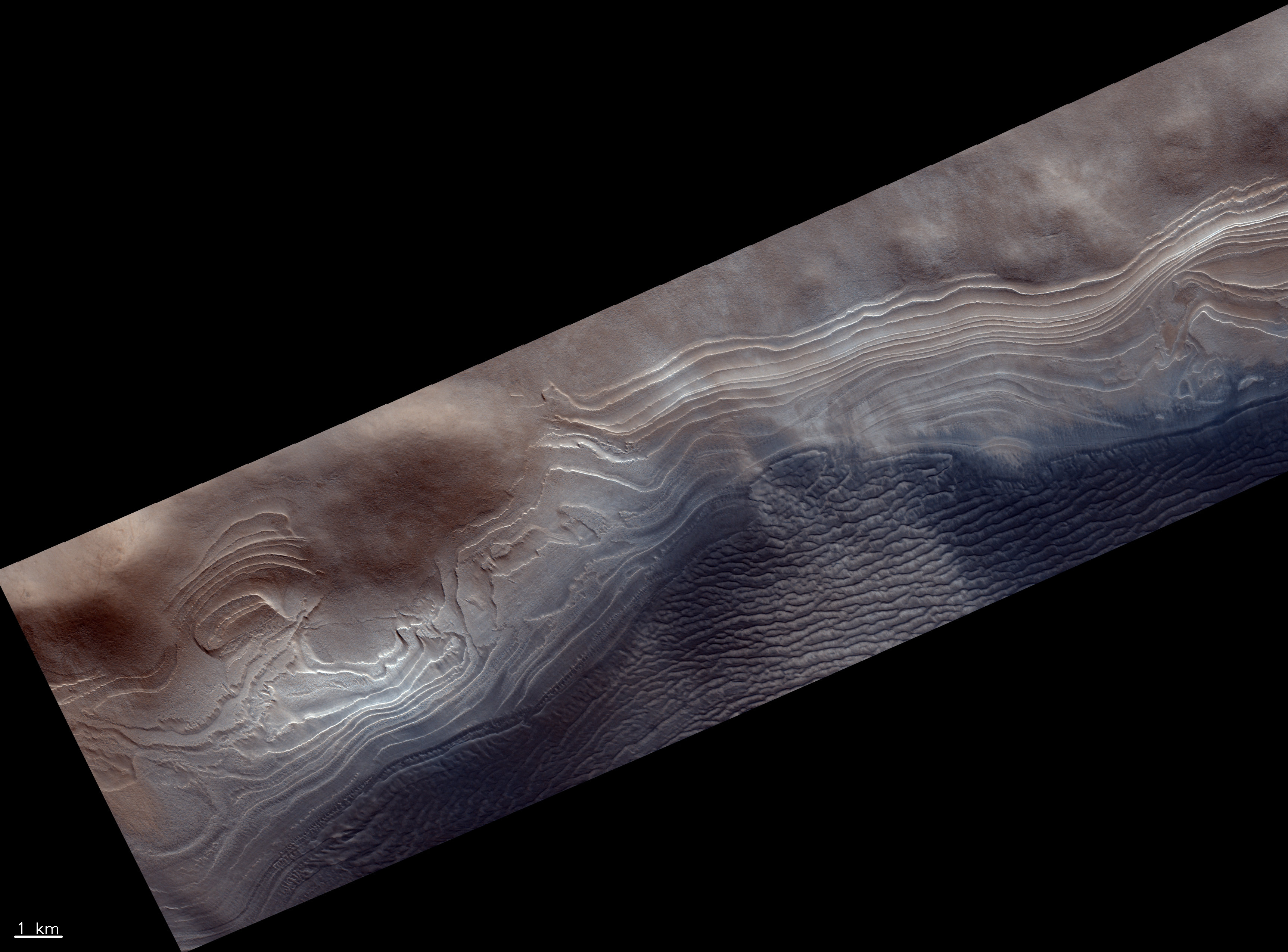
According to a new paper published today, scientists have used the ice layers inside Burroughs Crater on Mars to confirm the theory that the Red Planet has undergone numerous climate cycles during the past four million years, caused by the swings in the planet’s rotational tilt and eccentric orbit. From the press release:
Previously, Martian climate scientists have focused on polar ice caps, which span hundreds of kilometers. But these deposits are old and may have lost ice over time, losing fine details that are necessary to confidently establish connections between the planet’s orientation and motion and its climate.
Sori and his colleagues turned to ice mounds in craters, just tens of kilometers wide but much fresher and potentially less complicated. After scouring much of the southern hemisphere, they pinpointed Burroughs crater, 74 kilometers wide, that has “exceptionally well-preserved” layers visible from NASA HiRISE [Mars Reconnaissance Orbiter’s high resolution camera] imagery, Sori said.
The researchers analyzed the layers’ thicknesses and shapes and found they had strikingly similar patterns to two important Martian orbital dynamics, the tilt of Mars’ axis and orbital precession, over the last 4 to 5 million years.
The photo above of those layers was taken by Europe’s Trace Gas Orbiter on March 13, 2019, cropped and reduced to post here.
This research greatly strengthens the theory that the ice on Mars gets distributed to different latitudes in cycles, depending on the cyclical fluctuations in the planet’s orbit and tilt. However, it does not yet confirm these cycles apply to the glaciers found in craters in lower latitudes. Burroughs Crater is at 72 degrees south latitude, near the southern polar ice cap, well south of the band of glaciers scientists have discovered in the mid-latitudes down to 30 degrees latitude. Nonetheless, this research strongly suggest the same cycles apply in those lower latitudes.