April 10, 2023 Quick space links

Courtesy of BtB’s stringer Jay, who also prodded me into doing that earlier post today about the coming regulatory sledgehammer against commercial human spaceflight.


  • A photo of the Centaur-5 explosion during testing
  • The picture really doesn’t tell us much. Though ULA’s CEO Tori Bruno said this “anomaly” during testing will not impact the first launch of Vulcan-Centaur in May, we shall have to wait and see.


0 comments

Exploring the cratered southern highlands of Mars, part 4

Overview map

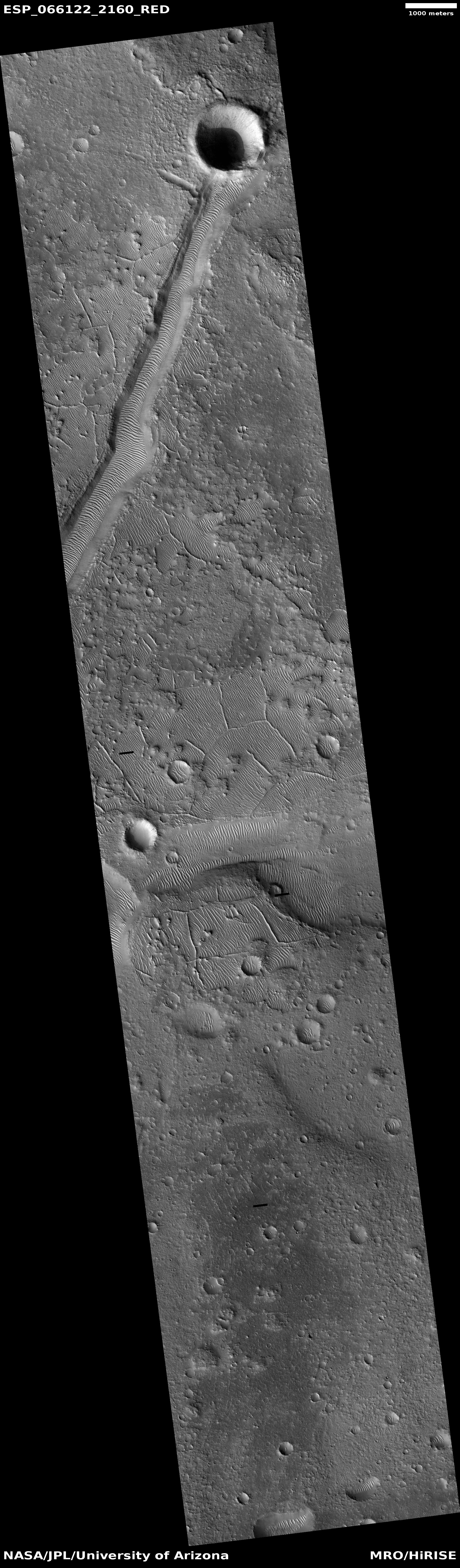
Gullies in Asimov Crater
Click for full image.

Today is the last part in our four part exploration of the cratered southern highlands of Mars, begun last week. (For the early parts, go here-Part #1, here-Part #2, and here-Part #3.) Though there is no need, new readers should read the first three parts first, in order to get the larger perspective of this final post.

The picture to the right, rotated, cropped, reduced, and sharpened to post here, was taken on December 20, 2022 by the high resolution camera on Mars Reconnaissance Orbiter (MRO). It shows the eastern main gully descending down into a pit that sits in the north center of 52-mile-wide Asimov Crater, as shown in the inset on the overview map above. (For an MRO high resolution of the western gullies into this pit, see this January 2019 cool image post.)
» Read more

0 comments

Genesis cover

On Christmas Eve 1968 three Americans became the first humans to visit another world. What they did to celebrate was unexpected and profound, and will be remembered throughout all human history. Genesis: the Story of Apollo 8, Robert Zimmerman's classic history of humanity's first journey to another world, tells that story, and it is now available as both an ebook and an audiobook, both with a foreword by Valerie Anders and a new introduction by Robert Zimmerman.

The print edition can be purchased at Amazon or any other book seller. If you want an autographed copy the price is $60 for the hardback and $45 for the paperback, plus $8 shipping for each. Go here for purchasing details. The ebook is available everywhere for $5.99 (before discount) at amazon, or direct from my ebook publisher, ebookit. If you buy it from ebookit you don't support the big tech companies and the author gets a bigger cut much sooner.


The audiobook is also available at all these vendors, and is also free with a 30-day trial membership to Audible.
 

"Not simply about one mission, [Genesis] is also the history of America's quest for the moon... Zimmerman has done a masterful job of tying disparate events together into a solid account of one of America's greatest human triumphs."--San Antonio Express-News

Pushback: Catholic college moves to end its need for any federal funding

Belmont Abbey College

Bring a gun to a knife fight: Belmont Abbey College, a small private Catholic college in North Carolina, has begun a major fund-raising campaign to free itself and its students from any need to obtain what it calls “intrusive” federal funding.

According to their fund-raising website,

Without the ability to remain financially independent and secure, we place our faith-based practices at risk from a federal government both increasingly intrusive to private institutions and increasingly hostile to faith. The mission of Belmont Abbey College is rooted in a desire to fill society with graduates prepared to restore the culture for the greater glory of God and create a world where charity and goodness thrive.

Their goal is to raise $55 million.
» Read more

14 comments

Report recommends Congress allow full regulation of commercial human spaceflight

The modern instruction manual for America

A new report by the RAND corporation has recommended that Congress allow the moratorium on full regulation of commercial human spaceflight, established by the Commercial Space Launch Amendments Act of 2004 and extended several times, to expire on October 1, 2023.

That recommendation came despite a lack of progress on voluntary standards and key industry metrics. While standards development organizations like ASTM International and ISO have published 20 standards related to commercial spaceflight, the RAND report noted that “companies have yet to clearly or consistently adopt them in a manner that can be confirmed or verified publicly.” A diversity of technical approaches also hinders the development and implementation of standards.

The report also found that while the FAA had developed key industry indicators to assess readiness for adopting safety regulations, there were no goals for those indicators to determine when it was time to implement regulations. “It is, therefore, difficult to assess whether there has been progress toward meeting key industry metrics when there are not clear targets that could be met,” the report concluded.

Despite that lack of progress on standards or metrics, the RAND report nonetheless concluded that allowing the learning period to expire this year was the best approach. Doing so, it argued, would allow FAA and industry to start the process of developing safety regulations in a gradual manner and avoid a rush to regulate imposed by Congress should a high-profile accident take place while the learning period is still in effect.

It also recommended additional resources for the FAA to support that regulatory process, but did not quantify an increase in the budget for or personnel assigned to its Office of Commercial Space Transportation, or AST. [emphasis mine]

The highlighted words illustrate the crushing fundamentals of all government regulation. » Read more

5 comments

Conscious Choice cover

Now available in hardback and paperback as well as ebook!

From the press release: In this ground-breaking new history of early America, historian Robert Zimmerman not only exposes the lie behind The New York Times 1619 Project that falsely claims slavery is central to the history of the United States, he also provides profound lessons about the nature of human societies, lessons important for Americans today as well as for all future settlers on Mars and elsewhere in space.

 
Conscious Choice: The origins of slavery in America and why it matters today and for our future in outer space, is a riveting page-turning story that documents how slavery slowly became pervasive in the southern British colonies of North America, colonies founded by a people and culture that not only did not allow slavery but in every way were hostile to the practice.  
Conscious Choice does more however. In telling the tragic history of the Virginia colony and the rise of slavery there, Zimmerman lays out the proper path for creating healthy societies in places like the Moon and Mars.


“Zimmerman’s ground-breaking history provides every future generation the basic framework for establishing new societies on other worlds. We would be wise to heed what he says.” —Robert Zubrin, founder of the Mars Society.


All editions are available at Amazon, Barnes & Noble, and all book vendors, with the ebook priced at $5.99 before discount. All editions can also be purchased direct from the ebook publisher, ebookit, in which case you don't support the big tech companies and the author gets a bigger cut much sooner.


Autographed printed copies are also available at discount directly from the author (hardback $29.95; paperback $14.95; Shipping cost for either: $6.00). Just send an email to zimmerman @ nasw dot org.

The Earth hangs above the Moon

The Earth hangs above the Moon

Cool image time! The picture to the right, cropped, reduced, and enhanced to post here, was taken by Lunar Reconnaissance Orbiter (LRO) on December 10, 2015 and released by the LRO team this week. From the caption:

LRO slewed to the east as it passed over the northwest rim (-8.536°N, 251.028°E, 82 km altitude) of the Orientale basin and snapped this spectacular Earth-Moon sequence with the NAC and WAC [cameras]. Tropical Cyclone Bohale is visible in the center of the image. MODIS (onboard the NASA Aqua satellite) imaged the same storm 3 hours after LRO.

The NAC and WAC images of the Earth were projected using a Point-Perspective projection to recreate the view one would see from the LRO spacecraft while taking the NAC image. Due to the relatively slow speed of the spacecraft slew, many NAC framelets of the Earth were acquired. All these WAC frames were oversampled and averaged, enabling a “super-resolution” color image (115 pixels across!), which was then combined with the 4000-pixel-wide NAC image.

…[For the Earth:] North is to the left, Antarctica to the right, Australia at the top, and Africa at the bottom

NAC and WAC are names of two different LRO cameras, one of which captured the Earth in high resolution color while the other captured the Moon. The two images were then combined, superimposing the Earth at the right size onto the second lunar image.

As noted in the caption, this view is as LRO sees the Earth from Lunar orbit, while taking a slewed oblique image of the Moon. It however is not how things would look if you were standing on the surface of the Moon. For one, the photo is zoomed in to get details on the lunar surface, making the Earth appear much larger.

For another, the image is taken 82 kilometers or 51 miles above the Moon. This higher altitude changes the position of the Earth relative to the Moon, making it appear farther from the horizon.

To a person standing in Orientale basin at 8 degrees south latitude (near the equator), but also near the edge of the visible near side of the Moon, the Earth would likely be very close to the horizon, but much smaller. To get a comparable view of the Earth, the person would likely need to use binoculars.

Orientale basin is mostly on the far side of the Moon, though it was known to exist before the space age because ground-based telescopes could see it on the edge of the visible face. It was only with the first lunar orbiters was the basin imaged from directly above, revealing its large size and distinct concentric rings forming its several circular rims.

At this location, the Earth would essentially always remain at approximately the same spot in the sky, though its illuminated face would wax and wane, like the Moon’s does, during the Moon’s twenty-eight day-long day.

3 comments

Leaving Earth cover

Leaving Earth: Space Stations, Rival Superpowers, and the Quest for Interplanetary Travel, can be purchased as an ebook everywhere for only $3.99 (before discount) at amazon, Barnes & Noble, all ebook vendors, or direct from my ebook publisher, ebookit.

If you buy it from ebookit you don't support the big oppressive tech companies and I get a bigger cut much sooner.


Winner of the 2003 Eugene M. Emme Award of the American Astronautical Society.

 
"Leaving Earth is one of the best and certainly the most comprehensive summary of our drive into space that I have ever read. It will be invaluable to future scholars because it will tell them how the next chapter of human history opened." -- Arthur C. Clarke

Exploring the cratered southern highlands of Mars, part 3

Overview map

Pit and surface in crater
Click for original image.

This is the third part of this week’s series taking a look at some of the strange features in the southern cratered highlands of Mars. In the first part I posted a beautiful image of what appears to be a crater filled to the brim with glacial ice, surrounded by an ice sheet plain. In part two we took a look at the interior of Rabe Crater, which though very nearby does not appear to have obvious glacial features within it at all. What it has instead are deep open air pits and a lot of sand dunes.

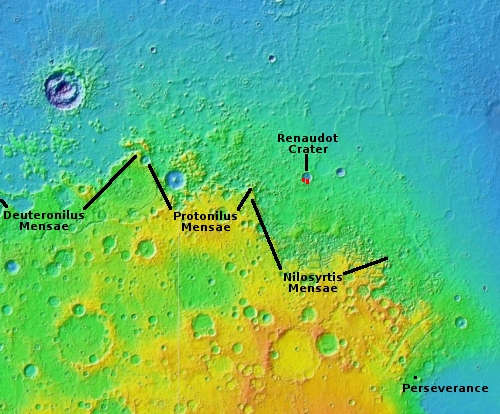
Today’s image to the right, cropped, reduced, and sharpened to post here, takes us to the interior of an unnamed 45-mile-wide crater only about 70 miles north of Rabe. The black dot in the inset on overview map above indicates the photo’s location. The picture was taken on January 1, 2023 by the high resolution camera on Mars Reconnaissance Orbiter (MRO). Like Rabe, this crater also has many large open-air pits. In the picture one pit, near the lower center of the picture, is surrounded by soft-looking mounds and a strangely swirling textured and uneven terrain that makes up the majority of the crater’s floor.

This picture might help explain what we saw in Rabe. The textured terrain in this unnamed crater could easily be ice-impregnated and now hardened sand dunes. The pit could be where that impregnated ice has sublimated away, leaving behind the dust from those ancient dunes which then forms new sand dunes. In Rabe, the crater floor above its pits looks very similar to this swirling textured surface, suggesting the same process is going on there.

What strengthens this explanation is the many other craters nearby, all indicated by red dots in the overview map above, that also have pits or distorted crater floors. Their proximity suggests that there is an underground ice layer in this region, always at about the same elevation, and each crater impact exposed it. With time that exposed ice, no longer pure but filled with material from the impacts, sublimated partly away, producing the pits as well as ample sand to form sand dunes.

0 comments

Pushback: University president forced out because she fired professor for including Muhammad images in classwork

Mohammad meeting Gabriel
One of the two works of art, “Mohammed receiving revelation
from the angel Gabriel,” that got Prater fired.

Bring a gun to a knife fight: The president of Hamline University in Minnesota, Fayneese Miller, has now announced her early retirement after the school’s faculty demanded her resignation in January when she dismissed a professor for showing images of Muhammad as part of an art class.

That teacher, Erika Lopez Prater, immediately sued.

The lawsuit, which Lopez Prater’s lawyers said on Tuesday will soon be filed in court, reiterated the professor’s previous statement that she had offered warnings before showing the image – including in the syllabus and immediately before showing the image – and had volunteered to work with students uncomfortable with viewing the depictions.

The suit has alleged the university subjected Lopez Prater to religious discrimination and defamation, and damaged her professional and personal reputation. “Among other things, Hamline, through its administration, has referred to Dr Lopez Prater’s actions as ‘undeniably Islamophobic,’” her attorneys said in a statement.

» Read more

13 comments

Japanese businesses face major losses due to Virgin Orbit bankruptcy

Two Japanese companies (one partnering with a Japanese airport) now face major financial losses due to the bankruptcy of Virgin Orbit.

Two Japanese companies, ANA Holdings … and little-known Japanese satellite development start-up iQPS Inc emerged among the top six creditors when Virgin Orbit filed for Chapter 11 bankruptcy protection on Tuesday.

ANA, owed $1.65 million, had been a key partner for the Oita spaceport, entering a provisional deal with Virgin Orbit in 2021 for 20 flights of its LauncherOne rocket there. ANA said it was hopeful Virgin Orbit, which has said it is seeking a buyer, would be able to restructure and resume business.

Fukuoka-based iQPS had paid a $5.2 million deposit to launch its small, lightweight constellation satellites weighing under 100 kilograms (220 pounds), representing a major portion of the $17.2 million Series A funding it had raised in 2017.

ANA and the government of Oita prefecture had also hoped to garner some economic benefits from tourism by making this deal with Virgin Orbit. That won’t be happening now, though the expectation by this Japanese local government was never realistic. In fact, it illustrates how divorced government officials are from economic reality. No airport spaceport is going to attract a lot of tourism, even if Virgin Orbit was prospering and launching monthly.

2 comments

Starship now stacked on launchpad

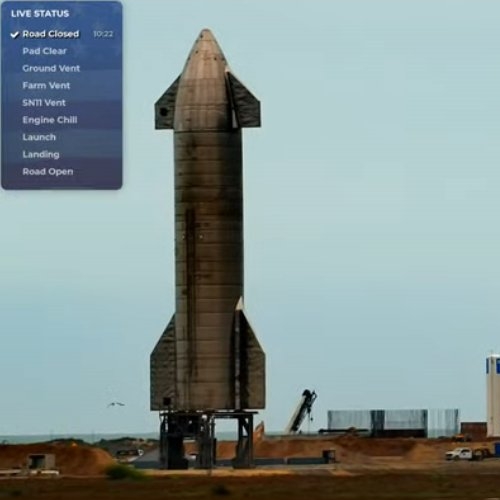
Starship stacked on top of Superheavy

In preparation for a final wet dress rehearsal countdown followed by its first launch, Starship has now been stacked on top of Superheavy at SpaceX’s launchpad at Boca Chica, Texas.

The picture to the right is a screen capture from a short video Elon Musk posted on Twitter. SpaceX had also tweeted that its “Team is working towards a launch rehearsal next week [April 10-11] followed by Starship’s first integrated flight test ~week later pending regulatory approval.”

At this time the FAA has still not issued the launch license. By announcing its plan to launch the week of April 17th, Musk and SpaceX puts pressure the government bureaucracy to get a move on.

23 comments

Venezuela agrees to join China’s lunar base project

During a visit to a new Chinese space facility in China, the head of Venezuela’s space agency announced that it has agreed to join China’s lunar base project.

Marglad Bencomo, executive director of the Bolivarian Agency for Space Activities (ABAE), visited China’s new, national Deep Space Exploration Laboratory (DSEL) March 30 to discuss cooperation and exchanges. She was met by Wu Yanhua, former deputy director of the China National Space Administration (CNSA) and now executive vice chairman of DSEL. The two sides exchanged in-depth views on international cooperation in the field of deep space exploration, according to a DSEL statement.

Bencomo said that Venezuela was willing to sign a China-Venezuela Memorandum of Understanding as soon as possible to jointly promote the construction of international lunar research stations, according to the DSEL statement.

If this partnership agreement is signed, Venezuela would be the first nation outside of Russia to join China’s project. China has offered a similar partnership deal to Brazil, which will likely not agree because it is a signatory to the Artemis Accords and working with China will threaten any work it does with the U.S. For example, the UAE recently ended a project to fly a rover on a Chinese rocket for these very reasons.

This deal with Venezuela is largely empty blather, since Venezuela is presently a bankrupt communist state, barely able to feed its own people.

6 comments
1 588 589 590 591 592 2,927