November 17, 2022 Quick space links

Courtesy of BtB’s stringer Jay, who trolls Twitter so we don’t have to.


4 comments

Today’s blacklisted American: Anti-Semitic attacks skyrocket on college campuses

The coming genocide
What American universities are aggressively working towards

They’re coming for you next: According to a recent study, anti-Semitic attacks against Jews have increased drastically on American college campuses in 2021 and 2022, rising in lock-step with the introduction of critical race theory and its anti-white, anti-American, and pro-Marxist agenda.

There were 254 attacks on 63 different college campuses with large Jewish populations, with Harvard University, the University of Chicago, Tufts University, UCLA, and Rutgers University having the highest number of incidents, according to a report by the AMCHA Initiative, a Jewish advocacy group that says its findings expose an “insidious,” never-before-revealed campus trend.
» Read more

5 comments

Genesis cover

On Christmas Eve 1968 three Americans became the first humans to visit another world. What they did to celebrate was unexpected and profound, and will be remembered throughout all human history. Genesis: the Story of Apollo 8, Robert Zimmerman's classic history of humanity's first journey to another world, tells that story, and it is now available as both an ebook and an audiobook, both with a foreword by Valerie Anders and a new introduction by Robert Zimmerman.

The print edition can be purchased at Amazon or any other book seller. If you want an autographed copy the price is $60 for the hardback and $45 for the paperback, plus $8 shipping for each. Go here for purchasing details. The ebook is available everywhere for $5.99 (before discount) at amazon, or direct from my ebook publisher, ebookit. If you buy it from ebookit you don't support the big tech companies and the author gets a bigger cut much sooner.


The audiobook is also available at all these vendors, and is also free with a 30-day trial membership to Audible.
 

"Not simply about one mission, [Genesis] is also the history of America's quest for the moon... Zimmerman has done a masterful job of tying disparate events together into a solid account of one of America's greatest human triumphs."--San Antonio Express-News

Slowly the Ukrainians continue to regain their country

The Ukraine War as of September 11, 2022
The Ukraine War as of September 11, 2022. Click for full map.

The Ukraine War as of November 16, 2022
The Ukraine War as of November 16, 2022. Click for full map.

In the two months since my last update on the Ukraine Way in September, the steady and continuing retreat of the Russians has continued, with the Ukrainians last week finally retaking all the territory north of the Dnipro River, including the city of Kherson.

The two maps to the right, created by the Institute for the Study of War (ISW) and simplified, reduced, and annotated to post here, show these gains, with the top map from their September 11, 2022 analysis and the bottom from their November 16, 2022 update. Pink areas are regions controlled by the Russians. Blue areas are regions retaken by the Ukraine. Red-striped areas are regions captured by Russian in its 2014 invasion. Blue-striped areas are regions inside Russian-occupied territories that have seen strong partisan resistance. The green lines in the top map mark the locations of important rivers.

Overall, the military actions of the Russians have continued to be haphazard, poorly thought out, and inexplicable, as they have been from the start of this war. For example, even as the Ukrainians were continuing their steady gains in the north, the Russians seemed relatively uninterested. Instead, it continued its attempts to gain ground in the middle, near Donetsk, as indicated by the two green circles. The Russians have been attempting for months to make gains in this area. Though they have captured some territory, those captures have been tiny and very costly. Nor have these captures done anything to impact the Ukrainian gains elsewhere.
» Read more

18 comments

Webb finding more galaxies in early universe than expected

The uncertainty of science: Astronomers using the Webb Space Telescope are finding in very early universe many more galaxies that are also far more developed then had been predicted.

The Webb observations nudge astronomers toward a consensus that an unusual number of galaxies in the early universe were so much brighter than expected. This will make it easier for Webb to find even more early galaxies in subsequent deep sky surveys, say researchers.

“We’ve nailed something that is incredibly fascinating. These galaxies would have had to have started coming together maybe just 100 million years after the big bang. Nobody expected that the dark ages would have ended so early,” said Garth Illingworth of the University of California at Santa Cruz, a member of the Naidu/Oesch team. “The primal universe would have been just one hundredth its current age. It’s a sliver of time in the 13.8 billion-year-old evolving cosmos.”

Erica Nelson of the University of Colorado in Boulder, a member of the Naidu/Oesch team, noted that “our team was struck by being able to measure the shapes of these first galaxies; their calm, orderly disks question our understanding of how the first galaxies formed in the crowded, chaotic early universe.”

The galaxies are smaller, more compact than present day galaxies, and appear to be forming stars at a tremendous rate. Because their distances, presently estimated, still need to be confirmed by spectroscopy, these conclusions remain somewhat tentative though quite alluring.

We should not be surprised if in the next two years data from Webb will overturn almost all the theories that presently exist about the Big Bang and its immediate aftermath.

2 comments

Conscious Choice cover

Now available in hardback and paperback as well as ebook!

From the press release: In this ground-breaking new history of early America, historian Robert Zimmerman not only exposes the lie behind The New York Times 1619 Project that falsely claims slavery is central to the history of the United States, he also provides profound lessons about the nature of human societies, lessons important for Americans today as well as for all future settlers on Mars and elsewhere in space.

 
Conscious Choice: The origins of slavery in America and why it matters today and for our future in outer space, is a riveting page-turning story that documents how slavery slowly became pervasive in the southern British colonies of North America, colonies founded by a people and culture that not only did not allow slavery but in every way were hostile to the practice.  
Conscious Choice does more however. In telling the tragic history of the Virginia colony and the rise of slavery there, Zimmerman lays out the proper path for creating healthy societies in places like the Moon and Mars.


“Zimmerman’s ground-breaking history provides every future generation the basic framework for establishing new societies on other worlds. We would be wise to heed what he says.” —Robert Zubrin, founder of the Mars Society.


All editions are available at Amazon, Barnes & Noble, and all book vendors, with the ebook priced at $5.99 before discount. All editions can also be purchased direct from the ebook publisher, ebookit, in which case you don't support the big tech companies and the author gets a bigger cut much sooner.


Autographed printed copies are also available at discount directly from the author (hardback $29.95; paperback $14.95; Shipping cost for either: $6.00). Just send an email to zimmerman @ nasw dot org.

Ispace announces new launch date and landing site on Moon for Hakuto-R lander

Lunar map showing Hakuto-R's landing spot

Ispace today announced that its commercial lunar lander, Hakuto-R, will now launch on a Falcon 9 rocket on November 28, 2022 and will arrive on the Moon in 54-mile-wide Atlas Crater in April 2023.

The white dot on the map to the right shows this landing spot, in the crater’s northern quadrant. Atlas is distinct in that its crater floor has many large fissures with the crater’s interior rim terraced, but this area is relatively smooth.

The spacecraft will carry seven commercial payloads, including the UAE rover Rashid, which is about the size of a small Radio Flyer wagon and will operate on the surface for about two weeks (one lunar day). It has cameras, whose primary research function will be to photograph the variety of different materials attached to the rover’s wheels to see how each interacts with the Moon’s very harsh and abrasive dust.

2 comments

Rocket Factory Augsburg signs deal to use German engine test facility

Rocket Factory Augsburg (RFA), one of three German rocket startups pushing to begin test launches next year, has signed a contract with Germany’s aerospace agency DLR to use of its engine test facility for static fire tests of its Helix engine.

RFA announced the deal at the Space Tech Expo Europe in Bremen, Germany, Nov. 16, which will allow RFA to use the P2.4 test site in Lampoldshausen. DLR provides the basic infrastructure while RFA brings its own test stand and supporting infrastructure.

Test stands in Lampoldshausen have so far only been used by DLR, the European Space Agency and ArianeGroup.

The new test stand will add to RFA engine testing capacity already established in Esrange in northern Sweden, where the company has been conducting testing on the Helix engine for the RFA One launcher. Testing will continue in Sweden but the new development simplifies logistics and bureaucracy related to import and export rules. [emphasis mine]

The highlighted sentence is the news. The German government has decided to break the monopoly held by government related operations of these facilities, and open up their use to private independent commercial companies.

RFA says it already has a dozen customers, and hopes to begin commercial launches by ’24.

1 comment

Leaving Earth cover

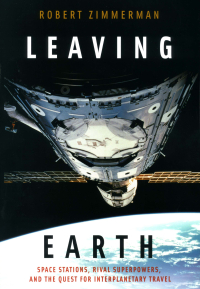
Leaving Earth: Space Stations, Rival Superpowers, and the Quest for Interplanetary Travel, can be purchased as an ebook everywhere for only $3.99 (before discount) at amazon, Barnes & Noble, all ebook vendors, or direct from my ebook publisher, ebookit.

If you buy it from ebookit you don't support the big oppressive tech companies and I get a bigger cut much sooner.


Winner of the 2003 Eugene M. Emme Award of the American Astronautical Society.

 
"Leaving Earth is one of the best and certainly the most comprehensive summary of our drive into space that I have ever read. It will be invaluable to future scholars because it will tell them how the next chapter of human history opened." -- Arthur C. Clarke

Canadian rocket startup with balloon for 1st stage wins launch contract

SpaceRyde, a Canadian smallsat rocket startup company that intends to use a stratospheric balloon to act as its first stage before releasing its orbital rocket, has won a contract for four launches from ISILaunch, a Netherlands satellite company.

Customers will pay $250,000 to launch 25-kilogram payloads on SpaceRyde’s Ryder rocket and Flying Spider balloon. The flights are scheduled to begin in 2024. For the SpaceRyde flights, ISILaunch will offer customization including scheduling weeks prior to launch, access to custom orbits and various fairing configurations.

…Stratospheric balloons will serve as the first stage, lifting Ryder rockets through Earth’s atmosphere before rocket engines fire. Ryder’s upper stage, called Black Bay, is designed to remain in orbit, maneuvering and refueling as needed to provide in-orbit servicing and in-space transportation.

The first test flights are scheduled in ’23, with commercial flights starting in ’24. The company apparently is targeting the smallest smallsat market, aiming to win customers with very very low launch prices.

2 comments

Ten cubesats released by SLS on way to Moon; one has problems

Shortly after SLS’s upper stage completed its engine burn to send Orion to the Moon, it separated and then successfully released ten cubesats on their own deep space missions.

These CubeSats will fly to various destinations including the Moon, asteroids, and interplanetary space. They will study various facets of the Moon and interplanetary travel, ranging from navigation techniques to radiation and biology. One of them is even planned to conduct a soft landing on the lunar surface.

Because of SLS’s numerous delays, there was a chance that many of these cubesats would lose the charges on their batteries and not function after launch. According to the article at the link, communications with six of these cubesats has been established.

The last cubesat above, from Japan and dubbed Omotenashi, was designed as a demonstration test. According to Japan’s space agency, JAXA, however, communications with the spacecraft are “unstable.”

Japan’s space agency said Thursday it has been unable to establish stable communication with the country’s mini moon lander launched on a U.S. rocket the previous day along with a mini satellite. The Japan Aerospace Exploration Agency said it is now trying to control the position of the Omotenashi lander, adding its system of automatically turning to the Sun to gain solar power appears to be not functioning.

Before launch JAXA had rated the mission’s chances of success at 60%, but that mostly referred to the lunar landing. Though intended as a demo mission, it will be unfortunate if it fails for these reasons this early in the mission.

0 comments

November 16, 2022 Quick space links

Courtesy of Jay, BtB’s stringer.


4 comments

Glaciers everywhere in Mars’ glacier country

Glaciers everywhere in Mars' glacier country
Click for full image.

Cool image time! The picture to the right, rotated, cropped, reduced, and annotated to post here, was taken on August 24, 2022 by the high resolution camera on Mars Reconnaissance Orbiter (MRO). It shows glaciers apparently flowing down from two different mesas to the north and south.

The arrows indicate a major glacial stream coming from two directions. The many layered flow on the image’s upper right illustrates the many past climate cycles of Mars, with each subsequent period of snowfall and glacial growth producing progressively less ice. The chaotic region in the lower right marks what I think is the lowest point between the two mesas. Here the flows form eddies as the glaciers collide.

The overview map below shows us why there are so many glaciers at this spot on Mars.
» Read more

0 comments

Today’s blacklisted American: Half of today’s students support the death penalty for some speech

The poll numbers, across all demographics

This is no longer a land of the free: According to a new poll, half of today’s college students now believe that the death penalty is justified for some people should they dare express an opinion that offends.

Specifically, the students were asked if they agreed or disagreed with the statement:

Violence in response to offensive speech is not a new phenomenon. In some cultures, some types of offensive speech even merit the death penalty. Some speech can be so offensive in certain cases that it merits such harsh punishment.

As shown in the graph to the right, across the board, 43% to 55% of students from private and public schools, from all types of majors, from all levels of income, and from across the political spectrum, all agreed with this statement. The results were remarkably consistent. Tolerance was not their watchword, but oppression and dictatorship. If you say something that offends, half of today’s students feel justified in calling for your death.
» Read more

20 comments
1 665 666 667 668 669 2,929