Water system in Caracas goes dry

The water system in Caracas, capital of the socialist paradise of Venezuela, is now shutting down because it needs electricity to operate and it does not have it because of the collapse of the power system.

Caracas began going dry Monday as Venezuela’s power crisis put utilities out of commission, risking supplies for 5.5 million people, many of whom found themselves reduced to carrying buckets of filthy river water.

Service, intermittent in normal times, was scarce to nonexistent in large swathes of the capital and experts saw little reason for hope. Caracas is 900 meters above sea level and water comes from the Tuy system of reservoirs and pumping stations below. Those depend on a reliable electric supply of 2,000 megawatts, said Norberto Bausson, who was the head of state utility Hidrocapital in the 1990s. “As of this morning, this system hasn’t been restarted yet,” Bausson said Monday. “The supply of water for the city is at risk.”

The power crisis — and now the water crisis — are testing the hold of strongman President Nicolas Maduro. Opposition leader Juan Guaido is trying to topple him after a re-election widely viewed as fraudulent and using as his main argument widespread deprivation after six years of Maduro’s rule. Hunger is widespread in the nation. Its infrastructure has decayed to critical levels.

But wait! Think of the wonderful things these people are doing to prevent climate change! No power system, no burning of those evil fossil fuels, and less carbon dioxide in the atmosphere! This is exactly what the modern luminaries of the Democratic Party like Congresswoman Alexandria Ocasio-Cortez (D-New York) want.

We should all congratulate Maduro and work to emulate him here in the U.S.

8 comments

Trump’s budget will not “destroy” or “gut” science

Our terrible press does it again. Yesterday the Trump administration released its proposed 2020 federal budget [pdf], and as usual the pro-government propagandists in the media got to work to lobby against it.

This proposed budget will do none of these things.

These articles all fail to apply even the slightest and tiniest bit of context to their analysis. The budget numbers proposed by the Trump administration might reduce the budgets of some science agencies from what they had gotten the year before, but overall the proposed budgets remain gigantic, far more than received by these same agencies only a few years before.

You don’t believe me? Let me open your eyes.
» Read more

5 comments

Genesis cover

On Christmas Eve 1968 three Americans became the first humans to visit another world. What they did to celebrate was unexpected and profound, and will be remembered throughout all human history. Genesis: the Story of Apollo 8, Robert Zimmerman's classic history of humanity's first journey to another world, tells that story, and it is now available as both an ebook and an audiobook, both with a foreword by Valerie Anders and a new introduction by Robert Zimmerman.

The print edition can be purchased at Amazon or any other book seller. If you want an autographed copy the price is $60 for the hardback and $45 for the paperback, plus $8 shipping for each. Go here for purchasing details. The ebook is available everywhere for $5.99 (before discount) at amazon, or direct from my ebook publisher, ebookit. If you buy it from ebookit you don't support the big tech companies and the author gets a bigger cut much sooner.


The audiobook is also available at all these vendors, and is also free with a 30-day trial membership to Audible.
 

"Not simply about one mission, [Genesis] is also the history of America's quest for the moon... Zimmerman has done a masterful job of tying disparate events together into a solid account of one of America's greatest human triumphs."--San Antonio Express-News

New research detects increase in Bennu’s rotation

New research using ground-based observations has detected a slight increase over time in the daily rotation of the asteroid Bennu.

The new research finds the asteroid’s rotation is speeding up by about 1 second per century. In other words, Bennu’s rotation period is getting shorter by about 1 second every 100 years.

While the increase in rotation might not seem like much, over a long period of time it can translate into dramatic changes in the space rock. As the asteroid spins faster and faster over millions of years, it could lose pieces of itself or blow itself apart, according to the study’s authors.

…The change in Bennu’s rotation could be due to a change in its shape. Similar to how ice skaters speed up as they pull in their arms, an asteroid could speed up as it loses material.

Nolan and his co-authors suggest the reason for the increase in Bennu’s rotation is more likely due to a phenomenon known the YORP effect. Sunlight hitting the asteroid is reflected back into space. The change in the direction of the light coming in and going out pushes on the asteroid and can cause it to spin faster or slower, depending on its shape and rotation.

Truth is, this is not a very significant finding. Asteroids don’t weight much, and thus have very weak gravitational fields. It is therefore very easy to change their orbit and rotation, as well as add or subject material from them.

In this sense, the conclusion above is likely incorrect. What they have found is that the asteroid’s rotation increased at a pace of about 1 second per century, during their study period. Their data only covers the period from 1999 to 2005. Bennu could easily slowed its rotation, or increased it even more, during other times.

2 comments

SpaceX about to install engines on Starship hopper

Capitalism in space: Late last week SpaceX officials revealed that they are about to install the first two Raptor engines on their Starship hopper prototype being assembled at the Texas spaceport.

According to an official SpaceX statement, once Raptor is installed on Starhopper, the integrated vehicle will perform a combination of ground systems testing, propellant loading, static fire tests, and low-altitude hover demonstrations to prove out the brand new vehicle, engine, and facilities. Prior to the final months of 2018, the build site, launch pad, and prototype Starship now preparing for imminent hop tests were little more than empty dirt lots on the southern tip of the Texas coast.

…“SpaceX will conduct checkouts of the newly installed ground systems and perform a short static fire test in the days ahead,” he said. “Although the prototype is designed to perform sub-orbital flights, or hops, powered by the SpaceX Raptor engine, the vehicle will be tethered during initial testing and hops will not be visible from offsite. SpaceX will establish a safety zone perimeter in coordination with local enforcement and signage will be in place to alert the community prior to the testing.” – James Gleeson, March 8th, SpaceX

It is not clear when these first hopper tests will occur, but based on the pace that SpaceX is setting, it should not be too far into the future. Before that however they will likely need to first do some static fire tests, on the ground.

10 comments

Conscious Choice cover

Now available in hardback and paperback as well as ebook!

From the press release: In this ground-breaking new history of early America, historian Robert Zimmerman not only exposes the lie behind The New York Times 1619 Project that falsely claims slavery is central to the history of the United States, he also provides profound lessons about the nature of human societies, lessons important for Americans today as well as for all future settlers on Mars and elsewhere in space.

 
Conscious Choice: The origins of slavery in America and why it matters today and for our future in outer space, is a riveting page-turning story that documents how slavery slowly became pervasive in the southern British colonies of North America, colonies founded by a people and culture that not only did not allow slavery but in every way were hostile to the practice.  
Conscious Choice does more however. In telling the tragic history of the Virginia colony and the rise of slavery there, Zimmerman lays out the proper path for creating healthy societies in places like the Moon and Mars.


“Zimmerman’s ground-breaking history provides every future generation the basic framework for establishing new societies on other worlds. We would be wise to heed what he says.” —Robert Zubrin, founder of the Mars Society.


All editions are available at Amazon, Barnes & Noble, and all book vendors, with the ebook priced at $5.99 before discount. All editions can also be purchased direct from the ebook publisher, ebookit, in which case you don't support the big tech companies and the author gets a bigger cut much sooner.


Autographed printed copies are also available at discount directly from the author (hardback $29.95; paperback $14.95; Shipping cost for either: $6.00). Just send an email to zimmerman @ nasw dot org.

Anti-Semite Democrat says Trump simply isn’t human

They’re coming for you next: In a discussion noting similar immigration policies of both Trump and Obama, anti-Semite Democrat congresswoman Ilhan Omar (D-Minnesota) said that the comparison was “silly” because “One is human. The other is really not.”

Every Democratic voter had better realize this basic fact: Too many of the people they are voting for see their political opponents in this light, which means it will be very easy for them to treat their opponents as bugs that should be squashed. And this is what almost always happens when leftist socialists gain power, in the Soviet Union, in Germany, in North Korea, in East Germany, in China, and in innumerable other places in the past century.

Omar is simply being honest about her hateful bigotry.

7 comments

Leaving Earth cover

Leaving Earth: Space Stations, Rival Superpowers, and the Quest for Interplanetary Travel, can be purchased as an ebook everywhere for only $3.99 (before discount) at amazon, Barnes & Noble, all ebook vendors, or direct from my ebook publisher, ebookit.

If you buy it from ebookit you don't support the big oppressive tech companies and I get a bigger cut much sooner.


Winner of the 2003 Eugene M. Emme Award of the American Astronautical Society.

 
"Leaving Earth is one of the best and certainly the most comprehensive summary of our drive into space that I have ever read. It will be invaluable to future scholars because it will tell them how the next chapter of human history opened." -- Arthur C. Clarke

The nationwide Venezuela power outage

Link here. The article gives a good overview of the now days-long blackout that will go on for days more. Key quote:

How did the country reach this point, in terms of its power network?

Years of disrepair, lack of maintenance and investment. From a human capital point of view, repressive management, terrible wages, and unsafe working conditions. For instance, the technicians are forbidden to talk about this. In February 2018, union leader Elio Palacios was detained because he said that a national blackout was imminent.

The one detail that would have accurately described those years of neglect would have been “socialist rule.” The people who have been in charge of Venezuela since the 1990s have all been heroes of today’s modern American socialists like Bernie Sanders and Alexandria Ocasio-Cortez as well as most of the leaders in the Democratic Party.

Be prepared for the same here. We already see signs of this collapse in urban cities that have been solid Democratic Party strongholds for decades, such as San Francisco, Chicago, and New York. These fascist political leaders like political and economic collapse, because they can use it as a lever to garner more power and wealth to themselves.

Note also this quote from the second link above:

“What can you do without electricity?” said Leonel Gutierrez, a 47-year-old systems technician, as he carried his six-month-old daughter while he walked to find groceries. “The food we have has gone bad.”

Yet this is exactly the future envisioned by Congresswoman Alexandria Ocasio-Cortez (D-New York) in her New Green Deal, where all future electricity will come only from renewable resources, a concept that is simply impossible. The result will be no electricity at all.

8 comments

Martian massive landslides

Though scientists have found some evidence of slow erosion and change on the Martian surface, it is today generally inactive. While the weak wind of Mars’ thin atmosphere continues to work its will, and the likely presence of underground frozen water acts to shift the surface shape as the seasons come and go, none of this happens quickly.

Essentially, Mars is a quiet place.

Once however catastrophic events took place, gigantic floods flowing down to the east from the planet’s huge volcanoes to carve out Marineris Valles, the solar system’s largest known canyon. As that water rushed eastward it ripped the terrain apart quickly, creating deep side canyons, drainage valleys, and chopped up regions now dubbed as chaos terrain, multiple mesas separated by numerous fissure-like canyons.

Overview of Marineris Valles and landslide

The overview map on the right shows Valles Marineris and its drainage to the east and north into the vast northern plains of Mars. It also shows the location of one of the largest regions on Mars of chaos terrain, dubbed Hydraotes Chaos, located close to the mouth of this gigantic drainage system more than 2,500 miles long.

Massive Martian landslide
Click for full image.

Recently scientists have used the high resolution camera on Mars Reconnaissance Orbiter (MRO) to begin taking images of the massive landslides on the face of the mesa north of Hydraotes Chaos that was hit directly by these floods. The location of the most immediately interesting of these landslide images is also indicated on this overview image.

To the right is that image, rotated, cropped, reduced, and annotated to post here. The white boxes indicate two full resolution sections that I highlight below at full resolution.

This image shows that full cliff. The total drop from the plateau at the top to the floor where Hydraotes Chaos is located to the south is approximately 8,200 feet, almost exactly comparable to the depth of the north rim of the Grand Canyon.

The image shows numerous evidence of avalanches and erosion, both at its base and at its rim. None of these avalanches likely occurred during those catastrophic floods, but long afterward.
» Read more

0 comments

The travels of Moon’s scarce surface water

An analysis of data from one of Lunar Reconnaissance Orbiter’s (LRO) instruments have allowed scientists to map the movements of the scarce water on the lunar surface.

Up until the last decade or so, scientists thought the Moon was arid, with any water existing mainly as pockets of ice in permanently shaded craters near the poles. More recently, scientists have identified surface water in sparse populations of molecules bound to the lunar soil, or regolith. The amount and locations vary based on the time of day. This water is more common at higher latitudes and tends to hop around as the surface heats up.

…Water molecules remain tightly bound to the regolith until surface temperatures peak near lunar noon. Then, molecules thermally desorb and can bounce to a nearby location that is cold enough for the molecule to stick or populate the Moon’s extremely tenuous atmosphere, or “exosphere”, until temperatures drop and the molecules return to the surface.

The quantities we are talking about here are very tiny. This will not be the water that future settlers will depend on. Instead, it will be those pockets of ice in the permanently shaded craters.

2 comments

Dragon successfully splashes down in Atlantic

Capitalism in space: SpaceX’s manned Dragon capsule has successfully returned to Earth, splashing down in the Atlantic this morning.

There is a short video at the link showing the splashdown.

As far as I can tell, this test mission went 100% right. They now have the capsule they will use for the launch abort flight, which they hope to do by June, if not sooner. Assuming that goes well, they will be ready to do the manned flight by July, as planned.

The only thing I can see preventing this would be elements in NASA’s bureaucracy, Congress, and the federal government that are hostile to SpaceX and the concept of independent free Americans doing great things. These elements prefer giving power and control to their big bloated government, even if it can’t accomplish anything and that failure gives aide and comfort to hostile foreign powers.

We shall see if those elements move to block this mission in the coming months.

10 comments

Air Force awards ULA and SpaceX three launch contracts each

Capitalism in space: The Air Force this week released more details about the new launch contracts for both ULA and SpaceX worth just under three quarters of a billion dollars.

The contracts announced in February by the Air Force’s Space and Missile Systems Center were split between ULA and SpaceX, rivals in the U.S. launch industry. ULA won deals for up to three launches worth $441.76 million, and the Air Force awarded SpaceX contracts worth $297 million, also for three missions.

I had reported this back in February when it was first announced, but it was not then revealed that one of the SpaceX launches would be with the Falcon Heavy, the second such Air Force launch planned. That the Air Force awarded this contract prior to its first launch, now scheduled for no earlier than June 2019, is somewhat surprising. I would have expected them to wait to first see if that launch, only the second Falcon Heavy launch, was successful.

The article also notes a minor change by the Air Force in its launch program.

The Air Force has also given a new name to the Evolved Expendable Launch Vehicle program, a multibillion initiative begun in the 1990s to fund and oversee the development and operations of the Atlas 5 and Delta 4 rockets now owned by ULA.

The Space and Missile Systems Center announced March 1 that the EELV program’s new name is the National Security Space Launch program, in response to language in the 2019 National Defense Authorization Act.

They really needed to eliminate “Expendable” from the name, since the first stage of SpaceX’s rockets are not expendable, and it is expected that future rockets will be reusable as well. Moreover, EELV was created in the 1990s to create a launch monopoly for Boeing and Lockheed Martin, which then merged to create ULA. That monopoly no longer exists, and the military is now aiming to widen the competition, opening it up to more companies.

2 comments

A Russian speaks truth to power about Roscosmos

Link here. The article outlines the obvious Russian ambivalence towards the success of SpaceX’s manned Dragon capsule this week, and then provides some insightful comments about this ambivalence from a Russian.

One person who would probably know is Vadim Lukashevich, a Russian-based space expert. He was fired from an aerospace think tank at Skolkovo in 2015 after writing articles opposing the transformation of Roscosmos from a government agency into a state corporation. On Monday, he gave an interview to Russian television station Moscow 24, which was published on YouTube and translated for Ars by Robinson Mitchell.

Lukashevich then proceeds to describe what readers of Behind the Black already know, but in much greater detail: The Soyuz capsule is outdated and cannot compete technologically or economically with SpaceX’s Dragon. Their business model of earning money by selling seats on it is over. And the Russian government is apparently unable or unwilling to do what must be done to make them competitive again. Its decision to form a single giant government-controlled aerospace corporation to run Russia’s entire space industry has failed, and they seem unable to recognize this.

2 comments

Hayabusa-2 to get close to Ryugu again to observe next touchdown point

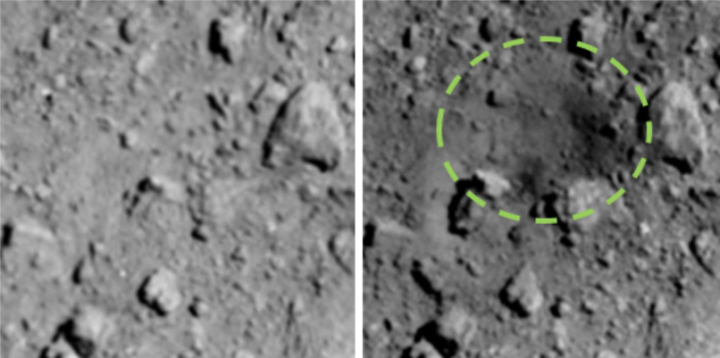
Hayabusa-2’s engineering team has decided it will on March 8 do a close approach to within 75 feet of its next planned touchdown target site in order to inspect it.

The DO-S01 operation schedule is shown in Figure 2. The spacecraft will begin descending on March 7 at 13:27 (JST, onboard time: times below are stated similarly) at a speed of 0.4m/s. The speed will then be reduced to 0.1 m/s around 23:47 on the same day. Continuing descent at this rate, we will reach our lowest altitude at around 12:22 on March 8 and then immediately begin to rise. The altitude of this lowest point will be about 23m. Please note that the times stated here are the planned values but the actual operation times may differ.

As before, they will upload navigation images as this approach is happening.

0 comments

Russia to install security cameras inside ISS

Roscosmos has decided to install security cameras on its portion of ISS, apparently to prevent the possibility of future sabotage.

The article does not say this outright, but that it specifically mentioned the hole that someone drilled in a Soyuz capsule makes me think so.

The equipment required will be ordered and dispatched to the ISS. The places where the cameras are to be installed will be determined by the space rocket corporation Energia.

At the end of August 2018 there occurred a drop in air pressure on the ISS. It took specialists several days to find out that the hull of the Soyuz MS-09 spacecraft had been drilled from the inside.

This report also suggests that the December spacewalk to inspect the hole from the outside did not help them solve the mystery.

I am skeptical these cameras will prevent future sabotage. First of all, it will be impossible to cover every spot. Second, the sabotage was not on ISS, it was on a Soyuz capsule. Are they also installing cameras there as well, and have simply not made that fact public? Third, what will prevent a saboteur on ISS to block the camera anonymously? I can’t imagine they will be installed in such a way that their locations will be unknown to ISS astronauts.

Unless of course they still suspect an American astronaut did the sabotage, and they plan to specifically deny NASA and its astronauts any information about the camera locations. If so, this partnership is truly beginning to fall apart.

4 comments

Next Rocket Lab launch delayed because of late delivery of payload

Capitalism in space: Rocket Lab’s next Electron launch, initial scheduled for late February, has been rescheduled for late march because its DARPA payload arrived late.

Rocket Lab confirmed the new schedule March 6. “Following a delay to payload arrival, the R3D2 spacecraft is now at LC-1 and integration is underway,” the company tweeted. In a later statement, the company said the launch would take place between March 16 and 30 (U.S. time), with four-hour windows each day from 6:30 to 10:30 p.m. Eastern.

Being a very new rocket, with only three launches under its belt. it is important to learn that the delay was caused by the payload, not the rocket.

0 comments

Hubble’s main camera resumes science work

The main camera on the Hubble Space Telescope has resumed science operations after going into safe mode last week.

At 8:31 p.m. EST on Feb. 28, the Advanced Camera for Surveys aboard NASA’s Hubble Space Telescope suspended operations after an error was detected as the instrument was performing a routine boot procedure. The error indicated that software inside the camera had not loaded correctly in a small section of computer memory. The Hubble operations team ran repeated tests to reload the memory and check the entire process. No errors have been detected since the initial incident, and it appears that all circuits, computer memory and processors that are part of that boot process are now operating normally. The instrument has now been brought back to its standard operating mode for normal operations.

From the press release, it appears that they have not been able to trace why the error occurred. However, much like a typical Windows computer, after a mysterious crash and reboot now all appears well, so they have shrugged their shoulders and moved on.

0 comments
1 776 777 778 779 780 1,759