For the past four years the glaciers in Glacier National Park have stopped shrinking.

The uncertainty of science: For the past four years the glaciers in Glacier National Park have stopped shrinking.

“We had this sort of pause,” Fagre said of shrinking at Sperry Glacier and, by extrapolation, other glaciers. “They pretty much got as much snow as they needed.” Sperry covered 0.86 square kilometers in 2005, 0.83 in 2009 and 0.82 in 2013, illustrating the “pause” in its retreat as there was a 0.03 square kilometer loss from 2005 to 2009, but only 0.01 in the last four years, from 2009 to 2013, Fagre said.

The article spends a lot of time talking about how the shrinkage is about to resume and the glaciers are certain to disappear, but this pause in glacier shrinkage corresponds nicely with the 17 plus year pause in warming that has been going on.

And then there’s this: Great moments in climate forecasting.

And this, also from Steve Goddard: In 1971 the world’s top climate scientists said fossil fuels would cause an ice age by 2020.

I especially like the quote from the last article, where these experts say that there is “no need to worry about the carbon dioxide fuel-burning puts in the atmosphere.” These are the same experts who have have spent the past three decades since 1988 telling us that CO2-caused global warming was going to kill us all.

4 comments

A place on Mars that was possibly habitable only 200 million years ago.

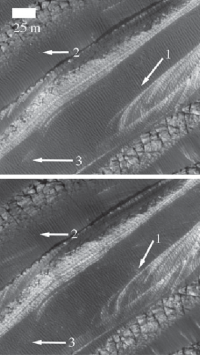
A place on Mars that was possibly habitable only 200 million years ago.

This article discusses the possibility of liquid water from the melting of the glaciers that scientists think once covered the western slopes of the giant volcano Arsia Mons. I have also written about this area in an article I wrote for Sky & Telescope last year on exploring caves in space. It is thought that there might be caves here in which some of that water from those glaciers might still be found.

As one scientist is quoted as saying in this article, “Arsia Mons would be the next place I would want to go.” Like the south pole of the Moon, it likely has all the ingredients for establishing a habitable colony.

1 comment

The Sun settling down?

Two weeks ago NOAA posted its monthly update of the solar cycle, showing the sunspot activity for the Sun in April. I have been remiss about doing my monthly post about this, so here it is now, posted below with annotations.

April Solar Cycle graph

The graph above has been modified to show the predictions of the solar science community. The green curves show the community’s two original predictions from April 2007, with half the scientists predicting a very strong maximum and half predicting a weak one. The red curve is their revised May 2009 prediction.

The Sun continued the drop in sunspots seen the previous month, though the total number remains above the 2009 prediction for this moment in the solar cycle. As already noted, that the second peak of this double peaked solar maximum has been much stronger than the first remains unprecedented.

Overall, the maximum continues to be the weakest seen in a hundred years. Whether this is an indicator of future events or an anomaly can only be discovered after the Sun completes this solar solar cycle and begins the ramp up to its next solar maximum, at least five years away.

The next update is only a few weeks away. Stay tuned.

5 comments

According to a prominent climate scientist, a research paper he co-authored suggesting the threat of global warming from carbon dioxide is exaggerated was rejected for publication for political reasons.

According to a prominent climate scientist, a research paper he co-authored suggesting the threat of global warming from carbon dioxide is exaggerated was rejected for publication for political reasons.

The five contributing scientists submitted the paper to Environmental Research Letters – a highly regarded journal – but were told it had been rejected. A scientist asked by the journal to assess the paper under the peer review process reportedly wrote: ‘It is harmful as it opens the door for oversimplified claims of “errors” and worse from the climate skeptics media side.’

Prof Bengtsson, 79, said it was ‘utterly unacceptable’ to advise against publishing a paper on the political grounds. He said: ‘It is an indication of how science is gradually being influenced by political views. The reality hasn’t been keeping up with the [computer] models.

Bengtsson is also the same climate scientist who was forced to resign last week from a skeptical global warming think tank because of threats of blacklisting if he did not.

0 comments

A climate scientist who joined the board of a skeptical think tank was forced to resign from that think tank after only three weeks due to intense outside pressure and harassment from the global warming community.

McCarthyism of the left: A climate scientist who joined the board of a skeptical think tank was forced to resign from that think tank after only three weeks due to intense outside pressure and harassment from the global warming community.

I have been put under such an enormous group pressure in recent days from all over the world that has become virtually unbearable to me. If this is going to continue I will be unable to conduct my normal work and will even start to worry about my health and safety. I see therefore no other way out therefore than resigning from [the Global Warming Policy Foundation] (GWPF). I had not expecting such an enormous world-wide pressure put at me from a community that I have been close to all my active life. Colleagues are withdrawing their support, other colleagues are withdrawing from joint authorship etc. I see no limit and end to what will happen.

It is a situation that reminds me about the time of McCarthy. I would never have expecting anything similar in such an original peaceful community as meteorology. Apparently it has been transformed in recent years. Under these situation I will be unable to contribute positively to the work of GWPF and consequently therefore I believe it is the best for me to reverse my decision to join its Board at the earliest possible time. [emphasis mine]

The emphasized language illustrates once again the blacklisting methods now being used by the left to destroy anyone who dares to disagree with them.

2 comments

Using computer models and data collected in the past decade, some climate scientists now believe that a major Antarctica ice sheet is in the process of collapsing.

Using computer models and data collected in the past decade, some climate scientists now believe that a major Antarctica ice sheet is in the process of collapsing.

One team combined data on the recent retreat of the 182,000-square-kilometer Thwaites Glacier with a model of the glacier’s dynamics to forecast its future. In a paper published online today in Science, they report that in as few as 2 centuries Thwaites Glacier’s outermost edge will recede past an underwater ridge now stalling its retreat. Their modeling suggests that the glacier will then cascade into rapid collapse. The second team, writing in Geophysical Research Letters (GRL), describes recent radar mapping of West Antarctica’s glaciers and confirms that the 600-meter-deep ridge is the final obstacle before the bedrock underlying the glacier dips into a deep basin.

Because inland basins connect Thwaites Glacier to other major glaciers in the region, both research teams say its collapse would flood West Antarctica with seawater, prompting a near-complete loss of ice in the area. “The next stable state for the West Antarctic Ice Sheet might be no ice sheet at all,” says the Science paper’s lead author, glaciologist Ian Joughin of the University of Washington (UW), Seattle.

This result really falls under the category of the uncertainty of science. Though the data suggests a glacier that is part of the much larger West Antarctica ice sheet is melting, the prediction that the ice sheet itself will collapse sometime in the next two centuries is solely based on computer models that have all too often turned turned out to be wrong.

4 comments

A new study confirms that increased atmospheric carbon dioxide lengthens the plant growing season.

Chicken Little was wrong! A new study confirms that increased atmospheric carbon dioxide lengthens the plant growing season.

Previous studies have documented a lengthening of the growing season in many parts of the world. In the United States, the time between the last spring frost and the first autumn freeze has gone up by nearly two weeks since 19002; in Europe, a study of more than 540 plant species found that, on average, spring events such as flowering had shifted about a week earlier from 1971 to 2000, and the onset of autumn had been pushed back by about four days3.

Such shifts have long been attributed to warming temperatures. But CO2 also plays a part, says study co-author Heidi Steltzer, an ecosystem ecologist at Fort Lewis College in Durango, Colorado.

Putting aside the uncertainty about whether carbon dioxide can even cause global warming, the assumption that global warming itself will be a bad thing has never been demonstrated clearly, while there is evidence that it might actually be beneficial.

11 comments

A history of global warming “Tipping Points” where it was declared that doomsday was certain in only a few years if we didn’t act now

Crying wolf! A history of global warming “Tipping Points” where it was declared that doomsday was certain in only a few years if we didn’t act now.

The article is quite hilarious. Again and again and again and again the climate fear-mongers have announced with absolute certainty that, unless we pass draconian government regulations, the climate was going to go crazy and we were all going to die. Sometimes they declared we only had hours, sometimes months, sometimes years, sometimes even decades, but every time they were certain they knew what was going to happen and thus we had better obey them. And anyone who dared question their certainty was worse than a fool and should be imprisoned!

Of course, none of these predictions have proven true. The climate might yet warm and even go wild, but none of these doom-sayers have done any of us any good. If things do start going bad in future years, it is now going to be very difficult to convince anyone of this fact.

Posted from Tucson International Airport. I am on the way to Denver to tape two television interviews with George Noory of Coast to Coast for his television show, Beyond Belief. Should be fun.

5 comments

The EPA admits that it does not have the data to justify its environmental regulations.

The EPA admits that it does not have the data to justify its environmental regulations.

The EPA was subpoenaed by Congress for the data it uses, and they responded to say that what they have doesn’t really provide any proof that their regulations are necessary. But they then add that they are going to continue imposing their regulations anyway.

1 comment

Forecasters at Colorado State University are predicting the 2014 hurricane season will be quieter than normal.

Uh-oh: Forecasters at Colorado State University are predicting the 2014 hurricane season will be quieter than normal.

This is the same team that last year predicted 2013 would be one of the worst hurricane seasons in history. Instead, last year was one of the weakest in history, and as a result they lost their funding. That these same guys are now saying 2014 will be weak makes me fear for the American Atlantic coast. It could be wiped out this time!

1 comment

“A lot of investment in green technology has been a giant scam, if well intentioned.”

“A lot of investment in green technology has been a giant scam, if well intentioned.”

The quote, and entire interview, are significant for two reasons. First, the interview is seeped with many skeptical opinions about human caused global warming, is very critical of that movement’s effort to politicize science, and the person being interviewed is James Lovelock, the founder of of the concept of Gaia, a former strong advocate of global warming but now a skeptic.

Most significant however is where the interview is published. It is in Nature, one of the most important and influential science journals, which previously has been aggressively pushing global warming politics for years. That they allowed these politically incorrect opinions within their walls and then broadcast them to their readers signals a major cultural shift within the science community. It is beginning to be acceptable to be a skeptic again!

4 comments

The Sun continues to hiccup

It’s sunspot time again! On Monday NOAA posted its monthly update of the solar cycle, showing the sunspot activity for the Sun in February. I am once again posting it here, below the fold, with annotations.

Like it did in January, the Sun’s second peak of the solar maximum continued to beat its first peak, an unprecedented event. Though activity dropped slightly, it still remained above prediction and was only slightly below the first peak’s maximum. Overall, the second peak has been much stronger than the first, something that scientists have never seen before. In the past, when the Sun had a double peaked solar maximum, the second peak was always weaker. Not this time!
» Read more

1 comment
1 36 37 38 39 40 84