
Roy Orbison – Only the Lonely
An evening pause: How many other well-known singers can you identify backing him up?
Hat tip Cotour.
An evening pause: How many other well-known singers can you identify backing him up?
Hat tip Cotour.

Click for full image.
Cool image time! Today we return to the Erebus Mountains, located just to the west of SpaceX’s prime candidate landing site for Starship on Mars. The photo to the right, taken on April 4, 2020 by the high resolution camera on Mars Reconnaissance Orbiter (MRO) and rotated, cropped, and reduced to post here, shows one particular area between the peaks in those mountains, and also happens to be very close to what I have labeled image #1 in SpaceX’s Starship landing site photos.
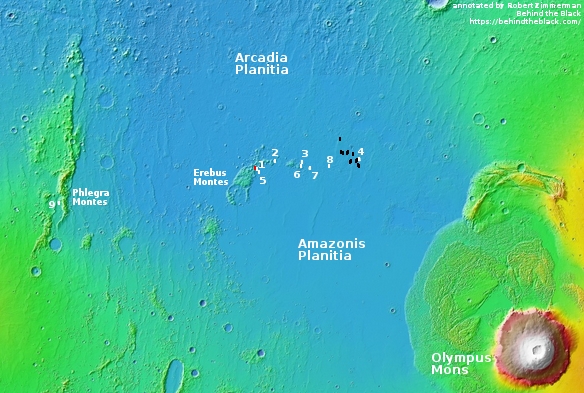
The second image below and to the right shows an overview map of this region, with the SpaceX photos indicated by the numbered white boxes and the location of this image indicated by the red box, right next to image #1. The black boxes were images that SpaceX had obtained from MRO earlier, when it was first planning to send a Dragon capsule to Mars using a Falcon Heavy, a project the company has put aside in its focus on building Starship.
To my eye, everything in the first image above reeks of an icy, glacial terrain. I certainly am guessing, but it is an educated guess based on looking at numerous similar images in this region (see here and here, ) as well as in the nearby Phlegra mountains to the west. I also base my guess on what I have learned interviewing planetary scientists who are studying these images. The reasonableness of this guess is further strengthened in that the location is at 39 degrees north latitude, dead center in the mid-latitude bands where scientists have found evidence of numerous buried glaciers.
If Starship lands just to the east of the Erebus Mountains, the first colonists will likely not only have water available at their feet close to the surface in the flat lowland plains, if they find that resource insufficient they will need only climb uphill a bit into these hills to dig out as much ice as they could ever need.
Capitalism in space: SpaceX’s first manned Dragon capsule successfully docked today with ISS.
A few hours after launch the two American astronauts, Doug Hurley and Bob Behnken, also revealed that they had named the capsule “Endeavour.”
I know this is really old news from late last night and early this morning, but I was out on a cave trip (taking a work break to have some fun underground for the first time in three months). I post it for completion. I also know that the live stream of these events was active here all day for my readers to follow things, as they happened.
Prepare for even more increasing space excitement in the coming years. The Trump administration increasingly is shifting NASA’s gears to have private companies build its spaceships and rockets and science instruments. The more they do this, the less expensive and the more capabilities we shall have as a nation. This success will be a challenge for other nations to match, which in turn will raise the stakes and increase the competition, the excitement, and the action in space.
Yes, the 20s I hope are going to roar, at least in space.
UPDATE: I am off on a caving trip on Sunday, May 31st, so I will not be doing any updates to this post. The live feeds however will still be here and, though they are presently showing a replay of the launch today, should be covering Dragon’s rendezvous and docking with ISS on Sunday..
UPDATE: Dragon is in orbit. SpaceX has successfully used its Falcon 9 rocket to place to Americans into space, the first American launch from American soil in an American spacecraft on an American rocket in nine years.
The leaders in the 2020 launch race:
9 China
7 Russia
7 SpaceX
3 ULA
The U.S. now leads China 12 to 9 in the national rankings.
UPDATE: I have added NASA’s media live feed to the one provided on SpaceX’s website. There will be some hype on SpaceX’s feed, but the media feed had no commentary. Pick which you prefer.
UPDATE: NASA and SpaceX have decided to attempt a launch today. The weather remains at 50-50 for launch.
Capitalism in space: Below are the live streams of SpaceX’s first manned Dragon launch, presently scheduled for launch at 3:22 pm (Eastern) tomorrow, May 30, 2020.
First, the feed from SpaceX’s website:
Second, the media feed from NASA, with no narration:
The live coverage will begin at 11 am (Eastern), and because this presentation is a partnership of NASA and SpaceX, will be filled with a lot of hype that one normally does not see during a SpaceX live feed, though I will note that during the live feed of the May 27th scrubbed launch, the NASA hype was kept relatively tame, compared to previous events. It seemed they accepted some guidance from SpaceX on how to do this in a way that seemed less fake or propagandistic.
This time I am embedding the media feed, which might have even less hype.
This post is also set to remain at the top of the page until after the launch, or after the launch is scrubbed, whichever happens. At the moment the weather says there is a 50-50 chance of launching, so we might end up having a scrub again, like on May 27th. In fact, NASA and SpaceX have already said in the evening of May 29th that they will reassess the weather in the AM on May 30th and decide whether to continue with the countdown or scrub. If so, this link and live feed will remain for the Sunday, May 31st, launch attempt.
As I did during the first launch attempt on May 27th, I will also periodically post below the fold images captured from the live feed, with some commentary. Comments from readers are of course welcome, as always.
NOTE: You will need to refresh the post periodically to see new images and commentary.
For other news updates, scroll down.
» Read more
An evening pause: Yesterday we saw wood being turned into high energy pellets. Today, watch glass being turned into beautiful round sculptures.
Hat tip Tom Biggar.
Because of the 50-50 weather conditions for launching the first manned Dragon mission to ISS tomorrow at 3:22 pm (Eastern), managers at both SpaceX and NASA have decided to maintain the schedule but reassess whether they will proceed come morning.
Thus, it is possible they might scrub the launch attempt very early in the countdown, and instead focus on the Sunday, May 31st launch opportunity. We shall have to wait.
In the meantime the embed of the live stream will appear here at Behind the Black at around midnight (Eastern). If the launch proceeds, the feed begins officially at 11:00 am (Eastern) tomorrow.
Capitalism in space: SpaceX engineers experienced another explosion during testing of their fourth Starship prototype today, completely destroying the protoype.
They already have their fifth prototype almost complete, so I expect they will clean up the debris, analyze again what went wrong, and start testing again.
At a certain point however these explosions have got to end, or else the project will begin to be in trouble.
Link here. These massive and very impressive working trains designed as trucks that could travel across roadless terrain, in the Arctic, is quite fascinating. This paragraph about their designer and builder however illustrates the kind of nation that made the fast building of such things possible:
Born in 1888, Robert Gilmore LeTourneau was an inventor of heavy machinery. In WWII, 70 percent of the Allies’ earthmoving equipment was created by LeTourneau Technologies, Inc. Having very little formal education, LeTourneau began his working career as an ironmonger. By the time he died in 1969 he was tremendously wealthy and personally held nearly 300 patents. He is buried on the campus of the University he founded in his name, where his gravestone reads “MOVER OF MEN AND MOUNTAINS.” Just a little character development for you.
Our country can still such a place, where we are not afraid and allow anyone to do anything, if they have the courage and the brains and the commitment. It requires however that we be both free and brave. Wearing masks for symbolic reasons and out of fear is certainly not a path to such a nation.
Hat tip Tom Biggar.
Capitalism in space: Yesterday SpaceX completed a new static fire engine test of its fourth Starship prototype while also obtaining a two-year launch license from the FAA for a future short up-and-down test hops
SpaceX briefly fired up the single Raptor engine of Starship SN4, the latest prototype of the company’s Mars-colonizing spaceship. The Raptor blazed for a few seconds while the SN4 remained tethered to the ground at SpaceX’s facilities near the South Texas village of Boca Chica. It was the fourth “static fire” test for the SN4, and the second with this particular Raptor engine. The previous static fire blazed a little hot, scorching the base of the spacecraft, but the flames seemed to behave themselves this time around.
Musk has said he wants to take the SN4 out for a spin soon, on an uncrewed test flight to a target altitude of about 500 feet (150 meters). With four static fires now in the books, SN4 seems poised to take that leap. But the prototype won’t get off the ground before Demo-2 does. “I have redirected SpaceX’s priorities to be very focused on the crew launch,” Musk told Aviation Week & Space Technology’s Irene Klotz recently. “As a rough guess, I think we’re a few weeks away from a hop.”
SpaceX has its paperwork in order to take Starship prototypes pretty high up, by the way. Today [now yesterday], the Federal Aviation Administration’s Office of Commercial Space Transportation issued the company a two-year license to launch suborbital flights from the Boca Chica site.
Note that whatever caused the fire that occurred in the previous static fire test has apparently been identified and quickly resolved.
Capitalism in space: With the New Zealand government finally lifting some of the Wuhan panic restrictions it imposed on its population, Rocket Lab has announced that it will resume launches in June.
The company announced May 28 it has rescheduled an Electron launch for June 11 local time from its launch site on New Zealand’s Mahia Peninsula. That launch was previously scheduled for March 30 but postponed because of a lockdown imposed by the New Zealand government in response to the pandemic.
The launch, called “Don’t Stop Me Now” by the company, has the same set of payloads as what the company originally announced in March. That includes three unidentified payloads for the National Reconnaissance Office, the ANDESITE (Ad-hoc Network Demonstration for Extended Satellite-based Inquiry and other Team Endeavors) cubesat built by students at Boston University and whose launch was arranged by NASA, and M2 Pathfinder built by the University of New South Wales Canberra.
I suspect that, because the launch business is normally filled with delays that can extend to two months, Rocket Lab has weathered this situation better than many others.
The weather for Saturday’s SpaceX launch presently gives only a 40% chance of launch.
Forecasters from the 45th Weather Squadron have issued a slightly more pessimistic outlook for the next two Crew Dragon launch opportunities Saturday and Sunday.
There’s now a 60 percent probability of weather conditions at the launch site violating one of the criteria for liftoff for launch opportunities at 3:22 p.m. EDT (1922 GMT) Saturday and at 3:00 p.m. EDT (1900 GMT) Sunday, according to the weather team.
The worst part is that the weather doesn’t look good for either day.
An evening pause: Hat tip Cotour.
Capitalism in space: According to Elon Musk, SpaceX has raised an additional $346 million more in investment capital.
According to the very short article at the link, this brings the total raised during this latest fund-raising round to $567 million. This is puzzling, as in March SpaceX announced that it had raised $500 million in this round. If the company has raised an additional $346, the total should be higher.
Either way, this brings the total raised by the company to close to $2 billion, almost all of which is being dedicated to building Starship & Super Heavy. Compared to what NASA spends on SLS/Orion — about $3 billion per year with a total about $50 billion when its first manned mission occurs finally in 2024 — this is chicken feed. However, for a private company fueled by competition and good management (unlike NASA), it is likely more than enough to get the job done.
An evening pause: Performed live, 1971. Nice song and performance, but I often wonder why the 60s generation so often seems so unhappy. We were the most blessed generation ever born on Earth, with more wealth and prosperity ever seen by anyone ever.
Hat tip Tom Biggar.
Capitalism in space: Yusaku Maezawa, the first person to buy a ticket to fly on SpaceX’s Starship around the Moon, has now been accused in the Japanese press to have evaded $4.6 million in taxes.
The reports, which first appeared in the Yomiuri newspaper, suggested that Mr Maezawa had failed to fully declare the personal use of a corporate jet owned by his asset management firm over a three-year period.
Japan’s national tax agency declined to comment.
Maezawa has vigorously denied the allegations on Twitter.
Capitalism in space: Virgin Orbit has posted a detailed update on the failure of its LauncherOne rocket on its first launch on May 25.
About 9 seconds after drop, something malfunctioned, causing the booster stage engine to extinguish, which in turn ended the mission. We cannot yet say conclusively what the malfunction was or what caused it, but we feel confident we have sufficient data to determine that as we continue through the rigorous investigation we’ve already begun. With the engine extinguished, the vehicle was no longer able to maintain controlled flight — but the rocket did not explode. It stayed within the predicted downrange corridors of our projections and our Federal Aviation Administration (FAA) launch license as the vehicle fell to the ocean, posing no risk to public safety, no danger our aircrew or aircraft, and no significant environmental impact.
They note that the rocket’s release and engine ignition went as planned, which is for them positive news. They say they their next rocket is being prepared for launch, but do not say when.
I have embedded their video report of the flight below the fold. It does include video of the rocket’s release, ignition, and shut down, but cuts off at that point.
» Read more
Capitalism in space: Despite declaring bankruptcy in March, the satellite communications company OneWeb has applied for an FCC license to launch as many as 48,000 satellites in its planned constellation to provide global internet access.
This suggests the company fully expects to continue operations after exiting bankruptcy procedures.
An evening pause: Hat tip Cotour.
Capitalism in space: The weather outlook has brightened tomorrow, increasing the chances that the SpaceX’s manned Dragon capsule will launch as scheduled.
No major technical issues of any significance were under discussion Monday, but the weather could be a factor. Forecasters initially predicted a 60% chance of a weather-related launch rule violation, but Mike McAleenan, launch weather officer with the 45th Weather Squadron, said conditions appeared to be improving somewhat. “If I was to issue the forecast today, right now we would probably be down to 40% chance of violation,” he said. “We have a bit more rain to go here and maybe another round of afternoon thunderstorms tomorrow, but … it looks like much less (cloud) coverage. So we have some hope for launch day.”
But McAleenan’s forecast does not include downrange conditions in the Atlantic Ocean along the Crew Dragon’s trajectory where Hurley and Behnken could be forced to ditch in the unlikely event of a catastrophic booster failure during the climb to space.
SpaceX managers will assess a complicated mix of weather models, high-altitude balloon data and actual wind, rain and wave data from multiple buoys along the ground track to determine whether conditions, on average, are acceptable for launch.
The launch is set for 4:33 pm. I will embed SpaceX’s live stream here on Behind the Black tomorrow earlier in the day, when things begin..
A evening pause: For Memorial Day. The words:
To fallen soldiers let us sing
Where no rockets fly nor bullets wing
Our broken brothers let us bring
To the Mansions of the Lord
No more bleeding, no more fight
No prayers pleading through the night
Just divine embrace, eternal light
To the Mansions of the Lord.
Where no mothers cry and no children weep
We will stand and guard though the angels sleep
Through the ages safely keep
The Mansions of the Lord.
Hat tip Tom Biggar.