Update on MOXIE’s two years on Mars, producing oxygen

Link here. MOXIE is a technology test instrument on the rover Perseverance that has proven it will be possible to practically produce sufficient oxygen from the Martian atmosphere to sustain a human colony.

The link provides a nice summary of everything the engineering team has accomplished since Perseverance landed in testing this technology. As I wrote in my December post about MOXIE’s achievements:

Based on these tests, MOXIE has unequivocally proven that future human explorers will not need to bring much oxygen with them, and will in fact have essentially an unlimited supply, on hand from the red planet itself. More important, MOXIE has also proven that the technology to obtain this oxygen already exists.

All we need to do is plant enough MOXIE trees on Mars.

0 comments

Sponge terrain on Mars

Sponge terrain on Mars
Click for original image.

Cool image time! The picture to the right, rotated, cropped, reduced, and sharpened to post here, was taken on January 11, 2023 by the high resolution camera on Mars Reconnaissnace Orbiter (MRO).

The scientists labeled this picture “Rocky Terrain.” Though this describes the overall sense of the full image, it fails to capture correctly the nature of this patch of ground at the center of the picture. As you can see, this patch of spongelike surface starts and ends abruptly. It appears that it is a layer on top of the surrounding terrain that has also been eroded aggressively since its placement.

The many craters on its surface seem to have come later, though as the crater size diminishes it becomes harder to separate the craters from the sponge holes. Moreover, some of the larger craters are distorted in shape, as if the impact hit material that was viscous and could flow somewhat.

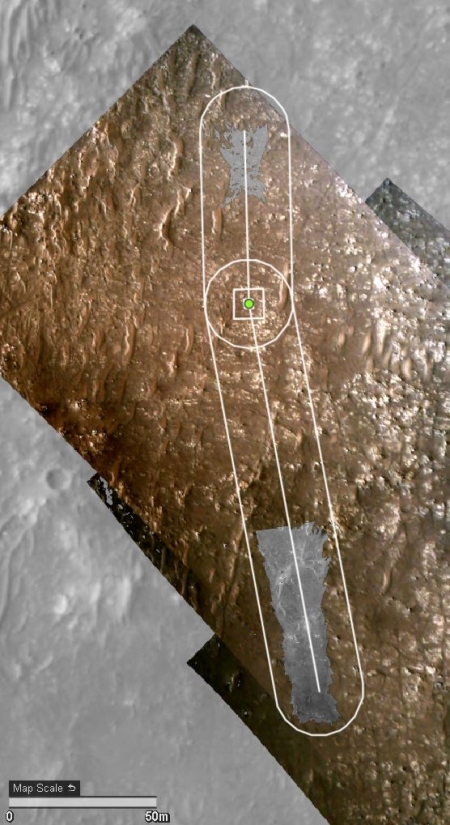
The overview map below gives some context, but only some.
» Read more

3 comments

Spain’s government officially establishes a Spanish space agency

Spain’s Council of Ministers has voted to officially established a Spanish space agency, with operations beginning on March 7, 2023 with an initial budget of $753 million.

This announcement comes only a month before the private Spanish company, PLD, attempts its first suborbital launch from a Spanish spaceport of its Miura-1 rocket, its first stage designed to come back to Earth by parachute, recovered, and then reused. If successful the company hopes to then develop an orbital version.

The news from Europe increasing suggests that the members of the European Space Agency (ESA) are beginning to go their own way, relying less upon it. In addition to these developments in Spain, Germany now has three private companies developing rockets while Italy’s government has provided $308 million to its own Italian rocket company Avio. The United Kingdom meanwhile has had its own space agency for several years, is building several spaceports, and has been trying to develop its own space industry, with very mixed results. In addition, both Norway and Sweden are building spaceports for commercial operations.

ESA, while mouthing support for commercial space, has so far not done well in the past decade in transitioning from a government run, built, and owned operation to one owned by commercial companies. Its new Ariane-6 rocket, built and controlled by ArianeGroup but heavily managed by ESA, is still too expensive to compete with the new commercial rockets from the U.S. Nor does it appear ESA is moving very fast to fix this situation. It appears many people in Europe have recognized this state of affairs, and are looking for alternatives.

1 comment

Two launches by China

China's spaceports
China’s spaceports

China yesterday and today successfully completed two launches using two different rockets from two different spaceports.

First, a Long March 2D rocket yesterday launched a set of four satellites establishing a new constellation of radar satellites designed to measure the Earth’s surface topography. Lift off was from the Taiyuan Satellite Launch Center in the northeast of China. No word on where the rocket’s first stage crashed.

Next, a Long March 4C rocket today placed in orbit a classified military “remote-sensing” satellite, lifting off from the Jiuquan Satellite Launch Center in China’s northwest. Once again, no information was released on where the first and second stages of the rocket crashed to Earth.

The leaders in the 2023 launch race:

21 SpaceX
13 China
6 Russia
3 Rocket Lab

American private enterprise still leads China 24 to 13 in the national rankings, and the entire world combined 24 to 23. SpaceX now trails the entire world combined, including American companies, 26 to 21.

1 comment

Virgin Orbit shuts down

Unable to secure new funding, the managers of Virgin Orbit have shuttered the company, possibly forever.

Virgin Orbit is ceasing operations “for the foreseeable future” after failing to secure a funding lifeline, CEO Dan Hart told employees during an all-hands meeting Thursday afternoon. The company will lay off nearly all of its workforce. “Unfortunately, we’ve not been able to secure the funding to provide a clear path for this company,” Hart said, according to audio of the 5 p.m. ET meeting obtained by CNBC.

The layoffs include all but 100 positions, about 85% of its workforce.

The company was killed because the UK’s Civil Aviation Authority (CAA) took an extra six months approving a launch license, during which the company could launch nothing and thus make no money. Lacking revenue, it ran out of cash. If the company goes into bankruptcy, this detail is most intriguing:

Branson has first priority over Virgin Orbit’s assets, as the company raised $60 million in debt from the investment arm of Virgin Group.

In other words, Branson will be able to walk off with everything, and even resurrect the company as his own, for pennies on the dollar. If he does, I guarantee our bankrupt mainstream press will shower him with praise, calling him a hero.

8 comments

A bubbly cauldron on the surface of Mars

A bubbly cauldron on the surface of Mars
Click for original image.

Cool image time! The picture to the right, rotated, cropped, reduced, and sharpened to post here, was taken on December 20, 2022 by the high resolution camera on Mars Reconnaissance Orbiter (MRO). It shows a strange terrain of craters and mounds, with all the mounds having pits within them like volcanic calderas. In between the surface has a two-toned stippled look, as if two different materials are in the process of mixing.

My immediate impression was that of the bubbly surface of a vat of tomato sauce simmering. Or maybe the vile mixture created by the witches in Shakespeare’s Macbeth, which as they mix they chant:

First witch:
Round about the cauldron go;
In the poison’d entrails throw.
Toad, that under cold stone
Days and nights has thirty-one
Swelter’d venom sleeping got,
Boil thou first i’ the charmed pot.

ALL:
Double, double toil and trouble;
Fire burn, and cauldron bubble.

Of course, this is not a vat of witch’s brew or tomato sauce. It is the surface of the planet Mars, but an alien surface nonetheless.
» Read more

0 comments

Frank Rubio’s flight to ISS will exceed a year, setting a new American record

Frank Rubio
Frank Rubio

Initially, Frank Rubio’s first flight in space was intended to be a standard six month mission on ISS. Launched on September 21, 2022 on a Soyuz-2 rocket inside a Soyuz capsule, the plan was for him and his two crewmates to return in March, 2023.

Then their Soyuz capsule developed a leak in its coolant system in December 2022. Not knowing if it was safe to use this capsule with humans inside, a replacement unmanned Soyuz capsule was launched by the Russians to ISS in February 2023, with the leaking Soyuz capsule brought back unmanned earlier this week.

The Russians however decided that this new capsule, designed for a six month mission, would stay in orbit for six months, so that it would be used to its planned capability. This decision also hinged on the lack of a new crew arriving on this new capsule. If it brought Rubio and his crew home earlier, ISS would be short three crew members for at least several months.

The planned return date, September 27, 2023, now means that Rubio’s mission will be at least 371 days long, making him the first American to fly a full year in space. Previously NASA falsely touted Scott Kelly’s 340-day mission as a year-long mission, when it never was. Later, Mark Vande Hei’s mission, also launched on a Soyuz, was extended to 355 days, still just short of a year, because the Russians wanted to send a film crew to ISS and return them on the capsule which Vande Hei was intended to come home on.

Whether Rubio truly does spend a year in space however remains uncertain. Two different Russian spacecraft — the Soyuz and a Progress freighter — have developed this coolant leak in the past three months. If this problem is a systemic manufacturing error, which Russia is now investigating, the decision might be to return the new capsule sooner than planned, out of fear it will develop its own leak. We shall likely find out sometime in the next three months.

If Rubio does end up in space for a full year, however, it will likely be a dream come true, having become an astronaut in 2017 but waiting six years for his first flight.

6 comments

New startup unveils 3D printer for making rocket tanks and fairings

Rosotics, a new startup focusing on providing manufacturing components for rocket companies, has now unveiled a prototype of its proposed 3D printer, dubbed Mantis, for making rocket tanks and fairings.

Mesa, Arizona-based Rosotics plans to begin delivering the Mantis in the third quarter of 2023 to customers who place $95,000 deposits and sign hardware-as-a-service contracts. After delivery, Rosotics β€œwill install, maintain and upgrade your hardware over time without any cost to you,” LaRosa said.

While the Mantis can be configured for various tasks, the starting point is a one printhead to additively manufacture aluminum or steel structures ranging in size from 1.5 to 8 meters in diameter.

The idea is sell this manufacturing capability to rocket companies as well as other manufacturers who need large structures built. Rather than machining these large structures themselves, or have outside machining companies do it for them, the companies would buy Mantis to do it in-house instead.

Whether this model will work depends on price and operations. Is it cheaper and quicker to use this 3D printer to make large rocket parts, or traditional methods? Obviously, Rosotics thinks it is. We will find out if others think so if Rosotics survives.

1 comment

H3 failure delays Japan’s entire space program

According to one official of Japan’s space agency JAXA, the failure of the first launch of its new H3 rocket in early March now threatens the schedule of much of Japan’s entire space program, even those missions being launched on the older H2A rocket.

The investigation into the launch failure, when the upper stage of the H3 rocket failed to ignite, remains unfinished with no word when it will be completed.

The H3 upper stage uses an engine designated LE-5B-3 developed by MHI [Mitsubishi Heavy Industries] and similar to the LE-5B engine used on the existing H-2A rocket. That is putting launches of the H-2A on hold while the investigation continues.

That may delay the upcoming launch of two science missions sharing an H-2A. The X-Ray Imaging and Spectroscopy Mission (XRISM), an X-ray astronomy spacecraft, and the Smart Lander for Investigating Moon (SLIM), a lunar lander, were scheduled to launch together as soon as May on an H-2A.

The article notes that XRISM replaces a 2016 Japanese X-ray telescope that failed immediately after launch. That failure then was bad, but just as bad is the seven years it has taken JAXA to have a replacement ready.

The H3 failure also threatens a JAXA Mars mission scheduled for launch in 2024, during the next launch window to Mars.

Japan’s space program more and more resembles Russia’s. It is controlled entirely by the government, which it appears does not allow competition within Japan, as all major rocket work is apparently confined to Mitsubishi. There have been unending quality control problems, within many probes as well as in the development of both the H3 and the Epsilon rockets. And the pace of operations is slow, much slower than other nations or companies.

It seems a major reform is needed, and it should start with Japanese government officials reading Capitalism in Space. They need to open up competition and release their space program from the control of JAXA, especially because JAXA is not doing a very good job. Like NASA, it would be better if JAXA stopped being a designer and builder, and become merely a customer obtaining products from many different competing private companies.

4 comments

Russia’s Soyuz-2 rocket launches classified military satellite

Russia today successfully launched a classified military satellite, using its Soyuz-2 rocket lifting off from Plesetsk spaceport in northern Russia.

The rocket traveled north over the Arctic Ocean, so its first stage fell harmlessly into the ocean.

The leaders in the 2023 launch race:

21 SpaceX
11 China
6 Russia
3 Rocket Lab

American private enterprise still leads China 24 to 11 in the national rankings, and the entire world combined 24 to 21. SpaceX now trails the rest of the world, including other American companies, 21 to 24.

0 comments

In U.S. sales of dumb phones are up

It appears that American users of mobile phones are shifting every so slightly away from smart phones, with sales of simple flip-phones lacking a screen rising in the past year.

In the U.S., feature flip phone sales were up in 2022 for HMD Global, with tens of thousands sold each month. At the same time, HMD’s global feature phone sales were down, according to the company.

In 2022, almost 80% of feature phone sales in 2022 came from the Middle East, Africa and India, according to Counterpoint Research. But some see that number shifting, as a contingency of young people in the U.S. revert back to dumb or minimalist phones. “In North America, the market for dumb phones is pretty much flatlined,” said Moorhead. “But I could see it getting up to 5% increase in the next five years if nothing else, based on the public health concerns that are out there.”

Companies like Punkt and Light are catering to the trend, selling devices geared toward those with a desire to spend less time on their phones and social media. On YouTube, you will find a slew of influencers touting these phones.

It is not clear if this is a real trend, or merely a bit of press release salesmanship by HMD and others. If it is however I think it is a good trend. Smart phones do very little to make people smarter. Instead, they foster a shallow thinking process focused on emotion. The more people who get away from them the better.

13 comments

Psyche asteroid mission now scheduled for October 2023 launch

After a year delay because certain flight software was not ready on time for its first launch window in the fall of 2022, the science team for the Psyche asteroid mission are now aiming for an October 2023 launch.

The launch period will open Oct. 5 and close Oct. 25. The asteroid, which lies in the outer portion of the main asteroid belt between Mars and Jupiter, may be the remains of a core of a planetesimal, a building block of a rocky planet.

Due to the new launch date, Psyche has a new mission plan, which includes a flyby of Mars for a gravity assist and arrival at the asteroid in August 2029. The mission then will enter its 26-month science phase, collecting observations and data as the spacecraft orbits the asteroid at different altitudes.

Meanwhile, the two Janus probes that were to launch with Psyche last year remain in limbo, as this new Psyche launch date is useless to that mission’s plan to fly past a different asteroid.

1 comment
1 340 341 342 343 344 1,353