A journey into Martian chaos

Overview map of Aram Chaos

With today’s cool image, we shall begin with the overview map, and drill our way down until we get a close look at another example of truly alien Martian terrain, with only a hint of similarity to comparable geology on Earth.

The overview map to the right shows us Aram Chaos, an ancient 170-mile-wide impact crater that has gone through such complex geology that it is difficult, maybe impossible, to unravel it based on data obtained from orbit. As I wrote in a detailed December 2020 post describing the confusing geology of this crater,

The floor of Aram Chaos is a place of great puzzlement to planetary geologists. The geology there is incredibly complex, and includes chaos terrain overlain by several sedimentary layers of sulfate minerals. The chaos terrain is most obvious in the southern part of the crater’s floor. The flat areas near the eastern center are those overlaying sedimentary layers.

When we zoom into the white box we can see a good example of this complexity.
» Read more

0 comments

Ingenuity completes 49th flight on Mars

Overview map
Click for interactive map.

The Ingenuity team today posted the official flight totals for the Mars helicopter’s 49th flight, which took place yesterday.

The helicopter flew 925 feet for 143 seconds, or two minutes and twenty-three seconds. The plan had been to fly 894 feet for 135 seconds, but has been happening consistently for the past dozen or so flights, the helicopter spent a little more time in the air and traveled a little farther.

As for altitude, it apparently did exactly as planned, averaging about 40 feet in height until the end of the mission, when Ingenuity went straight up another twelve feet to get a wider view of its landing area.

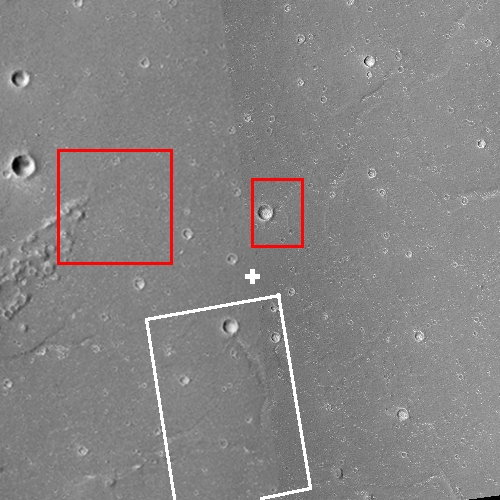
The map to the right shows the context. The green dot marks Ingenuity’s location at the start of the flight. The green line indicates my approximate estimate of its flight path and landing area, which the engineering team has not yet posted. The white dots and line mark Perseverance’s path, with its present location at the area dubbed Tenby where it has obtained its first core sample from the top of the delta.

1 comment

Sunspot update: Activity remained high in March

It is time for my monthly sunspot update. NOAA this week updated its graph that tracks the number of sunspots on the Sun’s Earth-facing hemisphere. This graph is posted below, with some additional details included to provide some context.

Last month the number of sunspots dipped slightly after a gigantic leap of activity in January. This month showed a small rise in activity, but not enough to bring levels back to the January’s levels. Nonetheless, activity remains the highest seen since 2014. when the last solar maximum was approaching its end, and continues to exceed significantly the 2020 prediction by NOAA’s panel of solar scientists.
» Read more

3 comments

NASA names four astronauts to fly on first manned Artemis mission around Moon

NASA today named the four astronauts who will fly on its Artemis-2 in a 10-day mission around the Moon, launched on SLS’s second launch in an Orion capsule and tentatively scheduled for late 2024.

The crew assignments are as follows: Commander Reid Wiseman, Pilot Victor Glover, Mission Specialist 1 Christina Hammock Koch, and Mission Specialist 2 Jeremy Hansen. They will work as a team to execute an ambitious set of demonstrations during the flight test.

The approximately 10-day Artemis II flight test will launch on the agencyโ€™s powerful Space Launch System rocket, prove the Orion spacecraftโ€™s life-support systems, and validate the capabilities and techniques needed for humans to live and work in deep space.

The flight, set to build upon the successful uncrewed Artemis I mission completed in December, will set the stage for the first woman and first person of color on the Moon through the Artemis program, paving the way for future for long-term human exploration missions to the Moon, and eventually Mars. This is the agencyโ€™s Moon to Mars exploration approach. [emphasis mine]

The highlighted words illustrate some important facts. First, this first manned flight of Orion will also be the first that will use the capsule’s life-support systems, which were not included the first flight around the Moon in December. Thus, these four humans are essentially guinea pigs for this engineering. Seems such a plan should have been questioned by NASA’S corrupt safety panel, but then, it is corrupt, and never seems to have much problem with unsafe practices done by NASA itself. Instead, it spends a lot of time making up problems for SpaceX and missing problems at Boeing and NASA.

Second, note NASA’s emphasis on race and sex for the first landing on the Artemis-3 mission. Note too that Artemis-2 crew also includes a black and a woman. Though the press release wisely and correctly makes no mention of race when describing the four astronauts, it does tout the achievements of Christina Koch as a woman, not as a person.

Don’t get me wrong. It is good that a black and a woman are flying to the Moon. It just appears very clear that NASA now has a firm quota system, requiring one of each for every mission.

Finally, there is something not mentioned in the press release or on the Artemis-2 webpage that is very telling. Neither says anything about a launch date, which NASA had previously announced as November 2024. I have been predicting from the beginning that this date is a fantasy. It now appears NASA realizes it but is not yet ready to admit it publicly.

4 comments

Starship and Superheavy readied for orbital flight

With Superheavy prototype #7 already on the launchpad at Boca Chica, Texas, SpaceX engineers yesterday moved Starship prototype #24 beside it in preparation for stacking the orbital spacecraft on top of Superheavy for a launch now expected no earlier than April 10, 2023.

As the article notes, when Superheavy lifts off, it will set a new record for the most powerful rocket, having twice the thrust of either of NASA’s Saturn-5 or SLS rockets. And this record will be achieved by a privately built and owned rocket whose development has been funded almost entirely by private investment capital. Note too that the development took about six years, from concept to first launch, a few years less than it took NASA to build the Saturn-5 in the 1960s, and about one third the time it NASA to do the same thing with SLS in the 2000s, the 2010s, and the 2020s.

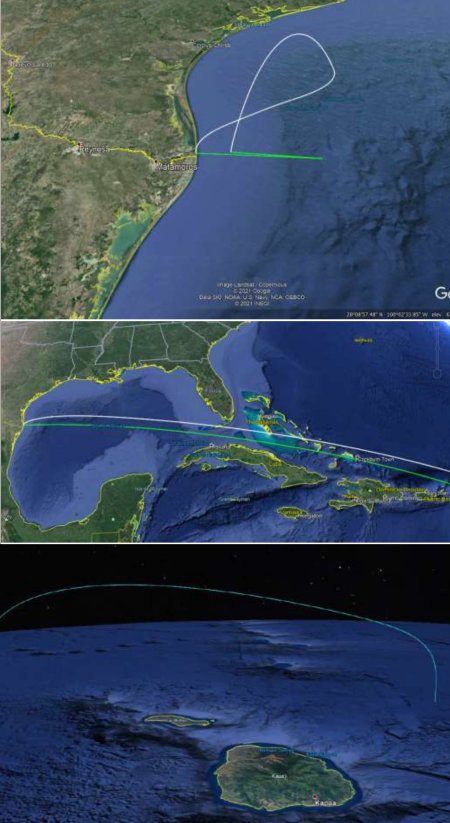
The orbital mission, it successful, will have Superheavy lift off, separate from Starship and then land controlled in the Gulf of Mexico. Starship will continue into orbit, and then attempt a controlled vertical splashdown in the Pacific Ocean northwest of the big Island of Hawaii.

At the moment, it appears the only obstacle to launch remains the FAA, which after many months has still not issued the launch license. This new activity at Boca Chica however suggests SpaceX expects that approval to occur momentarily.

15 comments

Japan officially delays next H2A rocket launch because of H3 launch failure

Japan’s space agency JAXA has now officially delayed its next H2A rocket launch, scheduled for May and carrying a Japanese lunar lander dubbed SLIM, because that rocket shares some components of Japan’s new H3 rocket, which failed during its inaugural launch in March.

No new launches are currently planned after a series of setbacks for the Japan Aerospace Exploration Agency, including the next-generation H3 rocket’s failure and that of the smaller Epsilon-6 in October, which was ordered to self-destruct after deviating from its intended trajectory shortly after takeoff.

The earliest the H2A launch can be rescheduled for is August, due to the orbital mechanics for getting it to the Moon. There are indications however that even this date will not be met.

0 comments

India successfully lands its own version of the X-37B on a runway

LEX landing

India’s space agency ISRO today successfully landed its own version of the X-37B on a runway.

The flight was a test of the landing system. The spacecraft, dubbed LEX, was dropped from a helicopter at an elevation of 2.8 miles above sea level. It then autonomously guided itself to the runway to land smoothly. The picture to the right shows LEX as it approaches the runway. Note how similar it looks to the X-37B.

ISRO had demonstrated the re-entry of its winged vehicle RLV-TD in the HEX mission in May 2016. … In HEX, the vehicle landed on a hypothetical runway over the Bay of Bengal. Precise landing on a runway was an aspect not included in the HEX mission. The LEX mission achieved the final approach phase that coincided with the re-entry return flight path exhibiting an autonomous, high speed (350 kmph) landing.

The next step will of course be to launch an orbital version, and bring it back to Earth for reuse.

0 comments

SpaceX and Chinese pseudo-company complete launches

Two launches today. First, a new Chinese pseudo-company, dubbed Space Pioneer, completed the first launch of its liquid kerosene-fueled Tianlong-1 rocket, putting a military surveillance satellite into orbit.

Space Pioneer is the third Chinese pseudo-company to achieve orbit, but the first to do it with a liquid-fueled rocket. The previous two, Ispace and Galactic Energy, used solid-fueled rockets based on military missile technology. All of these Chinese companies follow a private model. An individual or a group of individuals creates the company, obtains private investment capital, and then wins contracts from the Chinese government. What makes them pseudo is that they do not work independently and freely, and really do not own their products. The Chinese government supervises and approves everything, and can take over at any time.

The second launch today was by SpaceX, using its Falcon 9 rocket lifting off from Vandenberg Space Force Base in California to put a new smallsat constellation of ten military satellites, designed to test the quick development (under two years) of such smallsats for use by the military.

The first stage successfully completed its second flight, landing back at Vandenberg. The fairings completed their fourth and sixth flights, respectively.

The leaders in the 2023 launch race:

22 SpaceX
14 China
6 Russia
3 Rocket Lab

American private enterprise still leads China 25 to 14 in the national rankings, and the entire world combined 25 to 24. SpaceX by itself trails the entire world, including American companies, 22 to 27.

2 comments

Stratolaunch’s Roc airplane completes another test flight

Stratolaunch today announced that it has successfully completed the third capture-carry test using its giant Roc airplane, carrying an engineering test version of its Talon vehicle, designed to do hypersonic flight tests for the Air Force.

The flight was the tenth for the company’s launch platform Roc and marks the beginning of routine flight operations in Vandenberg Space Force Base’s Western Range off California’s central coast. The flight, which lasted a total of five hours, performed risk reduction by practicing a variety of separation profiles and confirming telemetry between Roc and Talon-A vehicles and Vandenberg Space Force Base’s communication assets, assuring that back-up telemetry data collection will occur during future flight tests.

Pending results of post-flight data analysis, the team will progress toward a separation test in the coming weeks, enabling the company to perform its first hypersonic flight in 2023.

There is a lot of potential test capability for Roc and Talon, not just with hypersonic missiles and aircraft. If Stratolaunch succeeds in fulfilling this Air Force contract, it will likely garner a good amount of additional business.

0 comments

Lunar rover startup signs deal to send rover to the Moon using Starship

The lunar rover startup Astrolab has signed a deal with SpaceX to send its FLEX rover to the Moon’s south pole region using a lunar lander version of Starship.

Jaret Matthews, founder and chief executive of Astrolab, said in an interview that the mission, which will include 1,000 kilograms of customer payloads, will be the first flight of the FLEX rover. It will be a rideshare payload on a Starship mission landing somewhere in the south polar region of the moon.

โ€œBecause our rover can traverse up to a couple thousand kilometers in a given year, weโ€™re less sensitive to exactly where we land,โ€ he said. โ€œโ€™It is definitely optimized for the south polar region because thatโ€™s fundamentally where we think that the bulk of the activity is going to be.โ€

The company unveiled a full scale prototype of its rover one year ago, when it made it clear it intended to compete for the rover contract in NASA’s Artemis program, competing against several big established players. Since then there has been little news. The story today sadly reeks to me of a lot of blarney. For example, the company has only 20 employees. Astrolab might have signed this deal, but I suspect it is a very tentative deal, easily canceled by either party at no cost.

0 comments

Update on MOXIE’s two years on Mars, producing oxygen

Link here. MOXIE is a technology test instrument on the rover Perseverance that has proven it will be possible to practically produce sufficient oxygen from the Martian atmosphere to sustain a human colony.

The link provides a nice summary of everything the engineering team has accomplished since Perseverance landed in testing this technology. As I wrote in my December post about MOXIE’s achievements:

Based on these tests, MOXIE has unequivocally proven that future human explorers will not need to bring much oxygen with them, and will in fact have essentially an unlimited supply, on hand from the red planet itself. More important, MOXIE has also proven that the technology to obtain this oxygen already exists.

All we need to do is plant enough MOXIE trees on Mars.

0 comments

Sponge terrain on Mars

Sponge terrain on Mars
Click for original image.

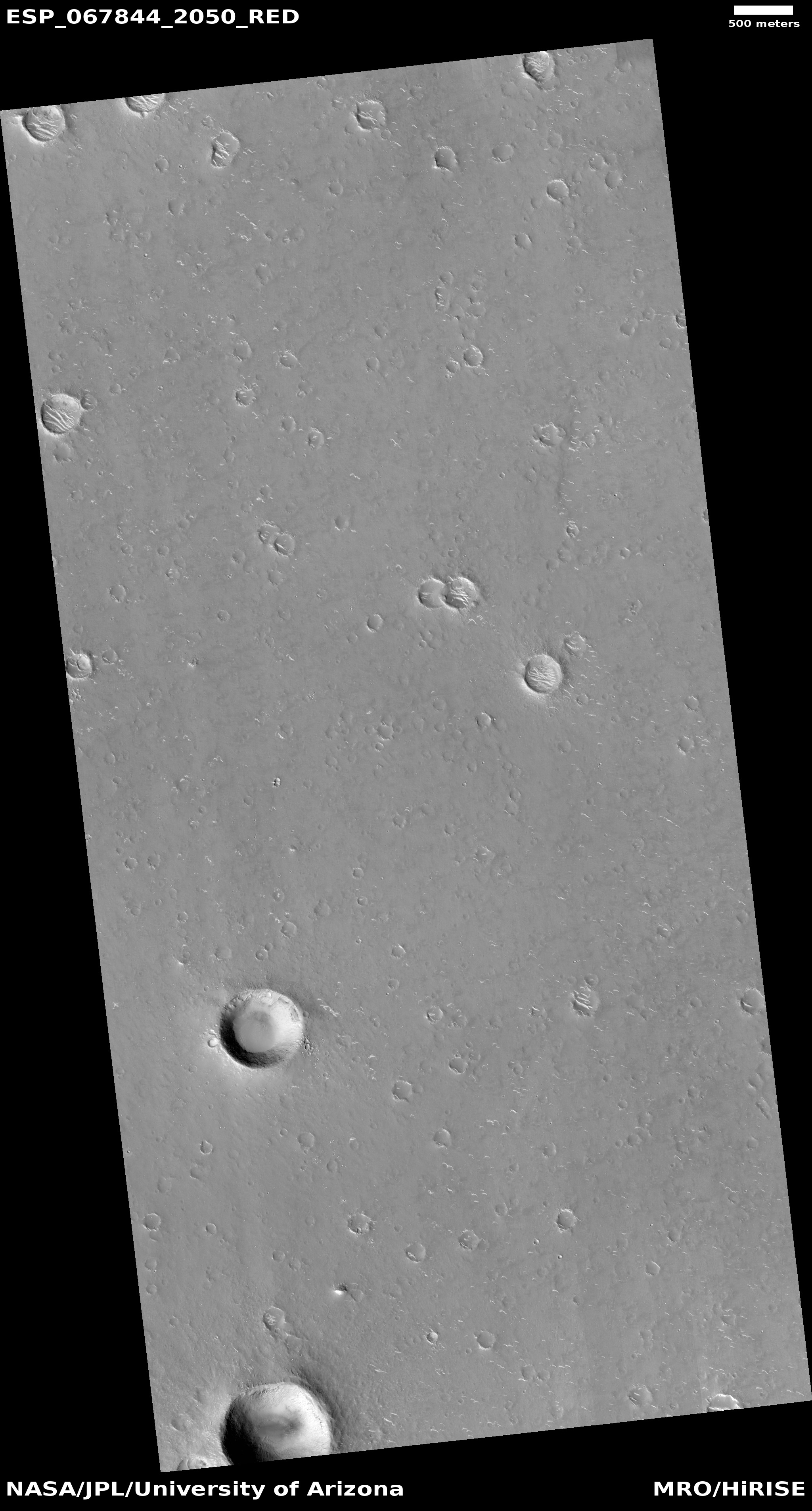
Cool image time! The picture to the right, rotated, cropped, reduced, and sharpened to post here, was taken on January 11, 2023 by the high resolution camera on Mars Reconnaissnace Orbiter (MRO).

The scientists labeled this picture “Rocky Terrain.” Though this describes the overall sense of the full image, it fails to capture correctly the nature of this patch of ground at the center of the picture. As you can see, this patch of spongelike surface starts and ends abruptly. It appears that it is a layer on top of the surrounding terrain that has also been eroded aggressively since its placement.

The many craters on its surface seem to have come later, though as the crater size diminishes it becomes harder to separate the craters from the sponge holes. Moreover, some of the larger craters are distorted in shape, as if the impact hit material that was viscous and could flow somewhat.

The overview map below gives some context, but only some.
» Read more

3 comments
1 339 340 341 342 343 1,353