The foot of a Martian glacier

The foot of a Martian glacier
Click for original image.

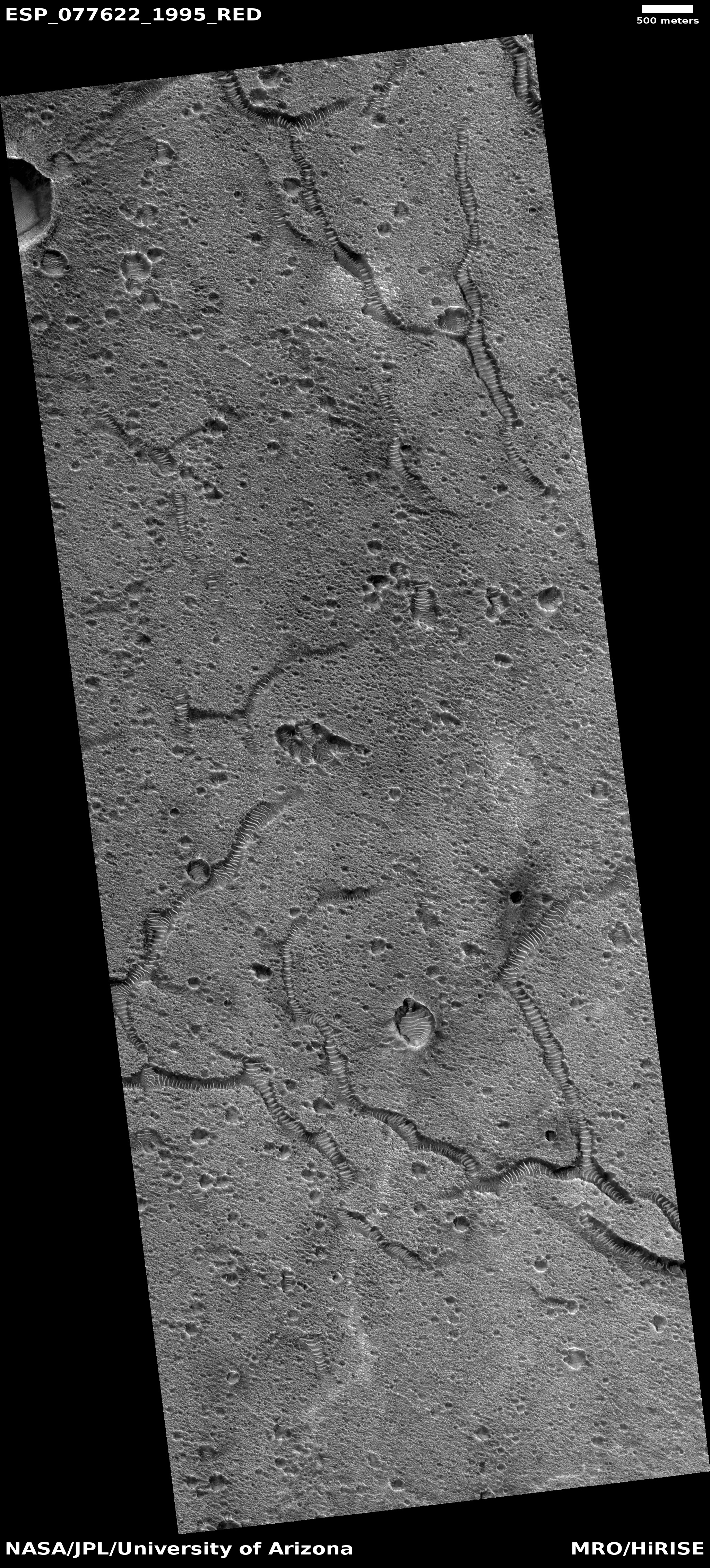
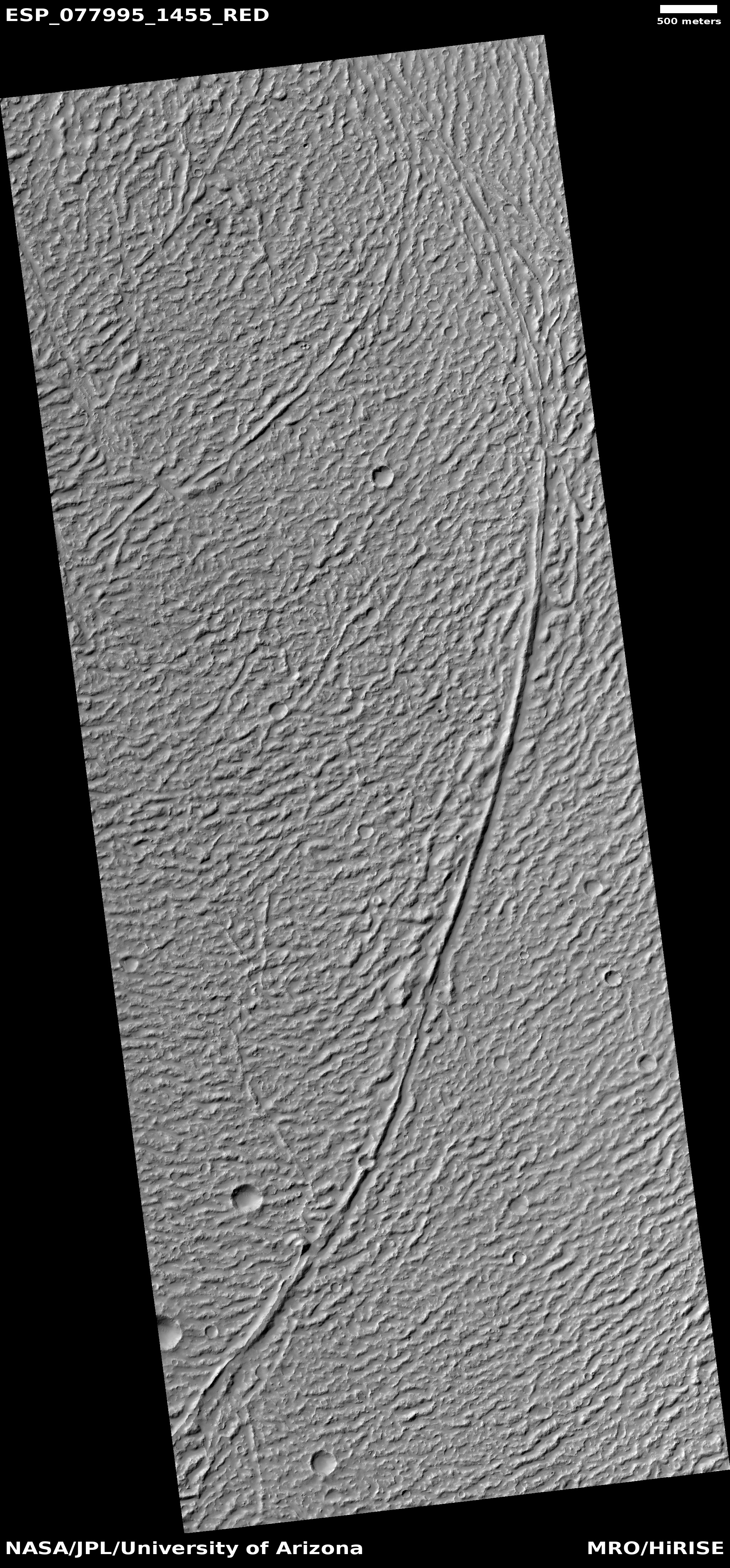
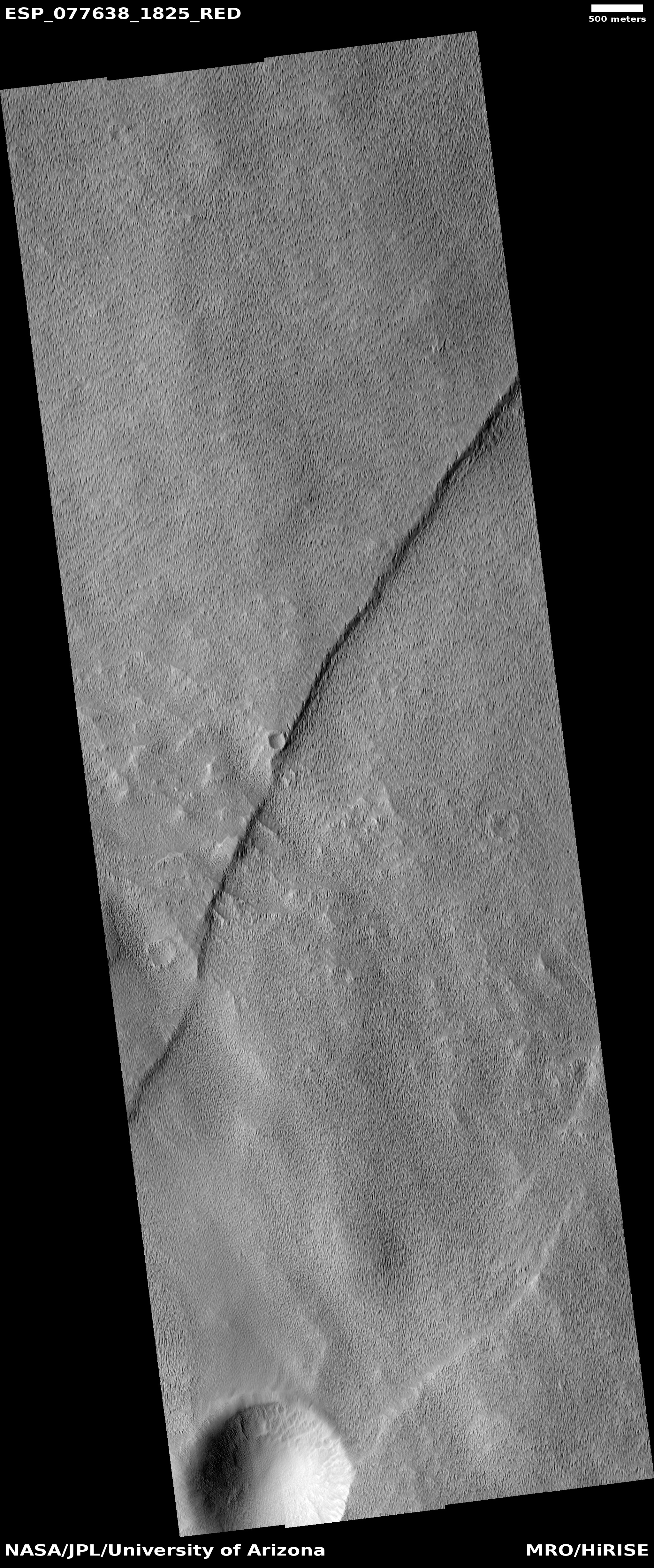
Cool image time! The picture to the right, cropped, reduced, and enhanced to post here, was taken on February 18, 2024 by the high resolution camera on Mars Reconnaissance Orbiter (MRO). It shows what the scientists label as the “terminus of possible glacier-like feature.” That feature is at the lower left, at the point where glacier-like material appears to be flowing out of the channel from the northeast but then ending in an area of rough fingers.

That this looks exactly like a glacier does not guarantee that it is one, which is why the scientists insert the word “possible.” Nonetheless, the geology resembles that of a glacier, from the parallel lines along its length as well as its existence inside this channel. The location is also at 49 degrees south latitude, well within the mid-latitude strips on Mars where scientists believe many such glaciers exist.

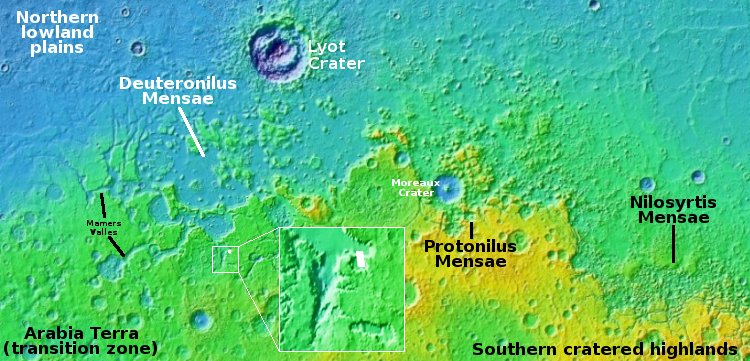
The overview map below adds further weight to this conclusion. It also suggests that there are even more glaciers on Mars than research up to now has suggested.
» Read more

0 comments

The taffy terrain in Mars’ death valley

Taffy terrain in Hellas Basin on Mars

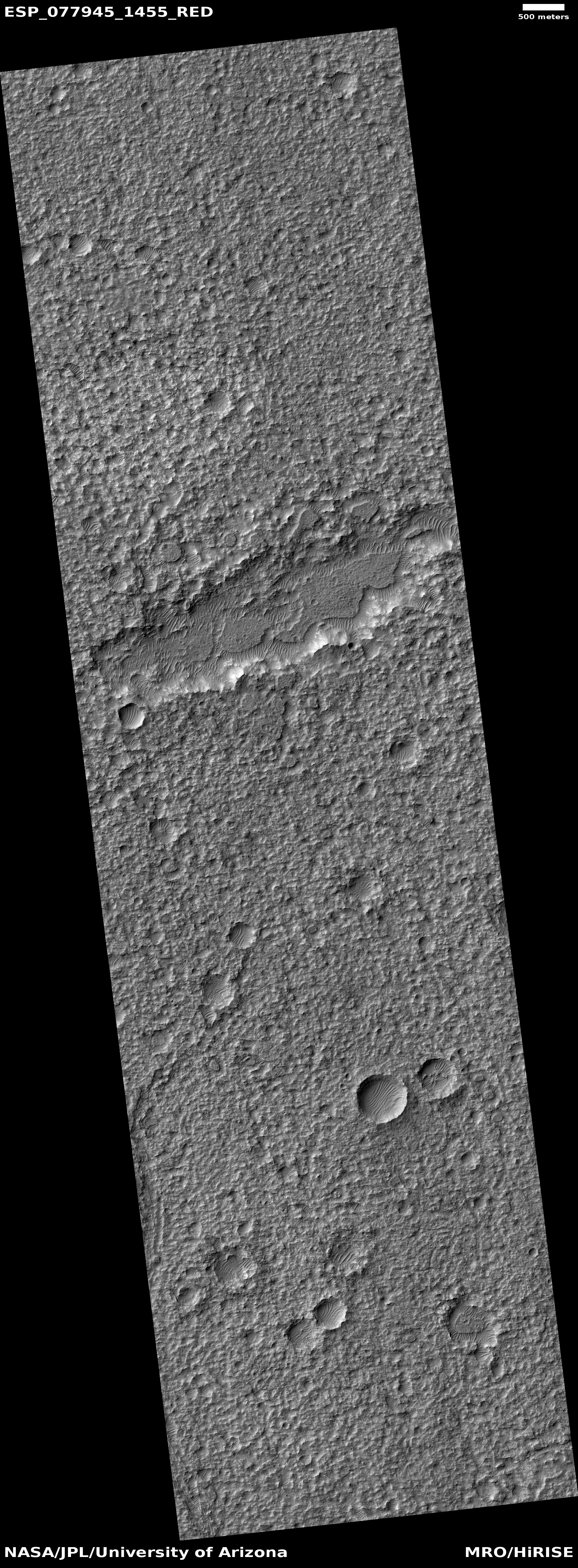
Cool image time! The picture to the right, rotated, cropped, reduced, and sharpened to post here, was taken on February 21, 2024 by the high resolution camera on Mars Reconnaissance Orbiter (MRO). Labeled “banded terrain and layering,” it actually is a good example of “taffy terrain,” a weird Martian geological formation unique to the Red Planet that scientists as yet don’t quite understand. This 2014 paper only says this:

The apparent sensitivity to local topography and preference for concentrating in localized depressions is compatible with deformation as a viscous fluid. In addition, the bands display clear signs of degradation and slumping at their margins along with a suite of other features that include fractured mounds, polygonal cracks at variable size-scales, and knobby/hummocky textures. Together, these features suggest an ice-rich composition for at least the upper layers of the terrain, which is currently being heavily modified through loss of ice and intense weathering, possibly by wind.

» Read more

0 comments

Complex ridged terrain in ancient Martian crater

Complex ridges in an ancient Martian crater
Click for original image.

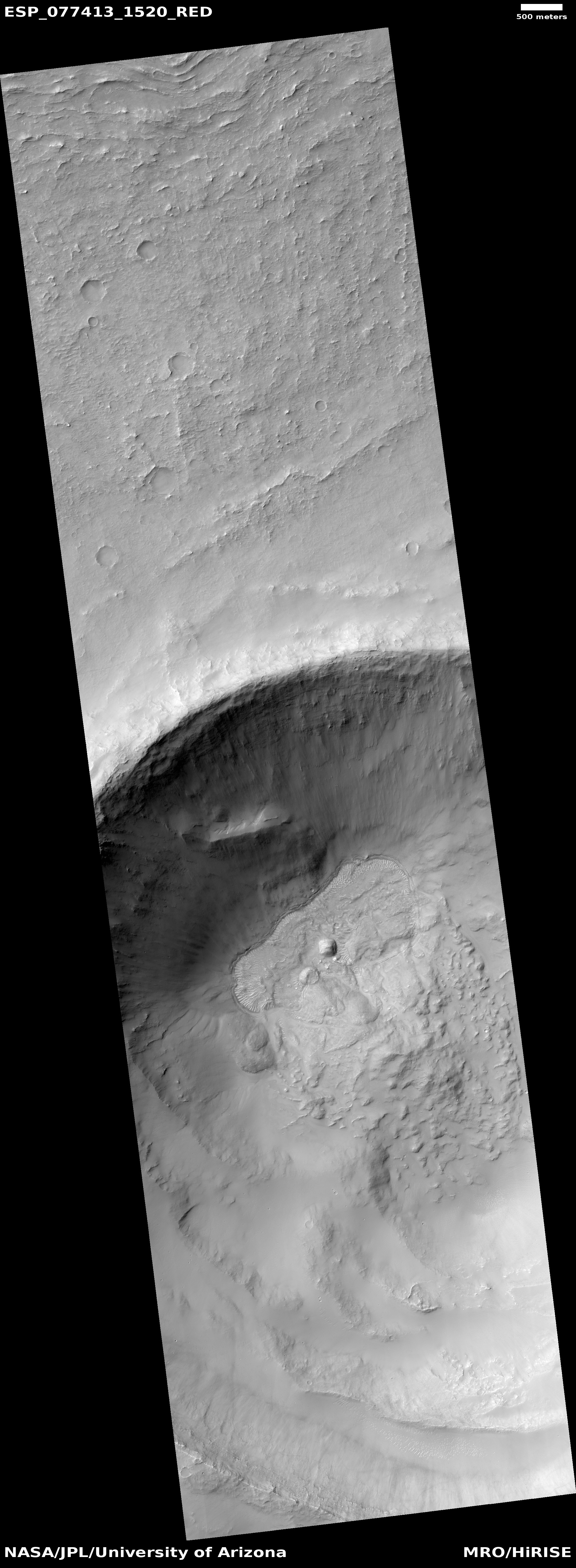
Cool image time! The picture to the right, rotated, cropped, reduced, and enhanced to post here, was taken on January 16, 2024 by the high resolution camera on Mars Reconnaissance Orbiter (MRO). Because an electronic unit for one of this camera’s filters has failed, causing a blank strip in the image center, I have filled in that gap using an MRO context camera image taken October 31, 2015.

The scientists describe this geology as “ridged terrain.” What I see is a surface that was like wet plaster once, and then a giant finger touched it and pulled away quickly, so that as it left some material pulled upward to create random ridges within the depression created by that finger.

These ridges are inside a very very ancient 110-mile-wide crater dubbed Margulis. According to the 2021 poster [pdf] of the scientists who did the first geological mapping of this crater, the crater floor “show remnants of sedimentary materials, suggesting the [crater was] subjected to widespread episodes of resurfacing and denudation.”

Though located in the dry equatorial regions, this ridged terrain suggests it formed suddenly when underground ice sublimated into gas, bursting upward to break the surface when the gas pressure became high enough.
» Read more

0 comments

Patches of volcanic Martian ash covering patches of frozen volcanic dunes

Patches of volcanic Martian ash over frozen volcanic dunes

Cool image time! The picture to the right, cropped, reduced, and sharpened to post here, was taken on December 24, 2023 by the high resolution camera on Mars Reconnaissance Orbiter (MRO).

What makes this terrain intriguing are the series of parallel ridges that cover most of the picture, with smaller ridges at right angles filling the hollows between. It appears we are looking at two different sets of dunes, the larger ridges indicating the southeast-to-northwest direction of the prevailing winds, while the smaller ridges in the hollows suggest the wind patterns within the hollows, causing smaller ripple dunes to form at right angles.

Note however the flat patches in the lower left. The material there appears to fill the hollows, covering the dunes. We can tell this by the hollows to the east, which have an almost identical dune pattern. Those flat patches then are likely covering similar dunes, with the patched material either having been blown away to expose the lower dunes, or having been blown here to cover them in patches. That the dunes appear unchanged under this patched material when exposed also suggests strongly that these dunes are hardened into stone, no longer soft sand that can be blown by the wind.
» Read more

0 comments

Martian waves of ridges and cracks

Martian waves of ridges and cracks
Click for original image.

In preparing today’s cool image I initially planned to post an picture taken on December 26, 2023 by the high resolution camera on Mars Reconnaissance Orbiter (MRO), as it showed a strange series of ridges that almost resembled waves or ripples on a pond.

In digging into MRO’s context camera archive to get the larger context, however, I immediately switched to the photo on the right, cropped, reduced, and sharpened to post here. Taken on December 17, 2010, it shows a much more mysterious and striking set of geological features than the closer view of the high resolution image, with the wave-shaped ridges on its western half but another set of wave-shaped cracks on its eastern half.

Even more intriguing, the arcs for the ridges curve in the opposite direction from the arcs for the cracks. It is almost as if there were two flows moving in opposite directions, right next to each other.
» Read more

0 comments

Bursting bubbles of water gas on Mars

Bursting bubbles on Mars
Click for original image.

Cool image time! The picture to the right, cropped, reduced, and enhanced to post here, was taken on January 12, 2024 by the high resolution camera on Mars Reconnaissance Orbiter (MRO). Because of a technical issue that leaves a blank strip down the center of recent high-res MRO images, I have filled in that gap using a MRO context camera photo taken on January 12, 2015. The resolution is much less, but by doing so we can see the ground features as a unit.

What are we looking at? According to the scientists, this picture shows “fresh-looking ruptures,” referring to the broken line of sharp tears inside that meandering canyon that almost resemble a fresh wound in flesh. As this location is at 28 degrees south latitude, it lies on the edge of dry equatorial regions, where orbital images have sometimes found hints of a few remaining buried glaciers that are much more common closer to the poles.

In this case it appears the warmer equatorial climate has acted to heat up the buried ice so that it sublimated into gas. At some point the gas pressure caused the surface to burst, much like bubbles bursting on the surface of a pot of simmering tomato sauce, leaving behind these scars.
» Read more

0 comments

Intuitive Machines: Odysseus is dead

In a tweet on March 23, 2024 the company Intuitive Machines announced that the mission of its first lunar lander, Odysseus, is officially over with the spacecraft failing to come back to life after sunrise on the Moon.

As of March 23rd at 1030 A.M. Central Standard Time, flight controllers decided their projections were correct, and Odieโ€™s power system would not complete another call home.

The engineers had begun listening for a signal on March 20th, when their computer models said enough sunlight would reach the solar panels to charge its communications system.

The failure of the lander to survive the lunar night is a disappointment, but it was never considered a strong possibility. Right now the company’s main task is to prevent the issues that caused Odysseus to land too fast and tip over, so that the next two missions, scheduled for either this year or next, each deliver their payloads properly on the Moon’s surface.

1 comment

Martian vent or sink?

A Martian vent or sink?
Click for original image.

Cool image time! The picture to the right, rotated, cropped, reduced, and enhanced to post here, was taken on January 29, 2024 by the high resolution camera on Mars Reconnaissance Orbiter (MRO).

Though the scientists label this image showing “channels”, what I see is either a vent or a sink, with the channels to the south indicating past flows either coming out of the depression or into it. The uncertainty exists because the surface grade in this region is essentially flat. There is a lot of small up and down variations, but overall it is very difficult to determine the general trend, suggesting that when the depression and channels formed the grade was different, and there is no way from this data to determine the angle at that time.

Were the flows that created the channels lava or water or ice? Knowing the grade when these channels formed would help answer this question, but other research now suggests the latter.
» Read more

0 comments

Some more “What the heck?” geology on Mars

What the heck?
Click for original image.

Cool image time! The picture to the right, rotated, cropped, reduced, and sharpened to post here, was taken on January 1, 2024 by the high resolution camera on Mars Reconnaissance Orbiter (MRO). It shows a small part of a region dubbed Iani Chaos, but what this geology shows is way beyond my pay grade.

Why there are those tiny aligned mounds, oriented at right angles to the slope, is not clear at all. Nor is it obvious what created the lighter chaotic terrain at the base of the slope.

The elevation difference between the low and high points is about 400 feet. The slope continues up to the west for another 600 feet to the top of a north-south ridgeline. The patterns here suggest vaguely some flows downhill, such as that widening east-to-west gap, but only vaguely.

The look at the overview map only compounds the mystery.
» Read more

3 comments

Citizen scientist project discovers 16 active asteroids

A project that has enlisted approximately 8,300 ordinary citizens to review more than 430,000 photos taken by a telescope in Chile has discovered sixteen asteroids that produce comae and tails like comets.

Identifying and tracking active asteroids whose activity specifically appears to be due to the sublimation of ice โ€“ known as main-belt comets โ€“ is a particular interest of the project team, as it is an essential part of understanding the abundance and distribution of volatile material like ice in the Solar System.

…The project, utilizing publicly available Dark Energy Camera (DECam) data from the Victor M. Blanco telescope in Chile, involved the examination of more than 430,000 images of known minor planets by 8,300 volunteers, where images identified by citizen scientists as being likely to contain active asteroids were then passed on to the science team for confirmation and additional analysis.

You can read the research paper here. If you want to participate, the Active Asteroids project is still on-going, and can be accessed here.

0 comments

Cracking terraces in Valles Marineris

Overview map

Cracking terraces in Valles Marineris
Click for original image.

Inset

Today’s cool image returns us to the truly spectacular terrain found on the floor of West Candor Chasma, one of the giant side canyons that form Valles Marineris, the biggest canyon in the solar system, many times larger than the Grand Canyon on Earth.

The picture to the right, cropped, reduced, and sharpened to post here, was taken on January 5, 2024 by the high resolution camera on Mars Reconnaissance Orbiter (MRO). On the overview map above its location is indicated by the red dot in the inset. The two green dots mark previous cool images from August 2022 and February 2024.

All three images show the same wild alternating dark and light terracing, suggesting many sedimentary layers like those seen in our Grand Canyon, but enhanced by the different erosion processes of the thin Martian atmosphere and its one-third Earth gravity.

The second image to the right zooms in on the area indicated by the rectangle. What makes this area doubly interesting are the cracks that appear to cut through the terraces. In the north-south crack it also appears that the terraces are now offset on each side of the crack.

Apparently, some event, likely an earthquake that occurred after the terraces formed, caused the ground to rip apart, with the earth shifting sideways on either side. Though the seismometer on the InSight lander detected no major quakes in this region, this image suggests they have occurred here, sometime in the past.

To give you a sense of scale, the canyon’s nearby rim to the west is about 14,000 higher, making that canyon wall two to three times taller than the walls of the Grand Canyon.

0 comments

The vast Martian plains of lava

The vast Martian lava fields
Click for original image.

Cool image time! The picture to the right, rotated, cropped, reduced, and sharpened to post here, was taken on January 31, 2024 by the high resolution camera on Mars Reconnaissance Orbiter (MRO). Labeled “Lava Embaying Highlands Ridge”, it shows an alcove along a ridgeline that appears filled with material, in this case solid lava.

If you look closely at the ridgeline, you can see several dark streaks on its southern slopes. These streaks could be one of two unique Martian features that remain unexplained. They could be slope streaks, which occur randomly through the year and fade with time, or recurring slope lineae, which occur seasonally at the same locations. In either case, though the streaks look like avalanches, they don’t change the topography, have no debris piles at their base, and even sometimes flow uphill for short lengths. Though there are a number of theories for their formation, many involving dust, none has been accepted as confirmed.

This location and its lava however are the stars of this picture, for a number of reasons, all revealed by the overview map below.
» Read more

1 comment
1 43 44 45 46 47 89