Spring near the Martian north pole

Spring near the Martian north pole
Click for original image.

Overview map

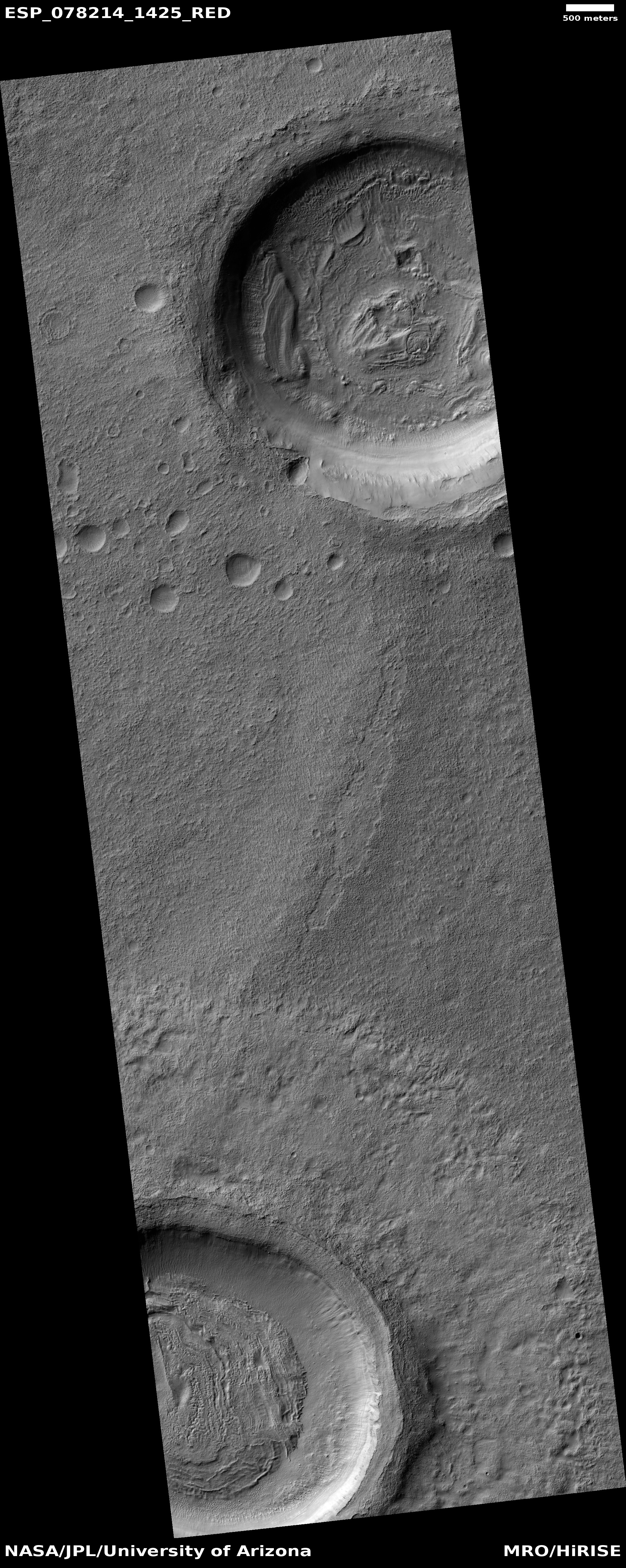
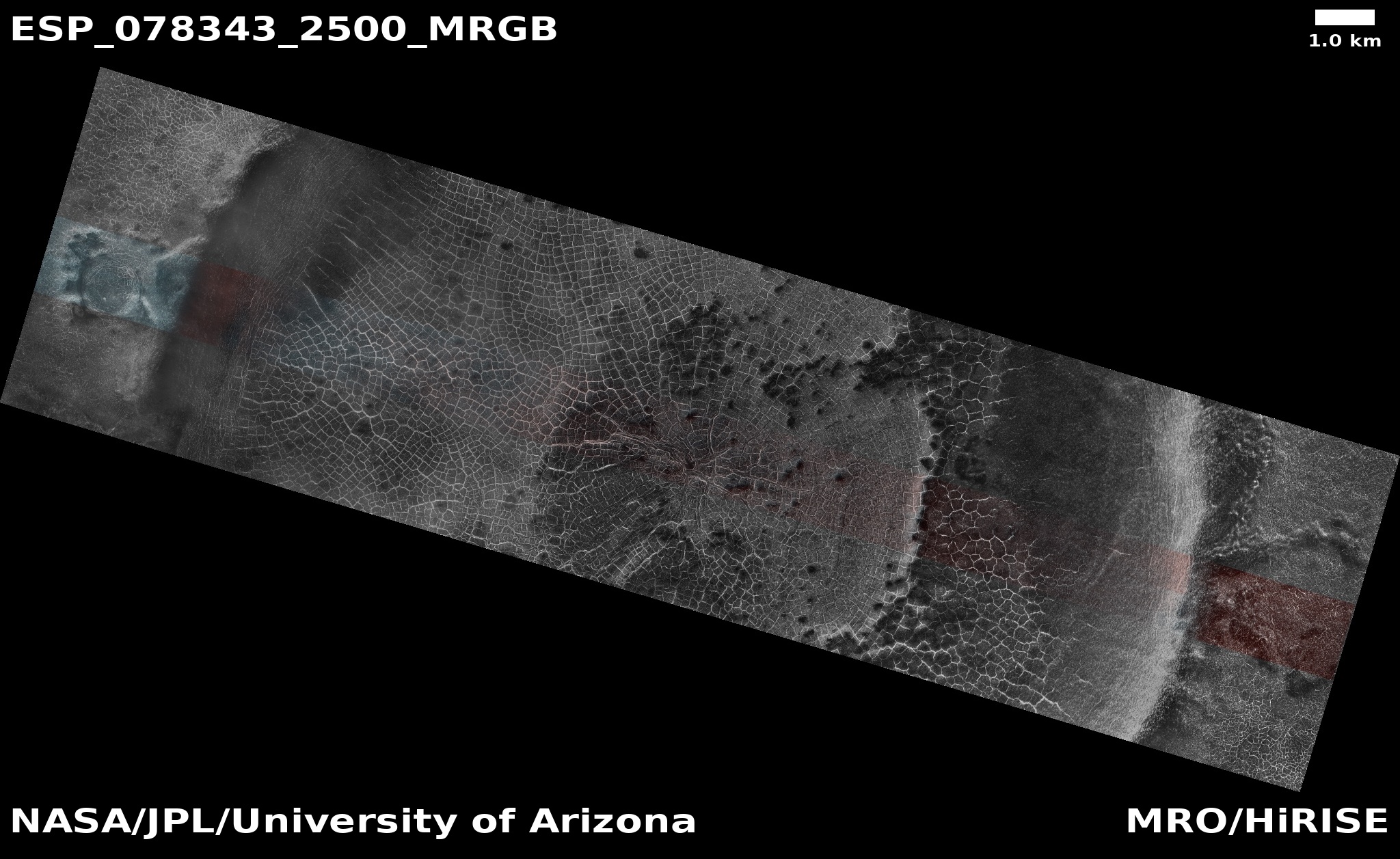
Cool image time! The picture above, rotated, reduced, and brightened slightly to post here, was taken on April 13, 2023 by the high resolution camera on Mars Reconnaissance Orbiter (MRO). It cuts a swath across an eleven-mile-wide crater only about 500 miles from the edge of Mars’ north pole ice cap.

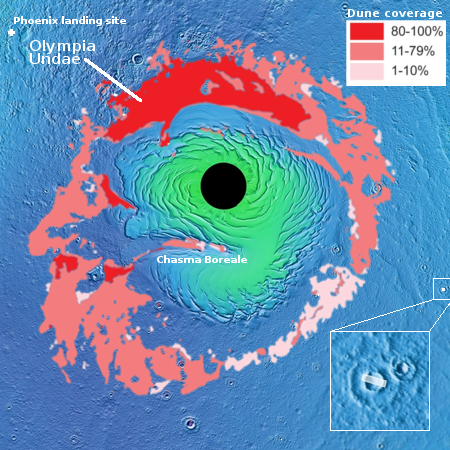
The overview map to the right marks its location, as indicated by the white dot on the right edge of the map. The inset shows the soft and likely icy nature of the surface in which this impact occurred. The crater resulted in a secondary outside ripple, that quickly hardened after impact.

The image was taken during spring, shortly after the sun’s light hit this crater. The cracks in the ice indicate long term sublimation that is slowly reducing the amount of water ice inside the crater. Like mud cracks in the desert after a puddle has evaporated, the ice here is cracking to produce polygon fractures.

It is also very likely that everything here is coated with a thin mantle of clear dry ice, deposited as snow from the atmosphere in the winter and then sublimating away with the coming of spring. That spring dry ice sublimation is likely ongoing, and this picture is probably an attempt by scientists to detect that process.

Why the surface colors shift from aquablue to orange might have to do with that sublimation process, or it might be revealing areas covered with dust (orange). That the northern parts of the strip is blue and the southern parts orange suggests the former. Or not. I don’t have enough information to answer this question with any confidence.

0 comments

A northern lowland ice sheet on Mars?

A northern lowland ice sheet on Mars?
Click for original image.

Cool image time. The picture to the right, cropped to post here, was taken on March 14, 2023 by the high resolution camera on Mars Reconnaissance Orbiter (MRO). Dubbed simply a “terrain sample,” this image was likely taken not as part of any specific research project, but to fill a gap in the camera’s schedule in order to maintain its temperature by taking regular images. When the camera team needs to do this, they try to find interesting locations not previously photographed. Sometimes the photos turn out somewhat boring. Most of the time however they capture something very intriguing.

In this case, the intriguing feature of this picture is its stippled surface that seems to overlay a relatively flat surface underneath, with some faint covered craters visible. On top are several more recent craters that suggest either the impact landed in very soft material, thus producing little ejecta and no crater rims or the craters are not craters but sinks, places where the ground is subsiding due to some underground process.
» Read more

0 comments

Determining whether a Martian crater is impact or volcanic

Determining whether a Martian crater is impact or volcanic
Click for original image.

Overview map

Cool image time! The picture above, rotated, cropped, reduced, and sharpened to post here, was taken on March 22, 2023 by the high resolution camera on Mars Reconnaissance Orbiter (MRO). The camera team labeled this “Crater rim and ejecta,” which subtly reveals the picture’s scientific purpose.

The white dot on the overview map to the right indicates the location of this 15-mile-wide unnamed crater, about 150 miles northwest of where the rover Opportunity landed and traveled south to the rim of Endeavour Crater. It also shows in the inset that the crater appears to sit in the center of an upraised mound, suggesting it was formed not by impact but by volcanic processes.

This picture however says otherwise. The many small mounds and mesas to the south of the crater rim are not what one would expect on the apron of a volcano. Instead, they suggest this crater is an impact, with those mounds the eroded ejecta from that impact, now also partly buried by dust. This hypothesis is strengthened by the data from Opportunity, which found a great deal of impact ejecta during its travels, possibly from the very event that created this crater.

6 comments

A spectacular Martian glacier

Overview map

A spectacular Martian glacier
Click for original image.

Mars appears to be a planet filled with past surface flows, none of which are active today but all of which came from widely different geological processes. Yesterday’s Martian cool image showed the hardened remains of a lava flow on Mars. Today’s cool image shows us what might one of the best examples of the kind of glacial evidence orbital images have been finding throughout the mid-latitudes of Mars.

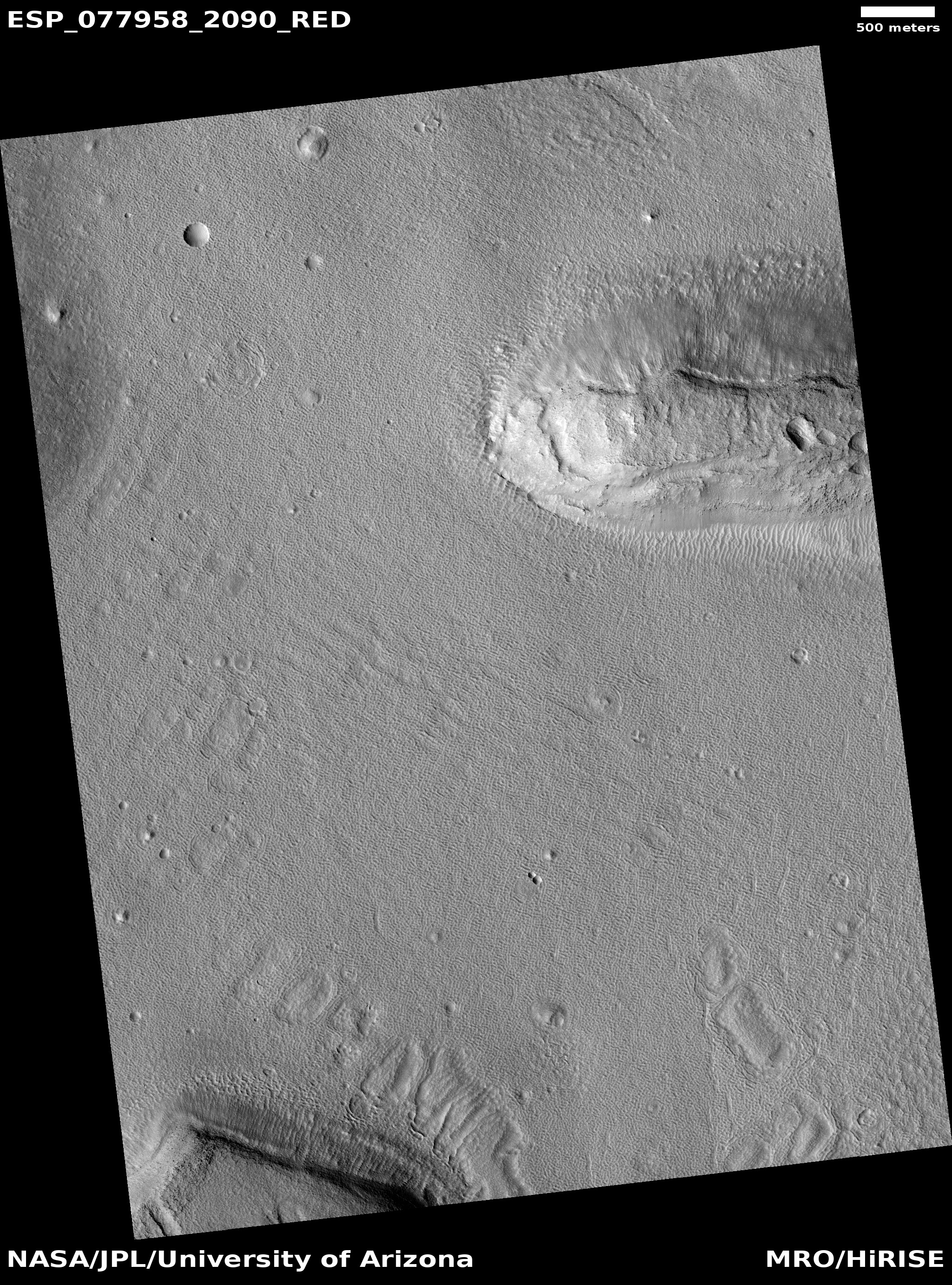
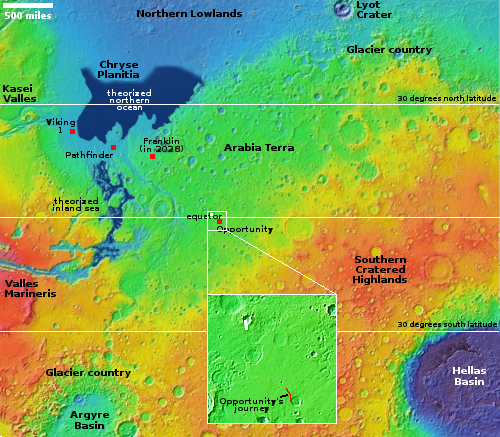
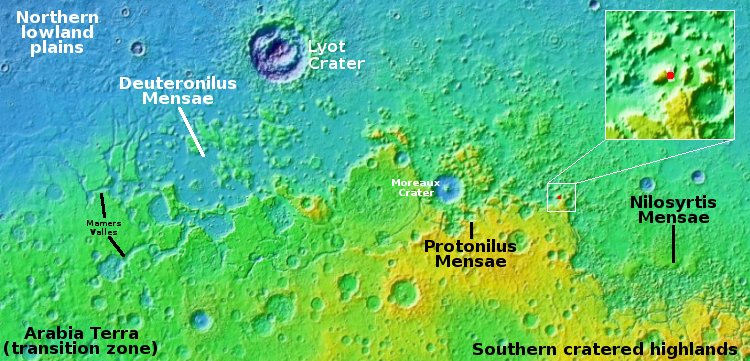
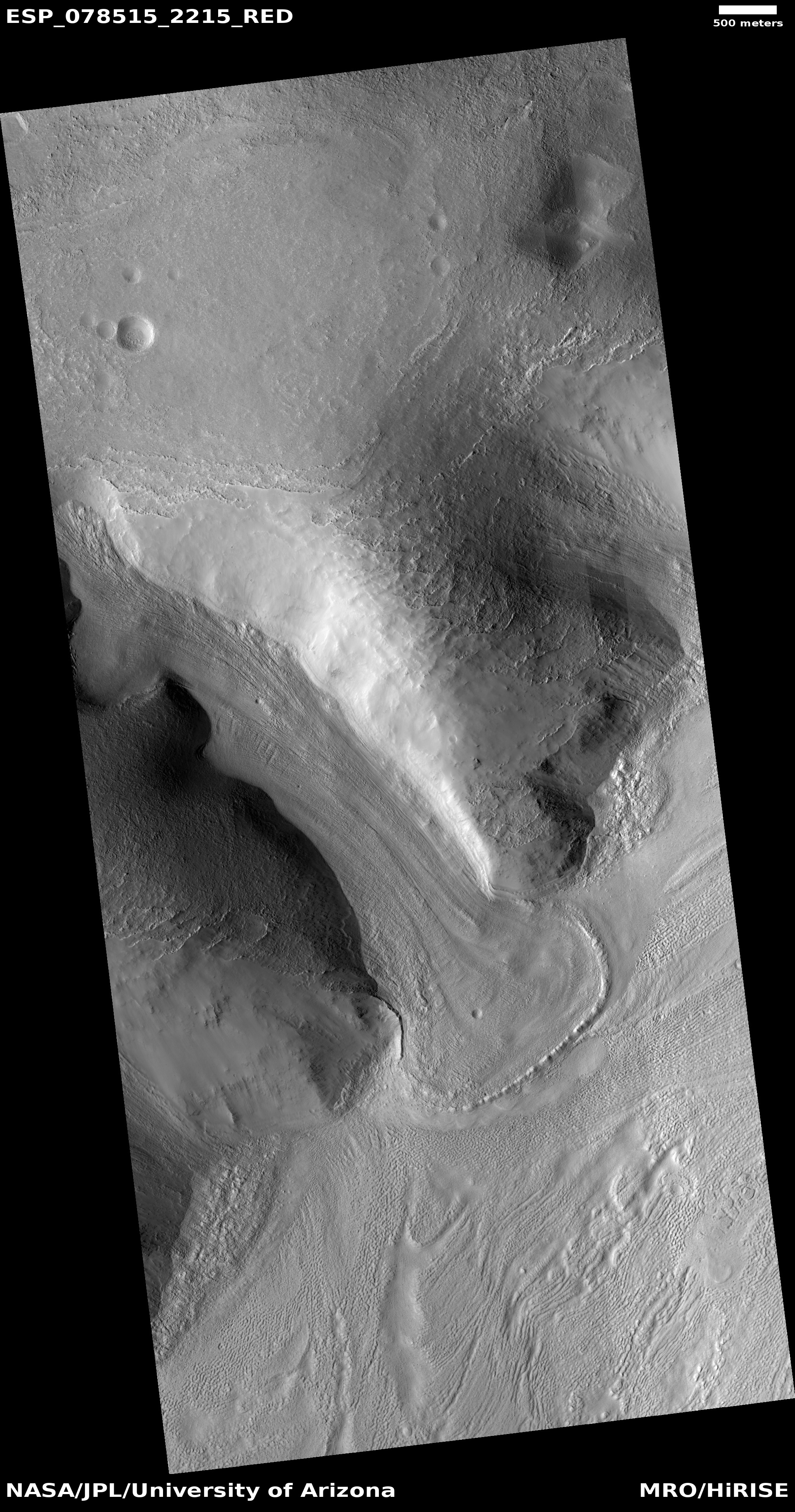
The picture to the right, rotated, cropped, reduced, and sharpened to post here, was taken on April 27, 2023 by the high resolution camera on Mars Reconnaissance Orbiter (MRO). The red dot in the inset on the overview map above indicates its location on Mars, in the chaos region dubbed Protonilus Mensae that forms the central part of the 2,000-mile-long Martian region in the north mid-latitudes I dub glacier country. In this region almost every high resolution image shows evidence of glaciers, all protected by a thin layer of dust and debris so they do not sublimate away.

This particular glacier fills a canyon carved into the southern cliff of a mile-high mesa five miles by ten miles in size, and drops dramatically almost 4,700 feet in about four miles. In fact, it so epitomizes what glaciers look like that the camera team for MRO’s high resolution camera used a 2020 image to give a quick lesson on how to spot a glacier on Mars.

This 2023 picture was likely taken as part of a long term monitoring program. Though planetary scientists presently do not think the glaciers on Mars are active and moving, this assumption is not yet confirmed. Taking repeated pictures of this same glacier over time will eventually answer this question.

0 comments

A lava flow on a Martian lava plain

A lava flow on a Martian lava plain
Click for original image.

While much of surface of the Martian equatorial regions is comprised of volcanic flood lava, the place where it is most obvious and evident is on the flanks of the three giant volcanoes of the Tharsis Bulge. Here, lava did not simple spout from surface vents to flood low-lying large areas, filling those depressions quickly almost like water. Instead it issued from vents on the slopes of those mountains, or from their calderas at their peaks, and flowed downhill almost like tsunamis of magma.

The picture to the right, rotated, cropped, reduced, and sharpened to post here, is a great example. Taken on March 11, 2023 by the high resolution camera on Mars Reconnaissance Orbiter (MRO), it shows the foot of one such flow, frozen in place as it oozed down hill from the Arsia Mons, about 300 miles away to the northwest.
» Read more

0 comments

BepiColumbo completes third Mercury flyby

Mercury as seen by BepiColumbo
Click for original image.

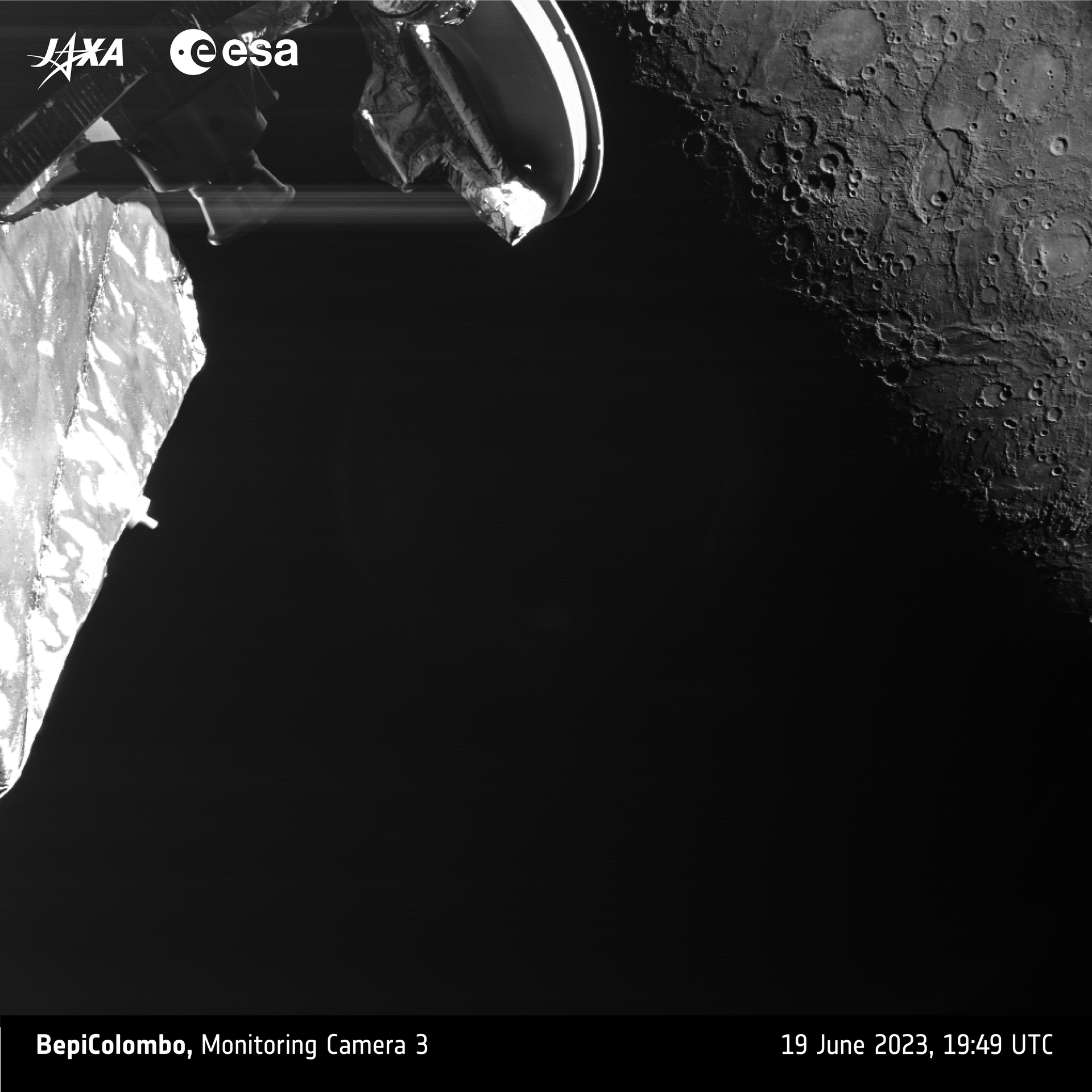
On June 19, 2023, the European Mercury orbiter BepiColumbo made the third of six planned flybys of Mercury on its way to orbit around that planet in 2025.

The closest approach was only 146 miles above the planet’s surface. Though no pictures were taken at that point because it was Mercury’s night side, as the spacecraft moved away it used one of its monitoring cameras, designed primarily to monitor the spacecraft itself, to look back at the planet. The picture to the right, cropped, reduced, and sharpened to post here, is one of the first taken. From its caption:

The image was taken at 19:49 UTC (21:49 CEST) by the Mercury Transfer Module’s monitoring camera 3, when the spacecraft was about 2536 km from the planet’s surface. Closest approach took place at 19:34 UT (21:34 CEST) on the night side of the planet at about 236 km altitude. The back of the Mercury Planetary Orbiter’s high-gain antenna and part of the spacecraft’s body is also visible in front of Mercury in this image.

Despite the dark nature of the image, several interesting geological features are seen in beautiful detail. Of particular interest is Beagle Rupes, a 600 km-long scarp that snakes over the surface. In this view it is seen cutting through a distinctive elongated crater named Sveinsdóttir, which likely got its shape from an impactor striking the surface at an angle.

The next flyby will occur on September 5, 2024.

1 comment

Looking down a canyon on Mars

Looking down a canyon on Mars
Click for original image.

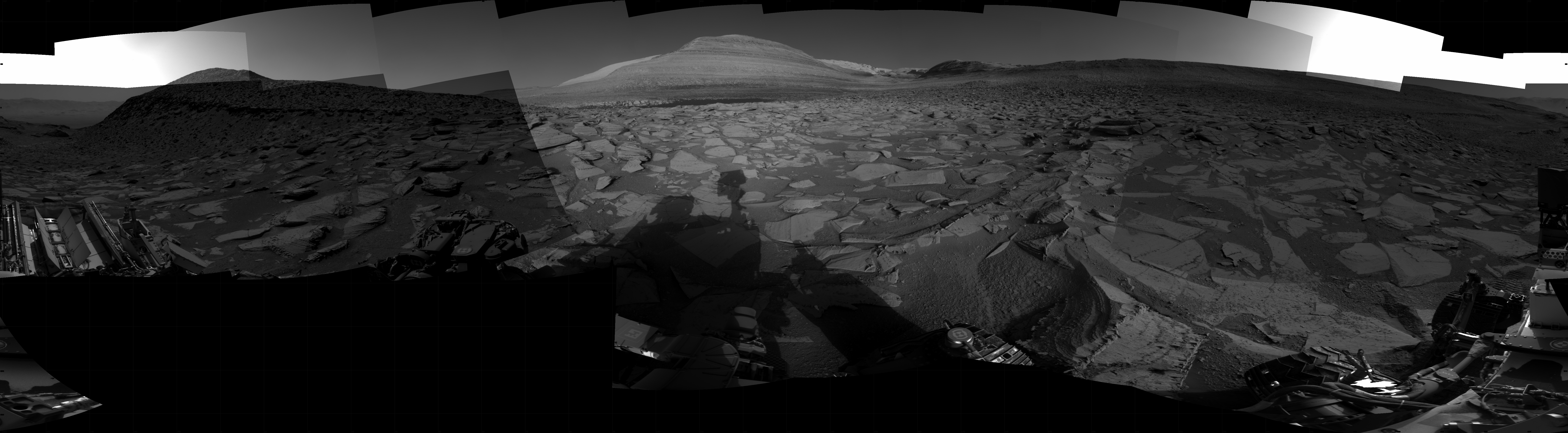
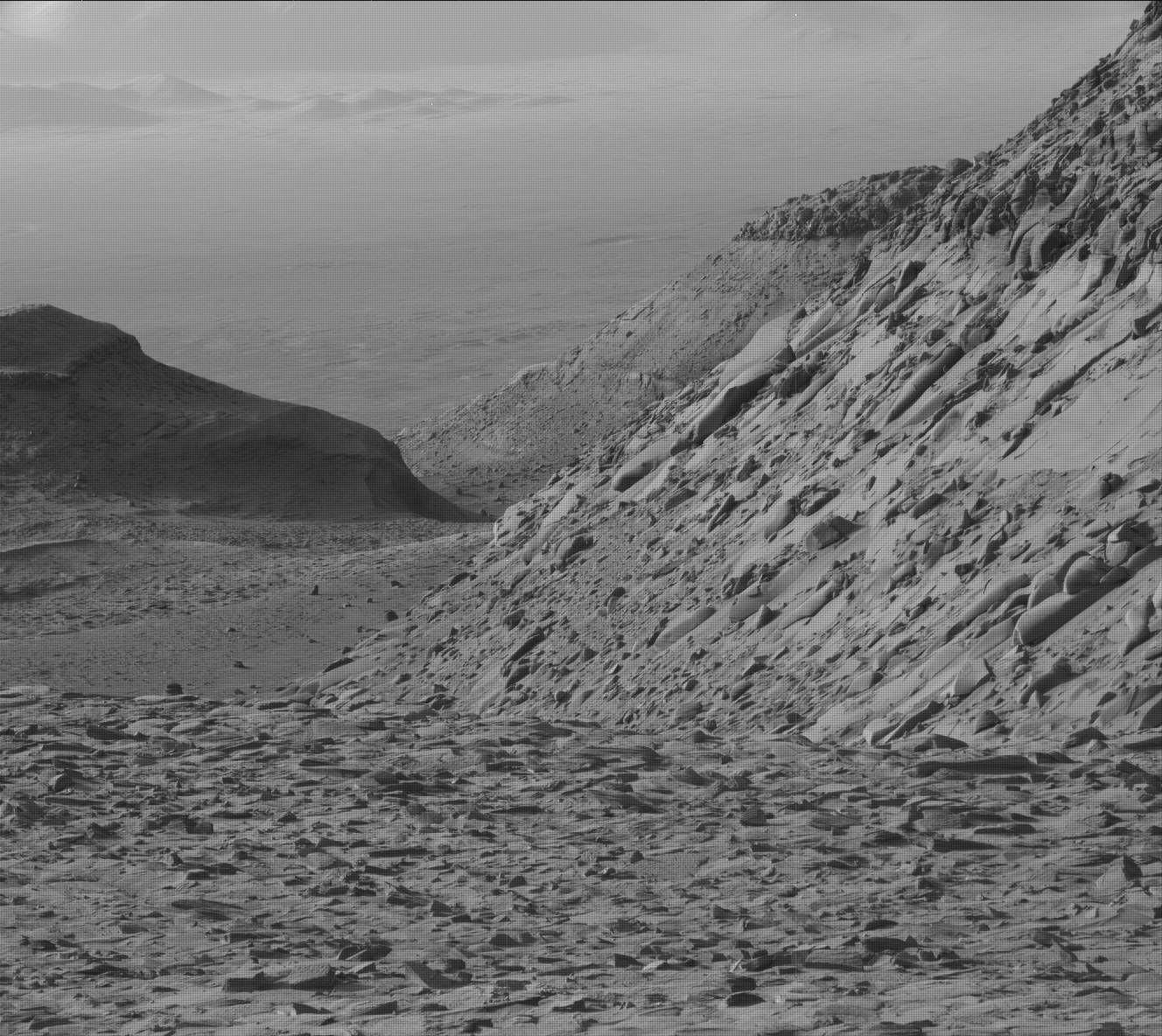
Cool image time! The picture to the right was taken on June 17, 2023 by Curiosity’s high resolution camera, looking back down Gediz Vallis and out across the distant floor of Gale Crater, far below. The white dotted line shows the route within this image where Curiosity had previously traveled inside this canyon, coming up around that shadowed mesa and then off to the west to try to get to terrain that it had earlier retreated because it was too rough on the rover’s wheels. Its subsequent path to the spot where this picture was taken was off to the left of the image, out of view.

This picture illustrates well the steepness and roughness of the mountainous canyon through which Curiosity presently travels. The small mountains visible on the floor of Gale Crater, about sixteen miles away, are no more than 450 feet high. The floor of the crater is 1,900 feet below where Curiosity present sits.
» Read more

7 comments

A Martian crater with a wake of lava

Overview map

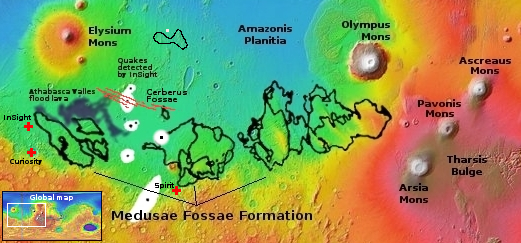
Cool image time! Today’s cool image begins with the overview map to the right. The white dot marks its location, on the western edge of Amazonis Planitia and about 1,000 miles east of the giant shield volcano Elysium Mons.

This is a region of numerous flood lava events that appear to cover the knobby mountainous terrain that was once here. We know that past terrain was knobby because in the black outline just south of this picture the knobs are everywhere, short peaks sticking up from a very flat flood lava plain. The region is also on the northern edge of the dry equatorial regions of Mars, at 27 degrees north latitude. It is likely there is little near surface ice here.

These details will help explain the cool image itself.
» Read more

0 comments

The icy mesas of Mars’ glacier country

Overview map

The ice mesas of Mars' glacier country
Click for original image.

Cool image time! The picture to the right, rotated, cropped, and reduced to post here, was taken on March 25, 2023 by the high resolution camera on Mars Reconnaissance Orbiter (MRO). The science team labeled this image “Cross-Section of Glacier-Like Form,” probably because the mesa in the center of the picture clearly shows numerous layers as you descend from its peak to the surrounding plains, an elevation difference of about 200 feet.

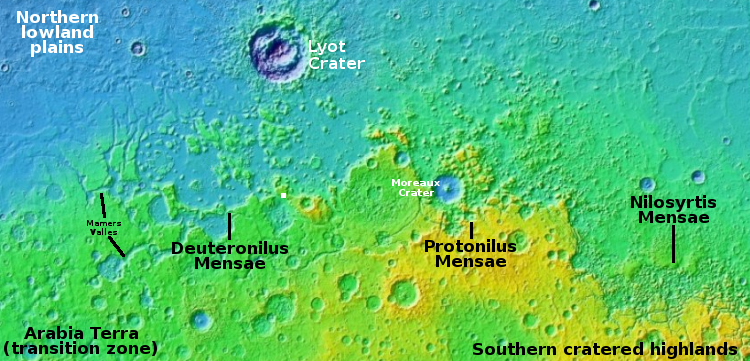
The white dot about 250 miles due south of Lyot Crater on the overview map above marks the location of this mesa, inside the chaos terrain of Deuteronilus Mensae that is the western section of the 2,000 long strip in the northern mid-latitudes of Mars that I call glacier country, since practically every image, like today’s, suggests the presence of glaciers.

The oblique mosaic below, created using MRO’s context camera images, illustrates this fact even more spectacularly.
» Read more

0 comments

Drainage channel between two Martian hollows

Drainage channel between two Martian hollows
Click for original image.

Cool image time! The picture to the right, cropped, reduced, and sharpened to post here, was taken on April 28, 2023 by the high resolution camera on Mars Reconnaissance Orbiter (MRO). Dubbed a “terrain sample” by the camera team, it was likely taken not as part of any specific research project but to fill a gap in the camera’s schedule so as to maintain that camera’s proper temperature. When they have to do this, they try to pick interesting targets, though there is no guarantee the result will be very interesting.

In this case the camera snapped what appears to be a drainage channel between two deeper hollows. The channel sits about 100 feet above the western hollow and 260 feet above the eastern hollow. This makes some sense, as the overall drainage in this region is going from the west to the east, and then to the north.
» Read more

0 comments

Rimstone dams in Mars’ youngest lava deposit

Rimstone dams in Mars' youngest lava deposit
Click for original image.

Cool image time! The picture to the right, rotated, cropped, reduced, and sharpened to post here, was taken on April 23, 2023 by the high resolution camera on Mars Reconnaissance Orbiter (MRO).

The scientists dub the features here merely as “land forms,” probably because it is difficult to explain the origins of many of these strange features. For example, why is the half-mile-wide crater filled that knobby terrain, far different than the surrounding plains? Similarly, what caused the small meandering ridges (less than five feet high) that appear to closely resemble the cave formation called rimstone dams?

And why is this terrain so generally flat and smooth?

As usual, the overview map helps explains some of this, but not all.
» Read more

0 comments

Eroding glacier on Martian slope?

Eroding glacier on Martian slope?
Click for original image.

Cool image time! The picture to the right, enhanced, cropped, reduced, and sharpened to post here, was taken on April 1, 2023 by the high resolution camera on Mars Reconnaissance Orbiter (MRO). It shows what the science team labels as “Rough Ground and Bright Exposures” on the flanks of a wide mountain range on Mars, whose highest point is about 4,400 feet higher to the northeast and about 30 miles away.

The arrow indicates the downhill grade. Notice the smooth flat areas that seem to only partially cover much rougher terrain below. To my eye this top layer resembles an Earth glacier that has partly sublimated or melted away, exposing the rougher bedrock below that has been ground and scraped by the glacier previously.

However, this is not on Earth, so assuming it is like an Earth glacier is dangerous.
» Read more

0 comments

Ice-filled fissure on Mars?

Ice-filled fissure on Mars?
Click for original image.

Cool image time! The picture to the right, cropped, reduced, and sharpened to post here, was taken on February 15, 2023 by the high resolution camera on Mars Reconnaissance Orbiter (MRO). The science team labeled this a “Terrain Sample”, which suggests but doesn’t guarantee that it was to fill a gap in the camera’s schedule in order to maintain that camera’s proper temperature, and therefore was targeted at a relatively random but potentially interesting location.

What we see is a fissure canyon, about 250 to 300 feet deep with cliffs about 125 high, that appears surrounded and even filled with icelike features. Even the craters on the plateau above the canyon appear like they either impacted in ice, or have since been filled and eroded by that ice.

But is it ice?
» Read more

0 comments

Distorted floor of a Martian crater

Overview map

Distorted floor of a Martian crater
Click for original image.

Cool image time! The picture to the right, rotated, cropped, reduced, and sharpened to post here, was taken on February 18, 2023 by the high resolution camera on Mars Reconnaissance Orbiter (MRO). It shows what the science team labels “Mantle Layers in Southern Mid-Latitudes.”

I would be less vague. These strangely shaped features invoke the typical glacial features seen throughout the mid-latitudes of Mars. The knobs and outcrops suggest some underlying breakdown that the top layers of glacial material has covered. They also suggest some form of sublimation or erosion process to the glacier itself.

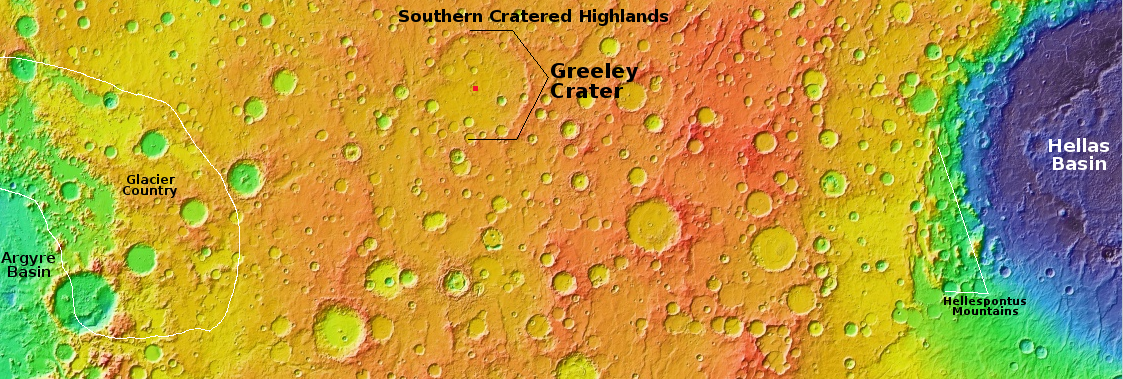
The white rectangle inside the inset on the overview map above marks this location, covering the floor of an unnamed 10-mile-wide crater in the cratered southern highlands at 41 degrees south. In this region all the craters show some evidence of this sublimation, all suggesting that there is a near-surface underlying ice layer that when exposed vanishes to leave depressions or hollows. Here however it appears that ice layer is mostly intact, the knobs and ridges indicating the shape of the bedrock and large breakdown below.

0 comments

Martian dust devil where none had been before

Dust devil on Mars
Click for original image.

Today’s cool Mars image is especially cool because it is of the exact same place on Mars I had featured in a picture only a little more than one month ago. I return to this spot only a month later because the location was yesterday’s featured captioned image from the high resolution camera team of Mars Reconnaissance Orbiter (MRO). The difference is that this time the camera captured a dust devil there that wasn’t there previously. From the caption:

The dust devil is casting a shadow, which can be used to estimate its height. This image is part of ongoing monitoring activities by HiRISE of seasonal activities on Mars.

Over the years, HiRISE has observed many dust devils. Just like on Earth, dust devils develop when the Sun heats up the ground such that it warms the air directly above it. When air heats up its density decreases causing it to rise up while colder air sinks down driving local convection.

If the region is windy, the wind my end up rotating the “convection cells” caused by the vertical motion of air leading to development of a dust devil. Since the main requirements for development of such features are the presence of dust and a warm ground, we focus our monitoring of dust devils in regions on Mars that are known to be dusty (like Syria Planum), and during the late spring and summer time, when we expect the ground to be warm.

» Read more

2 comments

Barren land on Mars

Barren land on Mars
Click for original image.

It might seem strange to call any particular place on Mars “barren” when the entire planet has no visible signs of life anywhere. However, much of the surface of Mars involves wind and ice features that show evidence of change and evolution over time. The presence of apparent near-surface ice and glacial features in almost every image located above 30 degrees latitude emphasizes this sense of potential life, even if that life will only be transported from Earth and established there someday by humans.

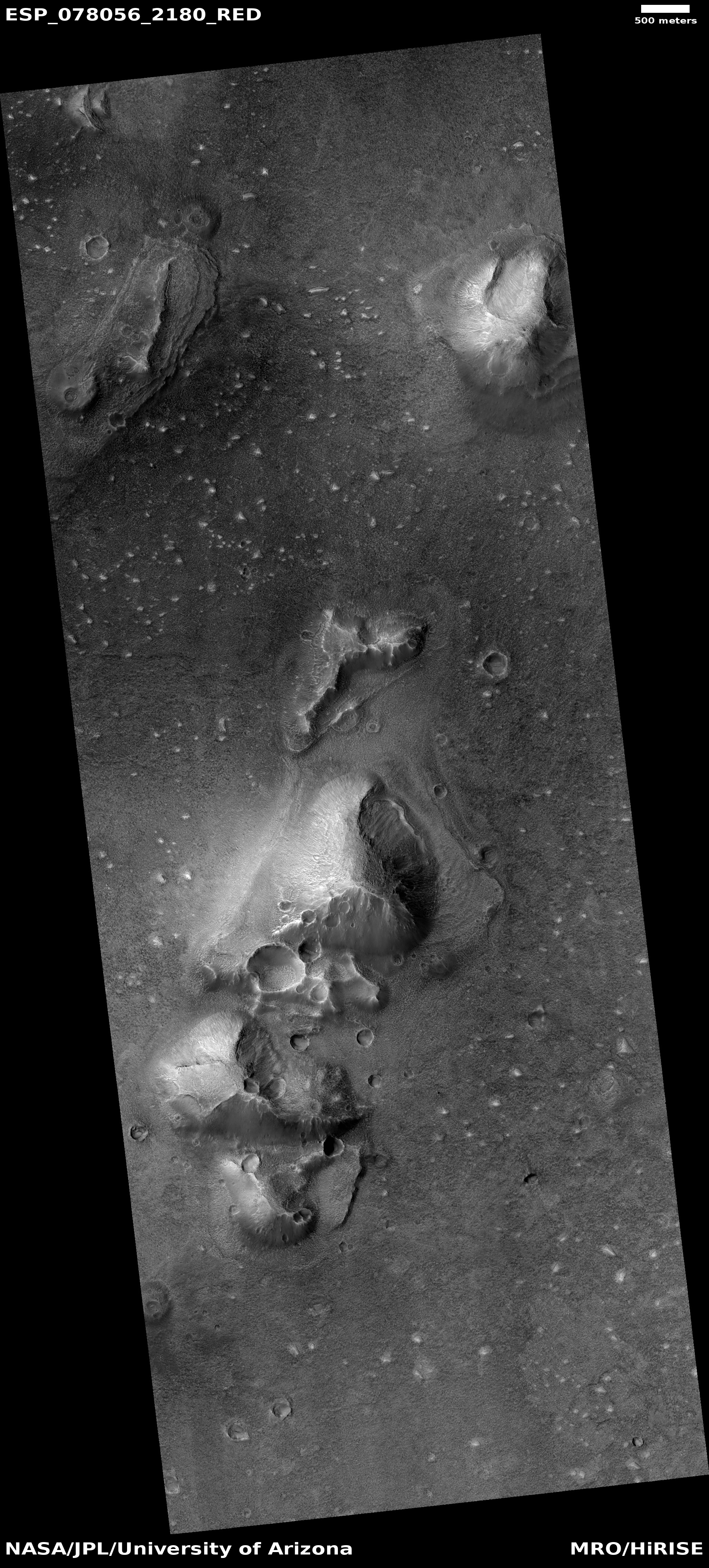
Today’s cool image to the right, cropped and reduced to post here, has none of these features. It is dry barren bedrock, with only a faint scattering of Martian dust indicated by many faint dust devil tracks.

The picture was taken on March 13, 2023 by the high resolution camera on Mars Reconnaissance Orbiter (MRO). The largest and most distinct flat-topped mesa in the image is only about 100 feet high, with the north-south ridgeline to the south about 20 feet high.
» Read more

0 comments

Avalanche to the east of Gale Crater on Mars

Landslide on Mars
Click for original picture.

Cool image time! The picture to the right, cropped, reduced, and sharpened to post here, was taken on February 19, 2023 by the high resolution camera on Mars Reconnaissance Orbiter (MRO). It shows an avalanche that slumped downward out of the material that forms the interior western wall of an unnamed 25-mile-wide crater about 100 miles east of Gale Crater, where Curiosity has been roving for more than a decade.

The scientists call these types of Martian avalanches “mass-wasting events”, since the entire mass of the cliff moves downhill in a chunk, rather than as a pile of rocks that grows in size and strength as it picks up material on its way down.

It is not clear how old this slide is. A lot of the material on this slope appears to be Martian dust, some of which has flowed into the avalanche material after it had slide downhill.
» Read more

1 comment

Shadowcam on South Korea’s Danuri lunar orbiter sees no obvious ice in the permanently shadowed interior of Spudis crater

Overview map

Using Shadowcam, a camera built by Arizona State University that is on South Korea’s Danuri lunar orbiter and is designed to see into very dark regions of little light, scientists have obtained optical images showing the permanently shadowed interior of Spudis Crater, located only about ten miles from the Moon’s south pole.

That picture is below. To the left is an annotated overview created from Lunar Reconnaissance Orbiter (LRO) high resolution images. The white box inside Spudis Crater indicates the area covered by the section of the Shadowcam image I have focused on. The red outlines indicate areas that are thought to be permanently shadowed. The relatively flat ridgeline between Shackleton and Spudis is one of the prime future landing sites for NASA’s Artemis program.
» Read more

5 comments

Martian rootless cones

Rootless cones
Click for original image.

Cool image time! The picture to the right, cropped, reduced, and sharpened to post here, was taken on March 8, 2023 by the high resolution camera on Mars Reconnaissance Orbiter (MRO).

The camera team labeled this picture simply “Rootless Cones,” which is a feature that is created when the lava that covers the surface is thin, allowing the heated material below (which is not lava) to burst upward, producing the cone and caldera. If you look at the full image you will see other similar clusters of cones scattered about on this very flat and featureless plain. Apparently, the material that this lava plain covered had several similar bursts in a number of areas.

Such cones in this particular lava field are not rare, and in fact are evidence that this particular field is young.
» Read more

0 comments

Curiosity looks back again as it climbs higher onto Mount Sharp

Panorama
Click for full panorama.

Overview map
Click for interactive map.

After completing several weeks of drilling, Curiosity has once again started climbing the rocky rough slope of Mount Sharp in Gale Crater, working its way up into the giant slot canyon dubbed Gediz Vallis.

The panorama above, cropped, reduced, sharpened, and annotated to post here, was created from 31 pictures taken on May 30, 2023 by the rover’s right navigation camera. It looks back both at Curiosity’s past travels climbing Mount Sharp as well as the now increasingly distant floor and rim of Gale Crater. The rim is about 20-30 miles away.

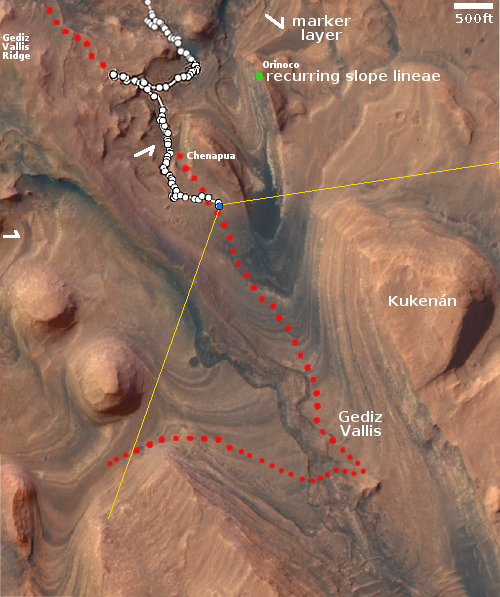
On the overview map to the right, the blue dot marks Curiosity’s position when this panorama was taken, with the yellow lines indicating the approximate area covered. The white dotted line on both the panorama and map indicates the rover’s actual route, with the red dotted line its planned route.

Because of the steep rough terrain, the science team has shifted the rover a bit to the west as it climbs. It is going to be fascinating to watch how it manages this climb into Gediz Vallis, as it appears the terrain is going to get no less steep or rough.

3 comments
1 27 28 29 30 31 95