Climate scientists are science’s biggest frequent flyers

From the people who want to shut down all fossil fuel technology: A newly published survey of 1,400 scientists from 59 countries has found that climate scientists fly more than researchers in any other field.

Climate experts — who accounted for about 17% of respondents — take five flights per year on average, the study found, whereas researchers who specialize in other fields took four. Climate scientists also fly more often for work than their peers, but take fewer international flights for personal reasons. Air travel becomes more frequent with job seniority across all disciplines, with climate-change professors flying on average nine times per year, and those in non-climate disciplines flying eight times.

Although the difference isn’t enormous, it adds up to a “colossal amount of flying”, says Lorraine Whitmarsh, an environmental psychologist at the University of Bath, UK, who led the study. “These figures are really quite stark, I think, and should be a wake-up call for all of science.”

The survey took place prior to the Wuhan panic, and thus does not tell us about the new fear-driven flying patterns of scientists.

That this story comes from the journal Nature,. which in recent years has become increasing controlled by the leftist propaganda machine, suggests the data is quite convincing. Nature wouldn’t allow any publication of any paper that throws a bad light on global warming or its researchers, unless the data was overwhelming and impossible to ignore.

It also tells us that climate scientists themselves don’t really believe their own doomsday predictions about global warming. Before the Wuhan panic they would routinely run numerous international conferences, often in wonderful warm-weather vacation spots in the midst of winter, and would flock there in the thousands to enjoy that warm weather even as they repeatedly called for government restrictions on everyone else. The article quotes one scientist, who tries to justify this travel:

International conferences might also have an influence, says Kim Cobb, a climate scientist at the Georgia Institute of Technology in Atlanta. Meetings to coordinate global mitigation efforts — such as of the Intergovernmental Panel on Climate Change — involve hundreds of researchers from different countries. “You need to have a frequent series of meetings to keep up with the data, to advance our findings, to make sure that they are disseminated across the community,” says Cobb. [emphasis mine]

I highlight her quote because her reasons for attending such conferences are unadulterated garbage. While it is important to personally get together periodically with other scientists in the field to exchange results (something that is unfortunately no longer happening because of fear of COVID-19), you don’t need to do this “frequently” in today’s intenet society. Nor do you need to do it to “keep up with the data” or to distribute it to everyone else. If anything, such conferences are very inefficient for achieving these goals. The internet does it far better.

No, the purpose of many of these very big climate conferences had nothing to do with science. I’ve attended a few, and noticed how little real science was discussed. Instead, these conferences were political gatherings, aimed at organizing political action and regulation, as determined by these high-flying climate politicos. And they were always in nice warm weather locations, in winter.

To sum up: Until the climate field acts like it believes its own pontifications about the evils of fossil fuels, no one else should.
13 comments

Sunspot update: Practically no sunspots for a month

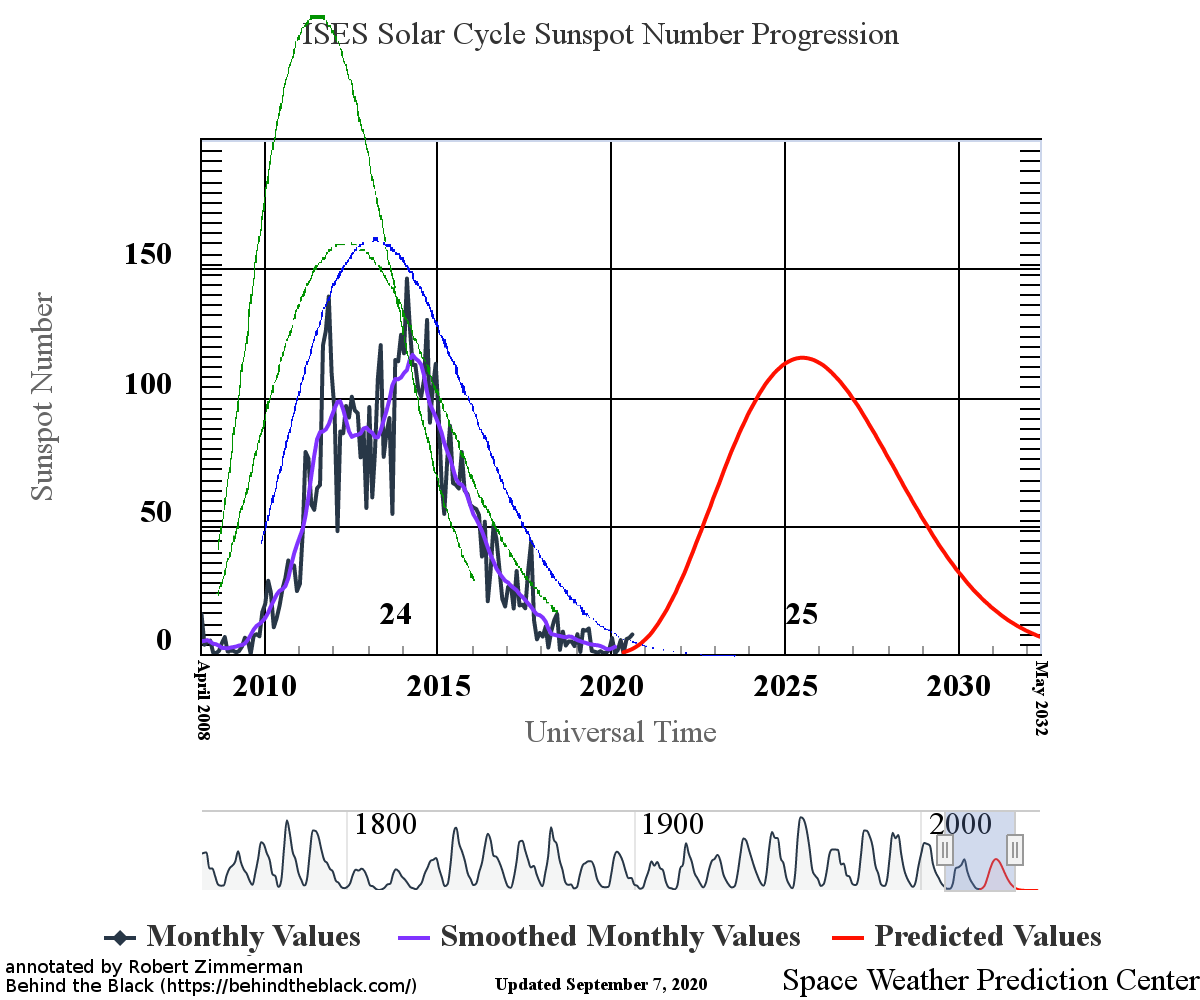
It is sunspot update time again! NOAA today updated its monthly graph for tracking the Sun’s monthly sunspot activity, and I have posted it below, with additional annotations by me to show the past solar cycle predictions.

July and August had seen sunspot numbers higher than the new NOAA prediction (shown by the red curve on the graph below). September however was almost totally blank, with only two weak sunspots for the entire month, as shown on the SILSO graph below.
» Read more

7 comments

California to ban all gas-powered vehicles

This is not the Babylon Bee: California Democratic governor Gavin Newsom today announced that as of 2035 the state will outlaw all gas-powered vehicles.

Newsom said that his new executive order would “eliminate” the sales of “internal combustion engines” and move to electric vehicles — a move that he said would create jobs and allow California to “dominate” the market, and address climate change. Those who currently own gas-powered vehicles would still be allowed to operate them and to sell them on the used market.

2035 happens to be the same year that former Vice President Joe Biden has set as a deadline for the U.S. to eliminate fossil fuels from electricity production, five years later than originally proposed by Rep. Alexandria Ocasio-Cortez (D-NY) in her “Green New Deal.” Ocasio-Cortez led the climate change panel on the “Biden-Sanders Unity Task Force” earlier this year.

The ignorance displayed by this policy decision is spectacular. These Democrats obviously believe that the power from electric cars comes from magic. They also seem to believe that new technology can magically be decreed, by government fiat.

What this degree will do is bankrupt California, and make living there a living hell, suitable only for the very very rich or the very very poor (whose survival will be wholly dependent on those very very rich).

Remember this when you go to vote in November. Newsom, Ocasio-Cortez, and Biden are very typical of the modern Democratic Party. Give it power and it will do the same for the entire nation.

25 comments

Scientists declare solar minimum over, with next sunspot maximum coming

Scientists from the government agencies of NOAA and NASA today announced that the solar minimum of the past sunspot cycle occurred in December 2019, and that the ramp up to the next solar maximum has begun, which they predict will be as active as the last weak maximum.

The announcement and prediction was put forth by “the Solar Cycle 25 Prediction Panel, an international group of experts co-sponsored by NASA and NOAA.” While this group is made up of legitimate scientists studying the Sun, its press releases tend to be lobbying efforts for government programs, which nicely describes today’s release as well. The release not only touts the importance of their work, it links this work to the Trump administration’s Artemis program to get back to the Moon.

Note also that this announcement only makes official what has been obvious for months, as I have noted in my monthly sunspot updates. See for example this quote from my September 7th update:

What is clear is that the activity does herald the next maximum. As in the past few months, the sunspots in August all had polarities that assigned them to the new maximum. While it is not impossible for there to be a handful of sunspots in the next few months that belong to the last maximum, it now appears that the last cycle is pretty much over. We are entering the ramp up to the next maximum, presently predicted by a portion of the solar science community aligned with NOAA to be a weak one.

The only change is that it appears they are upping their prediction for the next maximum slightly. Before the prediction panel had said that the next maximum would be weaker than the past maximum. Now they it appears they are saying it will be the same.

0 comments

Sunspot update: More evidence of an upcoming maximum

NOAA last week updated its monthly graph for tracking the Sun’s monthly sunspot activity. As I have done now for every month since 2011, I am posting that graph elow with additional annotations by me to show the past and new solar cycle predictions.

August 2020 sunspot activity

The graph above has been modified to show the predictions of the solar science community for the previous solar maximum. The green curves show the community’s two original predictions from April 2007 for the previous maximum, with half the scientists predicting a very strong maximum and half predicting a weak one. The blue curve is their revised May 2009 prediction. The red curve is the new prediction, first posted by NOAA in April 2020.

August continued the trends seen in the past two months whereby sunspot activity actually exceeded the prediction for this particular month.

Does this mean the prediction of a weak maximum in 2025 will be wrong? Hardly. Sunspot activity in any given month can easily be above or below the prediction, as is obvious if you compare the fluctuations of the last maximum with the prediction. We will not really know if these higher numbers the past few months mean anything until a lot more time has passed, with the gathering of a lot more data.

What is clear is that the activity does herald the next maximum. As in the past few months, the sunspots in August all had polarities that assigned them to the new maximum. While it is not impossible for there to be a handful of sunspots in the next few months that belong to the last maximum, it now appears that the last cycle is pretty much over. We are entering the ramp up to the next maximum, presently predicted by a portion of the solar science community aligned with NOAA to be a weak one.

Above all, the real scientific mystery remains: Scientists do not really yet understand the causes and processes that produce this sunspot cycle. They know without question that it is caused by cycles in the Sun’s magnetic dynamo, but their understanding of the details behind this process remain quite unknown.

Furthermore, the Sun’s importance to the climate on Earth is unquestioned. What we still do not know is its precise influence on long term climate changes. There is circumstantial evidence that it causes cooling and warming of the climate on scales of decades and centuries, but this remains unconfirmed. Once again, our understanding of the details behind the changes in the climate remain quite unknown.

And as always, the devil is in the details.

2 comments

Sunspot update: Hints of the next maximum

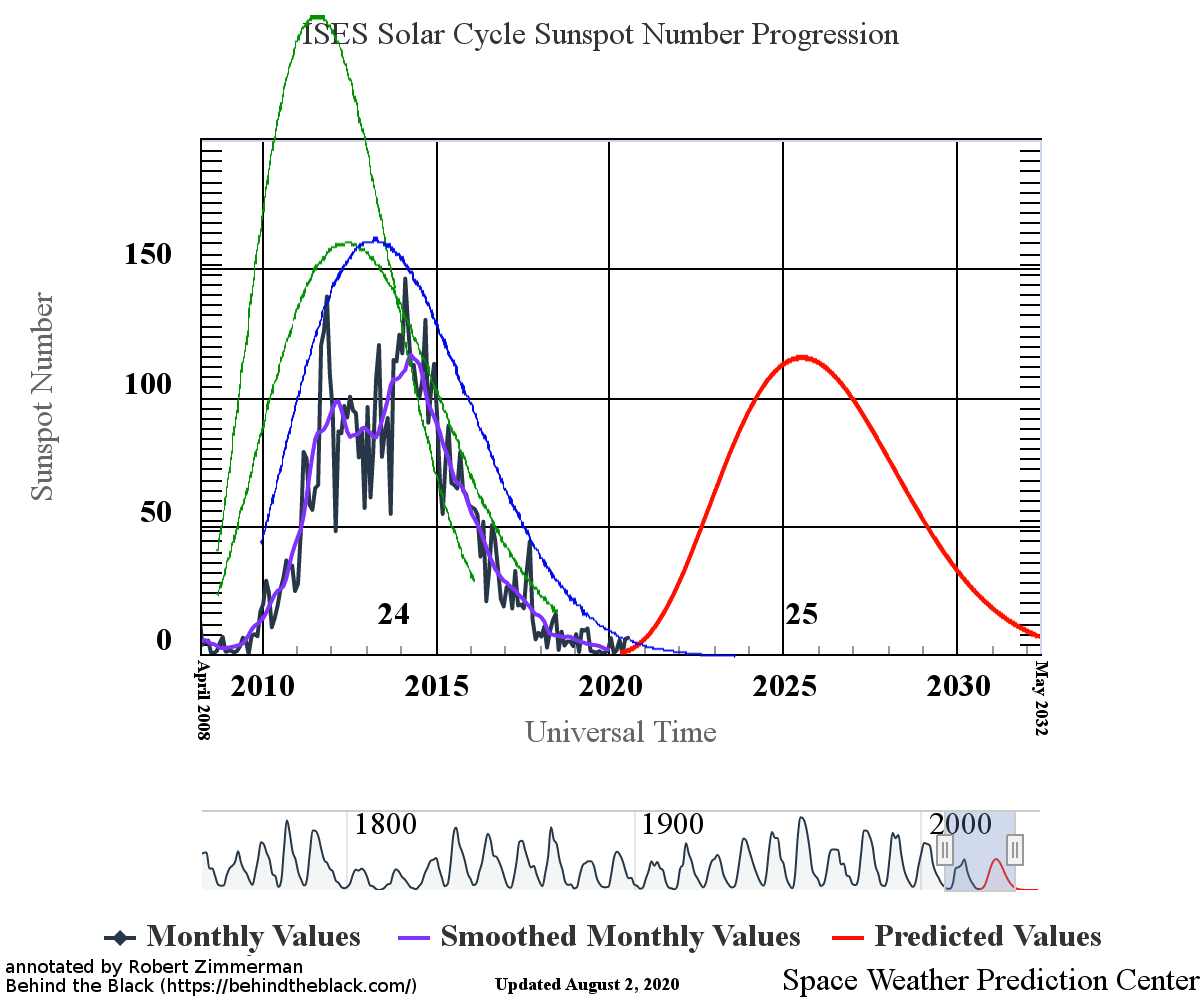
It’s time for another monthly sunspot update! NOAA yesterday updated its monthly graph for tracking the Sun’s monthly sunspot activity, and as I do every month, I am posting it below with additional anotations by me to show the past and new solar cycle predictions.

July 2020 sunspot activity

The graph above has been modified to show the predictions of the solar science community for both the previous and upcoming solar maximums. The green curves show the community’s two original predictions from April 2007 for the previous maximum, with half the scientists predicting a very strong maximum and half predicting a weak one. The blue curve is their revised May 2009 prediction. The red curve is the new prediction, first posted by NOAA in April 2020.

July continued the trend from June, with a slight uptick in activity. The SILSO graph below for July illustrates this.
» Read more

7 comments

Midnight repost: The absolute uncertainty of climate science

The tenth anniversary retrospective of Behind the Black continues: Tonight’s repost adds more weight to yesterday’s about the uncertainty of any model predicting global warming. Rather than look at the giant gaps in our knowledge, this essay, posted on January 28, 2019, looked at the data tampering that government scientists are doing to their global temperature databases in order to make the past appear cooler and the present appear warmer.

——————————-
The absolute uncertainty of climate science

Even as the United States is being plunged right now into an epic cold spell (something that has been happening repeatedly for almost all the winters of the past decade), and politicians continue to rant about the coming doom due to global warming, none of the data allows anyone the right to make any claims about the future global climate, in any direction.

Why do I feel so certain I can make this claim of uncertainty? Because the data simply isn’t there. And where we do have it, it has been tampered with so badly it is no longer very trustworthy. This very well documented post by Tony Heller proves this reality, quite thoroughly.

First, until the late 20th century, we simply do not have good reliable climate data for the southern hemisphere. Any statement by anyone claiming to know with certainty what the global temperature was prior to 1978 (when the first Nimbus climate satellite was launched) should be treated with some skepticism. Take a look at all the graphs Heller posts, all from reputable science sources, all confirming my own essay on this subject from 2015. The only regions where temperatures were thoroughly measured prior to satellite data was in the United States, Europe, and Japan. There are scattered data points elsewhere, but not many, with none in the southern oceans. And while we do have a great deal of proxy data that provides some guidance as to the global temperature prior to the space age, strongly suggesting there was a global warm period around the year 1000 AD, and a global cold period around 1600 AD, this data also has a lot of uncertainty, so it is entirely reasonable to express some skepticism about it.

Second, the data in those well-covered regions have been tampered with extensively, and always in a manner that reinforces the theory of global warming. Actual temperature readings have been adjusted everywhere, always to cool the past and warm the present. As Heller notes,
» Read more

1 comment

Midnight repost: The uncertainty of climate science

The tenth anniversary retrospective of Behind the Black continues: Tonight’s repost, from 2015, can be considered a follow-up to yesterday’s. While many global warming activists are absolutely certain the climate is warming — to the point of considering murder of their opponents a reasonable option — the actual available data is so far from certain as to be almost ludicrous.

——————————-
The uncertainty of climate science

For the past five years, I have been noting on this webpage the large uncertainties that still exist in the field of climate science. Though we have solid evidence of an increase of carbon dioxide in the atmosphere, we also have no idea what the consequences of that increase are going to be. It might cause the atmosphere to warm, or it might not. It might harm the environment, or it might instead spur plant life growth that will invigorate it instead. The data remains inconclusive. We really don’t even know if the climate is truly warming, and even if it is, whether CO2 is causing that warming.

While government scientists at NASA and NOAA are firmly in the camp that claims increasing carbon dioxide will cause worldwide disastrous global warming, their own data, when looked at coldly, reveals that they themselves don’t have sufficient information to make that claim. In fact, they don’t even have sufficient information to claim they know whether the climate is warming or cooling! My proof? Look at the graph below, produced by NOAA’s own National Centers for Environmental Information.
» Read more

24 comments

Midnight repost: Murder for the sake of climate idealogy

The tenth anniversary retrospective of Behind the Black continues: Tonight’s repost follows directly from yesterday’s, though it was written seven years earlier in 2010. Mindless hate always begets mindless violence, and Americans could have seen the mindless violence of today’s leftists a decade ago, if they had only being willing to look.

———————————–
Murder for the sake of climate idealogy

This video has been making the rounds on the web. Though I warn you that is somewhat graphic, it is essential that you watch it.

When I first saw this about a week ago, I didn’t quite know what to make of it. It was so vile and offensive I could not believe that it was legitimate. It obviously wants to pay some homage to Monty Python, but even Monty Python never went this far. How could anyone possibly think that killing small children in the name of environmentalism was in any way funny? And how could anyone ever believe that this video would persuade anyone to go along with the 1010 environmental campaign? If anything, the video does an excellent job of discrediting this organization and everyone involved with it.

Thus, despite what some bloggers were saying, I held back commenting, just to make sure the video was real and not a terrible prank meant to sabotage.

There is now no reason to hold back. Late last week, the 1010 organization itself issued an apology, admitting that this video was their handiwork. Before I continue, I think it is worthwhile for you to also read their apology, in all its venal glory. In many ways, it condemns them and their allies far more than the video did:
» Read more

8 comments

Midnight repost: Al Gore and the silencing of debate

The Behind the Black tenth anniversary retrospective: Today’s repost is from August 29, 2011, and was one of my earliest essays describing the real meaning of the scientific method.

——————————–
Al Gore and the silencing of debate

Yesterday I posted a link to a story about Al Gore claiming that any expression of skepticism about global warming is to him no different than racism. Here again is what Gore said,

“There came a time when friends or people you work with or people you were in clubs with — you’re much younger than me so you didn’t have to go through this personally — but there came a time when racist comments would come up in the course of the conversation and in years past they were just natural. Then there came a time when people would say, ‘Hey, man why do you talk that way, I mean that is wrong. I don’t go for that so don’t talk that way around me. I just don’t believe that.’ That happened in millions of conversations and slowly the conversation was won. We have to win the conversation on climate.”

More than at any other time, Gore here has very successfully illustrated the differences between how climate skeptics debate the scientific questions of climate change versus how global warming advocates do it.
» Read more

44 comments

Sunspot update: More evidence of an upcoming weak maximum

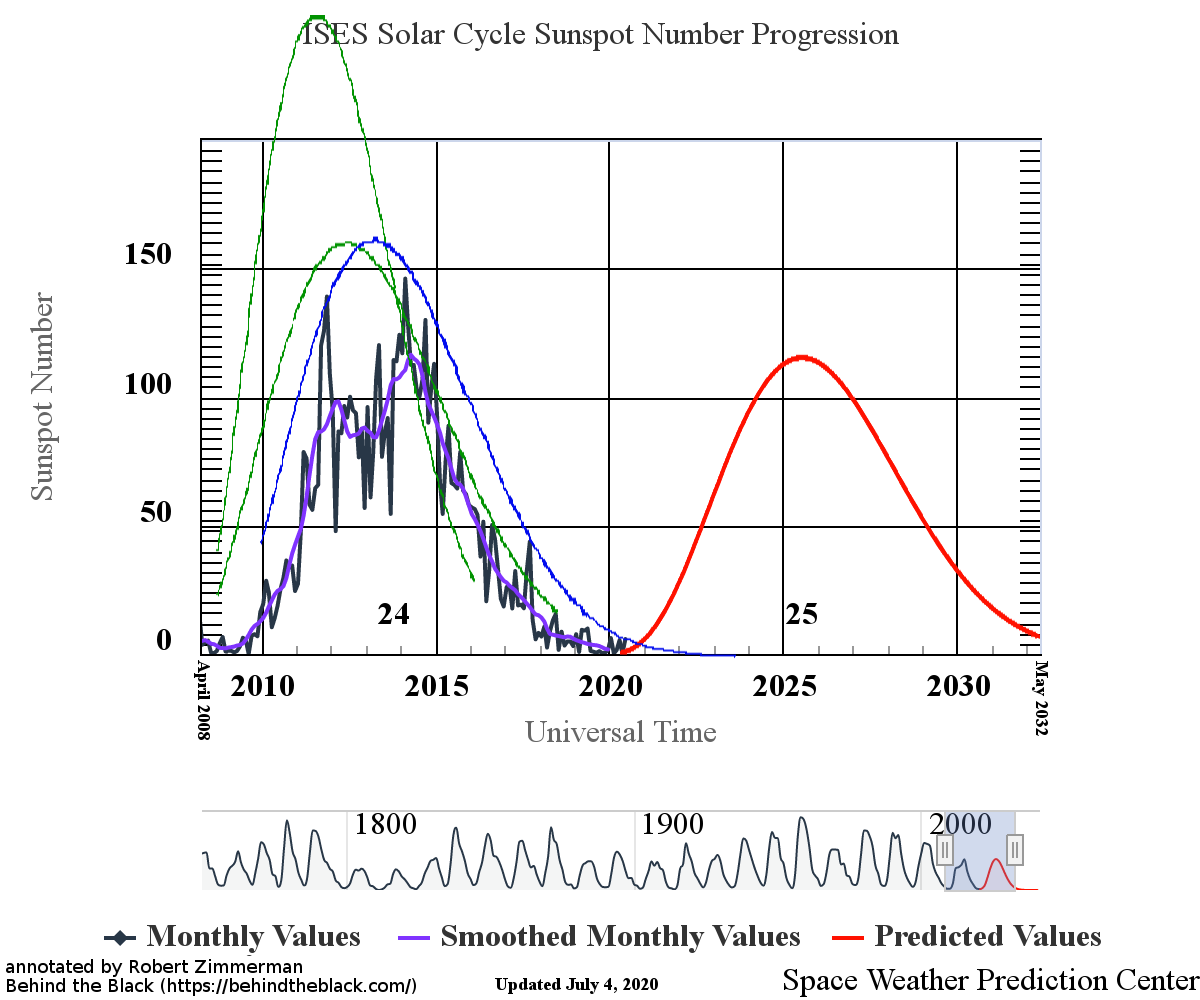
On July 4th NOAA updated its monthly graph tracking the monthly activity of sunspots on the Sun’s visible hemisphere. Below is that updated graph, annotated by me to show the past and new solar cycle predictions.

June 2020 sunspot activity

The graph above has been modified to show the predictions of the solar science community for both the previous and upcoming solar maximums. The green curves show the community’s two original predictions from April 2007 for the previous maximum, with half the scientists predicting a very strong maximum and half predicting a weak one. The blue curve is their revised May 2009 prediction. The red curve is the new prediction, first posted by NOAA in April 2020.

June saw an uptick of activity since my last update, though that activity remains quite low. We saw two sunspots during the month, both with polarities that link them to the next maximum and thus providing evidence that we will have a maximum in about five or six years. The first of those sunspots was also one of the strongest new cycle sunspots yet seen, and lasted for almost two weeks before it rotated off the visible face of the sun.

The ratio of next cycle sunspots vs sunspots from the past maximum has also been shifting. More and more, the new sunspots belong to the next cycle and less to the last. The ramp up to the next maximum is definitely beginning, though to call it a “ramp up” at this point is a big exaggeration. Sunspot activity remains low, though the last few months have seen some activity, unlike the seven months of nothing seen during the second half of last year.

The upcoming prediction for the next maximum calls for it to be very weak. Interestingly, the activity in June surpassed that prediction. This does not mean that the prediction will be wrong, only that June was more active when compared to the smooth prediction curve. As the cycle unfolds the monthly numbers will fluctuate up and down, as they did last cycle. The question will be whether their overall numbers will match closely with the prediction. In the past cycle actual sunspot activity was consistently below all predictions. It is too soon to say how well the new prediction is doing.

7 comments

Midnight repost: The Fantasy of Extreme Weather

The tenth anniversary retrospective of Behind the Black continues: The science described in this essay, posted originally on April 11, 2013 remains even today entirely accurate. Worse, the story illustrates the exact same kind of obtuse refusal to deal with reality that has put us today in the midst of a panic over a relatively minor seasonal virus.

Unfortunately, the links to the first two articles that I reference no longer work.

—————————–
The Fantasy of Extreme Weather

This week there were three stories describing new research proving that global warming is going to cause an increase in the number and violence of extreme weather events. Each was published in one of the world’s three most important scientific journals.

Sounds gloomy, doesn’t it? Not only will extreme heatwaves, cold waves, and droughts tear apart the very fabric of society, you will not be able to drink your soda in peace on your next airplane ride!

However, one little detail, buried in one of these stories as a single sentence, literally makes hogwash out of everything else said in these three articles.
» Read more

0 comments
1 6 7 8 9 10 57