UK smallsat rocket company unveils upper stage prototype

Capitalism in space: The smallsat rocket company Orbex yesterday unveiled a prototype of the upper stage of its Prime rocket.

UK launch services provider Orbex has unveiled a completed engineering prototype of the second stage for its Prime rocket at the opening of its new headquarters and rocket design facility in Forres in the Scottish Highlands. Prime is a small satellite launcher that is set to be the first UK rocket to launch UK satellites from a UK launch site. Orbex also announced two customers who have signed up for Prime launches.

They are aiming for 2021 for their first launch from the United Kingdom’s first spaceport in Sutherland in northern Scotland. Orbex and Lockheed Martin are the two companies that have a deal to use this spaceport.

The more significant part of this announcement that the two new launch agreements, from the smallsat satellite companies UK-based Surrey and Swiss-based Astrocast. This means that have some customers.

0 comments

Turkey’s president endorses creation of space agency

The new colonial movement: Recep Tayyip Erdoğan. the president of Turkey, has signed an order endorsing a proposed Turkish space agency.

The agency is expected to develop technologies for rocket launches and space exploration, as well as to coordinate the space-related activities of the country’s other space-research centres, according to the order, signed on 13 December.

It’s not yet clear how much of the national budget the new organisation will receive, or when it will be up and running. “The judicial details of the agency are still being sorted out,” said Mustafa Varank, the Minister of Industry and Technology, during a speech at the National Space Workshop held in Gebze, Turkey, on 19 January. He added that this is a historic moment for a country whose flag pictures the Moon and a star.

While this action has likely been inspired by the increasingly successful space efforts in both Israel and the UAE, the motives for it probably have more to do with power and control. Unlike the UAE, which clearly outlined its goals (to inspire its population and diversify its economy) with specific missions designed to do that (a mission to Mars and an astronaut mission to ISS that allowed the entire population to apply to go), this Turkish proposal seems only designed to take control of whatever space activities exist there. It might end up encouraging more aerospace industry, but that industry is now clearly going to be run by Turkey’s government.

1 comment

The bigoted communist “New Green Deal” of the Democratic Party

They’re coming for you next: This week Congresswoman Alexandria Ocasio-Cortez used National Public Radio to (D-New York) announce her proposed radical environmental policy, dubbed by her “the New Green Deal,” a name meant to harken back to Franklin Roosevelt’s policies during the Depression.

You can read the entire proposal here.

The link above is a blunt but I think honest analysis of her proposal.

As predicted, it is pure socialism.

The legislation, co-authored by Sen. Ed Markey (D-MA), is a non-binding resolution that reads, to borrow a phrase from the late Jeanne Kirkpatrick, like a letter to Santa Claus — or, in this case, a wish list to Gaia or Mother Nature.

The proposal is also incredibly bigoted, being entirely focused on helping certain racial and ethnic groups at the expense of others. If you have doubts about this conclusion, consider this quote from the policy itself:
» Read more

41 comments

Hawaiian activists say “No!” to smallsat spaceport

The coming dark age: At a meeting to obtain public feedback on a proposed smallsat spaceport in Hawaii, activists were almost all hostile or opposed to the project.

There might be justified reasons to oppose the spaceport, but since the environmental assessment is not yet published, it is unclear at this point what those reasons might be. The reasons cited by these opponents, noise and pollution, don’t seem serious. The spaceport being proposed is for smallsat rockets, rockets that are very small (only a few times larger than the biggest model rockets). Even if they launch weekly these rockets will not cause serious noise or pollution issues.

Thus, what I see here are a bunch of close-minded luddites afraid of new things, and determined to block those new things from happening.

1 comment

Auditor condemns Ariane 6

Capitalism in space: France’s independent government auditor has issued a new report that badly slams Arianespace’s next generation rocket, Ariane 6, accusing its design as being too cautious and too expensive, thus guaranteeing it will fail to compete with the reusable rockets now in use as well as being developed in the U.S.

This is the scathing assessment of France’s independent state auditor in a report that picked apart the flawed economic model behind Ariane 6, the next generation of rocket-launchers set to start operating in 2020.

It made the point that Europeans, who have taken part in developing the launcher, went for a “cautious” approach and invested in the kind of controlled technology that potential clients in the continent had no faith in, even back in 2014. This means that Ariane 6 is stuck in the past and “risks not being competitive over the long term.” Its U.S. rivals are way ahead and already testing future disruptive technologies. [emphasis mine]

The highlighted text is proven by the apparent unwillingness of Arianespace’s European partners to sign contracts for Ariane 6.

This isn’t really news. See for example this February 13, 2018 report on Behind the Black. Or this one from September 2017, where ArianeGroup first outlined the prices they expected to charge for Ariane 6. Then, I predicted what France’s auditor has only now realized:

Will these prices be competitive in 2020s? I have my doubts. I estimate, based on news reports, that SpaceX is charging about $40 million today for a launch with a reused first stage, and $62 million for a launch with an entirely new rocket. Give them another five years of development and I expect those prices to drop significantly, especially as they shift to entirely reused first stages for almost every launch and begin to demonstrate a routine launch cadence of more than one launch per month.

This quote…explains how ArianeGroup really intends to stay alive in the launch market: “The price targets assume that European governments — the European Space Agency, the European Commission, Eumetsat and individual EU nations — agree to guarantee the equivalent of five Ariane 62 missions per year, plus at least two missions for the light-lift Vega rocket.”

In other words, ArianeGroup really doesn’t wish to compete for business. It wants to use government coercion to force European space agencies and businesses to buy its product. They might get that, but the long term result will be a weak European presence in space, as everyone else finds cheaper and more efficient ways to do things. [emphasis mine]

Based on recent stories, it seems that ArianeGroup has been unable to force European space agencies to buy Ariane 6. Thus, the rocket faces failure, before it even launches.

3 comments

A look at SpaceX’s upcoming launch schedule

Link here. It appears that the launch dates for both Falcon Heavy launches depend entirely on when the first Falcon 9 manned Dragon test flight takes place.

With Demo-1 having priority, the final preparations for Arabsat [using Falcon Heavy] will not be able to begin until the Demo-1 launch has occurred as there is only so much space in the Pad 39A hangar. With that in mind, Arabsat 6A will likely occur in the second half of March at the earliest, as NASA announced on Wednesday that Demo-1 is now targeting no earlier than March 2nd, 2019.

While the March 2nd launch date for Demo-1 is still tentative, it is understood that the Space Station’s Visiting Vehicle Schedule does have availability for a launch on that date should the NASA and SpaceX teams be ready.

Once Demo-1 and Arabsat are out of the way, Pad 39A will not be done supporting high profile missions. SpaceX will work to quickly turnaround the first stage boosters from the Arabsat 6A flight in order to reuse them for the STP-2 mission – the second Falcon Heavy launch of the year. STP-2 is a mission for the U.S. Air Force which will feature several technology demonstration payloads. According to FCC filings, the launch is currently scheduled for no earlier than April 30th, 2019. However, since this mission requires boosters from the Arabsat 6A launch, SpaceX will require several weeks between the two flights to refurbish the cores.

Therefore, STP-2 is directly connected to the launch schedule for Arabsat 6A which is in turn connected to Demo-1’s schedule. Consequently, the odds of a slip with STP-2’s date are high, as two major dominos currently stand in front of it.

In addition, the date for SpaceX’s launch abort test of Dragon depends entirely on the completion of the Demo-1 flight, since they plan to use that same capsule in the abort test.

Though there are a handful of other launches described in the article through April, but much of SpaceX’s schedule for the spring depends entirely on whether NASA can get off its duff and allow the Dragon test mission to fly. If NASA continues to drag its feet, everything else will get delayed. It would seem that at some point SpaceX might even have the right to demand financial compensation from NASA for the loss of income NASA is causing it. They don’t get paid for any of these launches until they fly, and thus NASA is preventing them from earning money from other customers.

0 comments

Sunspot update January 2019: The early solar minimum

As I have done every month since 2011, I am now posting NOAA’s the monthly update of the solar cycle, covering sunspot activity for January 2019. They posted this update on Monday, and I am posting it below, annotated to give it some context.

January 2019 sunspot activity

The graph above has been modified to show the predictions of the solar science community. The green curves show the community’s two original predictions from April 2007, with half the scientists predicting a very strong maximum and half predicting a weak one. The red curve is their revised May 2009 prediction.

January saw a slight uptick in sunspot activity, but the overall activity remains comparable to mid-2008, when the last prolonged solar minimum began. If you go to my October 2018 update, you can see the graph when it included data going back to 2000 and see the entire last minimum.

That last minimum started in the last half of 2007, and lasted until mid-2009, a full two years. If you look at the red line prediction of the solar science community, it appears that they are expecting this coming minimum to last far longer, almost forever. I expect this is not really true, but that they have simply not agreed on a prediction for the next cycle. Some in that solar science community have hypothesized that we are about to enter a grand minimum, with no sunspots for decades and thus no solar maximum. Others do not agree.

Since neither faction really understands the mechanism that causes these sunspot cycles, there is no way now to determine what will happen, until it does so. What we do know from climate data is that the Earth cools when the Sun is inactive. Why remains unclear, though there is at least one theory, with some evidence, that attempts to explain it.

And despite the untrustworthy claims of NOAA and NASA scientists that the last few years have been hot, experience on the ground disputes this. Their data has been adjusted (tampered if one wants to be more blunt) to make it fit their global warming theory. The raw unadjusted data suggests things have instead cooled, which better fits with the brutal winters Americans experienced for the past decade or so.

If the Sun does enter a grand minimum in the coming decades, I suspect it will become increasingly difficult for NOAA and NASA to continue their temperature adjustments and continue claiming things are getting warmer. At a minimum, we will learn something about the Sun and its behavior and its influence on the climate that we never knew before.

6 comments

NASA confirms new Dragon launch date

Confirmed: NASA today announced a new launch date, March 2, for the first unmanned test flight of SpaceX’s manned Dragon capsule.

The agency now is targeting March 2 for launch of SpaceX’s Crew Dragon on its uncrewed Demo-1 test flight. Boeing’s uncrewed Orbital Flight Test is targeted for launch no earlier than April.

These adjustments allow for completion of necessary hardware testing, data verification, remaining NASA and provider reviews, as well as training of flight controllers and mission managers.

This is actually the first time that NASA itself has specified a launch date, which suggests to me that they finally have admitted that they cannot hold things up any longer. Based on this announcement and assuming the weather and everything else cooperates, the launch will likely happen then, which will also allow time for SpaceX to get the launchpad reconfigured for its Falcon Heavy launch a week later.

The announcement also listed the remaining test schedule for commercial crew, as it stands now:

  • SpaceX Demo-1 (uncrewed): March 2, 2019
  • Boeing Orbital Flight Test (uncrewed): NET April 2019
  • Boeing Pad Abort Test: NET May 2019
  • SpaceX In-Flight Abort Test: June 2019
  • SpaceX Demo-2 (crewed): July 2019
  • Boeing Crew Flight Test (crewed): NET August 2019

The manned flights have not been pushed back significantly from the dates that NASA announced in October, June for SpaceX and August for Boeing. I would expect that the delays now will force these dates to get delayed as well.

2 comments

NASA delays unmanned test of manned Dragon again

While not yet confirmed, industry rumors for the past twenty-four hours are saying that NASA has once again forced a delay in the launch of SpaceX’s unmanned test of manned Dragon, pushing it back into March.

I have linked to one article, but I have been hearing these rumors from a number of sources.

This delay, if true, will cause SpaceX scheduling problems in numerous ways. First, it will conflict with the second Falcon Heavy launch, presently planned for March using the same launchpad. Second, it forces a pushback on the manned Dragon launch. Because SpaceX will use this capsule to fly its launch abort mission, it needs at least three months to prep this capsule for its reuse. Assuming that is a success, it will then need three more months to assess that launch abort flight and prepare for the manned flight. This means the manned flight cannot happen prior to October.

Why the delays? Nowhere in this article or in any of the rumors I have heard has any real reason been given. The article says the following, with the important words highlighted:

As of the first week of December 2018, SpaceX was reportedly planning towards a mid-January 2019 launch debut for Crew Dragon. By the end of December, DM-1 was no earlier than the end of January. By the end of January, DM-1 had slipped to from late-February to NET March 2019. Put in slightly different terms, SpaceX’s Crew Dragon launch debut has been more or less indefinitely postponed for the last two months, with planning dates being pushed back at roughly the same pace as the passage of time (i.e. a day’s delay every day).

Admittedly, DM’s apparently indefinite postponement may well be – and probably is – more of an artifact than a sign of any monolithic cause. While the US government’s longest-ever shutdown (35 days) undoubtedly delayed a major proportion of mission-critical work having to do with extensive NASA reviews of SpaceX and Crew Dragon’s launch readiness (known as Readiness Reviews), much of the 60+ day DM-1 delay can probably be attributed to the complexity of the tasks at hand. Being as it is the first time SpaceX has ever attempted a launch directly related to human spaceflight, as well as the first time NASA has been back at the helm (more or less) of US astronaut launch endeavors in more than 7.5 years, significant delays should come as no surprise regardless of how disappointing they may be. [emphasis mine]

The first paragraph above outlines the endless delays that appear to me to be entirely caused by NASA’s endless review process, much of it designed solely to delay things, for political reasons. SpaceX has clearly been ready to launch since December. Moreover, NASA is somewhat irrelevant to this launch, as it is run by a SpaceX launch team on a SpaceX-run launchpad. The delays are all paperwork related, imposed by NASA bureaucrats hostile to this commercial private spacecraft because it is showing the world NASA’s own inability to build its own manned rocket and spacecraft, SLS/Orion.

These NASA bureaucrats are clearly putting their own interests ahead of the interests of the nation. While they play petty political games with this launch, their delays risk putting us in the position next year of having no way to ferry our own astronauts to and from our own space station. The contract with Russia runs out this year, and Russia has said that it would be very difficult for them to quickly schedule more flights beyond that.

Meanwhile, what is Trump doing? Nothing. He is allowing this, even though he has the power to prevent it.

2 comments

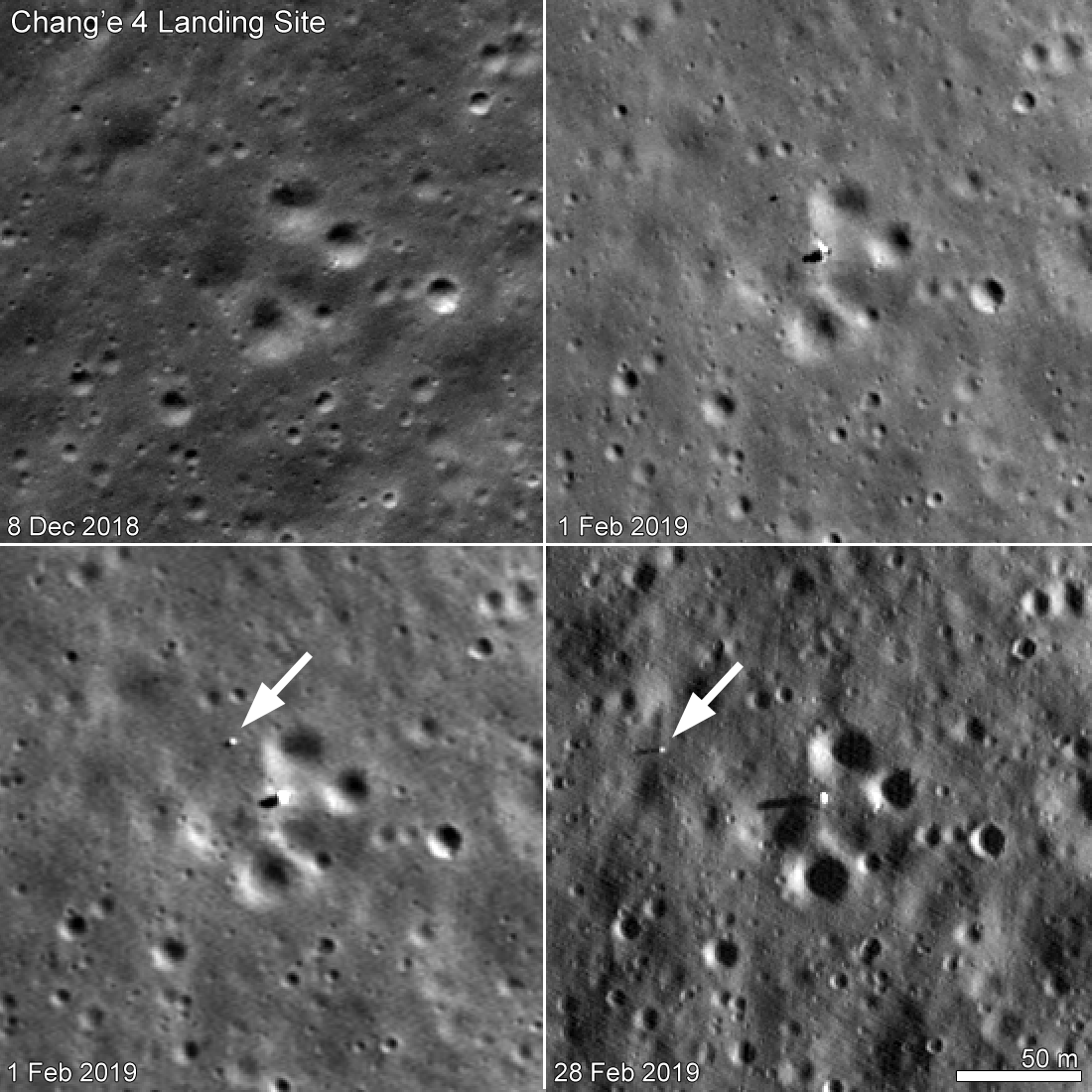
LRO photographs Chang’e-4 on lunar surface

Chang'e-4 on the lunar surface

The Lunar Reconnaissance Orbiter (LRO) science team has released a spectacular oblique image that shows Chang’e-4 on the floor of Von Kármán crater.

Four weeks later (30 January 2019), as LRO approached the crater from the east, it rolled 70° to the west to snap this spectacular view looking across the floor towards the west wall. Because LRO was 330 kilometers (205 miles) to the east of the landing site, the Chang’e 4 lander is only about two pixels across (bright spot between the two arrows), and the small rover is not detectable. The massive mountain range in the background is the west wall of Von Kármán crater, rising more than 3000 meters (9850 feet) above the floor.

The image on the right has been reduced to post here. If you click on it you can see a larger version, but you need to download a very large file at the above link to see it at full resolution.

0 comments

The story of an American family that moved to Russia

Link here. Russia has enormous problems, and I would be the last person to suggest leaving the United States to live there. Nonetheless, it is very instructive to read this article and the detailed explanation given by the father, Hal Freeman, as to why they moved.

The traditional values, the loss of which many in America are lamenting, are largely the values of the Russian culture in which I live. I do not write as someone who has been told this. I live here. The Russian Orthodox Church has a strong influence on local life. There are also active Catholic and Protestant churches in my town. The Church and State work together at a national level. For example, both want to reduce the numbers of abortions which skyrocketed during the Communist era because abortion was commonly used for birth control. The Church has made a strong commitment to help women in “crisis pregnancies.” The laws are more restrictive now about when and for what reason abortions can be performed. Watching the news here after Gov. Cuomo signed the bill in New York permitting late term abortions, I was struck by the contrast between the agony of my Christian friends’ posts on Facebook and the smiles and celebrations of the governor and legislators in New York. Abortions are still performed in Russia, but the numbers are steadily declining and no one smiles, laughs or brags about them.

I realize many in America are very glad that the American government is intervening and the understanding of “morality” has changed radically. They applaud freedoms won for gay, lesbian, trans-gender and many other Americans who have been oppressed. They have the right to rejoice: They won. The Benedict Option is one way for those on the other “side” to adapt. Many have been and are living it out. Others, like me, decided it was not in our family’s best interest to risk the future of our children to stay. After the New York decision on abortion I received an e-mail from an American Orthodox mother asking questions about moving to Russia. She realized the struggles involved in such a move. She wrote, however, “We have to move. No matter how well we are doing in home schooling and church, we cannot keep the government out of the lives of our children.”

If you wish to be an adult, it requires you to be brutally honest about life, pushing aside your emotions to rationally think about the world around you. This article places that demand upon ordinary but moral Americans, especially those living in leftist-controlled regions on the coasts and big urban cities. Are the political policies being pursued in those places going to make the future good or bad for your children? Freeman decided they would not, and for the sake of his kids he moved.

Not everyone can move, or should. Instead, I would advocate Americans look hard at these modern leftist policies and begin the fight to stop them, here and now. Our children’s future depends on it. If we do not, they will find themselves starving in a place not unlike today’s bankrupt socialist Venezuela.

0 comments

Oh no! Trump’s wall to block butterflies!

The bankruptcy of our modern intellectual culture, including its increasingly insane hatred of anything-Trump, might best be illustrated by this story today in the San-Antonio Express-News: First signs of border wall construction spotted at National Butterfly Center.

The full article might be behind a paywall, but let me quote from the teaser text:

A gigantic yellow earth mover arrived on National Butterfly Center land Sunday afternoon, the first sign of the beginnings of border wall construction in that protected habitat.

The steel-and-concrete levee wall is expected to slice through the center, placing 70 of the sanctuary’s 100 acres of land south of it.

Oh my! Isn’t Trump evil! This wall will prevent the illegal immigration of butterflies!

First, any sane rational person will immediately recognize that putting a wall through a butterfly sanctuary is going to do nothing to interfere with the butterflies that use that sanctuary. Butterflies are smarter than the average news reporter, and know that they can simply fly over a wall.

Second, the use of hyperbole in the article’s text reveals the reporter’s bias. The wall will “slice” through the center. And the earth mover is “gigantic” (which anyone can clearly see it is not, simply by looking at the picture at the top of the story). The writer used these absurd emotionally charged words to accentuate the disaster of this “slicing” by the “gigantic” earth mover.

Finally, the article’s timing also reveals the author’s biases. She is acting as a PR agent for Democratic congressman Henry Cuellar (D-Texas), who last week introduced amendments to the Democratic house budget bill that would have forbid any wall from being built inside or around this or other Texas border parks.

Cuellar’s proposal, however, is clearly not meant to protect the park, but to prevent the border patrol from protecting the U.S. border, as it is constitutionally required to do. It might make sense to require any border wall to skirt the southern edge of these parks in order to prevent harm to the parks, but Cuellar’s proposal specifically outlaws any wall “within, south of, or north of the National Butterfly Center,” essentially making this park a guaranteed gap in the wall which in turn could very well attract illegals in great numbers. Based on what I have seen of illegal trash in federal lands here in southern Arizona, that intrusion would do far more harm to the park than a simple wall.

7 comments

Unmanned test flight of manned Dragon delayed again?

SpaceX has applied for a new launch license from the FAA for its unmanned test flight of its manned Dragion capsule that sets the launch date as no earlier than March 2nd.

This does not necessarily mean the launch is delayed until then. As noted by commenter Kirk Hilliard here at Behind the Black, “their previous license was valid through 1 March, so they may just be covering their bases here while still planning on launching under the authority of their previous license.”

Regardless, I have seen nothing to change my opinion about the cause of these delays: the NASA bureaucracy. SpaceX has been ready to do this launch since December. It has already done two successful launch rehearsals, one in which they did a successful static fire test, as is standard for the company. Both illustrate their readiness. The launch would use their leased launchpad using their launch crew. There has been no indication of any technical reason for the delays, other than a demand that SpaceX complete paperwork for NASA and the government shutdown (which has not prevented other launches from government facilities).

5 comments

Because of Russian violations, U.S. withdraws from nuclear arms treaty

The United States announced today that it is withdrawing from the 1987 Intermediate-Range Nuclear Forces (INF) Treaty because of numerous and long-standing violations by Russia.

[Secretary of State Mike] Pompeo explained that Russia has been violating the treaty for years, and despite those violations, the U.S. has attempted to maintain the agreement. “To this day, Russia remains in material breach of its treaty obligations not to produce, possess, or flight test a ground-launched intermediate cruise missile system with a range between 500 and 5500 kilometers,” Pompeo explained. “We have raised Russia’s noncompliance with Russian officials, including at the highest levels of government, more than 30 times, yet Russia continues to deny that its missile system is noncompliant and violates the treaty,” Pompeo said.

Pompeo said Russia’s violation of the treaty has compromised U.S. security interests. “It’s our duty to respond appropriately,” Pompeo said. “When an agreement is so brazenly disregarded, and our security is so openly threatened, we must respond.”

The announcement comes one day ahead of the 60-day deadline the U.S. gave Russia to return to compliance with the treaty.

The treaty calls for a six month period following this announcement for the withdrawal to be completed.

Though the announcement mentions a specific “a prohibited missile system,” it does not say what that missile system is. I suspect it might be the hypersonic missile the Russians have tested and say they will deploy this year.

4 comments

A close look at Russia’s Vostochny spaceport

Link here. The article provides an excellent overview of the spaceport, its history, its corruption. It also gives some detailed information how the spaceport is affecting the remote cities nearby. This quote however is telling:

Across the space faculty and university at large, signs are written in Russian and in Chinese. Exchange students from across the river flock here in droves, and students participate in countless scientific and engineering projects with Chinese students. It is a very clear reflection of growing talk among Russian leadership that the country’s future in space does not lay in cooperation with NASA and the West, but with the ascendant Chinese space program.

Indeed, in the halls of Amur State University, the rich history of U.S.-Russia space rivalry and cooperation has already been relegated to the various rooms set aside as little space history museums. Something for students to ponder and reflect upon as they go about planning presentations for their next student scientific congress with their Chinese peers. Caught between the pull of Vostochny and China, these students have discovered hope for a future of opportunity in space.

This makes sense. Russia’s aerospace industry is in trouble. Worse, any future dependence on NASA’s very dubious lunar Gateway project to save it is questionable. China however is closer, and has a thriving and very successful space program. It would make sense for Russia to switch its partnership from the U.S. to China. Whether China is interested remains an open question.

3 comments

China fails to reduce its methane coal mine emissions

Surprise, surprise! Using satellite data, a new study has now shown that China has not only failed to reduce its methane coal mine emissions, it has allowed those emissions to increase.

China, already the world’s leading emitter of human-caused greenhouse gases, continues to pump increasing amounts of climate-changing methane into the atmosphere despite tough new regulations on gas releases from its coal mines, a study shows.

China is the world’s largest producer and consumer of coal, which accounts for approximately 72 percent of the country’s electricity generation. While data show that coal production has increased in China, it has been unclear until now much methane gas, or CH4, has increased. Methane that is released during coal mining is responsible for the majority of coal-related CH4 emissions and is likely the largest human-caused CH4 source in China.

“Our study indicates that, at least in terms of methane emissions, China’s government is talking the talk, but has not been able to walk the walk,” says Scot Miller, an assistant professor of environmental health and engineering and of earth and planetary sciences at Johns Hopkins University.

The truth is that while China might say it has imposed “tough new regulations,” its commitment under the Paris climate accords actually allowed it to increase its emissions significantly for years to come, even as those same accords required the U.S. to decrease its emissions. This unfair situation, which China has apparently taking full advantage of, is one of the major reasons Trump dumped the accords. It also illustrates how little the Paris Accords had to do with climate change. Its real goal was to shift the balance of power and wealth from the U.S. to other countries.

8 comments

China aims for at least 30 launches in 2019

The new colonial movement: The China Aerospace Science and Technology Corporation (CASC), China’s main government agency supervising its space program, has revealed that they have at least 30 launches planned for 2019.

This number brings the known predicted launches for 2019 to about 125, which I think would be the most ever in a single year, since Sputnik. It definitely would be the most since the 1980s.

The article also has the following information about the problems and delays that have prevented a third Long March 5 rocket launch since its second launch failed in 2017.

A redesign has been carried out to the liquid oxygen and liquid hydrogen YF-77 engines, two of which power the Long March 5 first stage, to correct the turbopump issue reported to be behind the 2017 failure. The return-to-flight mission will carry the Shijian-20 communications satellite, or “Practice-20” in Chinese, based on a new, large DFH-5 satellite platform which supports satellites from 6,500 to 9,000 kilograms.

A successful launch would mean the fourth Long March 5 would then be used to launch the Chang’e-5 lunar sample return toward the moon in late 2019. The mission will aim to collect up to 2 kilograms of rocks and regolith from a site near Mons Rümker in Oceanus Procellarum on the lunar near side and bring the samples to Earth.

A nominal return-to-flight would also clear the way for the test launch of the Long March 5B, a variant of the Long March 5 designed specifically for lofting the 20-metric ton modules of the planned Chinese Space Station (CSS) into low Earth orbit. CASC official Shang Zhi told China’s state-run Xinhua news agency that joint tests and exercises involving a test model of the rocket and the CSS core module will be carried out at Wenchang at the end of 2019 in preparation for the maiden flight of the Long March 5B. Launch of the first CSS module is currently slated for 2020.

I wonder if we will ever see the Long March 5 version ever launch again after the 5B launches successfully. I suspect not, as it appears to me that the new variant is really a cover for the significant redesign required after the 2017 launch failure.

2 comments

ArianeGroup successfully test fires new solid rocket motor

Capitalism in space: ArianeGroup, the private consortium building Europe’s next generation of rockets, has successfully test fired the new solid rocket motor it will use for both its Ariane 6 and Vega-C rockets.

The P120C is designed and built by a European consortium involving a joint venture known as Europropulsion, a venture between ArianeGroup and Avio, as well as CNES, the Italian ASI space agency, and Airbus Safran. This multinational venture uses the Avio facilities in Colleferro, Italy to manufacture the carbon fiber composite casing, a facility in France to build the ArianeGroup composite steerable nozzle, and the propellant casting and integration facilities in French Guiana to build up and prepare these boosters for flight.

The P120C, through its common use across launch vehicle lines and use of existing facilities, is designed to reduce costs as a competitive response to newer companies like SpaceX that have dramatically lowered launch costs and captured an increasing share of the worldwide launch market, dethroning the ArianeGroup from the dominating position it had held until very recently.

Without doubt they are going to save money using this solid rocket motor on both rockets. I remain somewhat skeptical, however, about whether they will achieve enough cost savings to compete with SpaceX. The seeming lack of interest by their primary European customers for Ariane 6 suggests this. It appears that its price might still be too high.

0 comments

Next Long March 5 launch delayed six months to July

The next launch of China’s largest rocket, the Long March 5, has now been delayed another six months until July.

The second Long March-5 rocket was launched from the Wenchang Space Launch Center in the southern province of Hainan on July 2, 2017, but a malfunction happened less than six minutes after its liftoff.

In October the Chinese had predicted this launch would occur in January, so this new schedule represents a six month delay. This further delay also confirms to me that their problem in 2017, which the Chinese have never fully explained other to say it caused damage to a turbopump in one first stage engine, resulted from a fundamental design flaw in the rocket’s first stage engines, requiring major reworking.

This delay also delays the launch of the first module of their space station, as well as their first sample return mission to the Moon.

0 comments

The absolute uncertainty of climate science

Even as the United States is being plunged right now into an epic cold spell (something that has been happening repeatedly for almost all the winters of the past decade), and politicians continue to rant about the coming doom due to global warming, none of the data allows anyone the right to make any claims about the future global climate, in any direction.

Why do I feel so certain I can make this claim of uncertainty? Because the data simply isn’t there. And where we do have it, it has been tampered with so badly it is no longer very trustworthy. This very well documented post by Tony Heller proves this reality, quite thoroughly.

First, until the late 20th century, we simply do not have good reliable climate data for the southern hemisphere. Any statement by anyone claiming to know with certainty what the global temperature was prior to 1978 (when the first Nimbus climate satellite was launched) should be treated with some skepticism. Take a look at all the graphs Heller posts, all from reputable science sources, all confirming my own essay on this subject from 2015. The only regions where temperatures were thoroughly measured prior to satellite data was in the United States, Europe, and Japan. There are scattered data points elsewhere, but not many, with none in the southern oceans. And while we do have a great deal of proxy data that provides some guidance as to the global temperature prior to the space age, strongly suggesting there was a global warm period around the year 1000 AD, and a global cold period around 1600 AD, this data also has a lot of uncertainty, so it is entirely reasonable to express some skepticism about it.

Second, the data in those well-covered regions have been tampered with extensively, and always in a manner that reinforces the theory of global warming. Actual temperature readings have been adjusted everywhere, always to cool the past and warm the present. As Heller notes,
» Read more

13 comments
1 288 289 290 291 292 591