German startup rocket company raises $75 million

Capitalism in space: The German startup rocket company Isar Aerospace announced today that it has raised $75 million, bringing the total in private investment capital it has obtained to $180 million.

The initial funding had funded construction of their Spectrum smallsat rocket. This new funding the company says will be used to expand their manufacturing and to begin work on making their rocket reusable.

Spectrum, the rocket Isar is developing, is a two-stage vehicle designed to place up to 1,000 kilograms into low Earth orbit. The vehicle is powered by Aquila engines that the company is also building.

Guillen said the company is preparing to start tests of the full Aquila engine soon on a test stand in Kiruna, Sweden. Isar is also working on a launch site in Norway, having signed an agreement in April with Andøya Space for exclusive use of a pad at a new site under development by the state-owned launch site operator.

A first launch of Spectrum from Andøya is expected in the second half of 2022, she said. The company expects to conduct three to four launches in 2023, with a long-term goal of about 10 launches per year. While Andøya is well-suited for launches to sun-synchronous orbits, Isar is considering alternative launch sites, such as French Guiana, for missions to lower inclination orbits.

Isar is one of three German smallstat rocket company startups, and appears from all accounts to be ahead of the other two, Rocket Factory Augsburg and HyImpulse Technologies, in funding and development.

There is some long term historical context to these German rocket companies. Following World War II, Germany was forbidden to build such things, both legally and culturally, as rockets too closely resemble the V2 rocket used by Hitler to bomb Great Britain. Even when Germany joined the European Space Agency as a partner the rocket building was left mostly to the French and the Italians.

This has now changed, partly because the rockets are small, partly because Europe has been shifting to the capitalism model in its space industry, partly because the memories from World War II have faded, and partly because ESA’s subsized effort at Arianespace to build a new low-cost replacement for its Ariane 5 rocket has not been successful. The Ariane 6 costs too much, and is thus not garnering customers from within ESA.

I think it will be really great to start listing separate European private companies in my launch race updates. Doing so will only emphasize the global acceleration of the competition to get into space.

8 comments

The Music Man – Till There Was You

An evening pause: Sung by Shirley Jones, from one of the greatest American musical films ever made, The Music Man (1962).

Diane and I have been watching a lot of those ’40s, 50s, and 60s American musicals. To today’s bitter and cynical youth, these films might seem to portray a too-perfect world filled with too much happiness and wealth. And while there is some truth to that cynical view, it is mostly wrong. The America portrayed in these films was actually quite like this. People were free, they were generally happy, and they lived a life of prosperity that no one before had ever seen. Nor are future generations likely to see such a life again during the coming dark centuries. These musicals provide a window into that time.

These musicals as well as most of the Hollywood movies prior to the 1960s are also quite unique in the history of literature and art in that they told stories not of kings or rulers or nobility, but of ordinary people. Such stories were rarely told before the coming of America. This fact also tells us much about the culture that then existed. It was ruled by those ordinary people, and thus the art and literature catered to them.

Which is why the Marxist power-driven culture that now dominates this country is desperate to ban the viewing of such art and the learning of that history. It tells a tale they cannot stomach.

20 comments

July 21, 2021 Zimmerman podcast interview on Pratt on Texas

Today Robert Pratt made available an hourlong podcast interview I did with him earlier this week, devoted entirely to discussing my new book, Conscious Choice: The origins of slavery in America and why it matters today and for our future in outer space.

The podcast is available here.

This was my first long interview discussing this book. It is also the first where you can hear the detailed impressions of it from someone else. Robert Pratt is a very educated radio host, with deep knowledge of western history and culture. That he repeatedly noted how Conscous Choice surprised him by teaching him things he hadn’t known and hadn’t even thought of I found very gratifying. I’ll let his closing words in the interview sum up his opinion of my book:

I really do believe that everybody needs to get a copy of Conscious Choice. It is that important a book. It is one of the most important books given today’s social upheaval.

There are lot of good histories out there, but they are mostly just retreads of the primary documents that we’ve read before. I get bored with them.

This book is new. This book is primary source history that will enlighten you and give you knowledge.

If you listen you will find out that I am not spinning his words. Nor is he merely providing a plug for a guest. This is his honest appraisal of Conscious Choice, after reading it.

1 comment

British startup rocket company wants to recover only satellite launched by UK

Capitalism in space: Skyrora, a British startup rocket company which is attempting to build the first rocket using hypersonic technology, has now issued a challenge to the commercial space industry to come up with a plan to snatch from orbit the only satellite ever launched by a rocket built by the United Kingdom and bring it back safely to Earth.

Edinburgh-based rocket company Skyrora is issuing a challenge to find a way to retrieve the Prospero satellite. The object was the first and only UK spacecraft to be launched on a British rocket, from Australia in 1971. It’s defunct now, obviously, but is still circling the globe on an elliptical orbit some 1,000km up.

Skyrora, who will soon start sending up rockets from Scotland, regards the satellite as an important piece of UK space heritage. The company has already recovered part of the Black Arrow vehicle that placed Prospero in orbit. This fell back to Australia in the course of the mission where it languished for decades in the Outback until the firm had it shipped home and put on display.

Now, Skyrora is looking for ideas as to how best to approach and grab hold of the 66kg satellite, whose original mission was to investigate the space environment.

After that single successful launch of Black Arrow, the British government decided to abandon it, and in fact for the next half century refused to invest any money in space, at all. While the decision was probably economically wise for the government, it also did not do anything to encourage a private space industry, and for the next half century there was none in the UK. This is now finally changing, but fortunately not as a government space program like Black Arrow but as a competitive private launch industry aimed at profit.

Recovering Prospero would be a nice public relations stunt that might help further encourage that private industry.

5 comments

1776 – Hatching an Egg

A evening pause: On this day, July 2nd, the day the Founding Fathers actually signed the Declaration of Independence, I think it appropriate to once again watch this wonderful song from the 1976 movie version of the 1972 musical, 1776. As I said in earlier posts of this song on Independence Day, “not only did the musical capture the essence of the men who made independency happen, it is also a rollicking and entertaining work of art.”

And despite the hate being spewed against America and its founding principle that all humans are created free with the right to life, liberty, and the pursuit of happiness, that truth still shines. As John Kennedy said of himself, ourselves, and these founding fathers. “We stand for freedom.”

10 comments

SpaceX successfully launches 88 smallsats, marking a renaissance in rocketry in 2021

null
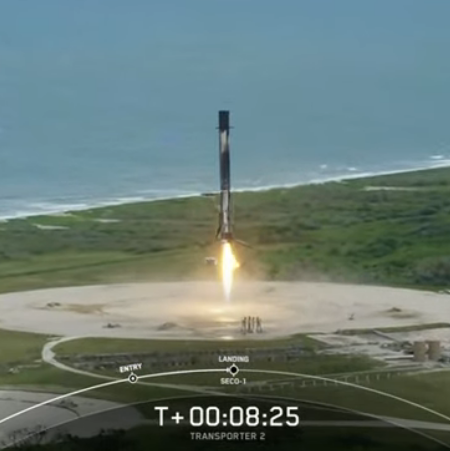
First stage landing at Cape Canaveral today

Capitalism in space: SpaceX today successfully used its Falcon 9 rocket to place 88 smallsats into orbit, the third rocket launch today.

While Transporter-2 won’t beat the unprecedented number of satellites launched on on Transporter-1 [the first such smallsat launch by SpaceX earlier this year], SpaceX says it will still “launch 88 spacecraft to orbit” and – more importantly – carry more customer mass. In other words, Transporter-2 will carry roughly 50% fewer satellites, each of which will weigh substantially more on average.

Ordering directly through SpaceX, [the price] begins at $1 million for up to 200 kg (~440 lb). … A majority of small satellites weigh significantly less than 200 kilograms but if a customer manages to use all of their allotment, the total cost of a SpaceX rideshare launch could be as low as $5000 per kilogram – incredibly cheap relative to almost any other option. For a [comparable] launch … on a Rocket Lab Electron or Astra Rocket 3.0 rocket using every last gram of available performance, the same customer would end up paying a minimum of $25,000 to $37,500 per kilogram to orbit.

The launch also included a handful of Starlink satellites, adding to SpaceX’s constellation. I have embedded SpaceX’s live stream below the fold. As I write this the satellites have not yet been deployed from the second stage, but that should happen shortly.

The first stage landed successfully, the eighth time this booster has done so. The fairings were also reused, completing their third flight. All told, this was SpaceX’s 20th launch in 2021, 18 of which used reused boosters.

The leaders in the 2021 launch race:
» Read more

2 comments

Today’s blacklisted American: College endorses segregation against whites, turning former coffee shop into blacks-only haven

The Civil Rights Act of 1964: repealed by Beliot College.
The Civil Rights Act of 1964: unilaterally repealed by Beliot College.

The new bigotry on American campuses: Beliot College in Wisconsin has decided to turn a former campus coffee shop into blacks-only haven, thus re-introducing Jim Crow segregation by treating blacks as a privileged race and all other ethnic groups and races as inferior and thus deserving of discrimination and second-class facilities.

In March, the private institution announced the Java Joint would be closed in order to become “a haven for Beloit College’s Black students.”

The gathering space was praised by Jada Daniel, the current Black Student Union president. “We hope to create a safe space for Black and Brown students, where we have a comfortable place to study,” said Daniel on the school’s website. “Daniel said BSU plans to host Soul Food Sundays, poetry readings, and other events during the year, following COVID safety guidelines,” the website says.

Meanwhile, when questions were raised about this clearly discriminatory policy, the school refused to comment, even as its own website said this:
» Read more

25 comments

Today’s blacklisted American: The American flag

Banned by the NAACP
The American flag: Banned by the NAACP.

The local NAACP chapter at Central Connecticut State University (CCSU) was badly triggered over Memorial Day weekend by the horrible sight of an American flag hanging from the end of a crane’s cable at a university construction site, and demanded the cable and flag be removed.

The NAACP claimed that what really upset them was the standard cable loop just below the flag at the end of the cable, which they immediately assumed was a noose!

Ronald Davis, president of the New Britain NAACP, told FOX 61 that “Regardless of what someone else says about that, what I see, as a black man? That’s a noose. Period. No ifs, ands, or buts about it. Take it down.”

But one intrepid College Fix reader noticed there are several steel cable loops hanging from the crane, and the only one that appears to bother another is the one with the American flag on the end of it. He cites one image of the crane in which viewers can see three or four cable loops.

“I guess they noticed only the one holding the flag, which means that it’s the flag that triggers them,” the reader said. [emphasis mine]

It is clear that because he and the NAACP specifically focused on the one loop where the American flag hung tells us what really offended them. They really wanted the American flag removed. And I am sure if they had their way it would be banned forever.
» Read more

19 comments

Make Mine Freedom

An evening pause: A 1948 cartoon, made at the start of the Cold War. It uncannily predicts quite accurately what is happening now, in America, because the Boomer generation and those who followed poo-pooed its lessons. They knew better!

I post it on Memorial Day because I wish to remember what once was.

Hat tip Lazarus Long.

4 comments

The arrival of routine flights of commercial space passengers to orbit now makes the meaning of the word “astronaut” very unclear

Link here. Up to now the word “astronaut” has generally been applied to anyone who has flown in space, though its use for the previous space tourists has generally seemed inappropriate.

The arrival this fall of regularly and frequent commercial flights carrying private passengers into space raises the question: What do we call these individuals? Some, such as the companies Axiom and Blue Origin, want to call them astronauts. Others, such as previous space tourists Richard Garriott and former senator and now NASA administrator Bill Nelson, think that word should be reserved for the professionals. Think for example of aviation. You don’t get wings by simply flying on a commercial jet. You have to fly a plane yourself, and do it solo to earn that designation.

In truth, the most likely thing that will happen in the future is that no future space traveler will be called an astronaut. As the article notes correctly,

It might be necessary to retire the term altogether once hundreds if not thousands reach space, noted Fordham University history professor Asif Siddiqi, the author of several space books. “Are we going to call each and every one of them astronauts?”

The term is going to become historical, referring not to those who have reached space, but to those early pioneers to made it possible for everyone else. It carries too much special meaning to assign it to every Tom, Dick, or Harry who simply bought a ticket. It signifies a person who did something special and at great risk, and deserves a special honor because of it.

Neil Armstrong and Yuri Gagarin were astronauts. It seems wrong to call every commercial passenger who follows the same.

22 comments

Blue Origin to auction the first seat on the first New Shepard tourist flight

Capitalism in space: Blue Origin announced today that it going to auction to the highest bidder the first tourist seat on the first New Shepard tourist flight, now scheduled for July 20, 2021, a little over two months from now. From the company^s website, where you can bid:

On July 20th, New Shepard will fly its first astronaut crew to space. We are offering one seat on this first flight to the winning bidder of an online auction.

There are three phases of the auction:

  • MAY 5-19: Sealed online bidding – you can bid any amount you want on the auction website (no bids are visible)
  • MAY 19: Unsealed online bidding – the bids become visible and participants must exceed the highest bid to continue in the auction
  • JUNE 12: Live auction – the bidding concludes with a live online auction.

The winning bid amount will be donated to Blue Origin’s foundation, Club for the Future, to inspire future generations to pursue careers in STEM and help invent the future of life in space.

This is a very smart move, as it will generate some excitement and interest. It also schedules this private suborbital flight ahead of SpaceX’s first private orbital flight in September, allowing Blue Origin to upstage its rival somewhat.

It also is designed to help Blue Origin gauge the true interest in suborbital tourism. The final price will give them a good idea the right price to charge future passengers in order to sell the most tickets.

Finally, the timing of everything shows a nice historic touch. The announcement today took place on the 60th anniversary of Alan Shepard’s suborbital flight. The flight itself will take place on the 52rd anniversary of the Apollo 11 landing on the Moon.

4 comments

Apollo 11 astronaut Michael Collins has passed away at 90

R.I.P. Michael Collins, the astronaut on Apollo 11 who stayed in lunar orbit while Neil Armstrong and Buzz Aldrin walked on the Moon, passed away today at the age of 90.

Collins was one of the most friendly and personable astronauts I ever met. He was always available and willing to answer questions, sometimes even willing to go an extra mile to provide you more than you asked for.

In many ways his later work as head of the Air & Space Museum was more important than his time as an astronaut. He helped make that museum and the history it documents one of the most popular in the world.

As long as humanity exists, on Earth and in space, Michael Collins will never be forgotten.

9 comments

The anti-satellite missile the Soviet Union designed for one of its early space stations

Link here. Apparently a prototype was actually flown in 1975 on the second successful Soviet space station, Salyut 3, a military mission. A more sophisticated version was never flown when the Soviet’s cancelled their military space station program. However, its design was most fascinating:

[L]ittle is known about the specifications and operation of the system, but, according to the Head of Science and Research Center at NPO Mashinostroenia Leonard Smirichevsky, who introduced the weapon, the vehicle’s grenade-like solid propellant charges doubled as engines! RussianSpaceWeb.com’s 3D recreation of the displayed variant established that it held 96 casings with solid propellant arranged in a globular fashion like the petals of a dandelion around a central combustion chamber. Upon their ignition, the chambers/grenades might have fed hot propulsive gas into a single or multiple combustion chambers at the center of the contraption, producing either the main thrust and/or steering the vehicle. When the missile reached the proximity of the target, according to its guiding radar, the entire vehicle would explode and the small solid chambers would eject under their own propulsive force in every direction acting as shrapnel.

The missile had a flight range of about 70 miles, and was designed to destroy any hostile satellite or spacecraft that approached the military station.

5 comments

Today’s blacklisted American: Anyone who is white, Christian, or male at Cigna

Cigna training presentation
According to Cigna’s training, these are bad things.

They’re coming for you next: Company documents as well as interviews have confirmed that the health insurance company Cigna actively discriminates against whites in its hiring practices, as well as runs training sessions using Critical Race Theory that aims at making all whites, males, and Christians ashamed of what they are, because by definition such people are automatically racist bigots.

The original story is here. From the first link:
» Read more

23 comments

Ingenuity flies!

Ingenuity takes off!
For full images go here and here.

The first autonomous flight of the helicopter Ingenuity on Mars successfully took place early this morning, according to JPL engineers.

NASA has pulled off the first powered flight on another world. Ingenuity, the robot rotorcraft that is part of the agency’s Perseverance mission, lifted off from the surface of Mars on 19 April, in a 40-second flight that is a landmark in interplanetary aviation. “We can now say that human beings have flown a rotorcraft on another planet,” says MiMi Aung, the project’s lead engineer at the Jet Propulsion Laboratory (JPL) in Pasadena, California.

As shown by the two images taken by Perseverance above, the first flight was very simple. The helicopter simply rose about 10 feet, hovered for about 30 seconds as it swiveled 90 degrees, and then carefully descended back down. I have also embedded the video that JPL scientists have created compiling by high resolution Perseverance images below the fold.

Four more flights will next be attempted in the coming weeks.

Four further flights, each lasting up to 90 seconds, are planned in the coming weeks. In these, Ingenuity is likely to rise up to 5 metres [16 feet] above the surface and travel up to 300 metres [1000 feet] from the take-off point. Each successive flight will push Ingenuity’s capabilities to see how well the drone fares in Mars’s thin atmosphere, which is just 1% as dense as Earth’s.

» Read more

16 comments
1 11 12 13 14 15 55