The strange terrain of the Martian southern ice cap

The strange terrain of Mars' south pole
Click for original image.

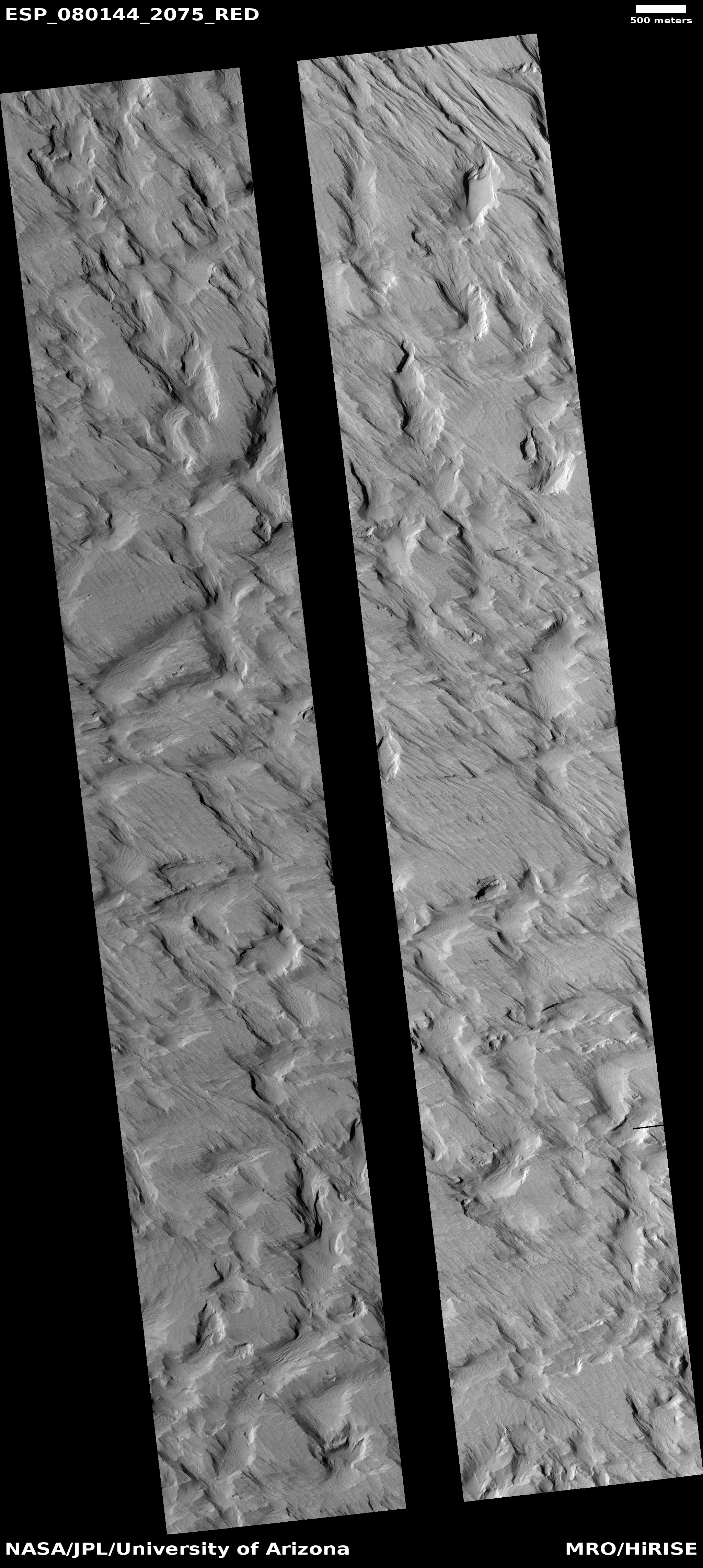
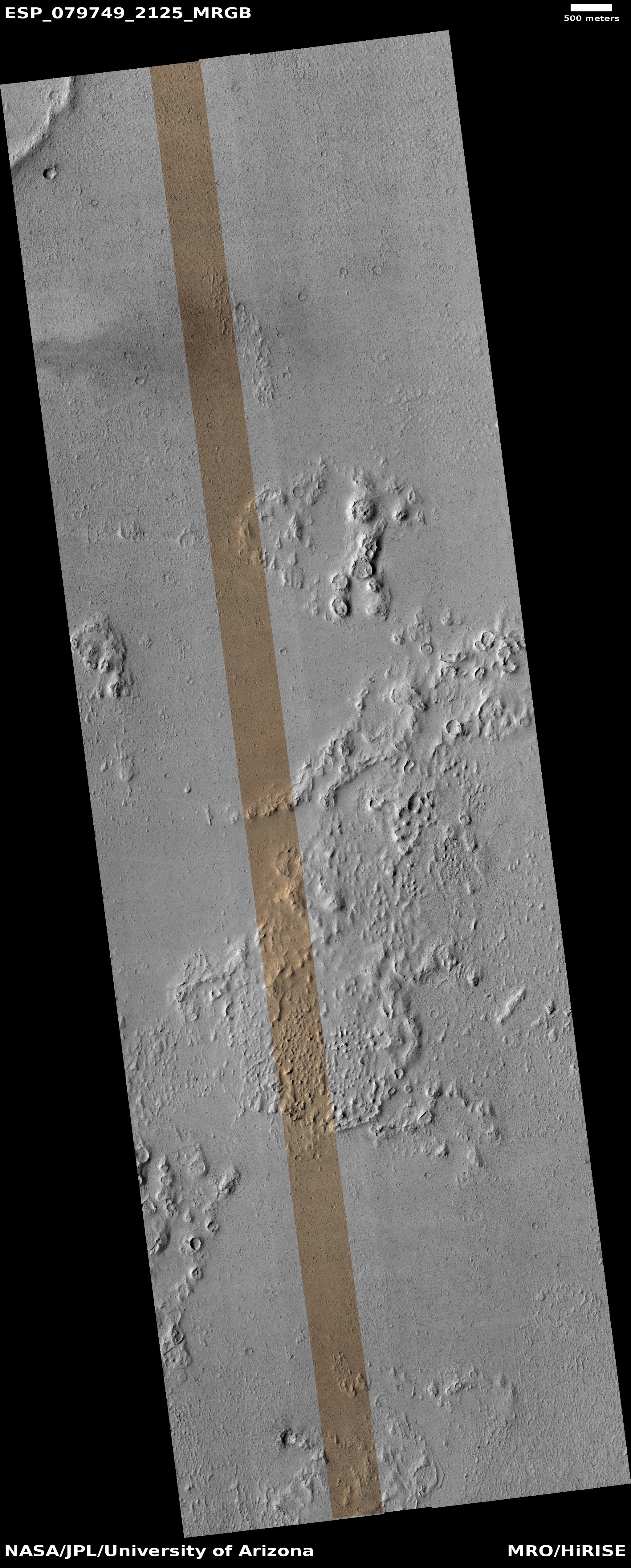
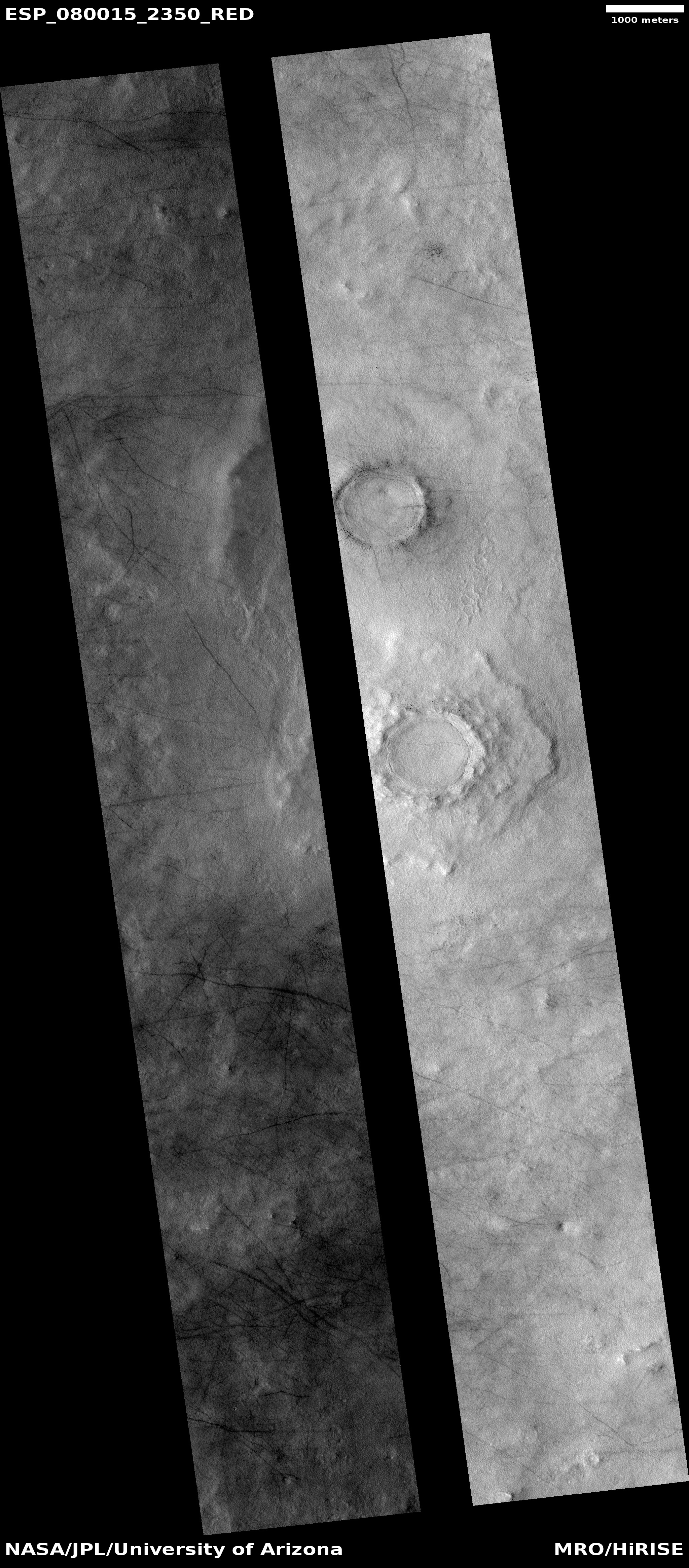
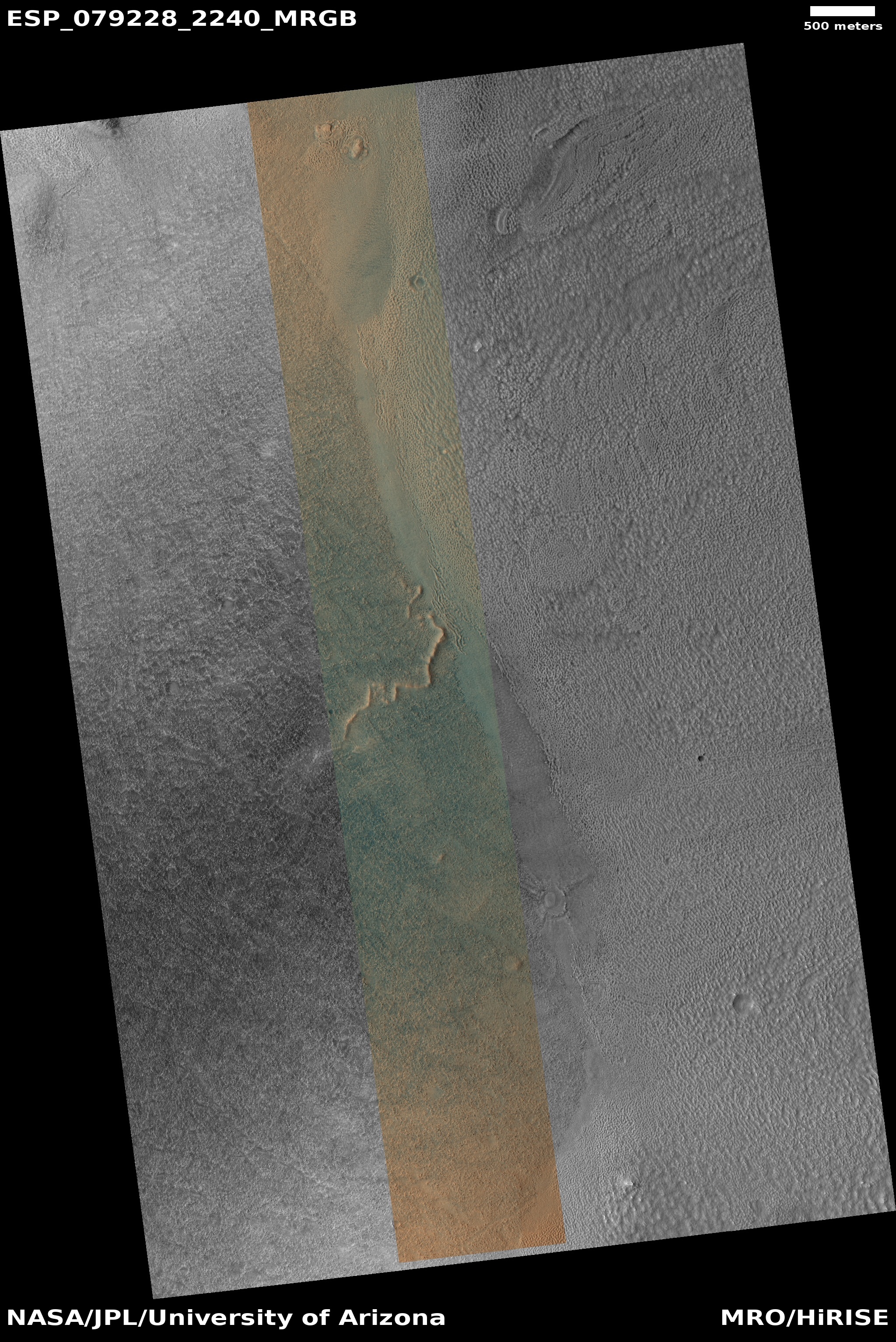
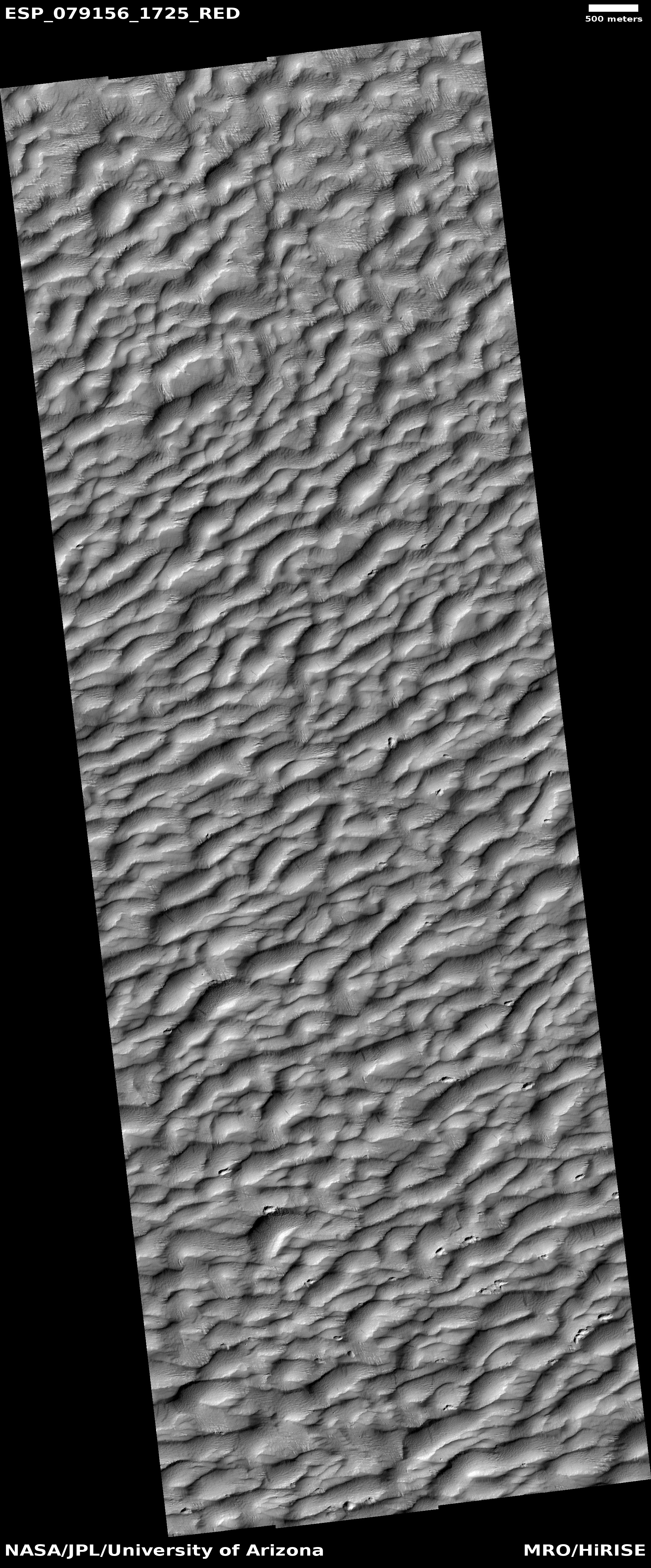
Cool image time! The picture to the right, rotated, cropped, and sharpened to post here, was taken on July 29, 2024 by the high resolution camera on Mars Reconnaissance Orbiter (MRO). It shows a section at the Martian south pole at the very high latitude of 87 degrees south, only about 100 miles from the pole itself.

The label for this picture is “possible water ice and mesas,” suggesting we are looking at an ice cap of water that is partly sublimated away.

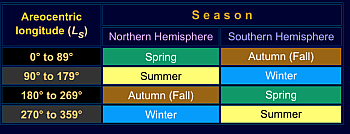
In truth, things are much more complicated. It was summer when this photo was taken. Note the drainage in the lower right and the dark spidery lines there. In the winter on Mars atmospheric carbon dioxide falls as snow and coats the poles to about 60 degrees latitude with a thin mantle of dry ice. In the spring this mantle sublimates away, but does so in an counter-intuitive manner. The sublimation first occurs at the mantle’s base, and the trapped gas flows up until it finds a weak spot in the mantle and cracks through, spewing out and deposting dark splotches of dust.

At the south pole this upward flow always follows the same paths, producing the dark spidery patterns we see here. In the case of the drainage in the lower right, this is a drainage of gas eastward until it pops out at the slope, causing that depression to become darkly stained.

This is only part of the story of this complex geology, however.
» Read more

0 comments

Crazy swirling Martian landscape

Crazy swirling Martian landscape
Click for original image.

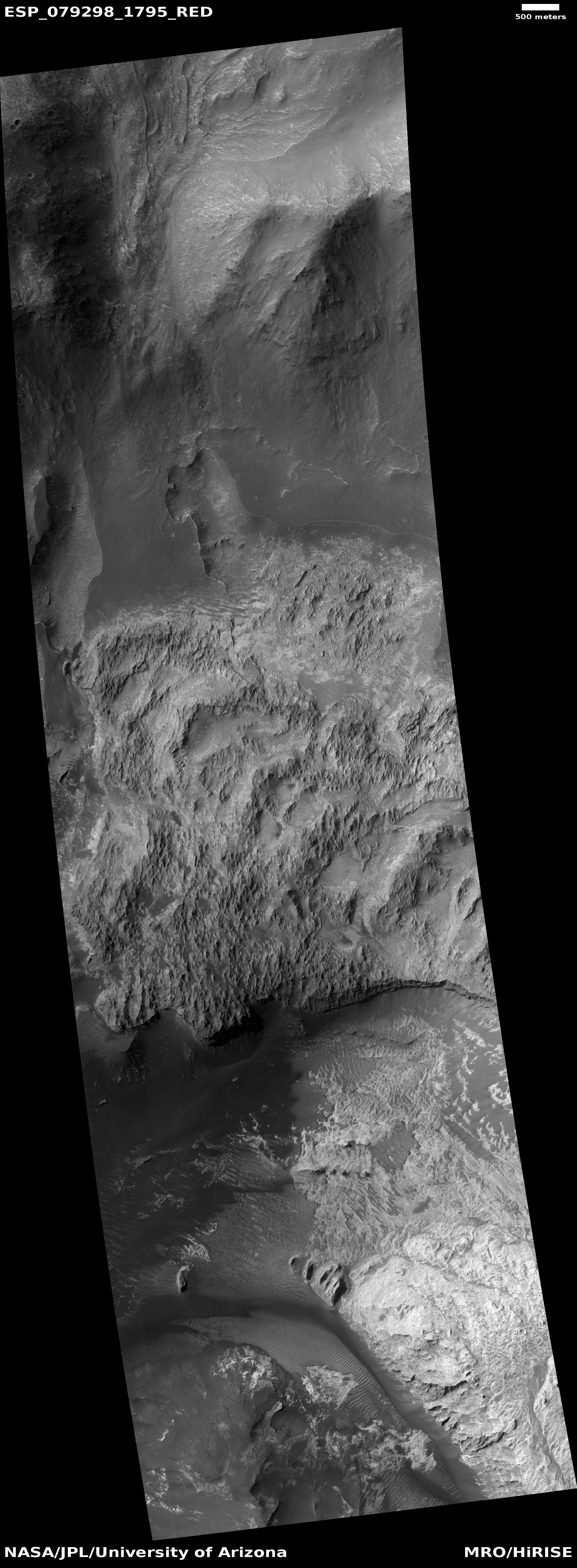
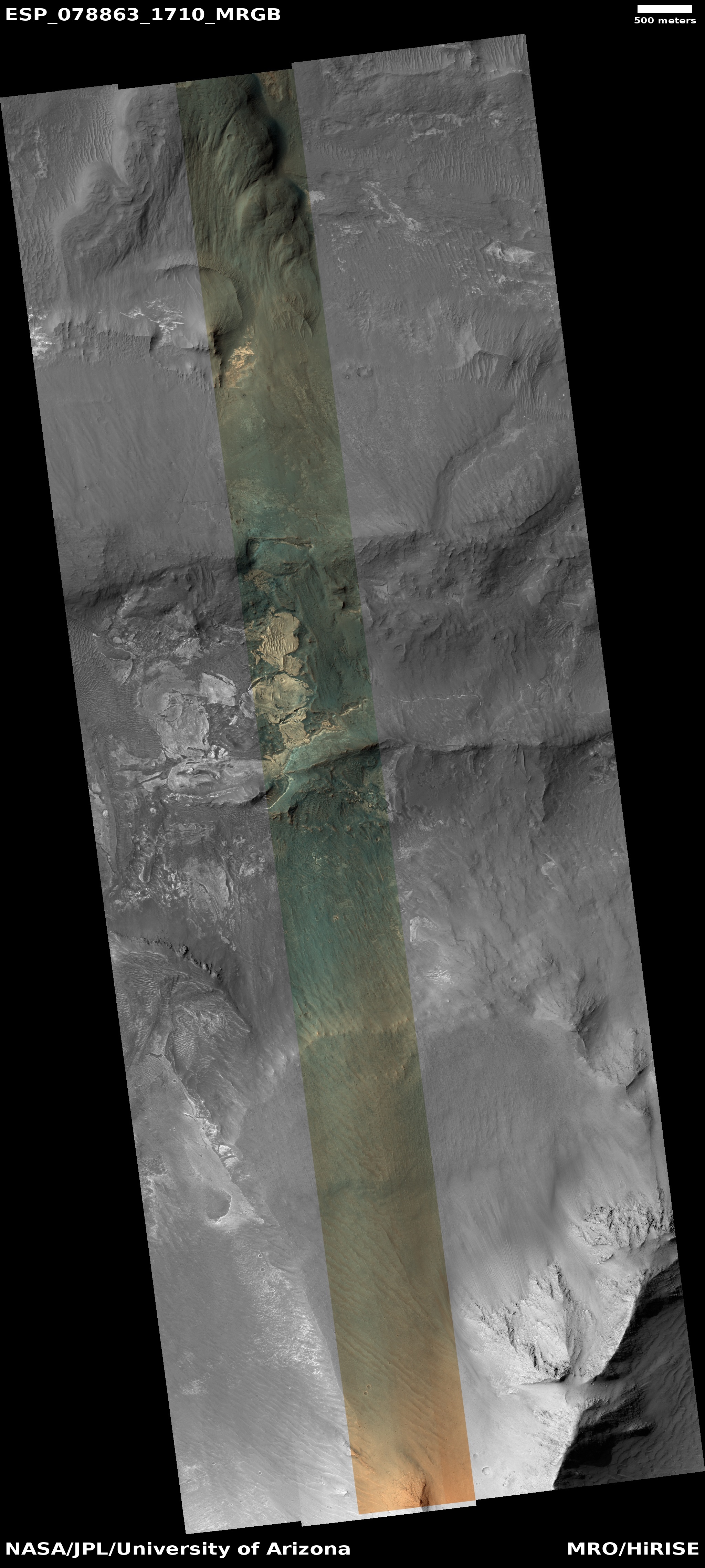
Cool image time! The picture to the right, cropped, reduced, sharpened, and annotated to post here, was taken on July 1, 2024 by the high resolution camera on Mars Reconnaissance Orbiter (MRO).

The science team labels this “Contacts between Likely Sulfates and Chaos Blocks.” That contact I have indicated with the dotted line. To the west the lighter terrain is likely the sulfate-bearing unit, similar to the sulfate-bearing unit that Curiosity has been traversing on Mount Sharp for the past year or so.

To the east are the chaos blocks, but I think that description is wholly inadequate. In truth, I haven’t the faintest idea how this terrain got to be the way it is. It is evident that a lot of dust and sand has gotten trapped in the hollows, leaving behind ripple dunes in some places, but why the higher ridges swirl and curve about as they do is utterly baffling.
» Read more

0 comments

Monitoring gullies on Mars for changes

Overview map

Monitoring gullies on Mars
Click for original image.

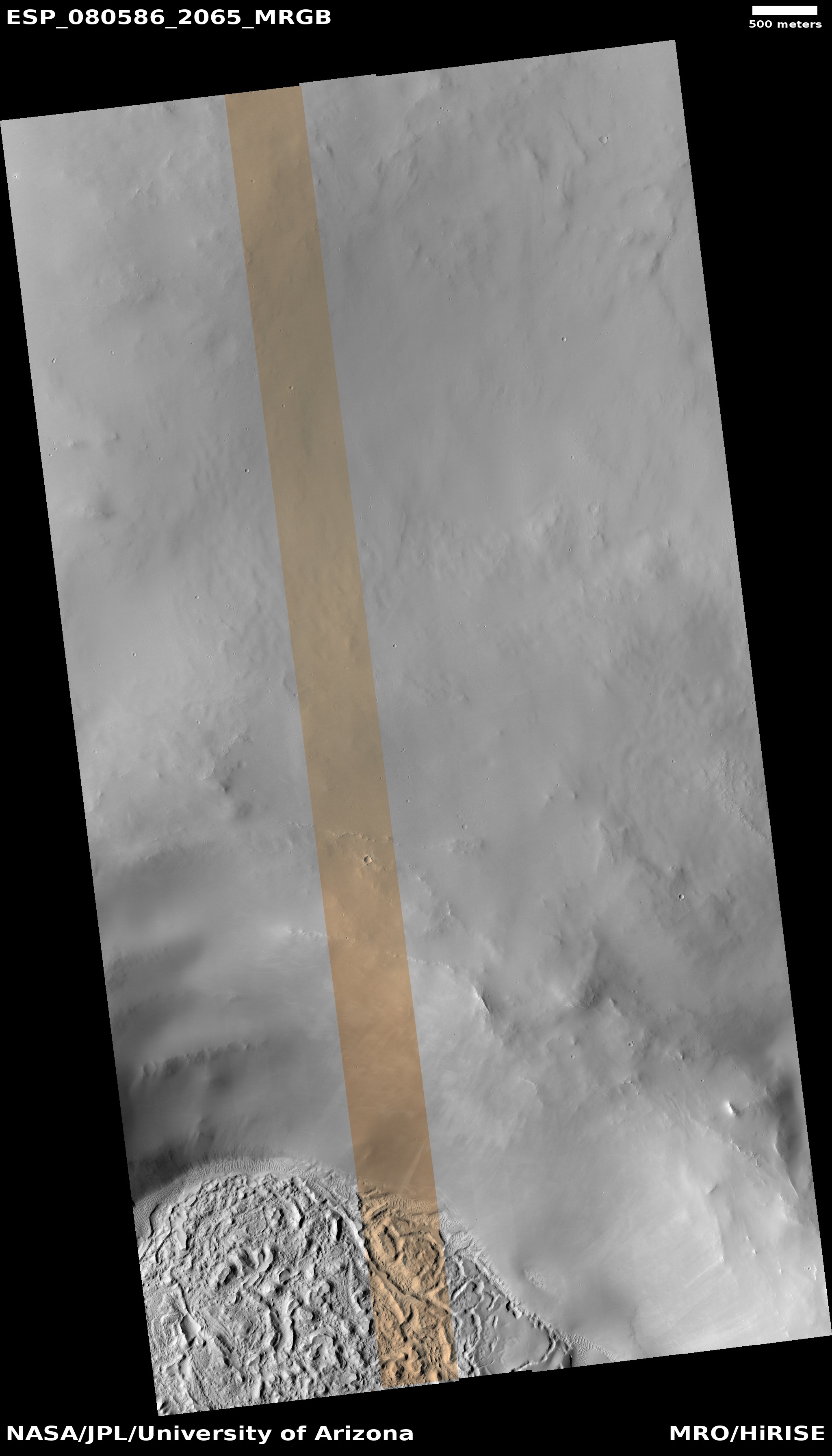
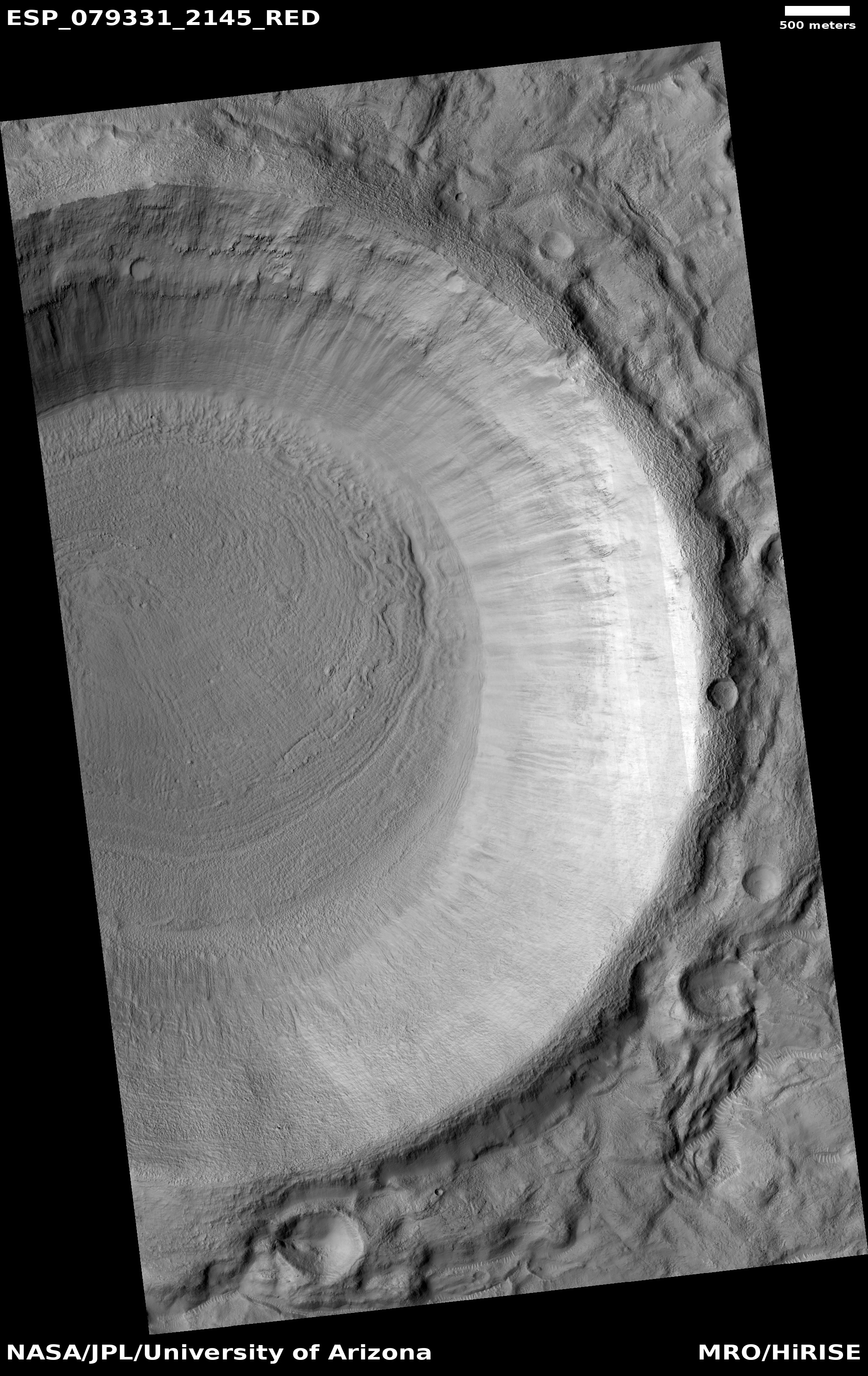
Cool image time! The picture to the right, cropped, reduced, and enhanced to post here, was taken on June 29, 2024 by the high resolution camera on Mars Reconnaissance Orbiter (MRO). The scientists label the picture simply as “gully monitoring,” with an apparent goal of looking to see if this gully has changed since MRO took the first high resolution image two years previously. In the interim this terrain went from Martian spring, through summer and winter, and has now returned to spring.

As far as I can tell, no changes are visible, but then I am not using the highest resolution data available. Small changes might be detectable in the highest resolution using good detection software. Overall, the gully drops about 3,000 feet.

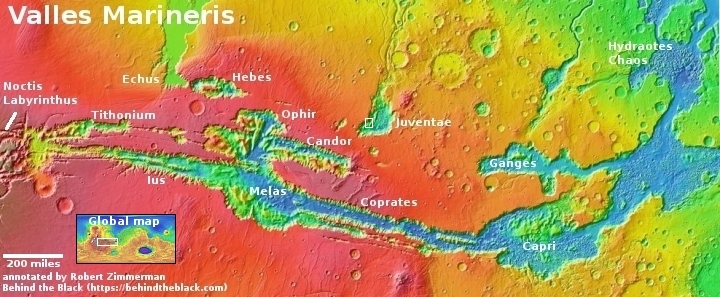
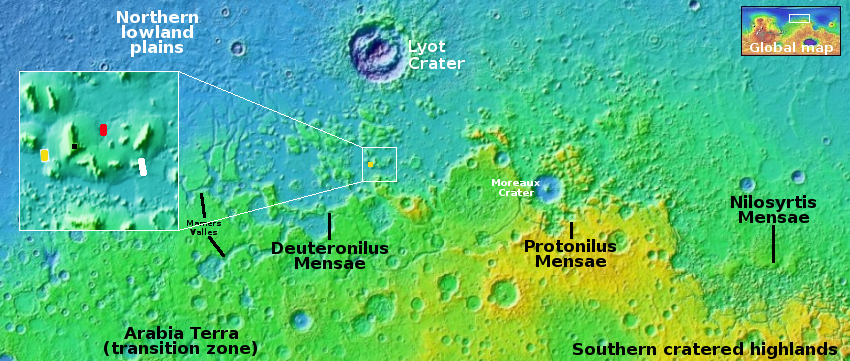
The white dot in the overview map above marks the location, on the southwest interior rim of an unnamed 30-mile wide crater. This region in the Martian cratered highlands was featured in a four part cool image series I did back 2023 (here, here, here, and here), with this as my conclusion:

Overall, our short survey of the southern cratered highlands suggests that the glacial material and ice found in the southern mid-latitudes affects the Martian surface differently than in the northern lowland plains. In the north the craters and the surrounding terrain often appear blobby, as if the ice is close to the surface and also a dominant component of the ground. Impacts therefore cause significant soft melt features, with craters often heavily distorted. Similarly, there is evidence of the existence of past mud volcanoes that once spewed water and mud from below ground.

In the south however the surface is at a higher elevation, and it appears the ice layer is deeper underground. Thus, it appears the ground is more firm, and the only obvious evidence of an underground layer of ice is revealed when sublimation and the subsequent erosion produce these large pits inside craters.

In the case of this crater, a small impact on its interior southwest slope apparently caused that underground layer of ice to melt temporarily and flow downhill, leaving behind the gully and flow features we see today. Based on the two MRO pictures taken a full Martian year apart, it appears the feature is generally stable and thus likely old, left over from that impact. If things are changing seasonally they are doing so in small amounts and slowly.

2 comments

Layered mesas in Martian chaos

Layered mesas in Martian chaos
Click for original image.

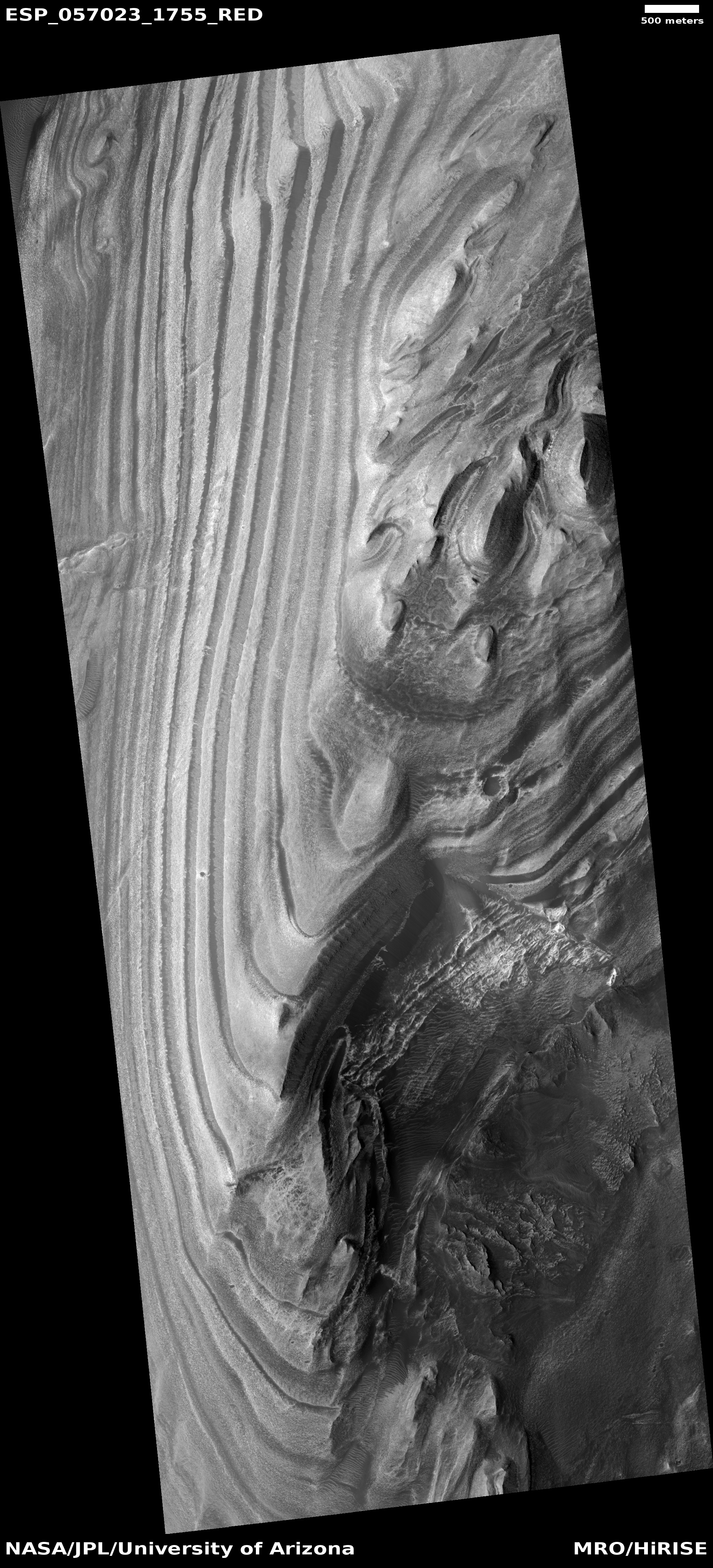
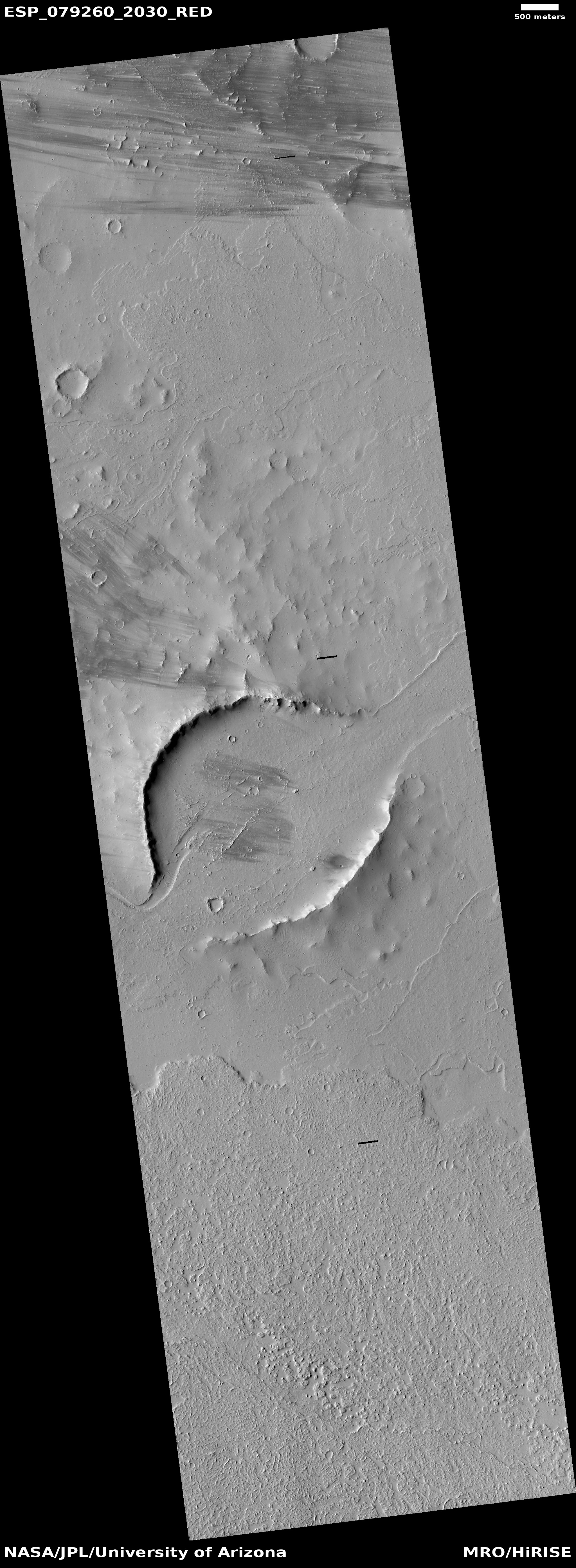
Cool image time! The picture to the right, rotated, cropped, reduced, and sharpened to post here, was taken on May 19, 2024 by the high resolution camera on Mars Reconnaissance Orbiter (MRO). It shows a 2,500 to 3,000-foot-high mesa with what the scientists call “bedrock layers”, most obvious as the lower terraces on the mesa’s western slopes.

What makes this mesa especially interesting is its overall shape. It appears as if something has taken a bite out of it, resulting in that bowl-like hollow on the mesa’s southern half.

Was this caused by an impact? Or has some other long term Martian processes caused it?

This mesa is just one of many mesas in a region of chaos terrain dubbed Hydraotes Chaos. Such chaos terrain is thought to form when erosion processes, possibly glacial in nature, that carve out canyons along faultlines, leaving behind mesas with randomly oriented canyons cutting in many directions.
» Read more

4 comments

Land of cracks

Land of cracks

Cool image time! The picture to the right, cropped to post here, was taken on June 28, 2024 by the high resolution camera on Mars Reconnaissance Orbiter (MRO). Labeled a “terrain sample,” it was likely taken not as part of any specific research project but to fill a gap in the camera’s schedule in order to maintain its proper temperature. When the camera team needs to do this, they try to pick something interesting, but don’t always have that option.

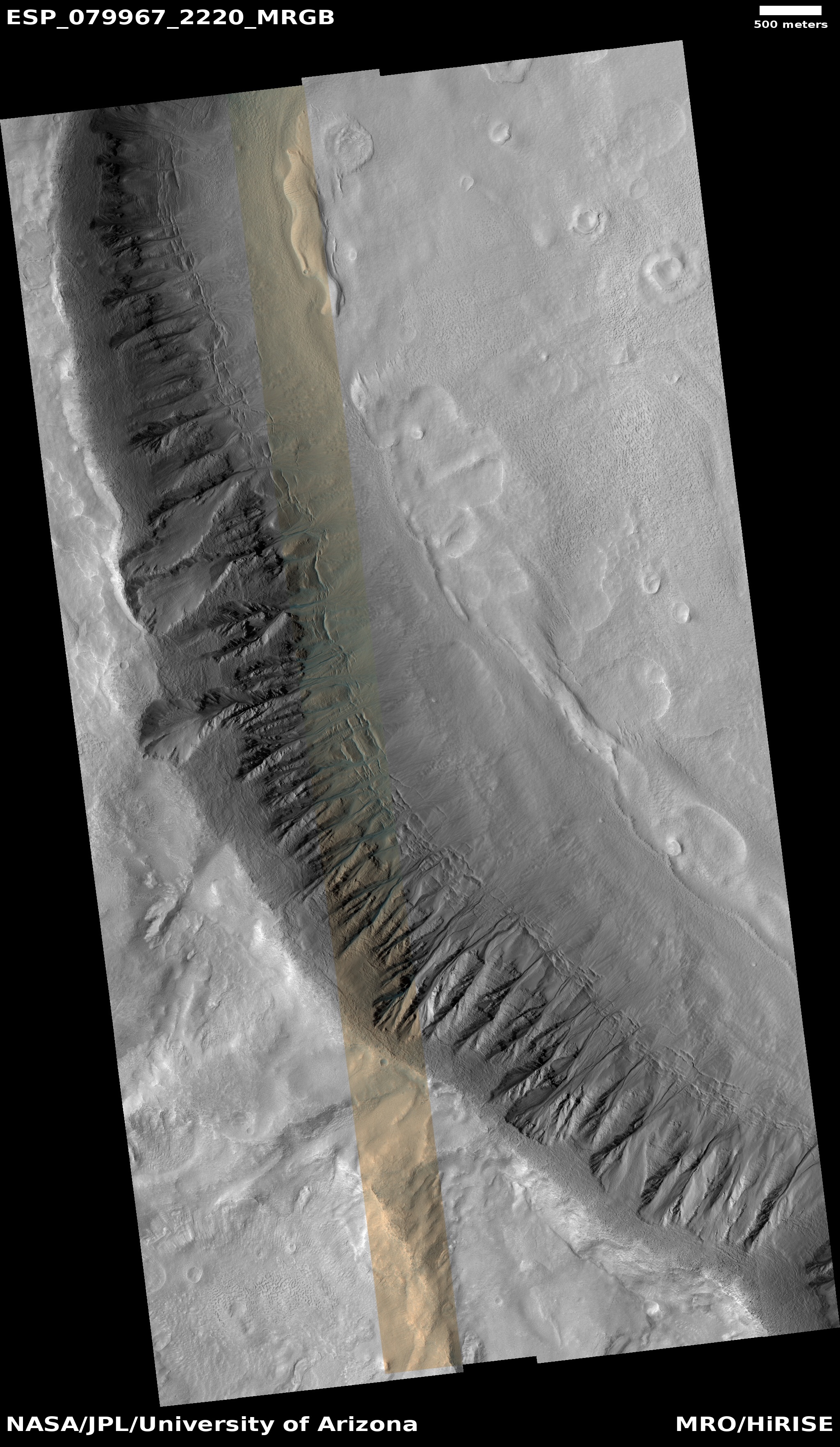
In this case, the landscape available included the channel shown to the right. About a half mile wide and only about fifty feet deep, the floor of this canyon appears to have a lot of trapped dust, forming ripple dunes, along with a lot of knobby protrusions, likely small mesas. The canyon walls appear layered, with the erosion processes producing different features on opposite sides. On the southeast the layers appear to produce distinct terraces, while on the northwest the cliff is very steep at the top and then forms a long gently descending slope that appears formed of alluvial fill (from that cliff) and formed from erosion and landslides.
» Read more

0 comments

Some new “What the heck?” geology on Mars

What the heck is going on here?
Click for original image.

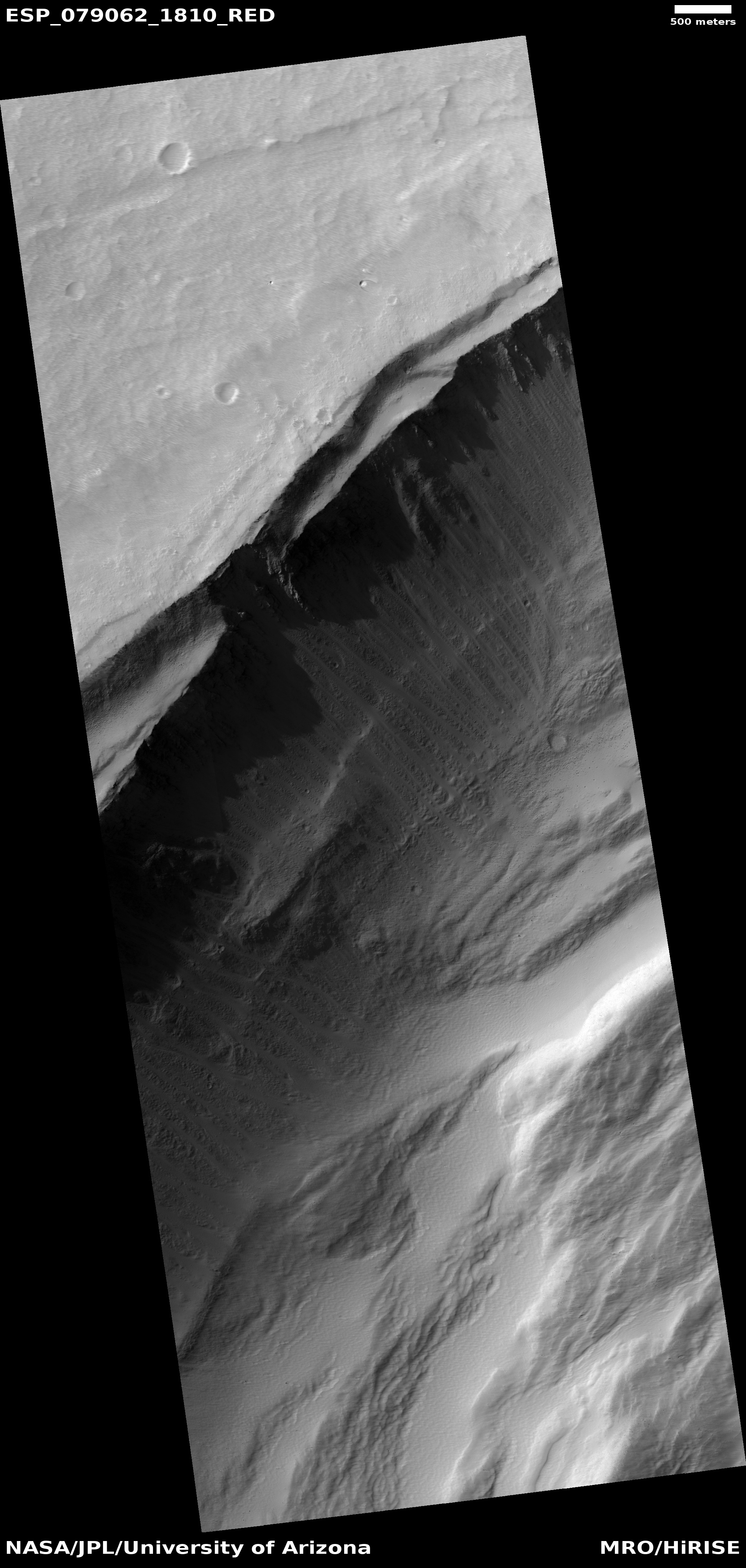
Cool image time! The picture to the right, rotated, cropped, reduced, and enhanced to post here, was taken on April 21, 2024 by the high resolution camera on Mars Reconnaissance Orbiter (MRO).

My first reaction on seeing this picture was to scratch my head? What am I looking at? Are those fluted dark features going downhill to the south, or uphill to the north? What are they? Are they slope streaks? Avalanches? How do they relate to the flat-topped ground in the middle of the picture?

I have made it easier for my readers to interpret the picture by adding the “low” and “high” markers. We are looking at two parallel thin mesas about 1,400 feet high, with the saddle between them only dropping about 350 feet.

But what about the dark fluted features? To understand what these are requires more information.
» Read more

2 comments

New gravity map of Mars released

New global map of Mars gravity field
Click for original image.
Using both seismological data compiled over four years by the InSight Mars lander as well tiny changes in the orbits of Martian satellites, scientists have now created a global gravity map of the red planet, indicating the regions below the surface that are either low or high density.

That map is above, annotated by me to indicate some of Mars’ major surface features.

The density map shows that the northern polar features are approximately 300-400 kg/m3 denser than their surroundings. However, the study also revealed new insights into the structures underlying the huge volcanic region of Tharsis Rise, which includes the colossal volcano, Olympus Mons.

Although volcanoes are very dense, the Tharsis area is much higher than the average surface of Mars, and is ringed by a region of comparatively weak gravity. This gravity anomaly is hard to explain by looking at differences in the martian crust and upper mantle alone. The study by Dr Root and his team suggests that a light mass around 1750 kilometres across and at a depth of 1100 kilometres is giving the entire Tharsis region a boost upwards. This could be explained by huge plume of lava, deep within the martian interior, travelling up towards the surface.

I once again note that the largest impact basin on Mars, Hellas Basin, sits almost exactly on the planet’s far side from Tharsis, and appears to have a light density. This contrast once again makes me wonder if the origin of that impact and the Tharsis Bulge are linked.

13 comments

A fluted mesa on Mars

A fluted mesa on Mars
Click for original image.

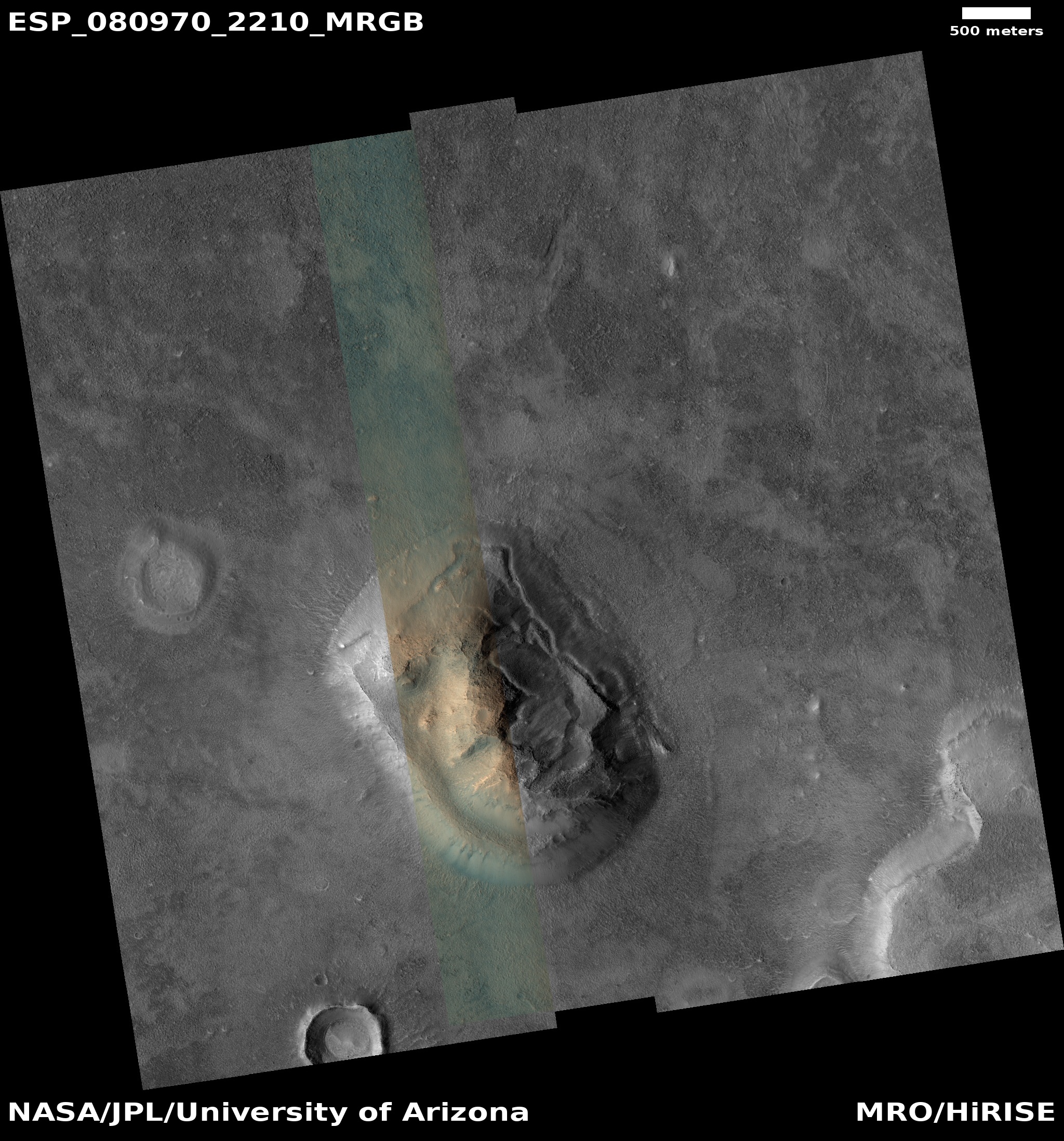
Cool image time! The picture to the right, cropped, reduced, and sharpened to post here, was taken on July 9, 2024 by the high resolution camera on Mars Reconnaissance Orbiter (MRO). It shows what the science team labels a “silica-rich mound”, as indicated by the bright streaks on all the high ridge points.

The flat-topped mesa on the right drops about 200 feet to the valley floor. The rims of that depression to the west rise about 50+ feet higher, while mesa nose in the upper left rising another 50+ feet more.

Was the depression caused by an impact? If so, the landscape has changed radically since that impact occurred, with most of the surrounding terrain eroded away. The two flat-topped mesas hint at the ancient surface when that impact occurred.

A wider view however raises questions about this impact theory.
» Read more

1 comment

The reasons why Mars two polar caps are so different

The Martian north pole
The Martian north pole.

The Martian south pole
The Martian south pole.

Elevation scale bar
What the colors mean in terms of elevation

A new paper, in review for the past year, has now been published describing the differences between the north and south poles of Mars, the most fundamental of which involve the planet’s orbit and the different elevations of the two poles, with the south pole three to six miles higher in altitude (as indicated by the colors on the maps to the right).

The cumulative data has allowed the researchers to explain why — when the thin winter cap of dry ice sublimates away in the spring — the process at the south pole results in spiderlike features that get enhanced from year to year, but in the north pole that sublimation process produces no such permanent features.

In both cases, the spring sunlight passes through the clear winter mantle of dry ice to heat its base. The sublimated trapped CO2 gas builds up, until the pressure causes the mantle to crack at weak spots. In the south that trapped gas flows uphill each spring along the same paths, carving the riverlike tributaries dubbed unofficially as “spiders” and officially as “araneiform terrain.”

Geophysicist Hugh Kieffer described that process in 2006. A few years later, [Candice] Hansen [the new paper’s lead author] followed up with her own model for the north polar cap, which also displays fans in the spring.

She found that the same phenomena occur in the north, but rather than relatively flat terrain, these processes play out across sand dunes. β€œWhen the Sun comes up and begins to sublimate the bottom of the ice layer, there are three weak spots – one at the crest of the dune, one at the bottom of the dune where it meets the surface and then the ice itself can crack along the slope,” Hansen said. β€œNo araneiform terrain has been detected in the north because although shallow furrows develop, the wind smooths the sand on the dunes.”

There is also a lot more dust in the north, including a giant sea of dunes that circles the polar cap. In addition, the northern winter is shorter due to the planet’s orbit, and takes place during the annual dust storm season, causing there to be more dust concentrated within the northern ice. All of these factors make the the dunes and general surface in the north is more easily smoothed by the wind.

0 comments

A crack on Mars more than 600 miles long

A crack on Mars more than 600 miles long
Click for original image.

Cool image time! The picture to the right, cropped and reduced to post here, was taken on March 29, 2024 by the high resolution camera on Mars Reconnaissance Orbiter (MRO).

The science team labels this “troughs in Labeatis Fossae.” On Mars, the word “fossae” is used to indicate regions where there are a lot of parallel fissures. Though there are a few examples where such fissures might have been caused by the movement of ice or water, carving out the channel, in almost all cases this is not the cause. Instead, fossae are usually formed when the surface stretches, either because underground upward pressure pulls it apart, or because there is a sideways spread at the surface. The resulting cracks are generally considered what geologists call “grabens,” depressions caused at faultlines when the ground on either side moves apart in some manner.

In this case the break in the trough proves this is a graben, though why it broke at this spot is not clear.
» Read more

0 comments

A channel of ice, water, or lava?

A channel of ice, water, or lava?
Click for original image.

Cool image time! The picture to the right, rotated, cropped, reduced, and sharpened to post here, was taken on July 16, 2024 by the high resolution camera on Mars Reconnaissance Orbiter (MRO). It shows one small section of a Martian canyon approximate 750 miles long and dubbed Elysium Fossae.

The canyon walls at this spot rise about 3,300 to 3,800 feet from the canyon floor. The canyon itself is thought to be what geologists call a graben, initially formed when the ground was pulled apart to form a large fissure.

That’s what happened at this location, at least to start. This canyon is on the lower western flank of the giant shield volcano Elysium Mons. The cracks, which radiate out outward from the volcano’s caldera, likely formed when pressure from magma below pushed upward, splitting the surface.

That formation process however does not fully explain everything.
» Read more

0 comments

A frozen Martian splash

A frozen Martian splash
Click for original image.

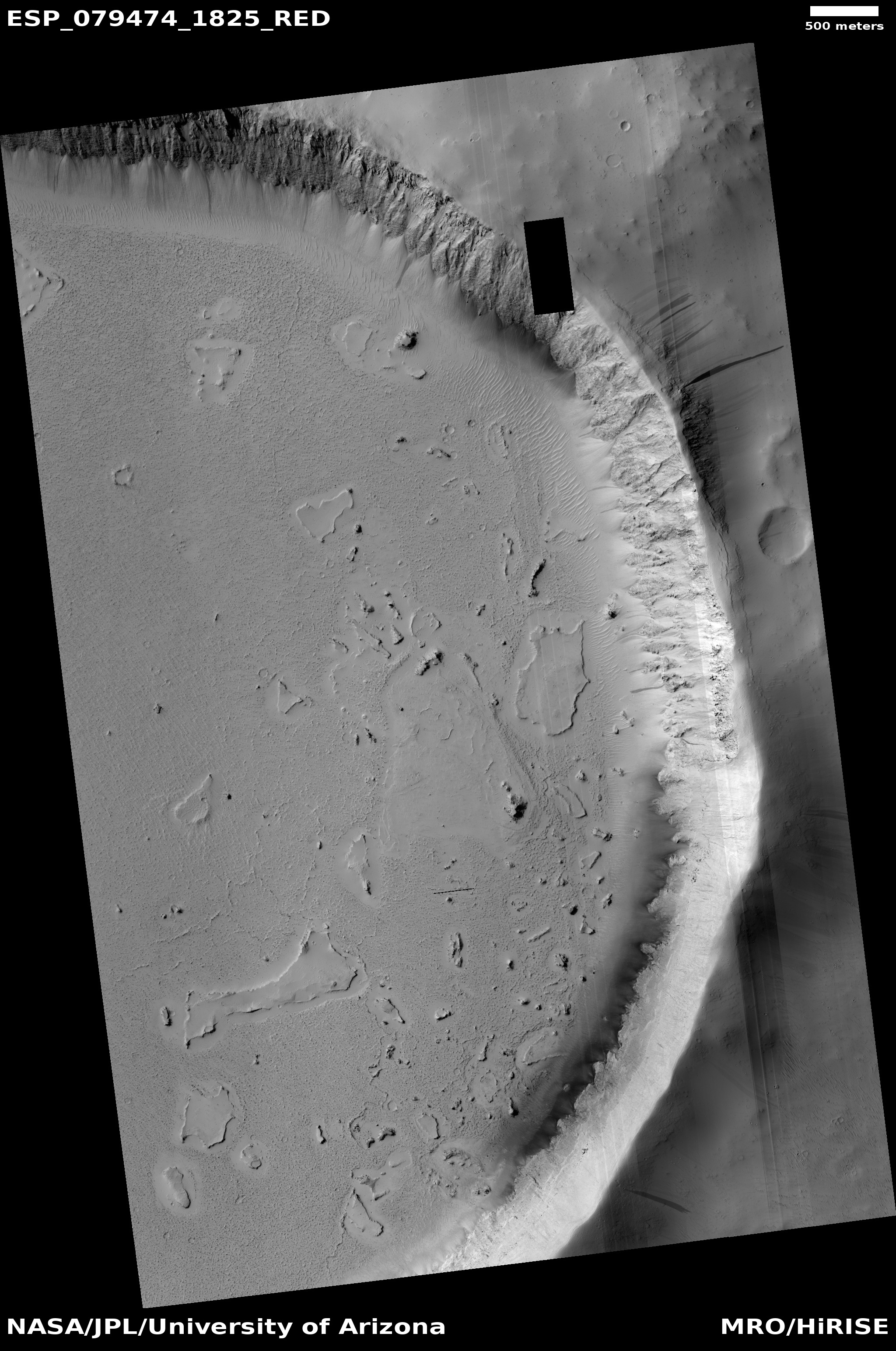
Cool image time! The picture to the right, rotated, cropped, and enhanced to post here, was taken on July 11, 2024 by the high resolution camera on Mars Reconnaissance Orbiter (MRO). It shows the southeast quadrant of a three-mile-wide unnamed crater that is surrounded on all sides by a dramatic but frozen splash apron of material, created when this impact occurred.

The rim rises between 200 to 400 feet from the surrounding plains, while the crater floor drops 700 feet to sit below those plains by 300 to 500 feet. In other words, that splash apron contains the material that was thrown up when the bolide drilled into the plain at impact, leaving behind this deep hole.

Why such a dramatic splash apron? Its existence suggests that the ground here was muddy, with a lot of water ice likely present. The location and wider context helps confirm this guess.
» Read more

0 comments
1 13 14 15 16 17 90