A chain of Martian sinkholes

Chain of sinkholes on Mars
Click for full image.

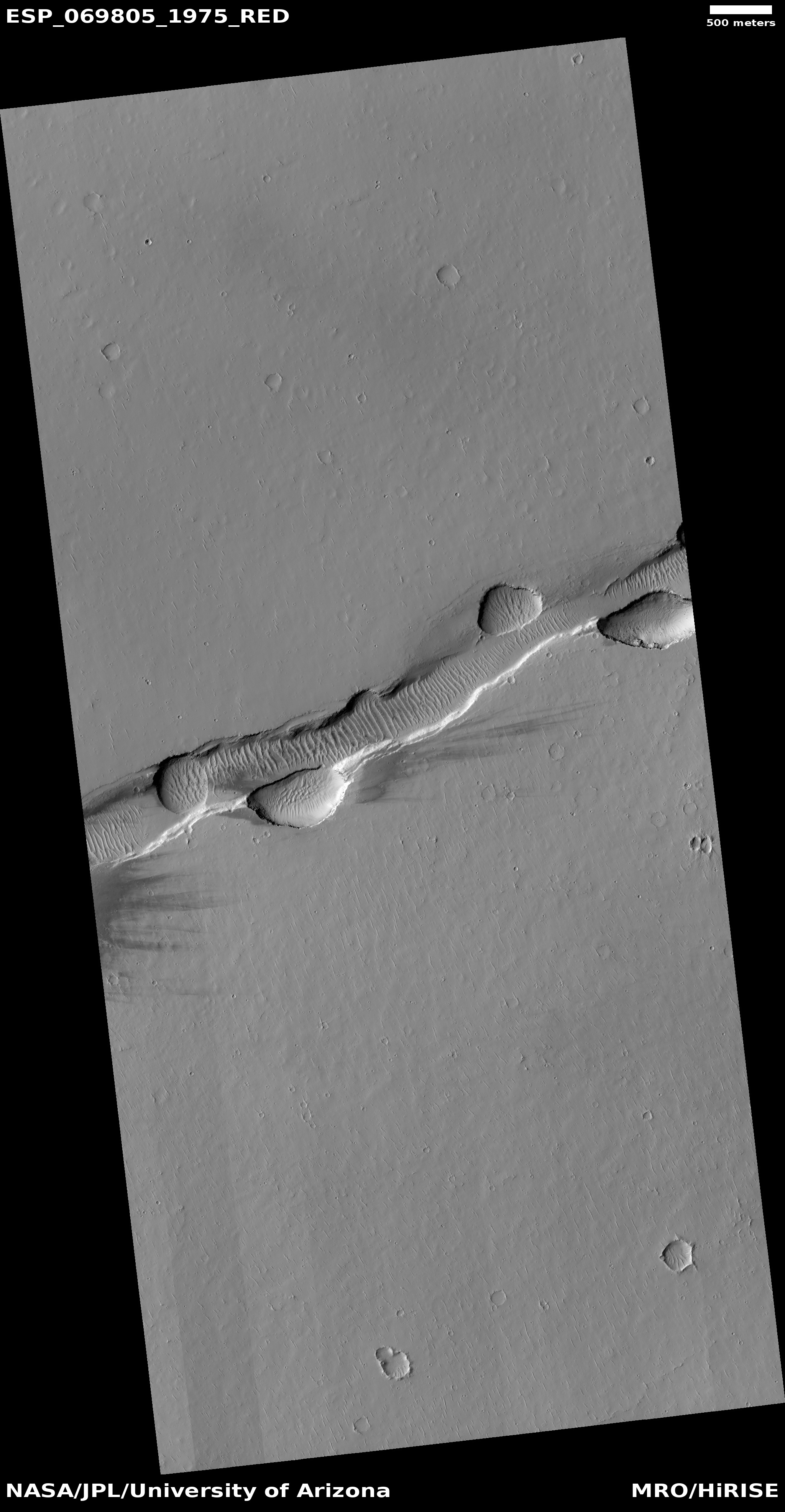
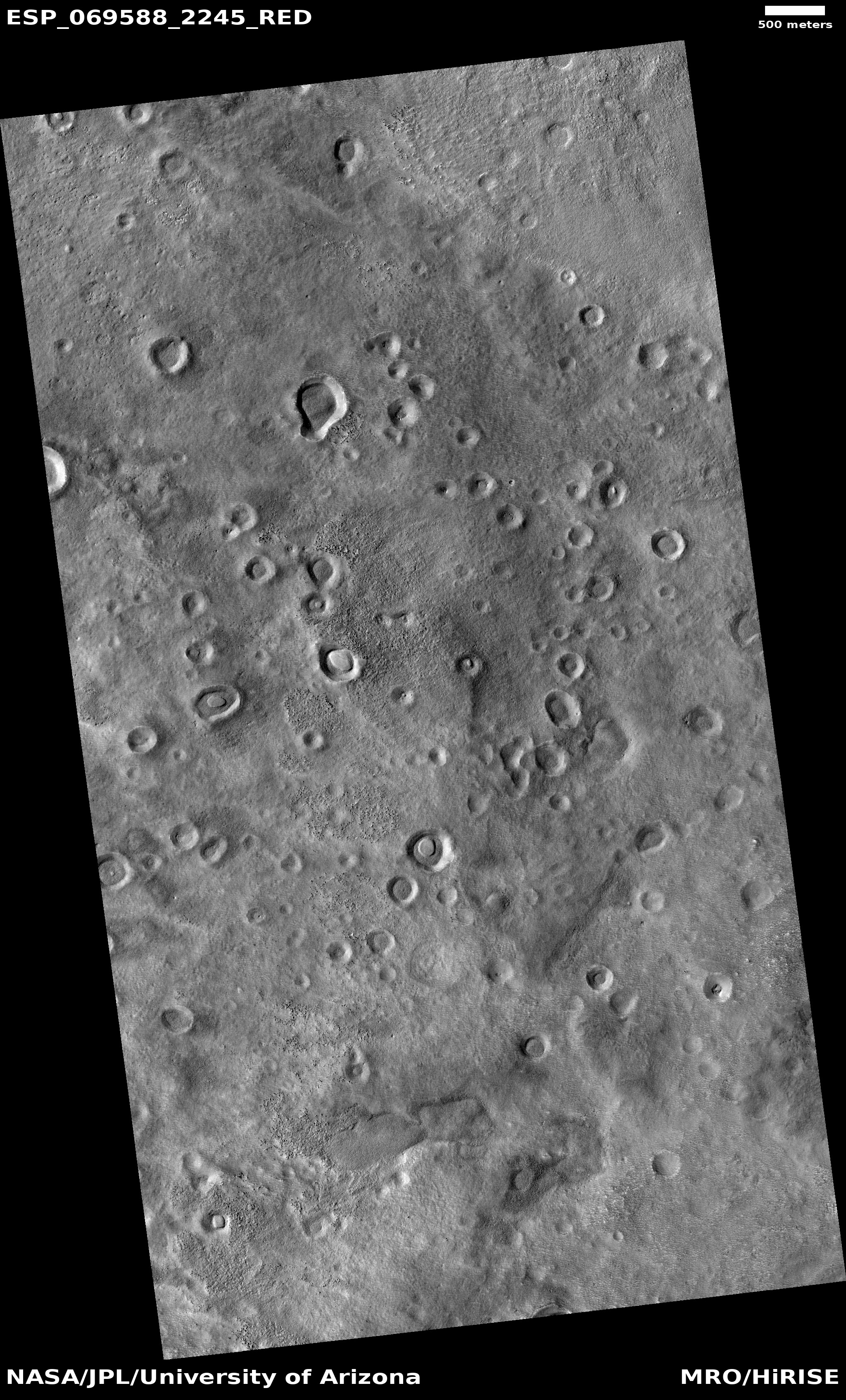
Cool image time! The photo to the right, rotated, cropped, and reduced to post here, was taken on June 17, 2021 by the high resolution camera on Mars Reconnaissance Orbiter (MRO). It shows a somewhat straight depression with several wider and deeper pits along it.

The feature immediately suggests sinkholes that exist because the ground is sagging into voids below ground. Yet, both the straight and circular depressions also appear filled, showing no evidence that they connect to any below ground cavities.

Are the sinks the result of a fissure produced by a graben, when two large blocks shift relative to each other to cause a fissure to appear? Or are they evidence of an underground lava tube? Or maybe they are the filled remains of a now mostly buried canyon carved by water or ice?

As always, a wider view helps clarify things, though whether it answers the question is uncertain.
» Read more

1 comment

Glacial ice sheets on Mars?

Glacial ice sheets on Mars?
Click for full image.

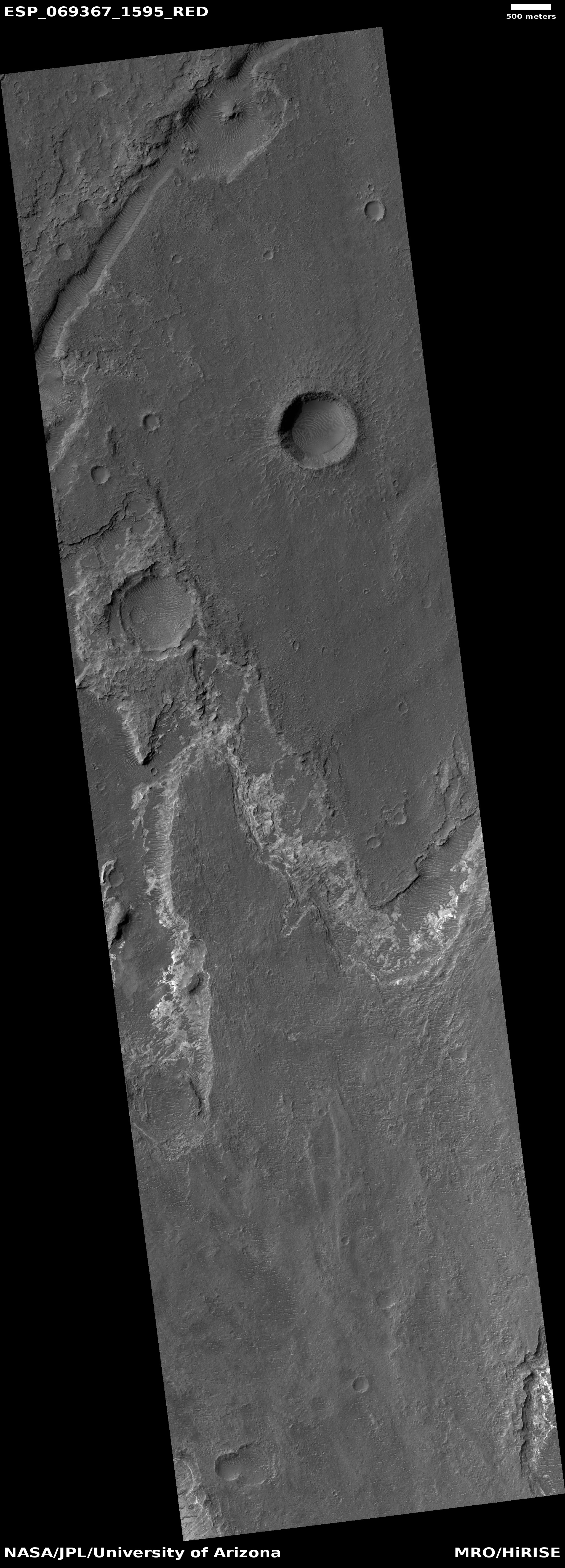
Cool image time! The photo to the right, rotated, cropped, and reduced to post here, was taken on June 29, 2021 by the high resolution camera on Mars Reconnaissance Orbiter (MRO). The location is in Mars’ glacier country, that strip of chaos terrain that runs about 2,000 miles along the transition zone between the northern lowland plains and the southern cratered highlands at 30 to 47 degrees north latitude. This particular feature is located in Deuteronilus Mensae, the westernmost region of that strip of chaos.

I call this glacier country because practically every image taken by MRO’s high resolution camera in this region suggests the presence of glacial material covered by a protective layer of debris. The photo to the right is typical, though a bit more puzzling because of the depressions that appear to run along highpoints.

As usual, the overview map below helps explain what we are looking at.
» Read more

1 comment

Peeling thin layers on a Martian plateau

Peeling thin layers on Mars
Click for full image.

Cool image time! The photo to the right, cropped to post here, was taken on May 14, 2021 by the high resolution camera on Mars Reconnaissance Orbiter (MRO). It shows what the science team labels as “light-toned layered deposits.”

Their focus, rightly from a geologist’s perspective, is the contrast in color between different layers, suggesting different composition and thus a different formation history for each layer.

To me, what made this feature appealing is the thinness and number of its layers. It reminded me of fillo pastry, “unleavened flour dough formed into very thin sheets or leaves.”

If you look at the full image you will see that cropped section only covers one edge of a tongue-shaped plateau, with similar layers revealed along its entire cliff wall. It is almost like those layers have been peeling off for eons to leave the plateau behind.

The location below gives some context.
» Read more

0 comments

White blobs on Mars

White blobs on Mars
Click for full image.

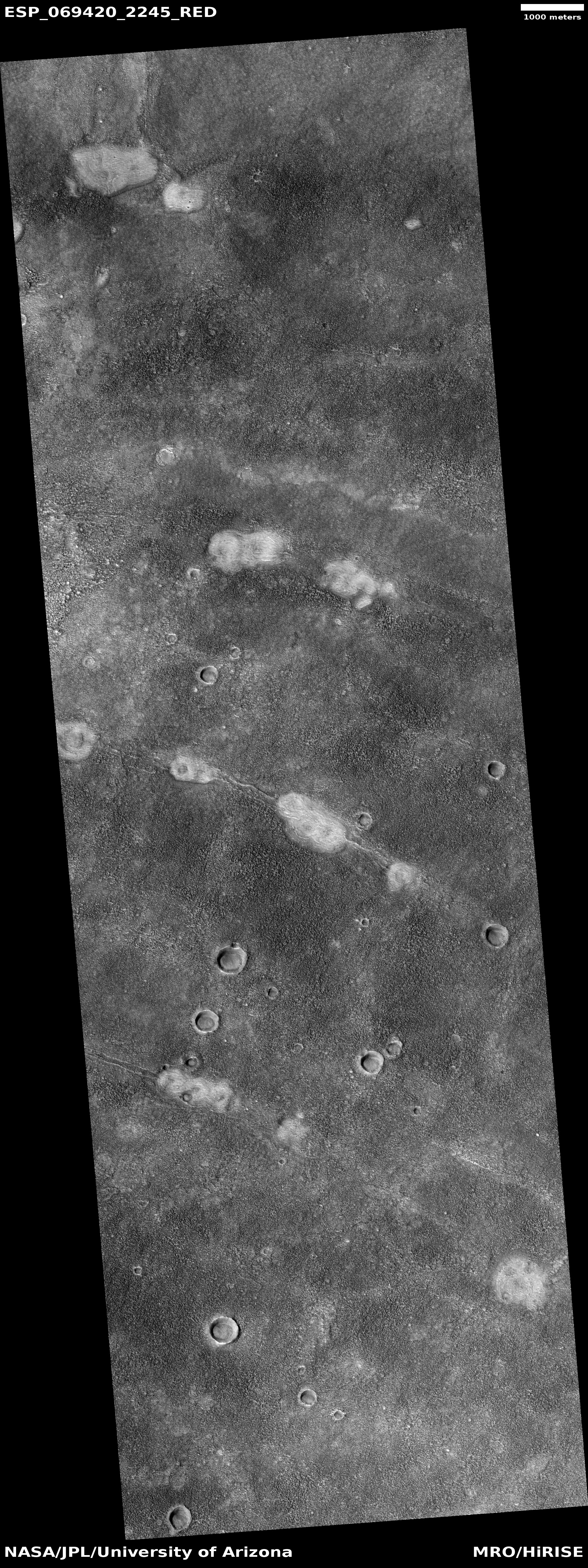
Time for another “What the heck?” image. The photo to the right, cropped to post here, was taken on May 18, 2021 by the high resolution camera on Mars Reconnaissance Orbiter (MRO). It shows what appears to be a series of white circular features aligned with a ridge line.

Are these eroded craters? Maybe, but their alignment with those ridges suggests otherwise. If you look at the full image, you will see further parallel ridges to the north and south, also with similar circular blobs lined along them. Furthermore, the flat surrounding terrain, part of the northern lowland plains north of the resurgences from Valles Marineris, has a scattering of very normal looking craters, with distinct rims and even some glacial material within. As this is at 44 degrees north latitude, the presence of glacial material inside craters is not surprising.

Thus, the white blobs are likely not craters, but some form of eruptive material from below, coming up along those ridges which are probably faultlines. The whiteness suggests that material is water ice, but this of course is unconfirmed.

The question is of course, why? What would cause water ice to erupt along these faultlines? And why are such features not seen elsewhere? Faults and underground ice are common on Mars. Yet, I don’t remember seeing features such as this in any other Martian images.

2 comments

Martian lava flooded crater?

lava flooded crater?
Click for full image.

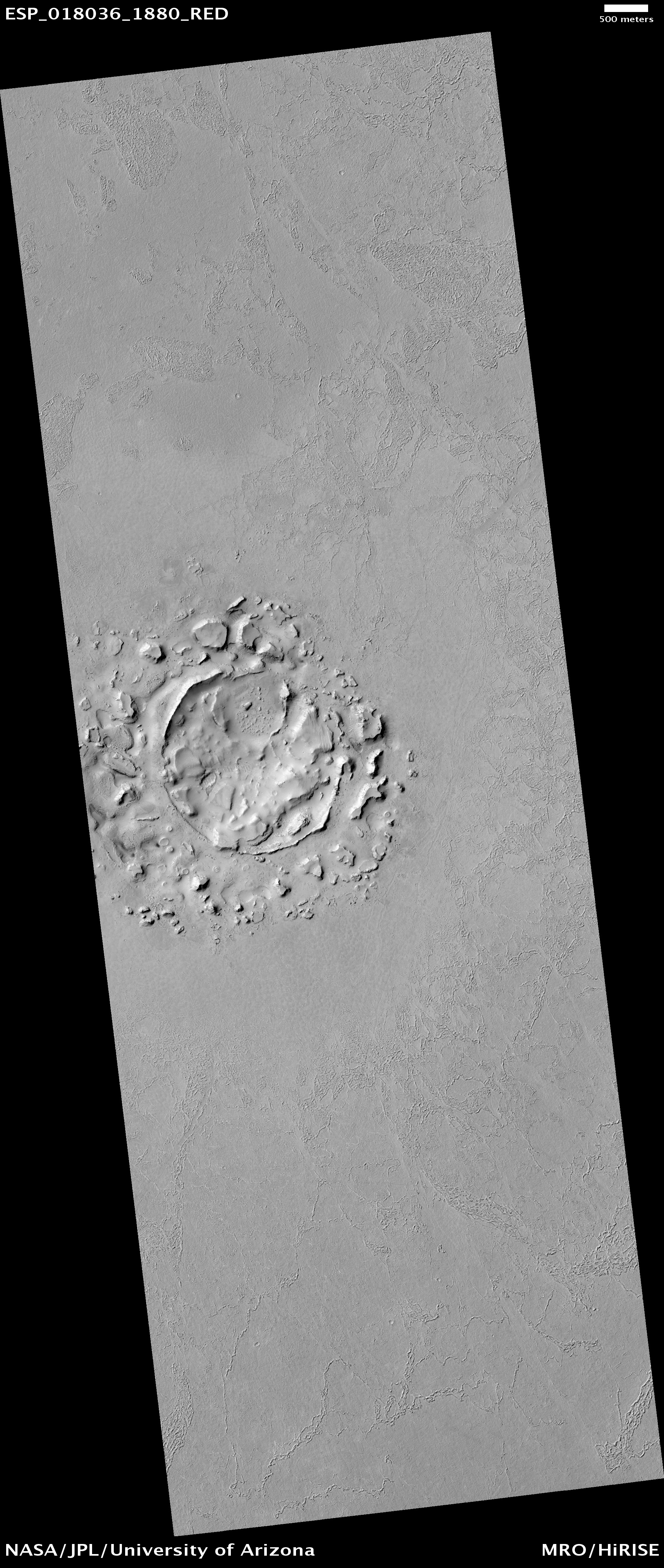
A quick cool image! The photo to the right, rotated, cropped and reduced to post here, was taken by the high resolution camera on Mars Reconnaissance Orbiter (MRO) more than a decade ago, on June 1, 2010. I post it now because it is today’s MRO picture of the day, and is definitely cool. The caption:

One of a few โ€œscaly-lookingโ€ inselbergs within regional platy-ridged flows in Elysium Planitia. This inselberg has a broken and blocky appearance with some of the blocks being tilted. Could this be the remnant of a once extensive mantling deposit? An inselberg is an isolated hill or mountain rising abruptly from a plain.

The wider image by MRO’s context camera below, also rotated, cropped and reduced to post here, illustrates even more forcefully how isolated this circular set of blocks is.
» Read more

0 comments

The sublimating surface of Mars’ northern plains?

Sublimating patches on Mars?
Click for full image.

Cool image time! The photograph to the right, cropped and reduced to post here, was taken by the high resolution camera on Mars Reconnaissance Orbiter on May 27, 2021. A sample image, likely taken not as part of any specific scientist’s research but by the camera team in order to maintain the camera’s temperature, shows an area of the Martian northern plains that appears filled with rough scattered depressions, possibly caused by sublimation of buried ice.

The location, at 54 degrees north latitude, is far enough north to easily have a lot of buried ice. It is also only about 40 miles to the east of Milankoviฤ Crater, where scientists have found many scarps that appear to have exposed layers of ice in their cliff faces.

However, the location has other components that must raise questions about this sublimating ice hypothesis.
» Read more

0 comments

The nearest hill to China’s Zhurong

Pitted cone near Zhurong
Click for full image.

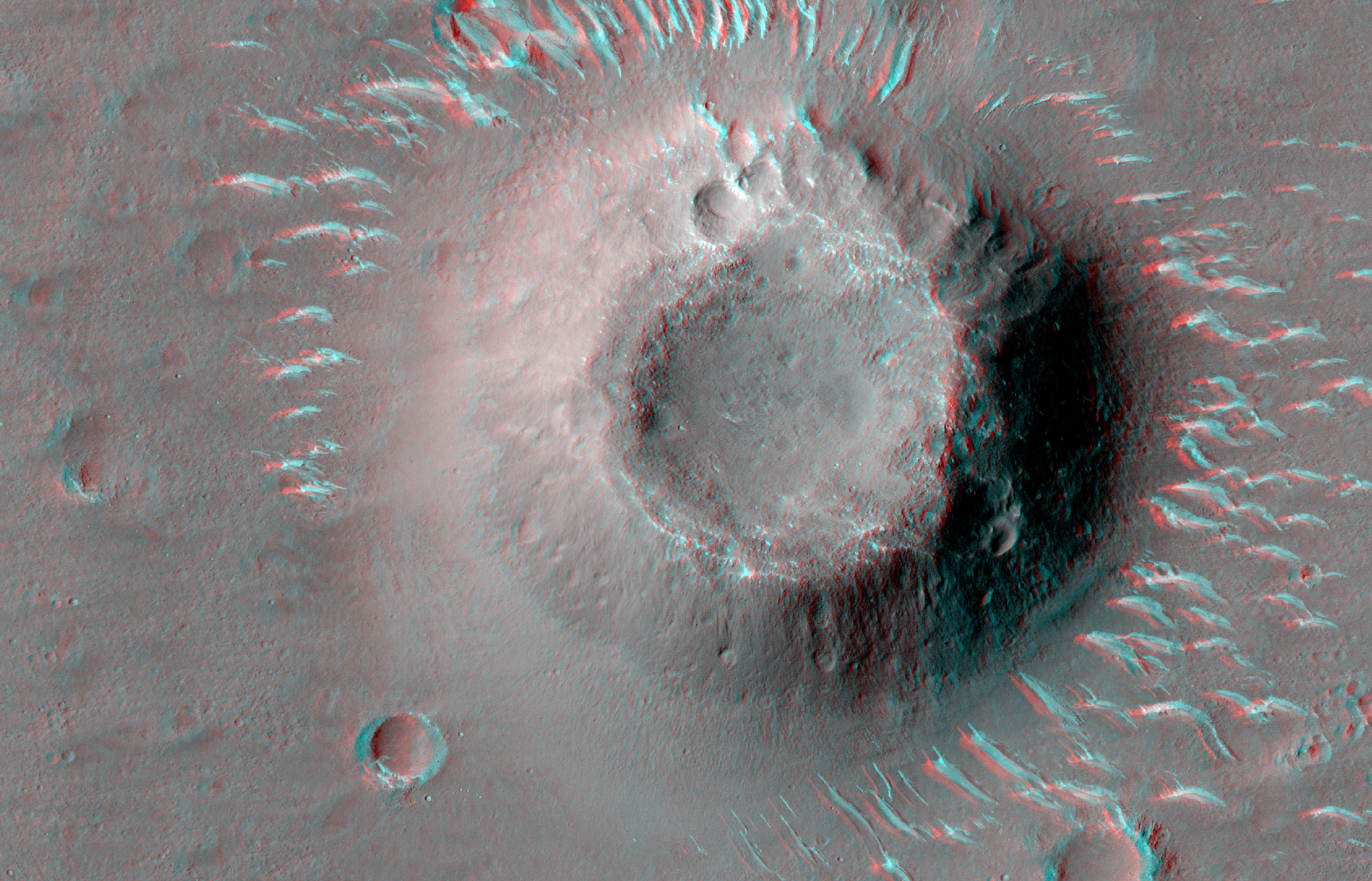
Cool image time! The science team for the high resolution camera on Mars Reconnaissance Orbiter (MRO) today released a pair of images the camera took on June 28, 2021 of the nearest pitted cone to China’s Zhurong rover.

The stereo anaglyph to the right, cropped and reduced to post here, allows you, with blue-red 3D glasses, to see the cone in three dimensions. Quite impressive. As noted by Alfred McEwen of the Lunar & Planetary Laboratory in Arizona in his caption,

This image completed a stereo pair of a region just west of where the Zhurong rover landed in southern Utopia Planitia.

The cutout is from a portion of the stereo anaglyph, showing an enigmatic pitted cone. Is this cone composed of sediments or volcanic materials? The sharp bright features surrounding the cone are aeolian (wind-blown) landforms.

According to McEwan, the hill itself is about 200 to 220 feet high, with the pit at its top about 60-65 feet deep.

While McEwan has told me this cone would be his primary target if he was running Zhurong, it appears the Chinese are instead heading south toward the largest nearby crater, and on the way inspecting the parachute, fairing, and heat shield discarded just prior to landing.

The mosaic below from three MRO context camera images provides a wider overview.
» Read more

4 comments

Fractured crater close to the Phoenix lander on Mars

Fractured crater on Mars
Click for full image.

Cool image time! The photo to the right, cropped to post here, was taken on May 3, 2021 by the high resolution camera on Mars Reconnaissance Orbiter (MRO). It shows a remarkably fractured crater that lies only a few miles to the southeast of where the now-inactive Phoenix lander put down back in 2008, at the very high latitude of 69 degrees north.

Phoenix was purposely sent to this high latitude to find out what the ground and atmosphere was like there. It found the following:

Phoenix’s preliminary science accomplishments advance the goal of studying whether the Martian arctic environment has ever been favorable for microbes. Additional findings include documenting a mildly alkaline soil environment unlike any found by earlier Mars missions; finding small concentrations of salts that could be nutrients for life; discovering perchlorate salt, which has implications for ice and soil properties; and finding calcium carbonate, a marker of effects of liquid water.

Phoenix findings also support the goal of learning the history of water on Mars. These findings include excavating soil above the ice table, revealing at least two distinct types of ice deposits; observing snow descending from clouds; providing a mission-long weather record, with data on temperature, pressure, humidity and wind; observations of haze, clouds, frost and whirlwinds; and coordinating with NASA’s Mars Reconnaissance Orbiter to perform simultaneous ground and orbital observations of Martian weather.

Below is an overview map showing the location of both this crater and the Phoenix lander.
» Read more

0 comments

Ice, lava, quakes, and faults, all in one Martian image

A lot of geology in one picture
Click for full image.

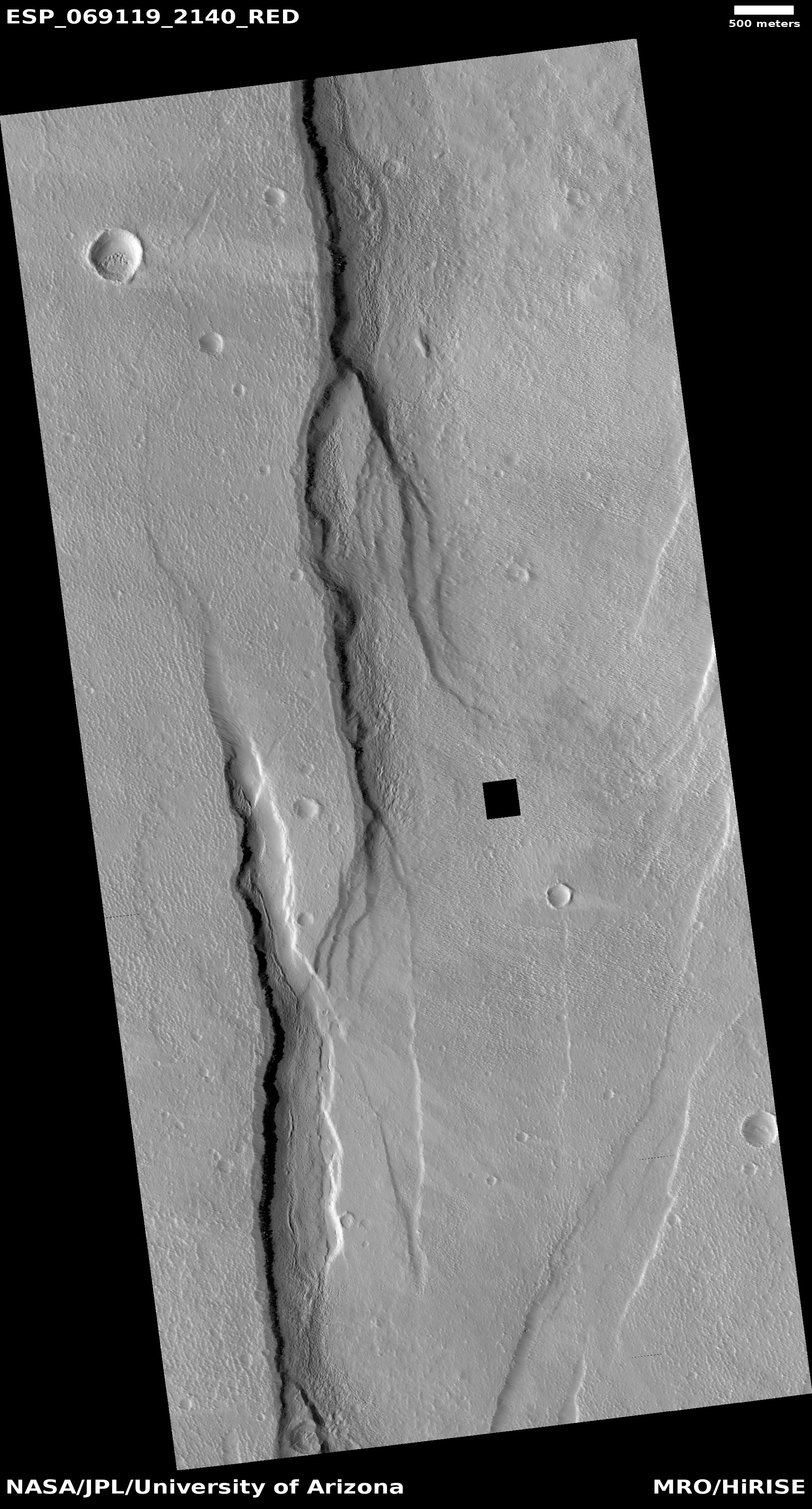
Cool image time! The photo to the right, rotated, cropped, and reduced to post here, was taken by the high resolution camera on Mars Reconnaissance Orbiter (MRO) on April 25, 2021. It grabbed my attention because it possibly captures a whole range of Martian geological processes, all in one place, including evidence of quakes, of lava, of faults, and possibly of glaciers.

First, ignore the black rectangle, which is merely a small section of lost data.

The picture itself shows a wide north-south fissure, as indicated by the distinct western cliff and the fainter and less pronounced eastern cliff. This fissure, likely formed along a fault, was created when the crust was pushed and stretched upward by the pressure of underground volcanic magma, part of the long series of eruptions that formed the many similar and parallel north-south fissures south of the shield volcano Alba Mons.

The overview map below illustrates this fissure’s relationship with Alba Mons.
» Read more

0 comments

The wind-swept volcanic ash plains of Mars

Overview map

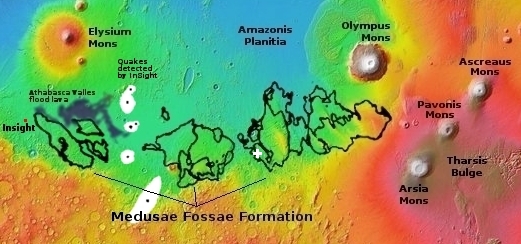
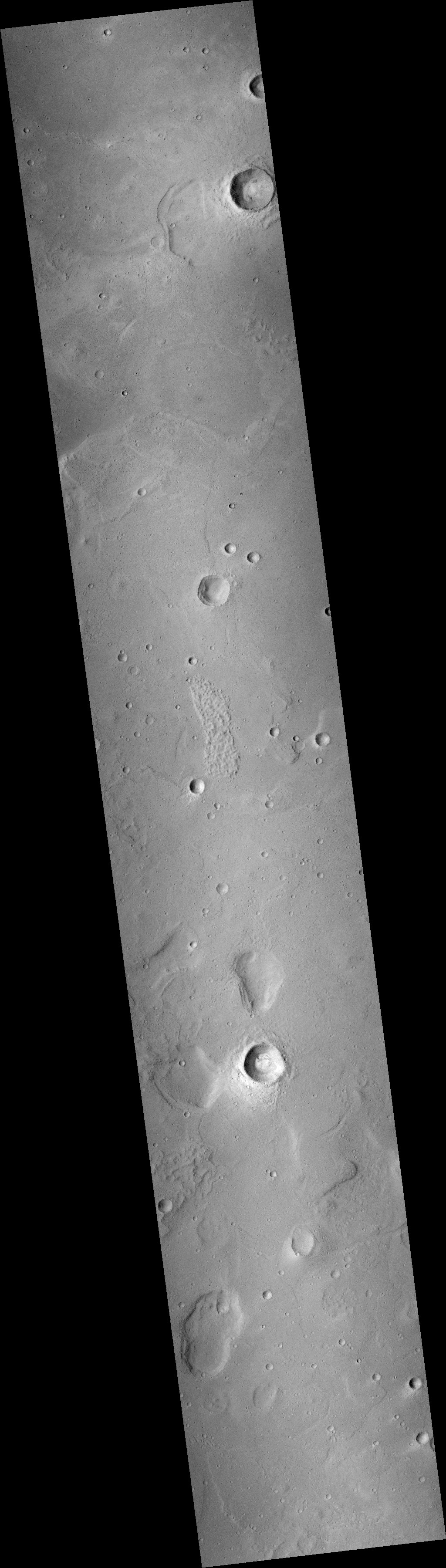
Cool image time! In Mars’ volcano country lies the planet’s largest ash deposit, dubbed the Medusae Fossae Formation. Scientists believe that this gigantic deposit, with a size comparable to the nation of India, was laid down by muliple volcanic eruptions over several billion years and is the source of most of the dust seen on the Red Planet.

The overview map on the right shows the location of this ash deposit on Mars. The white cross indicates the location of today’s cool image, found below.
» Read more

1 comment

Another “What the heck?” photo from Mars

Isolated clump of mounds on Mars
Click for full image.

The cool image to the right, cropped and reduced to post here, was taken a decade ago, on August 25, 2011, by the context camera on Mars Reconnaissance Orbiter (MRO), It shows a flat plain with a sudden clump of mounds or hills at the center.

This is one of those pictures from Mars which I like to call a “What the heck?” image. What caused the mounds, and why are they found only in this concentrated clump, with the rest of the terrain around them generally flat?

Though the context image was taken a decade ago, no follow-up high resolution images were taken of this area until very recently.

Below is the one recent high resolution image taken by MRO on May 12, 2021, cropped and reduced to show the bottom half of the mound clump as shown by the white box. It makes the mystery even more puzzling.
» Read more

4 comments

Ice-filled craters in Mars’ glacier country?

Craters in Protonilus Mensae
Click for full image.

Today’s cool image returns us to the chaos region dubbed Protonilus Mensae, the middle of three adjacent mensae regions in the northern hemisphere that I like to dub Mars’ glacier country because there is so much evidence of buried ice there.

The photo to the right, cropped to post here, was taken on May 31, 2021 by the high resolution camera of Mars Reconnaissance Orbiter (MRO). Titled “Layered Feature in Crater in Protonilus Mensae,” the section I have posted focuses on several craters, with the one with the central mesa likely the picture’s target. Based on many similar features found in craters in this region, it is somewhat safe to assume that this mesa is made of buried ice.

The overview map below as always provides the context.
» Read more

0 comments
1 53 54 55 56 57 90