Ingenuity completes 13th flight

Ingenuity landing on September 5, 2021
Click for full image.

Though the full slate of images taken has not yet been released, it appears from the five images available that the thirteenth flight of Ingenuity on September 5, 2021 ended successfully. The photo to the right is the last available, and shows the helicopter’s shadow on the ground mere seconds before touch down. The landing legs’ shadows suggest it is oriented properly for that landing.

No word yet on how successful the flight itself was. The goal had been to fly back over the South Seitah area from a different angle and lower altitude, getting different perspectives of the ridges there to help plan Perseverance’s coming travels across that terrain.

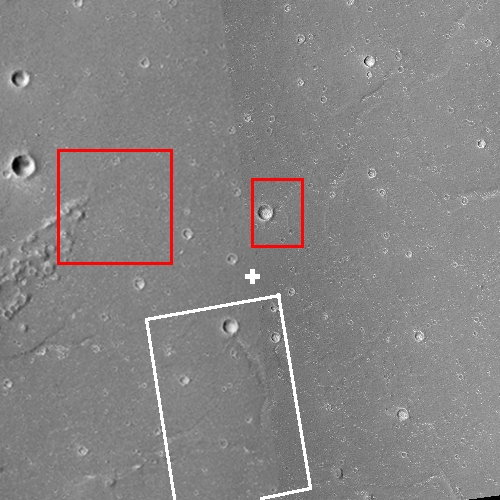
The second picture below, cropped, reduced, and enhanced to post here, was taken about forty minutes before take-off by Perseverance and captures Ingenuity in the lower left, as indicated by the arrow.
» Read more

3 comments

China Long March 4C rocket launches satellite

According to China’s state-run press, the country launched an “earth observation” satellite today using its Long March 4C rocket.

The satellite is part of a series of similar satellites launched by civilian agencies ostensibly for civilian use. The rocket was launched from an interior spaceport. No word on whether its first stage carried grid fins or parachutes to control its landing in the interior of China, or whether it crashed near habitable areas.

The leaders in the 2021 launch race:

30 China
21 SpaceX
13 Russia
4 Northrop Grumman

The U.S. lead over China in the national rankings has now narrowed to 32 to 30.

2 comments

House NASA budget cuts all funding for lunar lander but adds billions for “infrastructure”

The House science committee is about to propose a NASA budget that would cut all funding for a lunar lander but add $4 billion so that NASA can build new buildings and facilities.

An updated draft of the bill, dated Sept. 4, offers good and bad news for NASA. It includes $4 billion for “repair, recapitalization, and modernization of physical infrastructure and facilities” across the agency. The bill does not assign amounts to specific projects or centers.

NASA Administrator Bill Nelson had made funding for agency infrastructure a priority in any budget reconciliation package, seeking more than $5 billion earlier this year. “There’s aging infrastructure that is dilapidated,” he told House appropriators in May. “They’ve got holes in the roof where they’re putting together the core of the SLS” at the Michoud Assembly Facility in New Orleans. Michoud suffered additional damage from Hurricane Ida last month.

However, the draft bill includes nothing for the other priority identified by Nelson, the agency’s Human Landing System (HLS) program. Nelson said in May he wanted $5.4 billion for HLS to allow NASA to select a second company alongside SpaceX to develop and demonstrate a lander capable of transporting astronauts to and from the lunar surface.

Congratulations America! This is the Congress we have voted for. They want a space agency tasked with finding ways to explore the solar system but will only fund the “repair, recapitalization, and modernization of physical infrastructure and facilities” on Earth.

In other words, NASA will have gold-plated buildings in which they will be able to do nothing but shuffle paper because Congress has given them no funding to fly anything in space.

What a joke. But then, as I said, this is the Congress Americans have chosen, so that means not only is Congress a joke, so are the American people.

23 comments

House committee votes to postpone move of Space Force HQ to Alabama

The House Armed Services committee voted yesterday to postpone the proposed establishment of the Space Force’s headquarters in Alabama.

The House Armed Services Committee on Thursday passed, with bipartisan agreement, Colorado Springs U.S. Rep. Doug Lamborn’s amendment to the Fiscal Year 2022’s National Defense Authorization Act — an amendment that would prevent the move of the command to Huntsville, Ala., and work leading up to it, until after the Government Accountability Office and the Department of Defense Office of Inspector General complete their reviews of the decision.

Results of the GAO review, currently underway, are expected to be released in March, Chuck Young, managing director of public affairs for the agency, told The Gazette on Thursday.

This congressional action is not a surprise. The vested interests in Colorado, where a great bulk of the present military space operations are based, were not going to take the shift to Alabama lying down.

Posted still driving north to Las Vegas. (Don’t worry, I’m not doing the driving.)

3 comments

FAA grounds Virgin Galactic pending investigationn

Probably in response to the revelation of the flight issue, not an actual safety issue, the FAA has grounded Virgin Galactic from any further flights pending the resolution of the investigation of the July flight, which drifted out of its planned flight path due to high winds.

This will likely delay their planned next manned flight, which had been tentatively scheduled for September-October.

Posted on the way to Nevada.

6 comments

The problem Starship poses to NASA and Congress

An interesting essay published earlier this week in The Space Review raises the coming dilemma that both NASA and Congress will soon have to face once Starship is operational and launching large cargoes and crews to orbit, both near Earth and to the Moon.

That dilemma: What do about SLS and Lunar Gateway once it becomes ridiculously obvious that they are inferior vessels for future space travel?

I think this quote from the article more than any illustrates the reality that these government officials will soon have to deal with in some manner:

[When] the Lunar Starship ever docks with Gateway, the size comparison with Gateway will appear silly and beg the question as to whether Gateway is actually necessary. Does this even make sense? Couldn’t two Starships simply dock with each other and transfer propellant from one to another. Is there really a need for a middleman?

The author, Doug Plata, also notes other contrasts that will make SLS and Lunar Gateway look absurd, such as when two Starships begin transferring fuel in orbit or when a Starship launches 400 satellites in one go, or when a private Starship mission circles the Moon and returns to Earth for later reuse.

All of these scenarios are actually being planned, with the first something NASA itself is paying for, since the lunar landing Starship will dock with Lunar Gateway to pick up and drop off its passengers for the Moon.

The bottom line for Plata is that the federal government needs to stop wasting money on bad programs like SLS and Lunar Gateway and switch its focus to buying products from commercial sources like SpaceX. They will get far more bang for the buck, while actually getting something accomplished in space.

Though he uses different words, and has the advantage of recent events to reference, Plata is essentially repeating my recommendations from my 2017 policy paper, Capitalism in Space [free pdf]. Plata draws as his proof for his argument the recent developments with Starship. I drew as my proof a comparison between SLS and what private commercial space was doing for NASA, as starkly illustrated by this one table:

The cost difference between SLS and private space

The government has got to stop trying to build things, as it does an abysmal job. It instead must buy what it needs from private commercial vendors who know how to do it and have proven they can do it well.

If the government does this, will not only save money, it will fuel an American renaissance in space. As we see already beginning to see happen now in rocketry and the unmanned lunar landing business.

20 comments

Firefly first launch attempt fails after liftoff, shortly before stage separation

Alpha rocket exploding
Screen capture from Everyday Astronaut live stream.

Capitalism in space: Firefly’s first attempt to launch its Alpha rocket to orbit failed at T+2:30 minutes, shortly after it went supersonic and just before first stage engine cut-off and stage separation.

The screen capture to the right shows that explosion.

Lift-off procedures went very well, though the rocket itself appeared to reach supersonic speeds later than their timeline predicted, suggesting it was underpowered.

In fact, the whole operation reminded me of SpaceX’s early attempts to launch its Falcon-1 rocket. Just as happened in one of those early SpaceX launches, there was a launch abort at liftoff, the launch team quickly figured out what happened, recycled the rocket, and successfully lifted off an hour later. Kudos to that team!

The failure is unfortunate, but to repeat the cliche, this is rocket science. They will try again.

18 comments

A peanut-shaped crater in the northern plains of Mars

Context camera image of peanut-shaped crater
Click for full image.

Cool image time! The photo to the right, rotated, cropped and reduced to post here, was taken in May 2008 by the wide angle context camera on Mars Reconnaissance Orbiter (MRO). It shows what the scientists have since labeled a “peanut-shaped crater.”

What caused this unusual shape? The obvious and most likely explanation is that this was a double impact that occurred simultaneously. Imagine the ground being hit either by an asteroid with two lobes or by two similar-sized asteroids falling side-by-side.

Fast forward thirteen years to 2021. In the fifteen years since 2006 when MRO begin science operations in orbit around Mars no high resolution images were taken of this crater. Finally, on July 30, 2021, scientists finally decided to take a high resolution image of this crater’s western half. You can see that image below, rotated, cropped, and reduced to post here.
» Read more

3 comments

The troubled politics of ground-based astronomy

Link here. The article outlines the politics and negotiations now going on during the writing of the next astronomy decadal survey, the document American astronomers have published every decade since the 1960s to provide the science agencies in the federal government guidance on how to spend the taxpayers’ money on the next decade’s astronomy projects.

The focus is on the problems now faced by the two big American ground-based telescopes, the Thirty Meter Telescope (TMT) and the Giant Magellan Telescope (GMT).

The future of the Giant Magellan Telescope (GMT) and the Thirty Meter Telescope (TMT) likely depends on whether the survey recommends that NSF spend what sources put at $1.8 billion to support a recently forged partnership between the projects. If it does, other proposals could lose out, such as a ­continent-spanning radio array and detectors for neutrinos and other cosmic particles.

While some astronomers are pushing for this $1.8 billion bailout to save both, others are arguing the money can be better spent elsewhere. There is also a third option, not mentioned, which would be to abandon one of these telescopes and instead build just one.

The story is focused entirely on ground-based astronomy, which is remarkably very near-sighted for scientists whose job it is to see a far as possible. The future of astronomy is in space, and to not consider that alternative in this discussion means you aren’t considering all your options. For $1.8 billion, using private rockets and competitive construction approaches, I strongly believe a very large optical telescope could be launched that would provide far more cutting edge astronomy than any larger ground-based telescope. Hubble has proven that endlessly for the past thirty years.

4 comments

Prototype of reusable suborbital spaceplane from new startup completes five flights

Capitalism in space: Another rocket startup company, Dawn Aerospace, has completed a five flight test program of a prototype of its proposed reusable suborbital spaceplane, dubbed Aurora.

Dawn Aerospace has successfully completed five test flights of its uncrewed Mk-II Aurora suborbital spaceplane in the skies over Glentanner Aerodrome on New Zealand’s South Island. The flights were conducted by the New Zealand-Dutch space transportation company from July 28 to 30, 2021 at altitudes of up to 3,400 feet (1,036 m), with the prototype airframe fitted with surrogate jet engines.

The three-days of test flights to assess the airframe and avionics of the aircraft took place under a certificate issued to Dawn by the New Zealand Civil Aviation Authority (CAA), which allowed the Mk-II Aurora to operate from conventional airports without airspace restrictions after ground tests were completed.

The company claims this is a demonstrator for their fullscale two-stage-to orbit version that will take off from a runway and then launch small satellites into orbit.

Looks impressive, but my impression of this prototype is that it is a small scale model, only slightly more sophisticated and larger than a model airplane. That impression is reinforced by the video at the link, which provides no visible markers to judge size.

This company needs to get a lot more done if it wants to compete in this new market.

4 comments

Firefly set for first orbital launch today

Capitalism in space: If all goes right, Firefly Aerospace will attempt its first orbital launch today from Vandenberg Space Force Base in California, using its Alpha rocket to place a test payload of science experiments in space.

The launch window is from 6 pm to 10 pm Pacific.

If you wish to watch, I have embedded the live stream below. That stream however have been very poor. The stream is working better here.

Note: They had a launch abort right at launch, and appear to be recycling to try again.

7 comments

China building Ingenuity copycat

Ingenuity vs China

China’s space program revealed yesterday that it is designing its own Mars helicopter for future missions to the Red Planet.

The picture to the right shows this Chinese helicopter prototype on the bottom, with Ingenuity on Mars on top.

Notice the similarity? In fact, one could almost say that the Chinese helicopter is an outright steal of the JPL design.

But then, why not? According to an 2019 inspector general report [pdf], China hacked into JPL’s computers twice from 2009 to 2017 and stole 500MB of data. That data almost certainly included the design plans for Ingenuity, under development at the time.

Copying the work of others is expected, especially when that design is found to work. In this case however it almost certainly isn’t copying, but outright theft.

Of course, that has been par for the course for China’s space program. They don’t appear to be capable of innovating on their own. They first must steal someone else’s design, and then revise and upgrade from that. Their final products might be of high quality, but in the end their long term ability to build something new is going to be severely limited, if they cannot start inventing things on their own.

7 comments
1 46 47 48 49 50 126