Northrop Grumman wins contract to build Lunar Gateway’s habitable module

Capitalism in space: NASA yesterday announced that it has awarded Northrop Grumman the construction contract for building HALO, (Habitation and Logistics Outpost), the module where astronauts will live and work on its Lunar Gateway space station.

Combined with earlier development contracts this contract, worth $935 million, brings the total fixed-price cost to about $1.1 billion.

[HALO], one of the first for the Gateway, will serve as a habitat for visiting astronauts and a command post for the lunar orbiting facility. It will have docking ports for Orion spacecraft, cargo vehicles like SpaceX’s Dragon XL and lunar landers, as well as for later modules to be added by international partners. HALO is based on the Cygnus spacecraft that Northrop Grumman uses to transport cargo to the International Space Station, but extensively modified with docking ports, enhanced life support and other new subsystems.

This module is not expected to launch before 2024. Moreover, it is supposed to work in conjunction with what NASA calls its Artemis 3 mission, the third launch of SLS and the first to dock with Gateway. SLS however is so far only funded through its first two flights, and has a schedule that is presently highly uncertain.

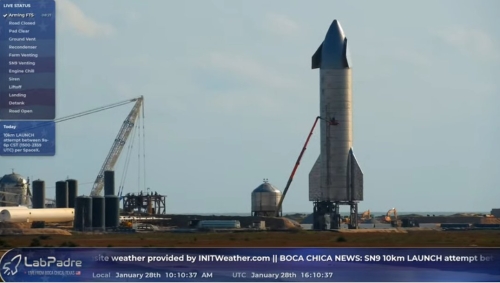
There is great irony here. HALO, based on the Cygnus cargo freighter, will be about that size. If the present schedule for SpaceX’s Starship continues as expected, it will be flying to the Moon at about the same time, and will have a cargo bay big enough to store several Cygnus freighters inside. And though no work has yet been done to make that cargo bay habitable, Starship’s cost per launch, about $2 million, is so far below the $1.1 billion cost for HALO that it will certainly cost much less than HALO to make it a habitable station. And it will be gigantic in comparison.

21 comments

China launches 5 military reconnaissance satellites

Using its Long March 6 rocket, China today successfully launched five military reconnaissance satellites.

This is China’s fourth successful launch in the past week.

Though this newer rocket’s first stage does not use toxic hypergolic fuels — China’s older rockets — that first stage still crashes in China after its job is done and it falls to Earth. No word on whether it landed near inhabited regions.

The leaders in the 2021 launch race:

22 China
20 SpaceX
11 Russia
3 Northrop Grumman

The U.S. still leads China 29 to 22 in the national rankings.

2 comments

Ingenuity’s view of Jezero Crater during its 9th flight

Ingenuity looks across Jezero Crater
Click for full image.

Overview map
Click for interactive map.

Cool image time! The photo above, cropped, enhanced, and reduced to post here, was taken on July 5, 2021, about thirty seconds after Ingenuity had taken off on its 9th flight on Mars. I have increased the contrast slightly to bring out the features. This is a raw image, so I do not think the colors are accurate, and I also do not know why the middle of the image is brighter than the edges.

The red lines on the map to the right indicates the general area this image captures. Essentially, once the helicopter reached its flying altitude after liftoff the engineers had it tilt so that it could see the route it was about to take to the southwest. As they noted in their description of this flight,

We began by dipping into what looks like a heavily eroded crater, then continued to descend over sloped and undulating terrain before climbing again to emerge on a flat plain to the southwest.

I think that crater is visible on the left edge of this picture.

So far 180 raw images from Ingenuity have arrived at JPL. There might be a few more, but I think this is the bulk from the flight. Of these, all but nine are black and white and point straight down. The nine color images seem tilted up towards the horizon to various degrees, though the image above is the only one that captures the horizon itself and the distance mountains of Jezero Crater’s rim.

8 comments

Watching Virgin Galactic’s suborbital flight on July 11th

Capitalism in space: Virgin Galactic has now made available the live stream for its planned suborbital flight on July 11th that will also carry the company’s founder, Richard Branson.

I have embedded the live stream below the fold. Though the company has not announced an actual launch time, according to that stream the broadcast is now scheduled to begin at about 9 am (Eastern). The flight itself should last about ninety minutes total, from takeoff of the carrier airplane to landing of both it and the suborbital spacecraft, VSS Unity.

The weightless portion of the flight will last about four minutes or so. Unity will get to more than 50 miles altitude, which meets the American definition of space but not the international standard of 67 miles. For more details about the flight, see this Space.com article.

Expect the broadcast to be filled with endless hype and blather about how “spectacular” and “amazing” and “wonderful” Virgin Galactic is. And yes, what the company is doing is very cool, a privately financed manned spacecraft capable of reaching space, returning to Earth, and then flying again. Unfortunately, both suborbital companies (Virgin Galactic and Blue Origin) seem to think they have to convince people of this obvious fact on their broadcasts, and scream it at the viewers endlessly. They would be wiser to take SpaceX’s soft-sell approach: State once what they are accomplishing and then simply report on what actually happens, with no breathless commentary.

I don’t expect that to happen however. Thus, I’m not sure I can stomach hours on end of Virgin Galactic PR hype on Sunday, especially considering that this spaceflight by Branson is more than a decade late. His own endless hype for the last fifteen years, promising over and over again that he would be flying in mere months, has soured me from any desire to listen to more. Maybe I’ll go on a hike instead.
» Read more

28 comments

British startup rocket company wants to recover only satellite launched by UK

Capitalism in space: Skyrora, a British startup rocket company which is attempting to build the first rocket using hypersonic technology, has now issued a challenge to the commercial space industry to come up with a plan to snatch from orbit the only satellite ever launched by a rocket built by the United Kingdom and bring it back safely to Earth.

Edinburgh-based rocket company Skyrora is issuing a challenge to find a way to retrieve the Prospero satellite. The object was the first and only UK spacecraft to be launched on a British rocket, from Australia in 1971. It’s defunct now, obviously, but is still circling the globe on an elliptical orbit some 1,000km up.

Skyrora, who will soon start sending up rockets from Scotland, regards the satellite as an important piece of UK space heritage. The company has already recovered part of the Black Arrow vehicle that placed Prospero in orbit. This fell back to Australia in the course of the mission where it languished for decades in the Outback until the firm had it shipped home and put on display.

Now, Skyrora is looking for ideas as to how best to approach and grab hold of the 66kg satellite, whose original mission was to investigate the space environment.

After that single successful launch of Black Arrow, the British government decided to abandon it, and in fact for the next half century refused to invest any money in space, at all. While the decision was probably economically wise for the government, it also did not do anything to encourage a private space industry, and for the next half century there was none in the UK. This is now finally changing, but fortunately not as a government space program like Black Arrow but as a competitive private launch industry aimed at profit.

Recovering Prospero would be a nice public relations stunt that might help further encourage that private industry.

5 comments

NASA to scientists: Don’t expect to use SLS for science missions for at least a decade

In a briefing held by the planetary science community to propose its future missions for the next decade, a NASA official explained that there will likely be no available launches on NASA’s SLS rocket for planetary missions until the late 2020s, and more likely not until the next decade.

While NASA has a goal of being able to launch three SLS missions in a 24-month period, and two in 12 months, the supply chain is currently limited to one SLS per year. That will change by the early 2030s, [the official] said, growing to two per year and thus creating opportunities for additional SLS missions beyond the Artemis program. That will be enabled by changes to at the Michoud Assembly Facility to increase core stage production and a “block upgrade” to the RS-25 engine used on that core stage that will be cheaper and faster to produce.

The official also claimed that the cost of buying a launch on SLS is at best going to be $800 million, but that price won’t be available until the ’30s when SLS’s are launching more frequently. Until then, it appears NASA will charge one billion per launch.

All of this is pure fantasy on NASA’s part. Once cheaper and more usable private commercial rockets come on line, such as SpaceX’s Starship, SLS will go the way of the horse buggy. And this is likely to happen much sooner than 2030, more likely in the next three years.

Moreover, for both cost and practical reasons I cannot see any planetary scientist planning a mission on SLS, ever. There are now much cheaper options that are actually flying, such as SpaceX’s Falcon Heavy, which costs about $100 million per launch. Moreover, SLS’s slow and cumbersome launch pace should scare any planetary scientist away, as such missions must launch on time, and SLS might easily miss their launch windows. In fact, this has already happened. For years Congress mandated that Europa Clipper launch on SLS. When it became clear that SLS would not be available for that mission’s launch window, Congress finally relented and allowed NASA to buy the launch from a commercial company.

17 comments

China targets 2024 for next lunar sample return mission

The new colonial movement: China’s next robotic lunar sample return mission, called Chang’e-6 and targeted for a 2024 launch, will also attempt to bring back the first samples from the far side of the Moon.

Hu Hao, chief engineer of the China Lunar Exploration and Space Engineering Center, announced in a statement released on China’s national space day in April this year that the Chang’e 6 probe, consisting of an orbiter, lander, lunar ascent vehicle and reentry capsule, will target the South Pole-Aitken (SPA) basin.The SPA basin is a colossal, ancient impact crater roughly 1,550 miles (2,500 kilometers) in diameter that covers almost a quarter of the moon’s far side. The impact basin, considered to be the oldest on the moon, holds vital clues about the history of the moon and the solar system, according to a new report.

The precise spot for landing has not been revealed. Since the basin is so large and covers the Moon’s south pole, the mission could land in that region where ice is thought to possibly exist in the permanently shadowed floors of some craters. Whether they would attempt a landing in one of those craters is presently unknown, though unlikely because of the technical challenge.

0 comments

FAA initiates new prelaunch air space clearance system

FAA has now begun using a new prelaunch air space clearance system that is intended to shorten the time airplane travel is disturbed by the scheduled launch of a rocket.

[The FAA] developed the Space Data Integrator (SDI) tool to reduce how long ATO must close airspace around space launches and reentries. The system is voluntary. SpaceX, Blue Origin, Firefly, and the Alaska Aerospace Corporation are current partners. SDI was first used operationally for SpaceX’s Transporter-2 launch last week and is being used for the SpaceX-22 Cargo Dragon reentry today.

…Space operators now are voluntarily sharing telemetry data including vehicle position, altitude and speed, as well as data if the vehicle deviates from its expected flight path. Asked when additional companies might join, Monteith said he would have to defer to ATO to answer that question.

…Using the automated SDI system coupled with “time-based procedures and dynamic windows,” the FAA expects to be able to shorten airspace closures “from an average of more than four hours per launch to just more than two hours” and eventually less.

The article makes no mention whether this new system will allow the FAA to shrink the closure areas as well, which was Elon Musk’s main complaint after SpaceX’s Transporter-2 launch near the end of June was scrubbed seconds before launch when a helicopter slipped into that airspace. As Musk wrote in a tweet,

Unfortunately, launch is called off for today, as an aircraft entered the “keep out zone”, which is unreasonably gigantic. There is simply no way that humanity can become a spacefaring civilization without major regulatory reform. The current regulatory system is broken.

I suspect there is discussion to reduce the size of the closure areas, but I also suspect that the FAA is resisting industry calls to do so.

1 comment

Curiosity looks across at the alien landscape of Gale Crater

Curiosity's view across Gale Crater
Click for full image.

Most of the images from Curiosity that I have posted recently have been of the spectacular mountain scenery looking south at Mount Sharp itself. Today’s cool image, taken on July 6, 2021 by the rover’s right navigation camera and cropped to post here, instead looks north, out across the floor of Gale Crater to its distant rim about twenty miles away.

The rover is likely not to move for a week or so, as it has just completed drilling its first drillhole since it moved up into the next geological layer, dubbed the sulfate unit. Because of this they have been using the rover’s cameras to take a lot of pictures of the surrounding terrain, including several high resolution mosaics.

The two overview maps below show what the cool image above is looking at.
» Read more

2 comments

Engineers successful complete simulation of Hubble repair

Though the details released are sparse, engineers working to get the Hubble Space Telescope back in operation since it shut down due to a computer problem in mid-June report today that they have successfully completed a simulation of the procedures they need to do to fix the problem.

This is their entire report:

[The engineers] successfully completed a test of procedures that would be used to switch to backup hardware on Hubble in response to the payload computer problem. This switch could occur next week after further preparations and reviews.

Apparently, because the switch to backup hardware requires switching more than one unit, the sequence is important and following it correctly is critical. It appears they have now determined the correct sequence and will attempt it on Hubble next week.

0 comments

Problems with Blue Origin’s engine force more delays of ULA’s new Vulcan rocket

In a detailed and very informative review of the partnership between ULA and Blue Origin yesterday, Eric Berger at Ars Technica noted these unfolding facts:

For years, United Launch Alliance chief executive Tory Bruno had been saying the new Vulcan rocket, powered by two [Blue Origin] BE-4 engines, would launch in 2021. However, he recently told Aviation Week the first launch would slip into 2022. Bruno said this was due primarily to the mission’s customer, Astrobotic, whose Moon lander was not ready. Technically, Bruno said, Vulcan still had a chance to be ready for a 2021 launch.

This seems highly unlikely because it is already July, and United Launch Alliance (ULA) still does not have a pair of flight engines. After receiving the flight engines from Blue Origin, ULA needs to attach them to the Vulcan rocket, roll it to the launch pad, and conduct a lengthy series of tests before a hot-fire ignition. After this hot-fire test, the rocket will be rolled back to the hangar and prepared for an actual launch attempt. As of January, Bruno was saying this hot fire test with the flight engines would take place this summer. That will no longer happen.

In December both companies promised delivery of those flight engines by this summer, but so far nothing has arrived. Moreover, both companies have remained very tight-lipped about the cause of the most recent delays. In October 2020 Bruno said that an issue with the engine’s turbopumps had been identified and fixed, but if so why has the engine not arrived as promised?

A GAO report released last month had described issues with the engine’s “igniter and booster capabilities,” but Bruno himself has denied the igniter was a problem.

Regardless, Blue Origin’s inability to deliver this engine is causing problems at both companies. Both have been forced to delay the launch of their new orbital rockets. Both rockets were initially scheduled to launch in 2020, were delayed to 2021 about two years ago, and now are likely not to launch until 2022.

While ULA can still switch to its Atlas 5 rocket for some planned Vulcan launches (and has already done so), that rocket is more expensive and thus eats into the company’s profit margin. Using the more expensive Atlas 5 in bidding also makes it more difficult for ULA to compete with SpaceX in any head-to-head competition.

Blue Origin does not even have this option. Its proposed New Glenn rocket is grounded until it gets its engine operational.

All told, the failure of Blue Origin to deliver here is essentially grounding all of SpaceX’s potential American competition, a situation that is not healthy for the American rocket industry.

5 comments

Update on Ingenuity’s 9th flight

Ingenuity's 9th flight
Click for interactive map

Ingenuity’s engineering team late yesterday posted an update on the helicopter’s successful 9th flight on July 5th, describing in detail the changes they made to their software that made the challenging flight possible.

The changes were required because the helicopter flew for the first time over much rougher terrain then initially planned, as shown by the map to the right.

Flight 9 was not like the flights that came before it. It broke our records for flight duration and cruise speed, and it nearly quadrupled the distance flown between two airfields. But what really set the flight apart was the terrain that Ingenuity had to negotiate during its 2 minutes and 46 seconds in the air – an area called “Séítah” that would be difficult to traverse with a ground vehicle like the Perseverance rover. This flight was also explicitly designed to have science value by providing the first close view of major science targets that the rover will not reach for quite some time.

In other words, Ingenuity flew for the first time over terrain that Perseverance cannot drive to, recording images from above of surface features beyond the rover’s range.

We began by dipping into what looks like a heavily eroded crater, then continued to descend over sloped and undulating terrain before climbing again to emerge on a flat plain to the southwest.

The images of that rough terrain have not yet been downloaded to Earth, but will be in the next week.

0 comments
1 64 65 66 67 68 126