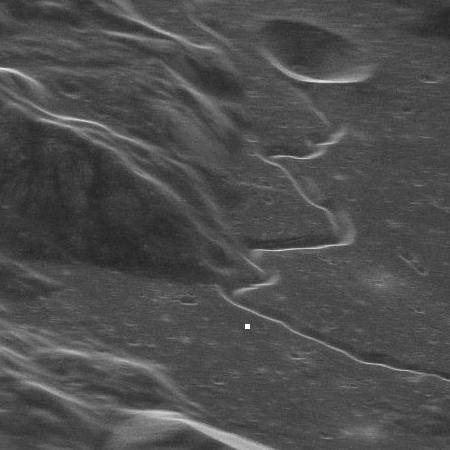
Craters on Ganymede’s striped surface

Craters on Ganymede
Click for full image.

Cool image time! The photo to the right, cropped to post here, is a color enhanced section taken from of one of the images taken by Juno when it did a close fly-by of the Jupiter moon Ganymede back on June 7, 2021.

The enhancement was done by citizen scientist Navaneeth Krishnan, using a wider Juno image of Ganymeded enhanced by citizen scientist Kevin Gill. That wider image is below, and marks the area covered by this first image with a white box.

In this one picture we can see many of the geological mysteries that have puzzled scientists since the Galileo orbiter first took close-up images back in the 1990s. We can see patches of grooved terrain with the grooves in the different patches often oriented differently. We can also see bright and dark patches that while they overlay the grooved terrain they bear no correspondence to those grooved patches. And on top of it all are these small craters, impacts that obviously occurred after the formation of the grooves.
» Read more

0 comments

NASA awards three contracts to develop nuclear propulsion concepts

Capitalism in space: NASA yesterday awarded three different contracts to three different corporation partnerships to develop new nuclear propulsion concepts for use in space.

The contracts, to be awarded through the DOE’s Idaho National Laboratory (INL), are each valued at approximately $5 million. They fund the development of various design strategies for the specified performance requirements that could aid in deep space exploration.

Nuclear propulsion provides greater propellant efficiency as compared with chemical rockets. It’s a potential technology for crew and cargo missions to Mars and science missions to the outer solar system, enabling faster and more robust missions in many cases.

The contracts went to these partnerships:

  • Lockheed Martin and BWX Technologies
  • Aerojet Rocketdyne, General Atomics Electromagnetic Systems, and X-energy
  • Blue Origin, Ultra Safe Nuclear Technologies, Ultra Safe Nuclear Corporation, General Electric Hitachi Nuclear Energy, General Electric Research, Framatome, and Materion

Once the concepts are put forth at the end of the 12-month contracts, the DOE’s laboratory will review them and make recommendations to NASA for further work.

This contract, along with other NASA contracts to develop nuclear power for use on planetary surfaces, strongly suggests that the fear of using nuclear power in space is receding. If so, the capabilities in space will increase significantly in the coming years.

13 comments

Facebook gets out of satellite business; “sells” its employees to Amazon

Capitalism in space: Facebook has now apparently abandoned a project to launch its own communications satellites and instead has made a deal with Amazon whereby it sold its satellite division to the Bezos-founded company, where they joined Amazon’s Kuiper communications satellite project.

Over the past year, Amazon has revealed details about Project Kuiper’s antenna design, selected United Launch Alliance’s Atlas V rocket for the initial satellite launches, and acquired still more office space for Kuiper employees in Redmond.

According to The Information, the employees who came to Kuiper from Facebook in April are based in the Los Angeles area. They are said to include physicists as well as optical, prototyping, mechanical and software engineers who have worked on aeronautical systems and wireless networks. One of the employees, Jin Bains, was formerly Facebook’s head of Southern California connectivity and is now described on his LinkedIn page as a director on the Project Kuiper team.

The Information reported that Amazon paid Facebook as part of the deal for the employee switchover, but did not provide further details. “It’s not unheard of for big companies to buy groups of employees from one another, just as they often buy small startups to beef up staff in various parts of their business,” The Information’s Sarah Krouse and Sylvia Varnham O’Regan explained. [emphasis mine]

This deal reveals a number of immediate facts, as well as one long term troubling one. First, it indicates as mentioned Facebook’s abandonment of its space ambitions.

Second, it suggests that Amazon might finally be recognizing that the people running its Kuiper satellite project are taking far too long to get it off the ground. Though proposed approximately the same time as SpaceX’s Starlink constellation, Kuiper remains unlaunched with no launches even scheduled, while SpaceX has more than 1,500 satellites in orbit, has been providing test service to customers in selected areas, and is about to become operational globally. This difference is achievement might be explained by this fact: The person Amazon hired to run its Kuiper project was someone Elon Musk fired in 2018 from his Starlink project because that person was taking too long to get it built and launched.

The new hires suggest that Amazon might have finally recognized this issue.

Finally, the long term troubling fact.
» Read more

7 comments

Clashing layers in Mars’ largest canyon

Clashing layers on a mountain slope on Mars
Click for full image.

Cool image time! The photo to the right, rotated, cropped, and reduced to post here, was taken on May 27, 2021 by the high resolution camera on Mars Reconnaissance Orbiter (MRO), and shows the clash of different layers on the western slope of a mountain within Mars’ largest canyon, Valles Marineris.

The scientist have labeled this a “possible angular unconformity.” In geology an unconformity generally refers to a gap in a series of layers, a period when instead of the layers being deposited they are being eroded away, leaving no record for that time period. An angular unconformity adds tilting to the older layers, which after erosion are then covered by new layers that are oriented somewhat differently.

Based on these definitions, what the scientists suspect is that the brighter layers to the left and lower down the mountain are older. After a period of erosion new layers were deposited on top at a different angle, forming the stripe of layers going from center left up to center right.

The swirly nature of the material on the top of the ridge suggests to me that these layers might be volcanic in nature, but that’s a pure uneducated guess. What some scientists do believe (but have not yet conclusively proven) is that the lower older layers are sediments laid down by an ancient lake that once filled the canyon here.

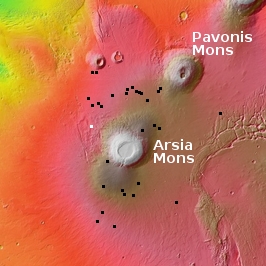
The overview map below provides a wider view and some context.
» Read more

1 comment

Scientists successfully predict resumption of bursts from magnetar

The uncertainty of science: Though they have no real idea why it happens, scientists have now successfully predicted the resumption of energetic bursts coming from a magnetar and according to schedule.

The researchers — Grossan and theoretical physicist and cosmologist Eric Linder from SSL and the Berkeley Center for Cosmological Physics and postdoctoral fellow Mikhail Denissenya from Nazarbayev University in Kazakhstan — discovered the pattern last year in bursts from a soft gamma repeater, SGR1935+2154, that is a magnetar, a prolific source of soft or lower energy gamma ray bursts and the only known source of fast radio bursts within our Milky Way galaxy. They found that the object emits bursts randomly, but only within regular four-month windows of time, each active window separated by three months of inactivity.

On March 19, the team uploaded a preprint claiming “periodic windowed behavior” in soft gamma bursts from SGR1935+2154 and predicted that these bursts would start up again after June 1 — following a three month hiatus — and could occur throughout a four-month window ending Oct. 7.

On June 24, three weeks into the window of activity, the first new burst from SGR1935+2154 was observed after the predicted three month gap, and nearly a dozen more bursts have been observed since, including one on July 6.

They made this prediction based on data going back to 2014 that showed the three-month-off/four-month-on pattern.

As to why this pattern exists, they presently have no idea. Theories have been proposed, such as starquakes activated by the magnetar’s fast rotation or blocking clouds of gas, but none are really very convincing, or are backed with enough data.

0 comments

SpaceX unveils third drone ship for landing Falcon 9 boosters

Capitalism in space: SpaceX’s founder Elon Musk yesterday unveiled the completion of its third drone ship for landing Falcon 9 boosters in the ocean and returning them to port.

The new ship will be put in place in Florida to support Atlantic launches of Falcon Heavy and the flagship rocket of SpaceX, the Falcon 9, that regularly sends Starlink broadband satellites to orbit and NASA astronauts and cargo to the International Space Station, among other customer requests.

This will give the company two drone ships in Florida and one in California, allowing them to do launches at an even faster pace than the one launch every 2 weeks or so since the beginning of the year. The ship also is designed to be more efficient than the older ships, no longer requiring a tug to take it out into the Atlantic.

1 comment

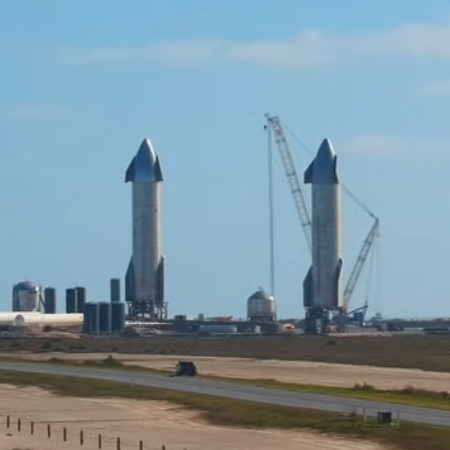
Superheavy passes first tank test

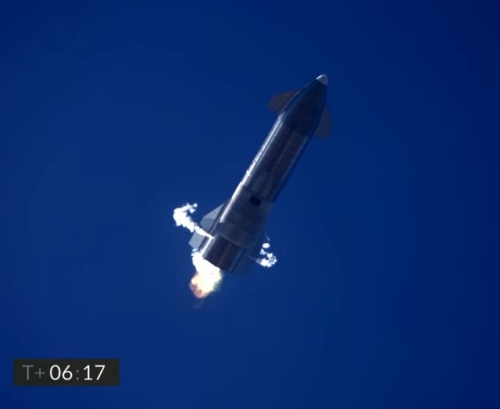
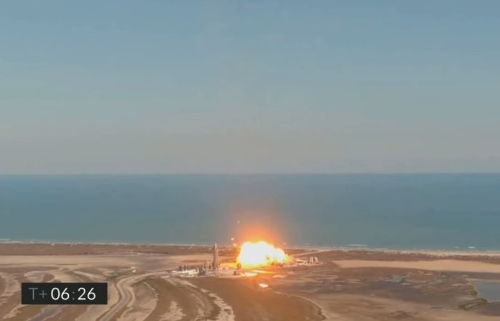
Superheavy after tank test, July 12, 2021
Screen capture from NASASpaceflight.com live stream,
shortly after tank test of Superheavy

Capitalism in space: SpaceX’s first fullscale complete Superheavy prototype, dubbed #3, passed its first tank test yesterday.

Booster 3 was likely filled with a few hundred tons of liquid nitrogen relative to the more than 3000 tons its tanks could easily hold and the fraction of that total capacity SpaceX’s suborbital launch site can actually supply. Teams have been working around the clock for months to outfit Starship’s first orbital launch site with enough propellant storage for at least one or two back to back orbital launches – on the order of 10,000 tons (~22M lb) – but the nascent tank farm is far from even partially operational. That’s left SpaceX with its ground testing and suborbital Starship launch facilities, which appear to be able to store around 1200 tons of propellant.

Assuming the suborbital pad’s main liquid oxygen and methane tanks can also both store and distribute liquid nitrogen, which isn’t guaranteed, SpaceX thus has the ability to fill approximately 30-40% of Super Heavy B3’s usable volume. Frost lines aren’t always a guaranteed sign of fill level but if they’re close, SpaceX likely filled Booster 3’s tanks just 5-10% of the way during the rocket’s first cryoproof.

While the company still says it is aiming for a July orbital launch, that seems highly unlikely. They still have to do a Superheavy tank test with full tanks, plus static fire tests. They also need to get the orbital launchpad finished, with a full tank farm.

Nonetheless, SpaceX is moving fast towards flight of this heavy lift reusable rocket. I still think the odds are 50-50 it will complete its first orbital flight before SLS, even though its development began more than a decade later and has cost a tenth of the money ($6 billion vs $60 billion).

9 comments

FAA approves Blue Origin’s license for commercial suborbital passenger flights

Capitalism in space: The FAA has approved the launch license for Blue Origin, allowing it to fly a commercial suborbital passenger flight using its New Shepard suborbital spacecraft later this month.

The company, founded by the former Amazon.com chief, is approved to conduct space flight missions from its Launch Site One facility in West Texas. The license is valid through August. “To gain license approval to carry humans, Blue Origin was required to verify that its launch vehicle’s hardware and software worked safely and as intended during a test flight,” the FAA said in a statement to FOX Business.

Bezos is scheduled to fly into space on July 20 on New Shepard’s 16th flight. Liftoff is targeted for 8 p.m. CDT, the company said. … The launch date marks the 52nd anniversary of the Apollo 11 moon landing. Bezos assigned himself to the flight just a month ago and asked his brother, Mark, to join him. Accompanying them will be a $28 million auction winner and Wally Funk, one of the last surviving members of the Mercury 13 who was chosen as an “honored guest.”

Expect the same kind of hype surrounding this short suborbital flight that accompanied Richard Branson’s flight this past weekend. The real big deal however will begin in September, when regular orbital tourist flights begin, with one almost every month for the rest of the year.

0 comments

Virgin Galactic shares crash after Branson flight

Capitalism in space: The price of the stock for Virgin Galactic plummeted 17% shortly after Richard Branson’s flight on July 11th, experiencing its worst day in more than a year.

The drop occurred shortly after the company announced it was going to sell an additional $500 million in new shares.

Virgin Galactic, which trades under the ticker SPCE, fell 17.3% after it filed notice of its stock sale offering with the Securities and Exchange Commission. Trading in Virgin Galactic was briefly halted Monday morning due to volatility.

The drop in price is likely a reflection of several things, none of which reflects negatively on the overall bright picture for commercial space. First, the release of new stock meant the supply was greater than demand, and thus the price dropped. Second, Branson’s flight, while grand, also highlighted its limitations. While there certainly appears to be a market for suborbital tourism, I suspect the arrival of regular and likely increasingly cheaper orbital flights will cut into this market. In comparison, a short five minutes of weightlessness cannot compare with spending a week in orbit.

Third, Virgin Galactic as a company has nowhere to go. The rocket is essentially an engineering dead end. It can do suborbital flights relatively cheaply and quickly, but the demand for such flights is limited, especially with the arrival of relatively cheaper orbital access.

9 comments

The bell of freedom rings in space

The Liberty Bell
“Proclaim liberty throughout all the land unto all
the inhabitants thereof.” Photo credit: William Zhang

Not surprisingly the mainstream press today was agog with hundreds of stories about Richard Branson’s suborbital space flight yesterday on Virgin Galactic’s VSS Unity spaceplane.

The excitement and joy over this success is certainly warranted. Back in 2004 Branson set himself the task of creating a reusable suborbital space plane he dubbed SpaceShipTwo, modeled after the suborbital plane that had won the Ansari X-Prize and intended to sell tickets so that private citizens would have the ability to go into space.

His flight yesterday completed that journey. The company he founded and is slowly selling off so that he is only a minority owner now has a vehicle that for a fee can take anyone up to heights ranging from 50 to 60 miles, well within the U.S. definition of space.

Nonetheless, if you rely on the media frenzy about this particular flight to inform you about the state of commercial space you end up having a very distorted picture of this new blossoming industry. Branson’s achievement, as great as it is, has come far too late. Had he done it a decade ago, as he had promised, he would have achieved something historic, proving what was then considered impossible, that private enterprise, using no government resources, could make space travel easy and common.

Now, however, he merely joins the many other private enterprises that are about to fly into space, with most doing it more frequently and with far greater skill and at a much grander scale than Virgin Galactic. His flight is no longer historic. It is merely one of many that is about to reshape space exploration forever.

Consider the upcoming schedule of already paid for commercial manned flights:
» Read more

17 comments

Israeli nonprofit that built Beresheet-1 raises $70 million for Beresheet-2

SpaceIL, the Israeli nonprofit company that built the Beresheet-1 lunar lander/rover that crashed just before landing in 2019 has now raised $70 million of the $100 million it needs to build Beresheet-2.

SpaceIL said the new pledges means that it has raised almost all of the $100 million it estimates is needed for the mission to meet its 2024 launch target. SpaceIL said the funding would come from South African-Israeli billionaire Morris Kahn, who bankrolled much of the first mission, French-Israeli billionaire Patrick Drahi and South African philanthropist Martin Moshal, co-founder of venture capital firm Entree Capital.

A number of the engineers who helped build the first Beresheet have since moved on, forming their own company as well as getting hired by the American startup rocket company Firefly. Still, there is no reason Beresheet-2 cannot be built and flown, especially if SpaceIL focuses on rebuilding it rather than redesigning something new. They came very close to a success, and probably only need some tweaking to make the next attempt succeed.

0 comments

Virgin Galactic finally flies Richard Branson on its reusable suborbital Unity spacecraft

Capitalism in space: After almost two decades of development and almost as many false promises by Richard Branson, Branson today finally flew on his SpaceShipTwo ship dubbed VSS Unity.

Unity was taken to about 45,000 feet by the carrier airplane WhiteKnightTwo, where it was released and its engines fired.

Once VSS Unity’s rocket engine cut off, the spacecraft’s momentum took it to an altitude of around 90 kilometers. This is above the minimum altitude of 80 kilometers required by the US Air Force, NASA, and the FAA to grant astronaut wings, and is above the discernible atmosphere. This apogee, or maximum altitude, is below the Federation Aeronautique Internationale (FAI) recognized boundary of space at 100 kilometers, which SpaceShipOne crossed twice to claim the X-Prize in 2004.

The craft spent around five minutes in weightlessness, with the crew evaluating the experience and looking at Earth and space from 17 windows on the craft, before they strapped back into their seats for reentry.

I have embedded below the fold the NASASpaceflight.com live feed, cued to just before Unity was dropped from WhiteKnightTwo. The commentary is far less offensive than the blather on the official live feed, but they end up losing the view from their live feed and switched to the Virgin Galactic live feed, rewinding it to pick it up just before the drop. You then see that feed, with good images and with all the blather, but no interior video during the weightless period. I suspect they want to edit that footage before releasing it, just in case anyone had vomited or Branson looked uncomfortable in any way.

Overall, Virgin Galactic deserves congratulations for finally accomplishing this flight. That it took so long and occurred just before the start of commercial manned orbital flights unfortunately pops the balloon on this achievement. The flight was so short that it now seems somewhat disappointing compared to the upcoming orbital tourist flights.

The next suborbital flight by Blue Origin on July 20th, and unlike today’s Virgin Galactic flight, will carry the first paying passenger, making it the first wholly financed and built private commercial space flight.
» Read more

27 comments
1 63 64 65 66 67 126