Springtime on Martian dunes near the north pole

Dunes near the Martian north pole, in the spring

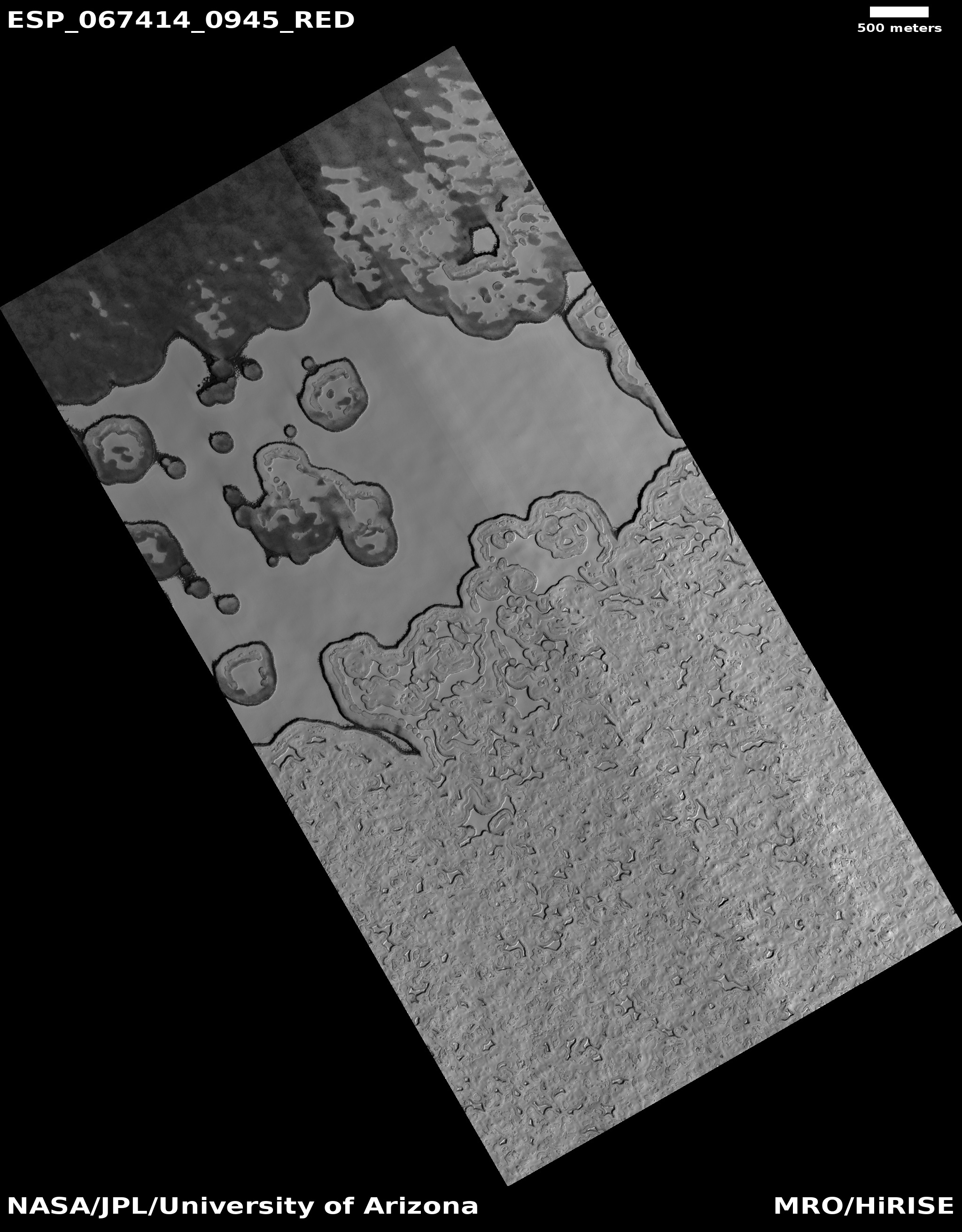
Cool image time! The photo to the right, rotated and cropped to post here, was taken by the high resolution camera on Mars Reconnaissance Orbiter (MRO) on April 27, 2021. It shows a strange scattering of dunes on a flat plain. The red at the top of each dune probably indicates exposed dust and sand. The white fringe is likely either water frost or the leftover mantle of dry ice that is deposited in the polar regions each winter down to 60 degrees latitude, and disappears with the coming of spring, sublimating back into carbon dioxide gas.

There are a lot of puzzles here. The overview map below provides some context, but only some.
» Read more

0 comments

NOAA struggles with concept of letting private commercial space build its satellites

Capitalism in space? An article today in Space News, “NOAA to take first step toward a small satellite constellation”, describes at great length NOAA’s recent effort to rethink how it builds its weather satellites, shifting from large and expensive single satellites launched years apart to constellations of smallsats that provide more redundancy and are cheaper and easier to replace.

What the article misses, as does NOAA apparently, is that this shift should not be designed by NOAA at all. During the Trump administration there was pressure on this agency to do what NASA had, stop designing and building its satellites but instead become a customer that hires private satellite companies to do it instead.

Not much came of that pressure. NOAA hired one private company to study the idea of building a private satellite to observe the Sun. It also awarded three companies experimental contracts to provide NOAA weather data from already orbiting smallsats.

That was it. NOAA made no other attempts to encourage private companies to design and build weather satellites for it, even as it struggled to get its own satellites off the ground. The second new GOES satellite in a constellation of four for providing global weather coverage failed almost immediately after launch in 2018. Overall, that constellation is expected to cost $11 billion, $4 billion more than initially budgeted. And it is years behind schedule.

What the article above suggests is that, with the Trump administration gone, NOAA has now abandoned the effort to transition to privately-built weather satellites. Instead the article describes at great length the effort by NOAA to redesign its satellites from big, rare, and costly to small, frequent, and cheap.

This effort will fail. Government agencies like NOAA are incapable of accomplishing such a task. They do not think in terms of profit, and keeping costs down to maximize those profits. Instead, such government institutions see high costs as beneficial, as they pump more money into their operations.

Until elected officials force NOAA to change, it will not, and its weather satellites will continue to be late, expensive, and untrustworthy. Sadly, the elected officials we have today, especially in the Biden administration, are not going to do that. They are as satisfied with the present situation as NOAA is.

10 comments

SpaceX drone ship arrives in California

Capitalism in space: One of SpaceX’s two drone ships used by its Falcon 9 first stages for ocean landings has arrived in California in preparation for frequent Starlink launches from Vandenberg Space Force Base.

The journey began on the East Coast two weeks ago and included passage through the Panama Canal. Once the drone ship gets offloaded, it will be based at Pier T, where it be part of recovery operations for the Starlink landings that potentially could occur in late July or early August.

These California launches will allow SpaceX to increase the global coverage of its Starlink constellation. It will also allow the company to begin frequent launches from both coasts.

9 comments

China launches communications satellite for space effort

Using a Long March 3C rocket China today successfully launched a communications satellite for use by its manned space missions and its space station, similar to the TDRS satellites used by NASA for similar purposes.

This satellite is the fifth such satellite launched, and is likely intended to enhance communications between the ground and China’s new space station.

No word on where the first stage crashed, or whether it landed near habitable areas.

The leaders in the 2021 launch race:

21 China
20 SpaceX
11 Russia
3 Northrop Grumman

The U.S. still leads China 29 to 21 in the national rankings.

2 comments

Sublimating scallops on Mars

Giant scallop on Mars
Click for full image.

Today’s cool image, shown in a rotated, cropped, and reduced version to the right, gives us a close-up look at one of the giant scallops found in the high mid-latitudes of the northern lowland plains of Mars, specifically in Utopia Basin north of the landing sites of both Perseverance and Zhurong. In fact, this particular image is only a few miles north of one of my previous cool images, Giant scallops on Mars, posted in December 2019.

The image was taken on February 3, 2021 by the high resolution camera on Mars Reconnaissance Orbiter (MRO). While such scallops are not unusual in the mid-latitudes, their formation process is not well understood. As I noted in the 2019 post, ” scientists believe [pdf] the formation process is related to the sublimation of underground ice.”

According to [one hypothesis] scallop formation should be ongoing at the present time. Sublimation of interstitial ice could induce a collapse of material, initially as a small pit, then growing [away from the equator] because of greater solar heating on [that] side. Nearby scallops would coalesce together as can be seen to have occurred.

This hypothesis is not proven, and today’s cool image raises questions about it. Though the bright material at its center suggests exposed ice, supporting the idea that sublimation of ice near the surface created the scallop, the scallop scarps seem more extended and distinct to the south, not the north as this hypothesis proposes. Sunlight should hit the northern scarps more, which suggests they should retreat more instead of the southern scarp.

The overview map below provides the context.
» Read more

1 comment

First images from Ingenuity’s 9th flight today

Ingenuity landing, July 5, 2021

Ingenuity has apparently completed its 9th flight on Mars, its most challenging yet attempted. Based on the six images so far released from that flight, all taking during its landing, it appears the flight was successful. Or at least, the helicopter landed without incident or damage.

The photo to the right was the last picture taken just before touch down. From the caption:

NASA’s Ingenuity Mars Helicopter acquired this image using its navigation camera. This camera is mounted in the helicopter’s fuselage and pointed directly downward to track the ground during flight.

The dark shadow of the helicopter is clearly visible. If you want to see the entire sequence of six images, go to the Ingenuity raw image website and pick the “latest images” filter in the right column. At present it shows this sequence, though I am certain as the day passes images from the entire flight will start appearing.

As noted at the first link above, the flight was to be more than twice as long as any previous flight while flying over the roughest terrain. There was the real risk that its software would become confused by that terrain.

1 comment

Sun unleashes strongest solar flare since last solar maximum

X1 solar flare as seen by Solar Dynamics Observatory

On July 3, 2021 the Sun emitted the first X-class solar flare of the rising present solar maximum, the first such flare since September 2017 during the previous maximum.

This flare is classified as an X1.5-class flare. X-class denotes the most intense flares, while the number provides more information about its strength. An X2 is twice as intense as an X1, an X3 is three times as intense, etc.

The image to the right was taken by the orbiting Solar Dynamics Observatory (SDO), designed to monitor the Sun continuously and catch such events.

More information here. The flare caused some disturbances to various radio instruments, though nothing that resulted in any serious consequences.

What the flare did demonstrate is that the Sun is definitely ramping up to solar maximum. In fact, the Sun has not been blank, with no sunspots on its facing hemisphere, since May 6th, the longest such stretch since the last solar maximum.

2 comments

China launches weather satellite

China yesterday successfully launched a new weather satellite using its Long March 4C rocket.

Launched from one of China’s three interior spaceports, the first stage crashed somewhere within China. No word on whether it came down near inhabited areas.

The leaders in the 2021 launch race:

20 SpaceX
20 China
11 Russia
3 Northrop Grumman

The U.S. still leads China 29 to 20 in the national rankings.

0 comments

Sunspot update: The hot streak continues

This past weekend NOAA released its monthly update of its graph showing the Sun’s sunspot activity, with the new update covering the period through the end of June 2021. As I have done since I began this website eleven years ago, I post that monthly graph below, annotated to show the previous solar cycle predictions and thus provide context.

In June the hot streak of sunspot activity exceeding the prediction of NOAA’s solar science panel continued, with activity rising again after a tiny dip in May. Except for two months, since 2019 the number of sunspots each month has consistently exceeded the prediction. Furthermore, the ramp up of activity has been faster than expected.
» Read more

3 comments

Next Ingenuity flight to push envelope significantly

Ingenuity's 9th flight plan
Click for full image.

The engineers running the Mars helicopter Ingenuity revealed today that they will be attempting their most ambitious flight for the helicopter’s ninth flight, presently scheduled for no earlier than July 4th.

I have annotated the map to the right to show Ingenuity’s present position and its approximate landing area.

Without question this flight will be the riskiest taken by Ingenuity so far, more than doubling the flight distance achieved on any previous flight. More important, it will be flying over terrain far rougher than it was initially designed for.
» Read more

9 comments

More parachute problems for Europe’s Franklin Mars rover

During a parachute drop test in late June, following a redesign of the parachute with U.S. help, engineers for the ExoMars Rosalind Franklin Mars rover found the chute still experienced problems that tore it during deployment.

They actually performed two drop tests, a day apart, using two different parachutes, with the first test apparently going off without a hitch. However, according to the press release:

β€œThe performance of the second main parachute was not perfect but much improved thanks to the adjustments made to the bag and canopy. After a smooth extraction from the bag, we experienced an unexpected detachment of the pilot chute during final inflation. This likely means that the main parachute canopy suffered extra pressure in certain parts. This created a tear that was contained by a Kevlar reinforcement ring. Despite that, it fulfilled its expected deceleration and the descent module was recovered in good state.”

I have embedded below the fold the only video released by the European Space Agency. It is not clear whether this is from the first or second test. Near the end it appears that the pilot chute above the main chute might be separated, but the video ends before that can be confirmed.

Though ESA has apparently improved the chute’s performance significantly since its earlier failures that contributed to the delay of ExoMars from last year to 2022, they still haven’t gotten the chute completely right. Fortunately they still have time to get it fixed before that ’22 launch.
» Read more

5 comments

China launches five military surveillance satellites

China today launched five military surveillance satellites using its Long March 2D rocket.

The rocket’s first stage crashed into “the extreme eastern Shaanxi Province, ” according to the article. No word on whether it landed near habitable areas.

The leaders in the 2021 launch race:

20 SpaceX
19 China
11 Russia
3 Northrop Grumman

The U.S. leads China 29 to 19 in the national rankings.

3 comments
1 65 66 67 68 69 126