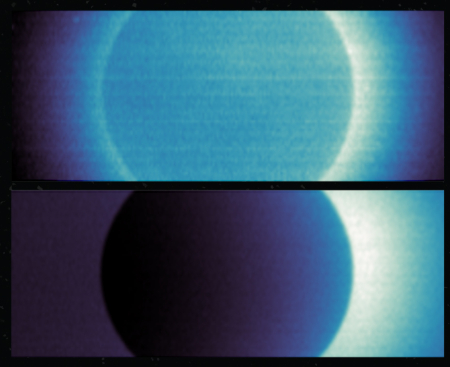
Hubble captures shadows on star’s outer accretion disk cast by inner accretion disk

Shadows cast on star's accretion disk
Click for original image.

Astronomers using the Hubble Space Telescope’s images taken five years apart have captured the changing shadows cast by a star’s inner accretion disk onto its outer accretion disk.

Those images are to the right, reduced and rearranged to post here. From the caption:

Comparison images from the NASA/ESA Hubble Space Telescope, taken several years apart, have uncovered two eerie shadows moving counterclockwise across a disc of gas and dust encircling the young star TW Hydrae. The discs are tilted face-on as seen from Earth and so give astronomers a bird’s-eye view of what’s happening around the star.

The [top] image, taken in 2016, shows just one shadow [A] at the 11 o’clock position. This shadow is cast by an inner disc that is slightly inclined to the outer disc and so blocks starlight. The picture on the [bottom] shows a second shadow that emerged from yet another nested disc at the 7 o’clock position, as photographed in 2021. What was originally the inner disc is marked [B] in this later view.

The shadows rotate around the star at different rates like the hand on a clock. They are evidence for two unseen planets that have pulled dust into their orbits. This makes them slightly inclined to each other. This is a visible-light photo taken with the Space Telescope Imaging Spectrograph. Artificial colour has been added to enhance details.

An artist’s conception of the system, as seen from an oblique angle, is available here. All told, this solar system of disks kind of resembles a spinning gyroscope, with its different rings tilted at different angles to conserve angular momentum.

2 comments

Celestis recovers astronaut’s remains from suborbital rocket explosion

Celestis, the company that specializes in sending people’s ashes into space, has successfully recovered the remains of a former Apollo astronaut Philip Chapman (who never flew in space) after the suborbital rocket they were on exploded four seconds into flight.

“All 120 flight capsules are safely in the hands of launch personnel and will be returned to us awaiting our next flight as soon as UP and Spaceport America complete their investigation and any required fixes are implemented,” Celestis said in a statement on Wednesday. The recovered payloads are set to fly again on board the company’s upcoming Perseverance Flight. The company said it only launches a “symbolic portion” of ashes or DNA sample from its participants.

Celestis has sent remains of many celebrities as well as ordinary customers on a number of orbital and suborbital flights over the years. The recovery of the remains and their expected reflight in this case enhances its business model, since none of its customers want their ashes lost in a rocket failure, before reaching space.

4 comments

Lockheed Martin reorganizes its space divisions to better compete in the new commercial market

Lockheed Martin today announced that it is reorganizing its space divisions to make them better aligned with the new commercial market, and thus better able to win market share.

The company will streamline its operation from “five lines of business to three,” the first focused on commercial space, the second focused on classified military projects, and the third focused on military missile work.

As a big space company, Lockheed Martin has made a great effort in recent years to break into the commercial rocket industry. It was a major investor in Rocket Lab, and is also a major investor in the rocket startup ABL, which it is sending a lot of business. It also realigned its satellite construction business to focus on smallsats, including investing a lot of money in the smallsat company Terran Orbital.

This reorganization is clearly an effort to underline these changes. Whether it will work remains to be seen. Often such reorganizations in big older corporations end up being nothing more than rearranging the deck chairs on the Titanic.

2 comments

ESA finally admits — sort of — that private enterprise can do it better

Stephane Israel, the architect of ESA's rocket failure
Stéphane Israël, the head of Arianespace and the
architect of its failure to compete in the field of rocketry.

Today there was a news report in which Stéphane Israël, the head of Arianespace, kind of admitted at last that the expendable design of Europe’s new Ariane-6 rocket was a mistake, and that it will take a decade more to fix it.

“When the decisions were made on Ariane 6, we did so with the technologies that were available to quickly introduce a new rocket,” said Israël, according to European Spaceflight.

He added that it will not be until the 2030s before Europe begins flying its own reuseable rocket.

Israël’s comments illustrate the head-in-the-sand approach he has exhibited now for decades. He claims the European Space Agency (ESA) chose to make Ariane-6 expandable so that it would be ready quickly, but its development has not been fast, and in fact is now more than three years behind schedule. When it finally begins flying operational it will have taken almost a decade to create it.

His comments also are his lame attempt to push back against a recent ESA report [pdf], issued in late March, that strongly rejected the decades-long model that ESA has used to build its rockets. Up until now and including the construction of Ariane-6, ESA designed and built its rockets, using Arianespace, headed by Israël, as its commercial arm. In other words, the government ran the show, much like NASA did for most of the half century following the 1960s space race. The result was slow development, and expensive rockets. Arianespace for example never made a profit in its decades-long existence, despite capturing half the commercial market in the 2000s and early 2010s.

The March ESA report rejected this model, and instead advocating copying what the U.S. has done for the past half decade by shifting ownership and design to the private sector, as advocated in my 2017 policy paper, Capitalism in space. To quote the ESA report:
» Read more

8 comments

Weird dome near Starship candidate landing zone on Mars

Weird dome near Starship candidate landing zone on Mars
Click for original image.

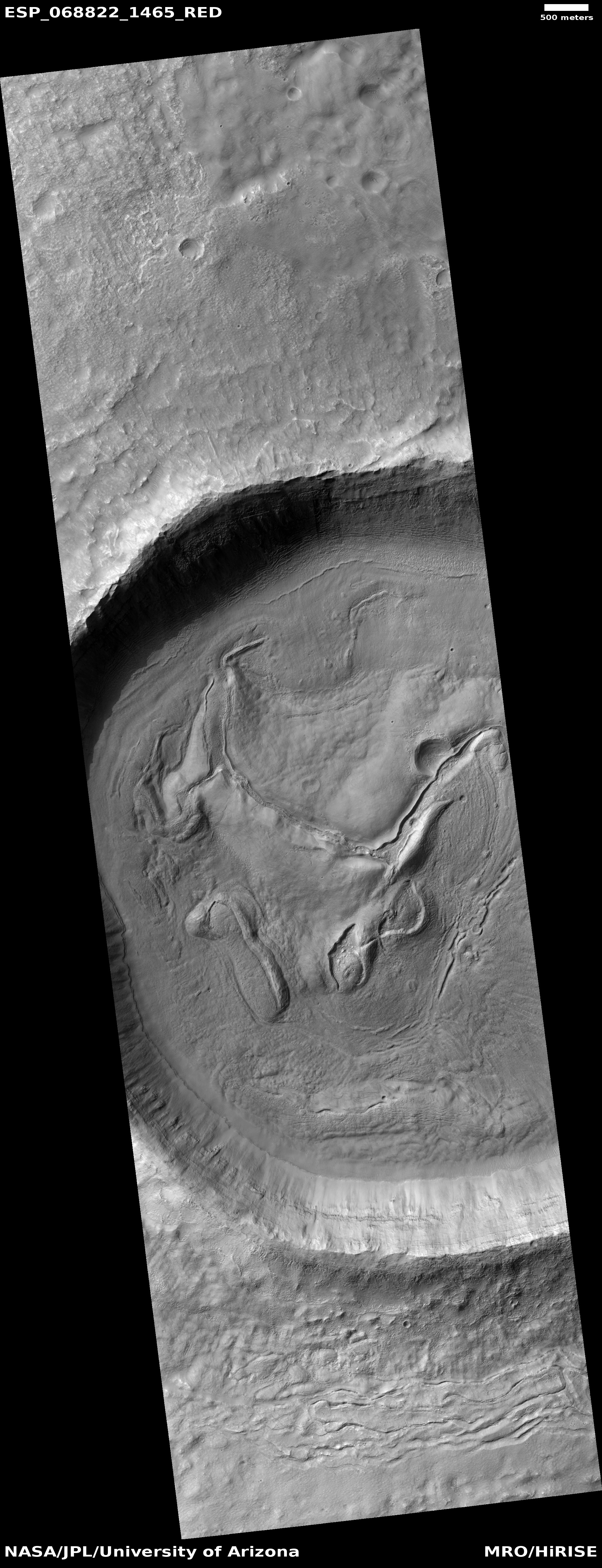
Cool image time! The picture to the right, rotated, cropped, reduced, and sharpened to post here, was taken on February 27, 2023 by the high resolution camera on Mars Reconnaissance Orbiter (MRO). It shows what the scientists label as domes in Arcadia Planitia, one of the many large northern lowland plains of Mars.

This to me is a “What the heck?” image. I won’t dare try to explain the warped concentric ringed pattern at the top of the mesa, nor the bright and dark splotch that surrounds it. The small craters around it appear to have glacier material within them, and the terrain here likely has a lot of near surface ice, being at 37 degrees north latitude in a region where the data suggests such ice exists. The different colors here likely indicate the difference between dust (orange) and coarser material (aqua).

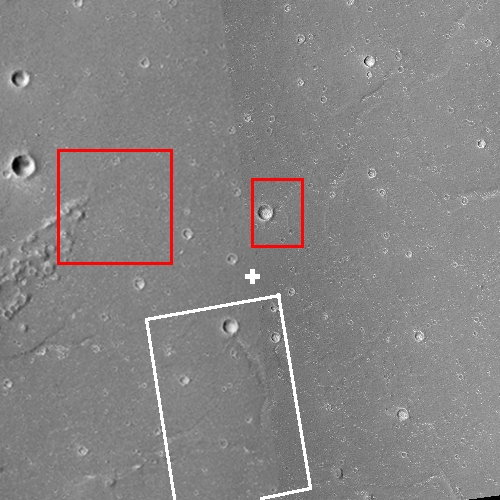
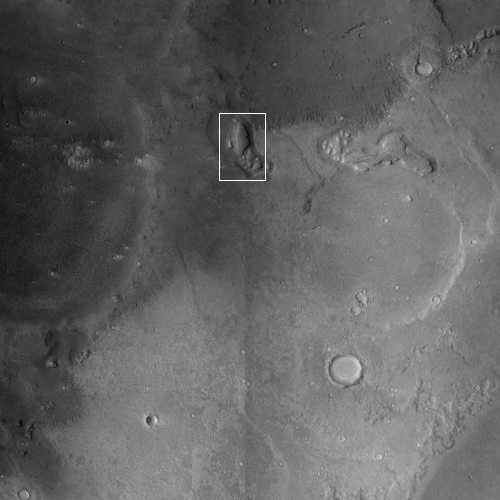
The location, as shown in the overview map below, makes this mesa more tantalizing.
» Read more

5 comments

Two Russian astronauts shift airlock on ISS during 7-hour spacewalk

With the help of the new European robot arm on the Russian half of ISS, two Russian astronauts completed a 7-hour spacewalk yesterday, successfully shifting a Russian airlock module to the new Nauka module on ISS.

The cosmonauts began their spacewalk at 11:01 p.m. Moscow time on Wednesday and spent seven hours and ten minutes outside the International Space Station (ISS). The main objective of their extravehicular activities was to transfer an airlock from the Rassvet module to the Nauka multi-purpose laboratory module. It was done with the help of the ERA robotic arm under the remote control of cosmonaut Andrey Fedyaev, who stayed aboard the ISS.

The work is part of an ongoing series of spacewalks required to complete the installation of Nauka to the station.

3 comments

Maxar sale closes and company goes private

With the purchase today for $6.4 billion of the satellite company Maxar by two private investment firms, its stock was removed from the NY stock exchange and is no longer traded publicly.

The company was acquired for $53 per share by the U.S. private equity firm Advent International and minority investor British Columbia Investment Management Corp. in a deal announced in December. “With the closing of the transaction, Maxar will remain a U.S.-controlled, owned and operated company,” the company said. Maxar’s common stock will also be delisted from the Toronto Stock Exchange.

Maxar started trading on the New York Stock Exchange and the Toronto Stock Exchange in 2017. It officially became a U.S. corporation in 2020 when the company spun off the Canadian subsidiary MDA.

The desire of these private investors to spend so much strongly indicates that Maxar has real value. It also indicates indirectly the strength of the emerging new commercial launch market. These investors clearly believe that this launch market will continue to grow and force the launch price of its satellites to go down.

1 comment

SpaceX launches 56 Starlink satellites into orbit

Using its Falcon 9 rocket, SpaceX tonight successfully placed 56 Starlink satellites into orbit, lifting off from Cape Canaveral.

The first stage completed its seventh flight, landing safely on a drone ship in the Atlantic. The two fairing halves completed their eighth and ninth flights, respectively.

The leaders in the 2023 launch race:

29 SpaceX
16 China
6 Russia
3 Rocket Lab
3 India

American private enterprise now leads China 32 to 16 in the national rankings, and the entire world combined 32 to 28. SpaceX now trails the rest of the world, including American companies, 29 to 31.

5 comments

In a Martian cold cauldron, boil and bake

bubbles and boiling ground
Click for original image.

Cool image time! My headline paraphrases slightly the witches’ chant from Shakespeare’s MacBeth, if only to make it more accurately describe the picture to the right, cropped and reduced to post here. Taken on January 5, 2023 by the high resolution camera on Mars Reconnaissance Orbiter (MRO), it shows a patch of mid-latitude terrain in the icy northern lowland plains of Mars.

While some of the craters here were certainly caused by impact, it is also likely that most were instead cryo-volcanic in nature, whereby ice bubbles up from below as changing temperature conditions — none of which need to be very warm — cause it to either melt temporarily into liquid or sublimate directly into a gas. The dark pimplelike hole on the picture’s right edge is a perfect example, with the hole sitting at the top of a cone.
» Read more

0 comments

SuperBIT balloon circling Antarctica snaps more high resolution astronomical pictures

Sombrero Galaxy
Click for full image.

The Super-Pressure Balloon Imaging Telescope (Super-BIT) that has been circling Antarctica for the last two weeks has now obtained two more more high resolution wide-field astronomical pictures.

The picture to the right, cropped to post here, is of Messier 104 (the Sombrero Galaxy). While the telescope cannot zoom in closer than this to such objects, it is able to get much wider and sharp pictures, covering an entire galaxy or nebula that ground-based telescope using adaptive optics (designed to counter the fuzziness caused by the atmosphere) cannot. Adaptive optics only work on very small fields of view, thus making it unable to observe some of the larger nearby astronomical objects like galaxies and nebulae.

If you look at the live stream of the balloon’s track, it has now almost completed its second circuit of Antarctica.

3 comments

Astronomers record moment star eats planet

Animation of a star eating a planet
Click to watch full animation.

Using data from a variety of space- and ground-based telescopes, astronomers now think they have recorded the moment a star similar to our Sun actually swallowed a planet thought to be comparable to Jupiter or smaller.

Once the science team put all the evidence together, they realized the dust they were seeing with NEOWISE [in orbit] was being generated as the planet spiraled into the star’s puffy atmosphere. Like other older stars, the star had begun to expand in size as it aged, bringing it closer to the orbiting planet. As the planet skimmed the surface of the star, it pulled hot gas off the star that then drifted outward and cooled, forming dust. In addition, material from the disintegrating planet blew outward, also forming dust.

What happened next, according to the astronomers, triggered the flare of optical light seen by ZTF [survey telescope in California]. “The planet plunged into the core of the star and got swallowed whole. As it was doing this, energy was transferred to the star,” De explains. “The star blew off its outer layers to get rid of the energy. It expanded and brightened, and the brightening is what ZTF registered.”

Some of this expanding stellar material then escaped from the star and traveled outward. Like the boiled-off layers of the star and planet that previously drifted outward, this material also cooled to form dust. NEOWISE is detecting the infrared glow of all the newly minted dust.

The picture above is a screen capture from a short artist’s animation created to illustrate what happened. The most amazing aspect of this event is how long the planet skimmed the surface of that star. It appears it did so for several orbits at least.

2 comments

The cliff wall of ancient Martian lava channel

The cliff wall of an ancient Martian lava channel
Click for original image.

Cool image time! The picture to the right, cropped, reduced, and sharpened to post here, was taken on January 17, 2023 by the high resolution camera on Mars Reconnaissance Orbiter (MRO) by the camera team not as part of any particular research project but in order to fill a gap in the camera’s schedule so as to maintain its proper temperature. In such cases the camera team tries to pick potentially interesting spots.

This cliff, about 1,100 feet high, is the north wall of a major volcano channel flowing across the Tharsis Bulge, the lava plains that surround Mars’ giant volcanoes. Located in the dry equatorial regions, there is no near surface ice here, but a lot of dust, much of it likely volcanic ash. In the full picture are several ancient craters, all of which are almost entirely buried by this dust and ash.

The cliff wall itself is made up of numerous layers, each representing a past volcanic flood lava event that covered this region with a new flow of material. These events occurred over more than a billion years.
» Read more

1 comment
1 356 357 358 359 360 1,327