The coming death of America

I have been so appalled and horrified by the events of the past three months, culminating in the riots and brutal violence and looting this past week, that I have found myself unable to express myself. I stand for freedom, for justice, for equal protection under law, and for our Constitution and Bill of Rights, fundamental documents that more than any philosophical tract ever written outline the most just way to run a country.

That country however appears to be dying, fast. It strongly appears that a large plurality, maybe even a majority, no longer believes in these ideals. This fact has made me depressed beyond words.

The speech below by Tucker Carlson however does a very good job of summing things up, based on facts, while making it clear what we must do to change this madness. He pulls no punches. He attacks every politician from both parties who have stood by or even supported the rioting and the nullification of our most basic laws. He demands better from them, and he demands that we, the citizenry, demand it as well.

I beg my readers to watch it. Set the speed at 1.25 and you can see it faster.

I also pray that some of my readers, after watching it, will recognize how deadly the situation really is, far beyond rioting, and how necessary it is for us to require proper behavior from our leaders, without exception, based on law and justice. No more race-baiting. No more apologies for enforcing the law meant to protect the innocent. No more cowardice. If our political leaders can’t protect everyone, then they must be fired. All of them.

And if we, the American people, still fail to recognize how bad things are and refuse to do something about it, then my headline above will simply be an accurate prediction. I weep to think I might be right.

I must also add that to understand what I mean, you must watch Carlson’s speech first. Otherwise, you will be doing exactly what I rage against.

58 comments

Forty Fingers – Bohemian Rhapsody

An evening pause: This is really badly filmed, with the camera constantly moving in a very distracting way, never stopping to actually let you watch them play. Very annoying.

However, the music is still magnificent, and the guitar arrangement is brilliant. Turn it on and listen as you do something else. You’ll enjoy it more.

Hat tip John Jossy.

0 comments

The strange squashed ridges at the basement of Mars

Squashed ridges at the basement of Mars
Click for full image.

Overview map

Cool image time! The photo on the right, cropped and reduced to post here, was taken by the high resolution camera on Mars Reconnaissance Orbiter (MRO) on April 9, 2020, and shows the very weird and very packed ridges and layers that are found routinely at the deepest part of Hellas Basin, what I have dubbed the basement of Mars.

Be sure to click on the image to see the full photograph. There’s lots more strangeness to see there. And be sure to read my post in the second link, which highlights a similarly strange set of packed ridges, and where I note:

This is the basement of Mars, what could be called its own Death Valley. The difference however is that unlike Death Valley, conditions here could be more amendable to life, as the lower elevation means the atmosphere is thicker.

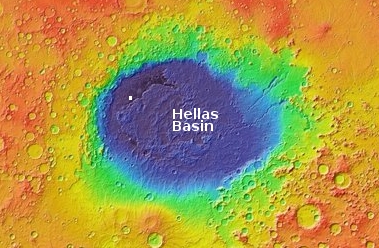
The context map to the right shows Hellas, with the location of today’s image indicated by the white box, close to basin’s lowest point, more than five miles below the basin’s rim. Overall the Hellas Basin is about the size of the western United States, from the Mississippi River to the Pacific Ocean. It is believed that the entire basin was created by a single gigantic impact that occurred about four billion years ago when the solar system’s inner planets were undergoing what has been labeled the Late Heavy Bombardment.

The specific process that formed these ridges, dubbed honeycomb terrain by scientists, remains unknown however. There are of course theories, none of which are very convincing. Here’s mine, as outlined in the previous post:
» Read more

4 comments

New proposal to end the “qualifified immunity” held by police

Justin Amash, former Republican and almost certainly to be out of Congress after the 2020 elections, has proposed a law that would eliminate the “qualified immunity” that police presently enjoy that prevents anyone from suing them personally for any egregious acts they commit.

U.S. Representative Justin Amash, a former Republican turned Libertarian, won support from a Minneapolis Democrat on Monday for his “Ending Qualified Immunity Act,” which would allow civil lawsuits against police, a recourse that the Supreme Court has all but done away with.

The high court’s adoption of the qualified immunity doctrine has largely shielded police from financial settlements for victims or grieving families. The doctrine protects cops even when courts determine that officers violate civil rights

As my wife Diane so eloquently notes, two things protect the police when they commit crimes, this qualified immunity and their police unions. If we want police to start behaving properly, we need to eliminate both. This law at least addresses the former.

Sadly, the bill probably stands little change of passage, mostly because of the Congressman proposing it. Amash used to be part of the very conservative Republican Freedom Caucus in the House. He then became a NeverTrumper willing to abandon all his principles (and his party) while sticking a knife in the backs of his former allies. This is why he is no longer a Republican, and why he almost certainly will be dumped come the 2020 elections.

No matter how wise his proposal might be, he has burned all the bridges he once had for getting any support. While he might get some in the Democratic Party to back him, most will turn their noses up at him because he is a former Republican. And the Republicans now want nothing to do with him.

This bill will unfortunately die, even though it is actually targeting very precisely one of the main causes of most police abuse. Such rationality is no longer given much play in our society. Instead, everyone else seems more interested in spouting hate and anger and rioting and destroying the lives of innocent people, out of blind emotional rage.

Such is a response now to the horrible murder by police of George Floyd. And it really is no different than the insane response to COVID-19: Rather than focusing rationally on the actual problem, our leaders — egged on by too many in the general population — instead focus on blaming and oppressing the wrong people.

23 comments

Second exoplanet confirmed orbiting Proxima Centauri

Worlds without end: Using archived Hubble data, astronomers have now independently confirmed the existence of a second exoplanet orbiting the nearest star, Proxima Centauri.

Dubbed Proxima c, this is not the same Earth-sized exoplanet confirmed to orbit the star last week. That planet, Proxima b, orbits close to the star every 11.2 days. The new planet is much farther out.

Benedict found a planet with an orbital period of about 1,907 days buried in the 25-year-old Hubble data. This was an independent confirmation of the existence of Proxima Centauri c.

Shortly afterward, a team led by Raffaele Gratton of INAF published images of the planet at several points along its orbit that they had made with the SPHERE instrument on the Very Large Telescope in Chile.

Benedict then combined the findings of all three studies: his own Hubble astrometry, Damassoโ€™s radial velocity studies, and Grattonโ€™s images to greatly refine the mass of Proxima Centauri c. He found that the planet is about 7 times as massive as Earth.

Though I am unaware of any hints of additional planets orbiting Proxima Centauri, the presence of two strongly implies the likelihood of more.

3 comments

Smallest satellite yet detects exoplanet

The smallest satellite yet, a cubesat, has demonstrated the potential of cubesats to do real cutting edge astronomy by successfully detected a known exoplanet.

Long before it was deployed into low-Earth orbit from the International Space Station in Nov. 2017, the tiny ASTERIA spacecraft had a big goal: to prove that a satellite roughly the size of a briefcase could perform some of the complex tasks much larger space observatories use to study exoplanets, or planets outside our solar system. A new paper soon to be published in the Astronomical Journal describes how ASTERIA (short for Arcsecond Space Telescope Enabling Research in Astrophysics) didn’t just demonstrate it could perform those tasks but went above and beyond, detecting the known exoplanet 55 Cancri e.

Scorching hot and about twice the size of Earth, 55 Cancri e orbits extremely close to its Sun-like parent star. Scientists already knew the planet’s location; looking for it was a way to test ASTERIA’s capabilities. The tiny spacecraft wasn’t initially designed to perform science; rather, as a technology demonstration, the mission’s goal was to develop new capabilities for future missions. The team’s technological leap was to build a small spacecraft that could conduct fine pointing control – essentially the ability to stay very steadily focused on an object for long periods.

…The CubeSat used fine pointing control to detect 55 Cancri e via the transit method, in which scientists look for dips in the brightness of a star caused by a passing planet. When making exoplanet detections this way, a spacecraft’s own movements or vibrations can produce jiggles in the data that could be misinterpreted as changes in the star’s brightness. The spacecraft needs to stay steady and keep the star centered in its field of view. This allows scientists to accurately measure the star’s brightness and identify the tiny changes that indicate the planet has passed in front of it, blocking some of its light.

This success is mostly a proof of concept, but it lays the groundwork for less expensive future space astronomy, using low cost cubesats capable of doing what the expensive orbiting space telescopes have done so far.

1 comment

Musk confirms cause of most recent Starship prototype failure

Capitalism in space: During a press event following the successful launch of SpaceX’s first manned Dragon, Elon Musk confirmed that the cause of the most recent Starship prototype failure was a leak at the connection point, called a quick disconnect or QD, for one of the umbilical cords that fuel the spacecraft.

If so, this cause is generally good engineering news, as it indicates the problem was not related to the prototype itself but with equipment that is more easily fixed. The article at the link notes:

Given that Starships are currently being tested independently on spartan launch mounts, itโ€™s unclear if the current generation of prototypes has been outfitted with advanced QD panels. More likely, Musk was referring to a test of a less advanced QD panel similar to the rough version used on Starhopper last year, and SpaceX simply wanted to test its ability to disconnect and reconnect to Starship on command.

The explosion itself had not only completely destroyed the prototype, it rendered the test stand unusable. Yet, as another demonstration of SpaceX’s agility and competence as a company, the test stand was “fully dismantled and scrapped in the two days since the anomaly.”

Two days! More important, the fifth prototype is ready to go, with a sixth almost finished. They expect to resume tests before the end of the month.

4 comments

On the radio

For those that wish to listen to me talk about this weekend’s success by SpaceX, I am right now going on the air with Robert Pratt on Pratt on Texas, aired on 790-AM KFYO in Lubbock, 1470-AM KYYW in Abilene, and 1290-AM KWFS in Wichita Falls.

9 comments

Thar’s ice in them Martian hills!

Icy mountains in Erebus Montes?
Click for full image.

Overview map of Starship landing site images

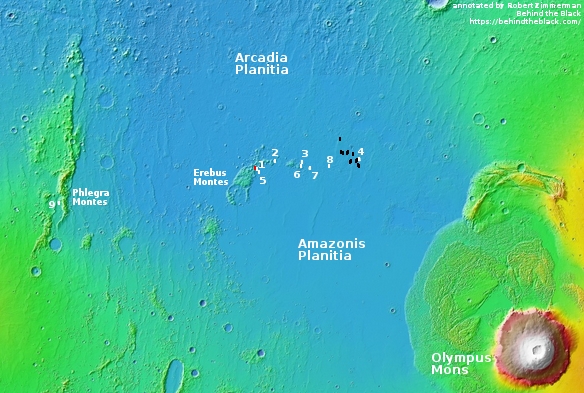
Cool image time! Today we return to the Erebus Mountains, located just to the west of SpaceX’s prime candidate landing site for Starship on Mars. The photo to the right, taken on April 4, 2020 by the high resolution camera on Mars Reconnaissance Orbiter (MRO) and rotated, cropped, and reduced to post here, shows one particular area between the peaks in those mountains, and also happens to be very close to what I have labeled image #1 in SpaceX’s Starship landing site photos.

The second image below and to the right shows an overview map of this region, with the SpaceX photos indicated by the numbered white boxes and the location of this image indicated by the red box, right next to image #1. The black boxes were images that SpaceX had obtained from MRO earlier, when it was first planning to send a Dragon capsule to Mars using a Falcon Heavy, a project the company has put aside in its focus on building Starship.

To my eye, everything in the first image above reeks of an icy, glacial terrain. I certainly am guessing, but it is an educated guess based on looking at numerous similar images in this region (see here and here, ) as well as in the nearby Phlegra mountains to the west. I also base my guess on what I have learned interviewing planetary scientists who are studying these images. The reasonableness of this guess is further strengthened in that the location is at 39 degrees north latitude, dead center in the mid-latitude bands where scientists have found evidence of numerous buried glaciers.

If Starship lands just to the east of the Erebus Mountains, the first colonists will likely not only have water available at their feet close to the surface in the flat lowland plains, if they find that resource insufficient they will need only climb uphill a bit into these hills to dig out as much ice as they could ever need.

0 comments
1 6 7 8