
Eddy Grant – Electric Avenue
An evening pause: Hat tip Diane Zimmerman.
An evening pause: Hat tip Diane Zimmerman.
China has rolled out its Long March 5 rocket and is now preparing to launch its Tianwen-1 orbiter/lander/rover to Mars this coming Thursday, July 23rd, some time between 12 am and 3 am (Eastern).
A Long March 5 rocket is set for liftoff with China’s Tianwen 1 mission some time between 12 a.m. and 3 a.m. EDT (0400-0700 GMT) Thursday, according to public notices warning ships to steer clear of downrange drop zones along the launcher’s flight path.
Chinese officials have not officially publicized the launch date. Chinese state media outlets have only reported the launch is scheduled for late July or early August, and officials have not confirmed whether the launch will be broadcast live on state television.
This will be the first operational launch of the Long March 5, which has had three previous test launches, with the first two failing. The success of the December launch, as well as the May success of the related Long March 5B, made this Mars mission possible.
After achieving orbit in February 2021 and spending two months scouting the landing site, the lander will descend to the surface, bringing the rover with it. The prime landing site is Utopia Planitia, in the northern lowland plains.

Click for full image.
Today’s cool image is not only cool, it gives a nice feel for the likely shallow ice table that is probably found close to the surface throughout the lowland northern plains of Utopia Planitia, which is also the prime landing site for China’s Taenwen-1 Mars lander/rover, scheduled for launch sometime in the next four days. [Update: there are now indications the launch will not occur until early August.]
The photo to the right, rotated, cropped, and reduced to post here, was taken on May 9, 2020 and shows a nice collection of strange land forms on the western edge of Utopia Planitia. In this one picture we can see large mounds that might be evidence of cryovolcanic activity (mud volcanoes), strings of small mounds that might be the same but that also suggest underground faults and voids, and distorted and eroded craters that could have buried glacial material in the interiors.
The largest crater in the upper left looks like it is actually filled with ice that has also spilled over to fill the adjacent and linked depression.
This location is quite typical of Utopia Planitia. See for example this post from May 13, 2020: The blobby wettish flows of Mars. In the mid-latitudes here we find ample evidence that buried very close to the surface is an ice table that when hit by an impact melts to form these strangely shaped craters.
China’s actual target landing area is far to the east of today’s cool image, in an area that is appears far less rough. » Read more
Using computer models and past radar images from orbiters, scientists now believe that Venus could have as many as 37 active volcanoes.
The type of feature on Venus they think might still be active is called a coronae, circular features detected by radar and distinct to this planet that have been thought to be inactive ancient volcanic features.
In the new study, the researchers used numerical models of thermo-mechanic activity beneath the surface of Venus to create high-resolution, 3D simulations of coronae formation. Their simulations provide a more detailed view of the process than ever before.
The results helped Montési and his colleagues identify features that are present only in recently active coronae. The team was then able to match those features to those observed on the surface of Venus, revealing that some of the variation in coronae across the planet represents different stages of geological development. The study provides the first evidence that coronae on Venus are still evolving, indicating that the interior of the planet is still churning.
Lots of uncertainty here, but nonetheless this is good science. It also reinforces other evidence in recent years that has suggested active volcanism on Venus.
Capitalism in space: For the first time SpaceX yesterday successfully caught both fairings halves in the nets of their ships as they floated down to the ocean on their parasails.
Previously they have mostly plucked the fairings from the sea, though they have caught a few in the netting of the ships. To catch both simplifies the preparation for the next flight enormously, as they never touched the water.
Click for full image.
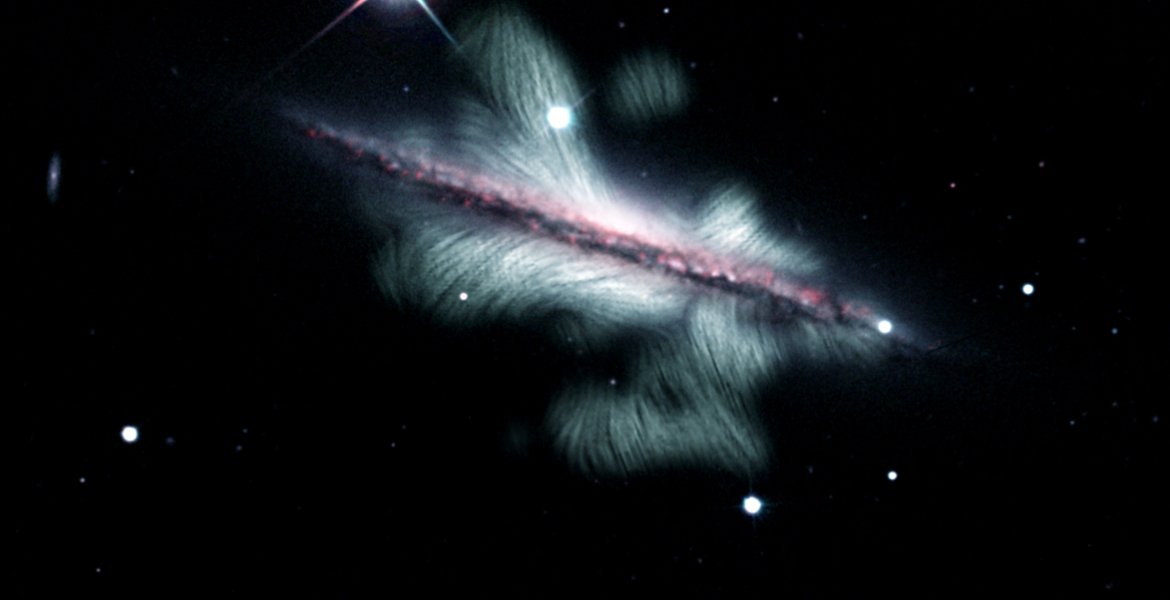
Using a variety of telescopes, especially the Jansky Very Large Array radio telescope, astronomers have successfully mapped the magnetic field lines of a spiral galaxy seen edge on and 67 million light years away.
The image to the right, cropped and reduced to post here, shows what they have found.
The magnetic field lines extend as much as 22,500 light-years beyond the galaxy’s disk. Scientists know that magnetic fields play an important role in many processes, such as star formation, within galaxies. However, it is not fully understood how such huge magnetic fields are generated and maintained. A leading explanation, called the dynamo theory, suggests that magnetic fields are generated by the motion of plasma within the galaxy’s disk. Ideas about the cause of the kinds of large vertical extensions seen in this image are more speculative, and astronomers hope that further observations and more analysis will answer some of the outstanding questions.
Our understanding of these kinds of gigantic magnetic fields is poor, to put it mildly. This data really only begins the research.
The tenth anniversary retrospective of Behind the Black continues: This essay was posted originally on July 20, 2010, then reposted on July 20, 2011, to celebrate the anniversary of the Apollo 11 landing on the Moon. It seems fitting to post it again, on this, the 51st anniversary of that landing.
————————–
A flag in the dust
Today, July 20th, is the anniversary of the Apollo 11 landing on the Moon, the first time ever that a human being arrived on another planet. Americans love to celebrate this event, as it symbolizes one of the finest moments in our history, when we set out to achieve something truly great and noble and succeeded far better than we could have imagined. Not only did we get to the Moon as promised, over the next three and a half years we sent another five missions, each with increasingly sophisticated equipment, each sent to explore some increasingly alien terrain. Forty-plus years later, no one has come close to matching this achievement, a fact that emphasizes how difficult it was for the United States to accomplish it.
There is one small but very important detail about the Apollo 11 mission, however, that most Americans are unaware of. » Read more
An evening pause: For this anniversary of Neil Armstrong’s first step on the Moon, a short musical piece, with images, that nicely encapsulates that 1960s space effort. If you are passionate about the human effort to become a space-faring civilization and you don’t know who and what mission each clip portrays, you need to find out.
They’re coming for you next: The Democrat prosecutor in St. Louis, circuit attorney Kim Gardner, who would eagerly ban you from owning guns and would also gladly defund the police, has issued criminal charges against the St. Louis couple for using their guns to protect their home from trespassing and threatening Antifa/BLM protesters.
The charge relates to them “flourishing” the guns while standing on their own property in order to ward off trespassers who were verbally and physically threatening them.
This is the Democratic Party today. Not only should you be denied the right to own guns, if you do own them you will not be allowed to defend your life with them. Moreover, there must not be any police available to enforce the law. These Democrats will also give carte blanche to any protesters they agree with, allowing them to trespass on your property and do what they will with you, in the name of free speech.
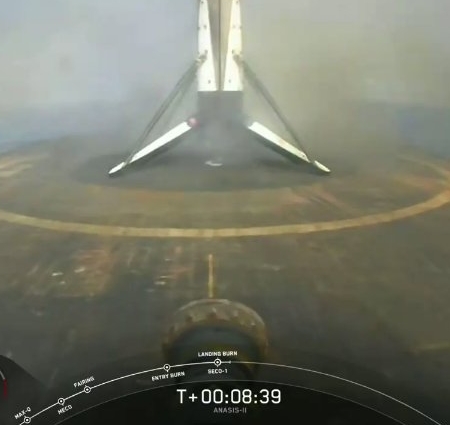
Capitalism in space: SpaceX today successfully launched a South Korean military satellite, with its Falcon 9 rocket using the same first stage that launched two American astronauts to ISS less than two months ago.
This was the company’s fastest turnaround yet of a used first stage, 51 days, which also beats the fastest turnaround ever by the shuttle program, 54 days. And as you can see by the screen capture image to the right, they successfully landed it so that it can be used for a third time.
Watching the camera on that first stage after separation (on SpaceX’s live stream) to landing was most fascinating. After separation its tail end points down to the west and its launch site in Florida. As it curves upward and then down towards its landing in the Atlantic, its small thrusters and grid fins very slowly and gracefully swing that tail to instead point east and down to the drone ship. I had not noticed previously the gentleness of that re-positioning. The daylight clear weather today, plus excellent camera access, made it very obvious.
The leaders in the 2020 launch race:
16 China
11 SpaceX
7 Russia
3 ULA
3 Japan
The U.S. now leads China in the national rankings, 18 to 16.
The Texas Republican Party yesterday ousted its chairman to give former congressman and hard-nosed conservative Allen West the job.
Conservative firebrand and former Florida congressman Allen West will lead the Texas Republican Party into the 2020 election, after ousting the current chairman early Monday during a convention marred by technical difficulties. He vowed to use his post to push back against Democrats’ “progressive socialism.”
“I am sick and tired of Republicans being on their heels, being on the defense, always being reactionary with a party that as we see right now– they don’t stand up for the rule of law, they stand for rule of the mob,” he said during a victory lap on conservative media.
If anything, this decision indicates the continuing shift in the Republican Party from the milquetoast go-along-to-get-along types to those willing to fight the Democrats on all fronts. One of the reasons West lost his seat in Congress is because past Republican leadership looked at him with distaste, refusing to give him the kind of support he needed. That is now changing.
Today there were many many news stories touting the successful launch of the United Arab Emirates’ (UAE) first interplanetary probe, Hope, (al-Amal in Arabic), successfully launched yesterday from Japan. This story at collectSpace is typical, describing the mission in detail and noting its overall goals not only to study the Martian atmosphere but to inspire the young people in the UAE to pursue futures in the fields of science and engineering.
What most of these reports gloss over is how little of Hope was really built by the UAE. The UAE paid the bills, but during design and construction almost everything was done by American universities as part of their education programs, though arranged so that it was UAE’s students and engineers who were getting the education.
» Read more
The tenth anniversary retrospective of Behind the Black continues: Tonight’s repost adds more weight to yesterday’s about the uncertainty of any model predicting global warming. Rather than look at the giant gaps in our knowledge, this essay, posted on January 28, 2019, looked at the data tampering that government scientists are doing to their global temperature databases in order to make the past appear cooler and the present appear warmer.
——————————-
The absolute uncertainty of climate science
Even as the United States is being plunged right now into an epic cold spell (something that has been happening repeatedly for almost all the winters of the past decade), and politicians continue to rant about the coming doom due to global warming, none of the data allows anyone the right to make any claims about the future global climate, in any direction.
Why do I feel so certain I can make this claim of uncertainty? Because the data simply isn’t there. And where we do have it, it has been tampered with so badly it is no longer very trustworthy. This very well documented post by Tony Heller proves this reality, quite thoroughly.
First, until the late 20th century, we simply do not have good reliable climate data for the southern hemisphere. Any statement by anyone claiming to know with certainty what the global temperature was prior to 1978 (when the first Nimbus climate satellite was launched) should be treated with some skepticism. Take a look at all the graphs Heller posts, all from reputable science sources, all confirming my own essay on this subject from 2015. The only regions where temperatures were thoroughly measured prior to satellite data was in the United States, Europe, and Japan. There are scattered data points elsewhere, but not many, with none in the southern oceans. And while we do have a great deal of proxy data that provides some guidance as to the global temperature prior to the space age, strongly suggesting there was a global warm period around the year 1000 AD, and a global cold period around 1600 AD, this data also has a lot of uncertainty, so it is entirely reasonable to express some skepticism about it.
Second, the data in those well-covered regions have been tampered with extensively, and always in a manner that reinforces the theory of global warming. Actual temperature readings have been adjusted everywhere, always to cool the past and warm the present. As Heller notes,
» Read more
A close look at the infection rate based on the increased number of tests in the past two months suggests that by election day the entire country will be close to herd immunity, and that quite possibly 40% of the population is already immune.
As of July 17, 44.2 million people have been tested, with 3.63 million positives (8.2%). Those folks who tested negative either never contracted COVID-19 or had it (with or without symptoms) and recovered.
…One eighth of the country [44.2 million] already tested is a very large sample, statistically. Applying the 8% baseline infection rate to the entire population, this means that every week after the beginning of April, another 2.67% of the people in the U.S. had recovered from COVID-19, were immune and non-contagious, and were not a threat to anybody. These numbers are additive. By July 17 (15 weeks), 40% of the country is now immune to the coronavirus, whether or not these people know it, and they cannot infect anybody else (for as long as the period of immunity lasts, likely well into the fall).
We can use the trajectory of the “hot spots” in March and April (which peaked about mid-April) to estimate the future trajectory of the percent of nationwide positive COVD-19 test results — which are now less than 2% in the former hot-spot areas — as the current set of “hot spots,” which are currently at peak, subside. I roughly estimate the following: for August, 5.4%; September, 4.0%; October, 2.1%. On the day you go to the polls to vote for either Orange Man or Senator Senex, by my estimate, 62% of the country will be immune to COVID-19, which is close to herd immunity.
And yes, there is uncertainty here, but the analysis appears reasonable, based on the number so far tested and the numbers found to test positive. It also matches what a reasonable person should expect from this respiratory disease.
Of course, because it suggests we have a lot to be optimistic about the Wuhan virus, this analysis must be dismissed immediately, out of hand. It just can’t be right. We are all gonna die from COVID-19 and that’s it.
According to the university consortium building the Thirty Meter Telescope (TMT), they will make no attempt to begin construction until the end of winter in 2021.
According to the official spokesman, the consortium remains committed to building the telescope in Hawaii on Mauna Kea, but I do not see how it will ever happen. The present Democratic government supports the protesters, and there is no chance that government will ever be voted out of power.
Based on this information, I do not think TMT will ever be built, anywhere.
The new colonial movement: The United Arab Emirates first interplanetary probe, its Hope Mars Orbiter, was successfully launched by a Mitsubishi H-2A rocket today from Japan, and is now on its way to Mars.
It will arrive in February 2021, when it will attempt to inject itself into orbit, where it will then be used to study the Martian weather.
The leaders in the 2020 launch race:
16 China
10 SpaceX
7 Russia
3 ULA
3 Japan
The U.S. still leads China in the national rankings, 17 to 16.
The tenth anniversary retrospective of Behind the Black continues: Tonight’s repost, from 2015, can be considered a follow-up to yesterday’s. While many global warming activists are absolutely certain the climate is warming — to the point of considering murder of their opponents a reasonable option — the actual available data is so far from certain as to be almost ludicrous.
——————————-
The uncertainty of climate science
For the past five years, I have been noting on this webpage the large uncertainties that still exist in the field of climate science. Though we have solid evidence of an increase of carbon dioxide in the atmosphere, we also have no idea what the consequences of that increase are going to be. It might cause the atmosphere to warm, or it might not. It might harm the environment, or it might instead spur plant life growth that will invigorate it instead. The data remains inconclusive. We really don’t even know if the climate is truly warming, and even if it is, whether CO2 is causing that warming.
While government scientists at NASA and NOAA are firmly in the camp that claims increasing carbon dioxide will cause worldwide disastrous global warming, their own data, when looked at coldly, reveals that they themselves don’t have sufficient information to make that claim. In fact, they don’t even have sufficient information to claim they know whether the climate is warming or cooling! My proof? Look at the graph below, produced by NOAA’s own National Centers for Environmental Information.
» Read more
Embedded below post in two parts.
» Read more
We now have substantial evidence going back years — well before its illegal misuse of the FISA court — that the Obama administration and officials in its FBI and Justice Department misused National Security Agency (NSA) databases to illegally spy on its political opponents.
The article at the link is very long and detailed, but this is necessary to unpack the history that not only documents that spying before 2016, but why Justice and FBI high officials felt compelled then to use a fake dossier paid for by the Clinton campaign to get a warrant from the FISA court. Once they lost access to the NSA databases that year, they needed something that would allow them to continue that spying.
During the time-frame of December 2015 through April 2016 the NSA database was being exploited by contractors within the intelligence community doing unauthorized searches. On March 9, 2016, oversight personnel doing a review of FBI system access were alerted to thousands of unauthorized search queries of specific U.S. persons within the NSA database.
NSA Director Admiral Mike Rogers was made aware. Subsequently NSA Director Rogers initiated a full compliance review of the system to identify who was doing the searches; & what searches were being conducted. On April 18, 2016, following the preliminary audit results, Director Rogers shut down all FBI contractor access to the database after he learned FISA-702 “about”(17) and “to/from”(16) search queries were being done without authorization.
In other words, the NSA database of phonecalls between Americans, an illegal database in its own right (the Constitution forbids such indiscriminate spying on Americans without a warrant), was being used by unauthorized individuals to gain information on Americans. From the article it becomes clear that those individuals were Obama administration operatives, and the Americans they were digging dirt on were their political opponents.
When Rogers shut down access to this keyhole, it was then necessary to instigate an unjustified warrant from the FISA court to allow these same Obama officials the right to continue their spying. At the same time they also instigated an effort to get Rogers fired.
What infuriates me about this is that even now, years later, no one has been indicted for any of these clearly illegal acts, despite substantive and documented evidence. We get reports, we get leaks, we get outraged Congressman on cable networks, and we get Trump tweets ranting about how terrible it is. What we don’t get is anyone behind bars.
Because of the crash in customer demand due to the Wuhan virus panic, British Airways has abruptly retired its entire fleet of 747s.
This retirement had been planned, as the 747 is expensive to operate. The airline had planned however to phase them out over several years. Now they simply don’t need them, as they are flying so few passengers.
I am fortunate that I got to fly on one in 2019, in a vacation trip to Wales with Diane. This might have been the only time I ever flew on a 747, and it was a remarkably smooth flight, both during take-off and landing. It is sad to see this magnificent American achievement finally leave us.