Audiobook of Genesis: the story of Apollo 8 now available

I am pleased to announce the release of the audiobook edition of Genesis: the story of Apollo 8. From the official press release:

This year marks the fiftieth anniversary of one of mankind’s boldest adventures, the first manned flight to another world. To mark the occasion, an audio version of the first book about the mission of Apollo 8 has been released, narrated by Grover Gardner, a legend in the ears of fans of audiobooks all over the planet.

Says Valerie Anders, wife of Apollo 8 crew member Bill Anders, “When I first read this excellent account, published before the end of the space shuttle era, I was delighted.”

Now, with the advent of high quality audio books and online merchants like iTunes and Audible, and the resonant and expressive voice of narrator Grover Garner, everyone can enjoy this recording of this pivotal moment in space history.

While more recent books have been published on the mission of Apollo 8 (most of which rely heavily on Zimmerman’s work), none has captured the impact the Apollo program had on the families of the astronauts nearly so well as “Genesis – the story of Apollo 8.” The new forward to “Genesis,” by Valerie Anders, contains a moving tribute to those pilots who never returned from their missions – not as faraway as the moon, but just as dangerous and far more frequent.

This audio presentation also includes a preface and afterward recorded by the author, Robert Zimmerman, noted science journalist, a member of the National Association of Science Writers, and winner of numerous awards. Grover Gardner has been the narrator of more than 500 books, including many of the most popular audio books ever recorded, including the three part biography of Lyndon Johnson by Robert Caro and Ron Chernow’s Alexander Hamilton. AudioFile magazine refers to him as “one of the best voices of the century.”

“Genesis – the story of Apollo 8” was produced for audio distribution by space fan and Army Lt Colonel William Hartel, who spends his work days as a professor of dentistry at the University of Tennessee. It is available wherever audiobooks are sold and runs 9 hours and 33 minutes.

Contact info: William Hartel, whartel123@aol.com 314-402-5227

You can listen to Grover Gardner’s reading of the foreword by Valerie Anders here.

The audiobook can be purchased directly from all the standard vendors. Or you can get it free with a 30-day trial membership in Audible for $19.99. This costs $2 more than buying the book direct, but this free trial deal will give me a much bigger cut per sale. If you support what I am doing, consider it.

And as always, for those who prefer to read, the ebook edition is also available.

5 comments

Hollywood once again reveals its distaste for America

The just released new Hollywood movie detailing the life of Neil Armstrong, First Man, has so far gotten rave reviews.

Sadly, however, there is one detail about the Apollo 11 mission that the filmmakers decided they couldn’t include, even though it was in many ways the entire point of the mission. They made a conscious decision to exclude any mention of the planting of the American flag on the surface of the Moon.

Star Ryan Gosling, who plays Armstrong, defended director Damien Chazelle’s decision to omit the star-spangled moment when asked about it in Venice. “I think this was widely regarded in the end as a human achievement [and] that’s how we chose to view it, ” Gosling said per the Telegraph. “I also think Neil was extremely humble, as were many of these astronauts, and time and time again he deferred the focus from himself to the 400,000 people who made the mission possible.”

The Canadian actor added that based on his own interviews with Armstrong’s family and friends, he doesn’t believe the pioneering astronaut considered himself an American hero. “I don’t think that Neil viewed himself as an American hero,” Gosling said. From my interviews with his family and people that knew him, it was quite the opposite. And we wanted the film to reflect Neil.” [emphasis mine]

This is bunk. All the astronauts who flew to the Moon were very aware that they were warriors in the Cold War against the Soviet Union and communism, and did it very consciously so that the U.S. could win that space race, for the U.S. Planting the flag was thus for them a very important aspect of the mission, maybe in many ways the most important.

That these Hollywood filmmakers purposely excluded that moment only illustrates to me once again the hostility, even hate, that the modern elitist culture has for the United States and everything it has stood for since 1776: freedom, blind justice before the law, and individual responsibility. Here it appears they are making an effort to separate that very decidedly American culture, which made the lunar landing possible, from that achievement. They want to honor Armstrong as an individual, but do not want to give any credit to the country and culture that sent him to the Moon. Instead, they want to claim that the Apollo landings were merely “a human achievement.”

For shame.

This makes me very unwilling to spend any money to see this movie. Why should I support the work of such intellectually dishonest people?

I must add that I have already been emailed by several readers who are similarly outraged. I wonder therefore if this will turn into something that will actually hurt ticket sales. I suspect not, as too many Americans today do not care very much about these issues. They will go to be entertained, and many will buy into the lie that the Apollo missions was an achievement not of America but of the entire global world, working together in love and peace.

70 comments

The search for Mars Polar Lander

A small section where Polar Lander might have crashed

In December 1999 the U.S. lander Mars Polar Lander was to set down near the southern polar cap of Mars. After an almost routine eleven month journey to Mars, all efforts to contact the spacecraft after its landing failed. A NASA review eventually concluded that the spacecraft had prematurely shut down its landing engines while the spacecraft was still far above the surface, and had therefore crashed to the ground.

Since then there have been extensive efforts to locate the lander’s remains on the surface, all to no avail. Though Mars Global Surveyor, in orbit at the time, tried to find it, its resolution was not sufficient. In recent years Mars Reconnaissance Orbiter (MRO) has taken several dozen high resolution images of the estimated landing area, two of the most recent were included in the August 2018 image release. The image on the right is a cropped section of one of those images, illustrating the difficulty of the search. (If you click on the image you can explore the full version.) The other image is quite similar.

As the southern polar cap shrinks and grows seasonally, it produces endless numbers of black spots from the release of underground dust as the carbon dioxide dry ice sublimates into gas. Moreover, the growth and retreat of the dry ice cap changes the landscape, periodically covering any remains of the rover as well as quickly removing many of the ground disturbances that the crash might have caused. In the almost two decades since the lander’s crash landing, about ten Martian years have passed, meaning that cap has melted and frozen ten times over this region in that time.

Images taken by MRO of Mars Polar Lander landing area

The image on the right shows the footprint of all the images that MRO has so far taken of the Mars Polar Lander landing area. If you are ambitious and want to get your name in the news, all you have to do is spend some time combing through those images and find the lander there. Every one of these images is available for public download at full resolution. Go to HiRise image archive, hover your mouse over latitude 77 degrees south, longitude 166 degrees east, and click several times to zoom in. You then change the selector icon at the top from “+” to “the arrow”. When next you click on any portion of that footprint it will show you a bunch of the images taken, all of which you can now download and inspect.

If you are successful and find the lander, please let me know. It would be nice to make that announcement here on Behind the Black.

0 comments

Trump administration goes all in for LOP-G

The swamp wins! In a speech today Vice President Mike Pence made it clear that the Trump administration is giving its full endorsement to the construction of the Lunar Orbiting Platform-Gateway (LOP-G), as well as SLS and Orion. These big boondoggles, which will trap us in lunar orbit while the Chinese set up lunar bases and take possession of the surface and its resources, are going forward, with both the president’s support as well as Congress’s.

Providing further evidence that the Trump administration has bought into these projects, in his introduction of Pence NASA administrator Jim Bridenstine gave a big public endorsement to the executive secretary of the National Space Council, Scott Pace, a man who has been a big supporter of these projects of the bureaucracy. Pace believes we need these projects, despite the fact that they have been under construction for two decades, have cost an ungodly amount, and have literally flown nowhere.

Pence also said that they intend to have the space force a reality by 2020, and also hinted that the Trump administration is making a careful review on the future of ISS.

Overall, the speech was a big endorsement for government space, in every way, with the private sector designed not to lead as free Americans following their personal dreams but to follow, servants of the desires of the government and its wishes.

If you want to listen to about 30 minutes of pro-government promotion, I expect it will be posted here at some point.

20 comments

Oblique mosiac of bright spot on Ceres

Cerealia Facula on Ceres

Cool image time! With the Dawn spacecraft now swooping with 22 miles of the surface of Ceres every 27 hours, the science team has assembled a spectacular oblique image of Cerealia Facula, one of the dwarf planet’s bright spots thought to be brine deposits that at some point erupted up from below the surface.

The image on the right, reduced in resolution to show here, shows that mosaic. If you click on the image you can see the full resolution version. From the image webpage:

This mosaic of Cerealia Facula combines images obtained from altitudes as low as 22 miles (35 km) above Ceres’ surface. The mosaic is overlain on a topography model based on images obtained during Dawn’s low altitude mapping orbit (240 miles or 385 km altitude). No vertical exaggeration was applied.

There are a lot of intriguing details in the full resolution image. I have highlighted one feature, indicated by the white box and shown in full resolution below.
» Read more

4 comments

3D-printed solar panels for cubesats!

A solar panel for a cubesat

The image on the right was sent to me last night by engineer Joe Latrell. It shows a 3D-printed solar panel designed for use on a cubesat. As he wrote,

[This is] the first integration of a solar panel with the 3D printed material. The panel is not attached but rather embedded in the plastic during the printing process. This helps protect the panel from transport damage and makes it easier to assemble the final satellite. This design needs a slight adjustment but is almost there.

What makes Joe’s work most interesting is where he is doing it. Last week, in posting a link to a story about a Rocket Lab deal that would make secondary payloads possible on its smallsat rocket Electron, I noted that things were moving to a point where someone could build a satellite for launch in his garage.

This in turn elicited this comment from Joe:

As a matter of fact, I am building a PocketQube satellite for launch in Q3 2019. Yes, I am working in a small shop – just behind the garage. Nothing fancy but the price was right. I am working with Alba Orbital and the flight is scheduled on the Electron. These are very exciting times.

Alba Orbital is smallsat company aimed at building lots of mass produced smallsats weighing only about two pounds.

Anyway, Joe then followed up with another comment with more information:

This first [satellite] is just to see if it can be done. I plan to have it take a couple images and relay data regarding the orientation methods I am planning to use (gravity and magnetic fields). If it works, I am hoping to get funding to develop a small series of satellites to track global water use.

It is also a good way to test some of the materials I think would make spacecraft lighter and cheaper.

Yesterday he sent me the above image. This is the future of unmanned satellites and planetary probes, small, light, cheap, and built with 3D printers by single entrepreneurs. And because of their inexpensive nature, the possibilities for profit and growth are truly almost infinite, which in turn will provide developments that make space travel for humans increasingly smaller, lighter, cheaper, and easier to build as well.

To repeat Joe’s comment, these are very exciting times.

7 comments

Roscosmos in the news!

Three news stories from Russia, two from today and one from last week, provide us a flavor of the kind of space stories that come out of Russia almost daily, either making big promises of future great achievements, or making blustery excuses for the failure of those big promises to come true.

In the first the head of Roscosmos, Dmitry Rogozin, rationalizes the failure of Russia to compete successfully with SpaceX.
» Read more

7 comments

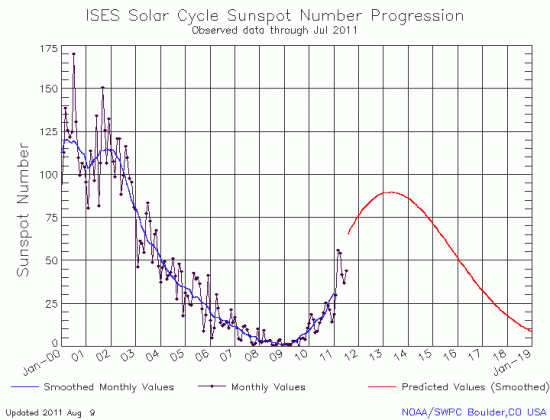
Sunspot update for July 2018: The Sun flatlines!

Yesterday NOAA posted its monthly update of the solar cycle, covering sunspot activity for July 2018. As I do every month, I am posting it below, annotated to give it some context.

This might be the most significant month of solar activity that has been observed since Galileo. Except for two very short-lived and very weak sunspots that observers hardly noted, the Sun was blank for entire month of July. This has not happened since 2009, during the height of the last solar minimum.

What makes this so significant and unique is that it almost certainly signals the return of the next solar minimum, a return that comes more than a year early. The solar cycle the Sun is now completing has only been ten years long. It is also one of the weakest in more than a hundred years. This combination is unprecedented. In the past such a weak cycle required a long cycle, not a short one.
» Read more

9 comments

Landslide on Mars

Landslide on Mars

Cool image time! The image on the right, cropped and reduced in resolution to post here, was taken by Mars Reconnaissance Orbiter on May 30, 2018. It shows the remains of a landslide where it appears a huge chunk of the cliff face broke off and then flowed downward, pushing ahead of it more material to produce a tongue of debris more than four miles long. (If you click on the image you can see the full photograph.)

The picture invokes a spectacular single event. When the cliff broke off, it hit the ground below it like a rock would in wet beach mud. Like wet sand, the ground was pushed away in a muddy gloppy mess.

Is this terrain wet however? The location of this landslide provides some intriguing geological context. Below are two context images, showing this landslide’s location on Mars.
» Read more

0 comments

A vegetable grater on Mars

A vegetable grater on Mars

Cool image time! I honestly can’t think of any better term but “vegetable grater” to describe the strange surface in the image on the right, cropped from the full sized image that was released with the July 11, 2018 monthly release of new images from the high resolution camera on Mars Reconnaissance Orbiter (MRO).

If you click on the image you can see the whole image, which merely shows more of the same terrain over a wider area. When I cropped it, I literally picked a random 450×450 pixel-sized area, since other than slight variations the entire terrain in the full image is as equally rough. The resolution captures objects as big as five feet across.

Looking at the full image there does seem to be flow patterns moving across the middle of the image, but if so these flow patterns had no effect on the surface roughness, other than indicating a very slight difference in the size of the knobs and pits. Overall, very strange.

The location of this place on Mars is in the cratered southern highlands, to the southwest of Hellas Basin, as indicated by the black cross in the image below.
» Read more

2 comments

“They’re coming for you next.”

This week we had a number of really ugly examples of the hate the left has for anyone who might dare express an opinion that might suggest even the slightest support for President Donald Trump.

But then, how is this week different from any other week since Trump was elected president in 2016?

The top example however is how Judge Jeanine Pirro was treated when she appeared on the The View. I have embedded the video below. You must force yourself to watch. It is painful and ugly, but the hate and very clear close-mindedness of those who disagreed with her, especially from Whoopie Goldberg, illustrates well the terrible state we are in.


» Read more

13 comments

Mars rover update: July 17, 2018

Summary: Curiosity climbs back up onto Vera Rubin Ridge to attempt its second drillhole since drill recovery, this time at a spot on the ridge with the highest orbital signature for hematite. Opportunity remains silent, shut down due to the global dust storm.

For a list of past updates beginning in July 2016, see my February 8, 2018 update.

Curiosity

Curiosity's travels on and off Vera Rubin Ridge

For the overall context of Curiosity’s travels, see Pinpointing Curiosity’s location in Gale Crater.

In the almost two months since my May 23, 2018 update, a lot has happened, much of which I covered in daily updates. Curiosity found a good drill spot to once again test the new drilling techniques designed by engineers to bypass its stuck drill feed mechanism, and was successful in getting its first drill sample in about a year and a half. The rover then returned uphill, returning to a spot on Vera Rubin Ridge that, according to satellite data, has the highest signature for hematite on the entire ridge. The light green dotted line in the traverse map to the right shows the route Curiosity has taken back up onto Vera Rubin Ridge. The red dotted line shows the original planned route off the ridge and up Mount Sharp.
» Read more

3 comments
1 68 69 70 71 72 139