
The Partridge Family – I think I love You
An evening pause: From the 1970s television show.
Hat tip Diane Zimmerman.
An evening pause: From the 1970s television show.
Hat tip Diane Zimmerman.
Capitalism in space: SpaceX today successfully launched from Vandenberg Space Force Base a National Reconnaissance Office spy satellite .
What made this launch unusual was that it used a new first stage, only the third time SpaceX has done so since the beginning of 2020. Last year, of 31 launches all but two used a used first stage. This new first stage landed successfully at Vandenberg.
5 SpaceX
2 China
1 Virgin Orbit
1 ULA

Freedom of speech banned at Plainwell High School.
They’re coming for you next: The faculty at Plainwell High School in Michigan suspended student David Stouts for three days because he dared to express his Christian religious beliefs in private texts to his friends.
Some of the things he discussed were the love God has for sinners, Stout’s love for his friends, and, here is where the “problems” began, Stout said he believed homosexuality is a sin and….drum roll…there are only two genders!
Before Stout was suspended, he claims he was asked by a faculty member [band leader Austin Hunt] why he didn’t turn himself in for his private discussions involving religion and “inappropriate” jokes shared amongst friends, (Stout allegedly chuckled at homophobic/racial jokes his friends made during band camp in July 2021).
Stout claims he was informed that speaking about religion on campus was verboten because he might hurt someone’s feelings, and that students who overhear his opinions (on text message???) might feel “unsafe.”
Jeff Foust of Space News today has a detailed article detailing NASA’s decision-making process that led to its awarding Blue Origin, Northrop Grummann, and Nanoracks development contracts for their proposed commercial and private space station.
The article not only describes NASA’s analysis of each winning bid, it also describes the analysis of some of the eight bids that lost. Most interesting were the strengths and weaknesses NASA saw from SpaceX’s bid.
The company won strengths based on its technical maturity linked to HLS proposal (the Starship lunar lander) and a “strong approach” to communications that appeared to be associated with SpaceX’s Starlink constellation. However, NASA assessed several weaknesses because of a lack of details about its concept, including how it will accommodate payloads and scale up an environmental control system for long-duration missions. [emphasis mine]
While SpaceX so far has proven itself to be a brilliant rocket and engineering company — achieving things that everyone else said couldn’t be done and doing so so quickly it takes your breath away — the company has so far appeared to have little understanding or knowledge about the complexities of building an interplanetary manned vessel. This NASA analysis, as noted by the highlighted phrases in the quote above, underlines that impression.
None of this precludes SpaceX from gaining that knowledge and applying it to the engineering of future Starship designs. This information however shows that the company still lacks this knowledge. It apparently has still not tackled the job of designing the insides of Starship, only its rocketry for getting into orbit.
With the posting yesterday by NOAA of its monthly update to its graph showing the long term trends in the Sun’s sunspot activity, it is time for me to do my own update, showing this graph below with annotations in order to provide some context.
While sunspot activity dropped slightly in January, the activity still remained well above the prediction made by NOAA’s panel of solar scientists in 2020, with the upward trend towards a solar maximum much steeper than predicted as well.
» Read more
Astronomers have now confirmed that an asteroid discovered in 2020, dubbed 2020 XL5, is an orbit that makes it the second Earth Trojan asteroid discovered, orbiting the Sun in the same orbit as the Earth but 60 degrees ahead of us.
In December 2020, 2020 XL5 was spotted by astronomers with the Pan-STARRS 1 survey telescope in Hawaii and added to the International Astronomical Union’s Minor Planet Center database. Amateur astronomer Tony Dunn went on to calculate the object’s trajectory using NASA’s publicly-available JPL-Horizon’s software and found that it orbits L4, the fourth Earth-sun Lagrange point, a gravitationally balanced region around our planet and star. 2010 TK7, the first-confirmed Earth Trojan asteroid, is also at L4.
The confirmation that it is definitely a Trojan was then made using both new observations as well as a review of archival images, allowing the astronomers to not only refine the asteroid’s orbit, but determine that it is a C-type asteroid, dark with lots of carbon. The data also suggests that in about 4,000 years, 2020 XL5 will drift from its Trojan point.
There are certainly more such asteroids, but detecting them is difficult from Earth because they can only be seen in twilight.
Capitalism in space: Blue Origin has successfully tested the jettison of the two fairing halves that will be used on its orbital New Glenn rocket.
The test took place at NASA’s Glenn Research Center in Ohio. The company’s video, available at the link, is like all such videos made by all these companies nowadays, filled with dramatic music in order to make it seem like a movie trailer. The jettison itself occurs near the end of the video, and only shows the separation..
This success is encouraging. Moreover, according to Scott Henderson, Blue Origin’s vice president of test and flight operations and Florida site director, they have also completed the launchpad in Florida.
The first launch of New Glenn is presently targeted for late this year, so these successes indicate that launch is getting close. However, everything still hinges on the production of the company’s BE-4 rocket engine, more than two years behind schedule. Until a flightworthy engine is finally available, that first New Glenn launch will remain an ephemeral dream.
NASA today announced in an update for its Artemis program that the wet dress rehearsal of its SLS rocket, essentially a full countdown on the launchpad fully fueled to T-0, has been delayed from February to March.
NASA has added additional time to complete closeout activities inside the VAB prior to rolling the integrated rocket and spacecraft out for the first time. While the teams are not working any major issues, engineers continue work associated with final closeout tasks and flight termination system testing ahead of the wet dress rehearsal. [emphasis mine]
Engineers and managers are now reviewing the schedule to see if the actual launch can be scheduled for April or May, assuming the dress rehearsal goes well.
Even if all goes well, I predict a June launch at the earliest, with mid-summer more likely. While private companies like SpaceX work incessantly to compress schedules to get things done, government agencies like NASA like to expand schedules — as NASA has done here — so that no one feels they are under too much pressure.
An evening pause: Originally aired January 1, 1961. For those too young to know, Benny had two running gags that help explain some of the humor. First, he was ridiculously cheap, and second, he never admitted he was older than 39. Above all, you must recognize the intended silliness of everything said or done.
Note also that the telegram delivery man is Mel Blanc, who provided the voices for Bugs Bunny, Daffy Duck, and almost all Warner Brothers cartoons from the 1940s to the 1960s.
I wish I could be reporting that the Kickstarter campaign for the video game of my science fiction book, Pioneer, has begun today as planned. Unfortunately, it has not, but for entirely good reasons. To quote the producer Aaron Jenkin in his update last night to newsletter subscribers:
Jellop, the Kickstarter marketing company I mentioned in our last newsletter, has asked us to make some changes to our reward tiers – changes that make sense, but that will require some major revisions. The request came last minute, and so we need more time to knock it all out properly.
Instead of announcing a new launch date and risking another false start, we’ll finish the changes and then communicate the date to you.
Since there’s no Kickstarter launch tomorrow, we will do the next best thing – we will release the game demo in the next newsletter instead! On Windows, Mac, & Linux. Be on the look out for that and after you play, please send us your feedback!
For those who want to get that newsletter update so they can try the demo, you can subscribe at PioneerSpaceGame.com. I’ve played it, and found it both fun and challenging, even though I wrote the book!
For those who want to get a sense of of what the game itself will be like now, below the fold is the game’s trailer, this time with an audio narration added for effect.
» Read more

“A little child shall lead them,” painting by James L. Johnson.
If there is any hopeful sign coming out of the last two years of Wuhan panic, it might be the long term reaction of the young to how the political community has treated them.
Let me explain. For decades it has been assumed, quite rightly, that the young would automatically gravitate to the Democratic Party. That party’s tendency to favor social programs based on helping everyone fit well with the young’s lack of experience, their natural instinct to think emotionally, and their personal lives so tightly bound to their school’s social community. The young lived in a type of emotional and socialist existence, so it was natural for them to instinctively favor the socialist ideas based on feel-good emotions put forth routinely by the Democratic Party.
Polls and voting patterns have consistently for decades proven this assumption to be true. For example, small college towns found the politics of their communities suddenly shift significantly leftward when the voting age was lowered from 21 to 18. The large but temporary college population in their towns, mostly leaning left, suddenly swamped out the more moderate voting patterns of the smaller general population.
This assumption has also been illustrated by many get-out-the-vote campaigns put forth by the Democratic Party. Rather than try to get voters of all stripes to vote, the Democrats would routinely focus these campaigns inside college campuses, a tactic that for decades has repeatedly brought them great success.
Above all — and most important — the Democratic Party never put forth policy proposals that would offend the young. Instead, the party would aim its policies at businesses, which the young did not own and would thus not be impacted by any negative consequences of any new leftist laws.
The Democrats love affair with “green” policies is a perfect example. A campaign to save the planet from global warming is something that sounds so good to the emotionally-driven young. For children under eighteen environmental issues would especially resonant. They would naturally like the high-minded idealistic sounding goals of environmentalism while feeling none of the negative effects of its sometimes draconian regulation. When these youngsters reached voting age they would thus instinctively pick the Democratic Party as their home, since it had portrayed itself as the true representative of their idealistic but very naive beliefs.
Environmentalism is just one of a whole slate of policy positions taken by the Democrats, from poverty to police abuse to civil rights, that have been designed to please the young without impacting them negatively in any way. The result has been a young population that routinely favored in great numbers the Democratic Party.
The Wuhan panic however has changed this situation radically. » Read more
Capitalism in space: A committee in the New Mexico legislature yesterday rejected a space tourism sales tax proposal submitted by two sponsors, one from each party, essentially killing the bill.
The vote to kill the bill was 9-1, with the only yes vote coming from the Democrat representing Albuquerque.
That the tax was voted down so conclusively suggests there actually might be some brain cells among the elected officials in New Mexico. Hard to believe, considering that the tax was actually proposed at a time when New Mexico’s only customer for space launches, Virgin Galactic, is in trouble and might go bankrupt. Raising its taxes would likely have only guaranteed that company’s failure.
Capitalism in space: Astra’s first satellite launch from Cape Canaveral has now been scheduled for Feb 5, 2022, when the startup will attempt to launch four cubesats for NASA.
This launch will also be Astra’s first operational launch, and the first to carry actual satellites on its Rocket-3.3 rocket. If successful it will join Rocket Lab and Virgin Orbit as the third operating commercial smallsat rocket company.
The Coast Guard has started an investigation of the Royal Caribbean cruise ship, Harmony of the Seas, that violated the launch zone of the SpaceX Falcon 9 launch on January 30, forcing a scrub.
The ship veered into the exclusion zone along a Falcon 9 rocket’s flightpath just before the 6:11 p.m. EST launch, forcing SpaceX to stand down from the mission and prepare for a 24-hour turnaround. Harmony of the Seas is the world’s third-largest cruise ship at 226,963 gross tons. It has 2,747 staterooms, a passenger capacity of 6,687 and a crew of 2,200.
In a statement issued Monday, U.S. Coast Guard spokesperson David Micallef said: “We can confirm the cruise ship was Harmony of the Seas. The Coast Guard is actively investigating Sunday’s cruise ship incursion and postponement of the SpaceX launch.”
“Our primary concern is the safety of mariners at sea, and we will continue to work with our federal, state and local port partners to ensure safe and navigable waterways,” Micallef added.
I am quite certain such investigations are routine, since ship captains are supposed to know about such launches and avoid the launch range accordingly. We normally never hear about them because the violations are almost always done by small boats or planes, not giant cruise ships.
SpaceX’s expected increased launch pace in ’22, combined with the desperate need of the cruise lines to resume normal operations following the Wuhan panic, will probably make this kind of conflict more possible. It also highlights SpaceX’s request to rethink the size of the exclusion zone, since today’s rockets are much more reliable than the rockets of the 1960s, when the zones were first created.
An evening pause: Performed live on television 1973.
Hat tip Dan Morris.
Capitalism in space: SpaceX today successfully used its Falcon 9 rocket to launch an Italian civilian/military radar satellite.
This was the fifth attempt to launch in five days, with the first three attempts canceled due to weather and fourth canceled because a cruise ship had violated the no-go zone in the Atlantic.
The first stage completed its third flight, landing at Cape Canaveral after sunset. I highlight this last fact because it shows how completely routine these 1st stage landing have become. No one even notices that the first stage has come back to Florida, and did in the dark. Also, this 1st stage had originally been configured for Falcon Heavy as one of its side boosters. This was its first flight after being reconfigured.
As I write this the satellite and upper stage are still linked together, coasting to the orbital point where the upper stage can boost the satellite into a transfer orbit and then deploy it. UPDATE: Satellite has successfully deployed.
The 2022 launch race:
4 SpaceX
2 China
1 Virgin Orbit
1 ULA

Click for full image.
In the past four years I have posted hundreds of cool images taken by the orbiters circling Mars. From those images I have been able to slowly gather and pass on to my readers some of the solid knowledge that scientists are gaining now about the Red Planet.
The image to the right illustrates best why one must never make any quick assumptions about the features you see in these photos. Taken on November 28, 2021 by the high resolution camera on Mars Reconnaissance Orbiter (MRO), it shows a small crater that appears partly filled with material. On its walls can be seen many slope streaks, a still unexplained feature unique to Mars that is not caused by rock or debris avalanches.
As for the material inside the crater, based on the majority of Martian images showing similar craters, the first assumption one might make is that this material is some form of eroding glacial material.
That first assumption however would simply be wrong. Glacial material found in Martian craters is routinely found in the mid-latitude bands between 30 and 60 degrees. This crater is sits almost exactly on the equator of Mars, where scientists have found no evidence of any glacial material or near-surface ice. In the equatorial regions the surface of Mars is essentially dry.
So what is that patch of material? As always, location is all.
» Read more
Freedom of speech cancelled at NC State.
They’re coming for you next: Blacklisted, attacked, ostracized, and subject to violent threats because he happened to be conservative and had publicly defended such ideas, Chadwick Seagraves, an IT employee at North Carolina State University, killed himself three weeks ago.
The attacks against him were part of an effort to get him fired by NC State, based entirely on anonymous accusations that slandered him as a bigot and racist and “white supremacist”, even though there was no evidence of such things. His anonymous accusers also claimed Seagraves had doxxed about 1,400 leftist activists, including members of Portland’s Antifa organizations, based on no evidence. The college, after an investigation, soon agreed that there was no evidence, and decided he would not be fired or punished in any way.
This wasn’t good enough however for our modern American Stasi storm-troopers. According to an email Seagraves sent to NC State professor Stephen Porter (who has himself been blacklisted by these storm-troopers and has sued the university because of it):
» Read more
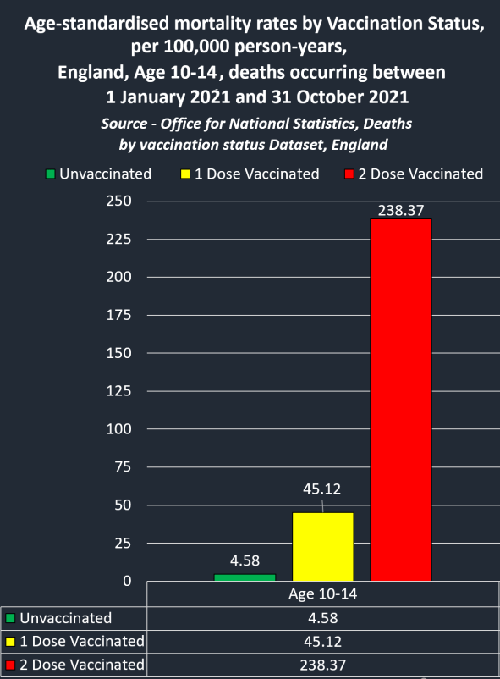
Data compiled by the Office of National Statistics in Great Britain shows that giving young children the COVID shots, especially those aged from 10 to 14, makes their mortality 10 to 52 times higher, depending on the number of shots received.
The graph to the right, from the link, illustrates this starkly. If a child gets one shot, the mortality goes up about ten times. If a child gets two shots, it increases the mortality another five-fold, or about fifty times greater than for children who get no shots at all.
The article at the link also notes that this data was gathered when 10 and 11 year olds were not eligible to get COVID shots. Thus all 10 and 11 year olds at that time fell into the unvaccinated category, where the death rate was low. However, since October 31, 2021, kids in Great Britain in these age brackets began getting shots, which means that we should expect deaths in these age brackets to rise. This also suggests the 52 times increase in childhood deaths caused by the COVID shots is likely understated.
Since the chances of death from the Wuhan virus itself among these children is practically nil, it is insane to give them these shots. Any government official who advocates it, such as Dr. Anthony Fauci, should be fired at once. At a minimum, such fools should certainly not be listened to or used as a guide for establishing any government health policy.
Par for the course: According to one member of NASA’s safety panel, the contractor building NASA’s second SLS launch tower, is having performance problems and is already behind schedule.
On Thursday, during a meeting of NASA’s Aerospace Safety Advisory Panel, one of its members provided an update on Mobile Launcher-2. George Nield, an engineer and scientist who previously led commercial space transportation for the Federal Aviation Administration, said the 90-percent design, review, and fabrication drawings for the large structure are behind schedule. These are the engineering drawings that should closely represent the final design and inform a construction schedule and logistics plan.
“Mobile Launcher-2 has encountered some challenges,” Nield said. “The selected contractor, Bechtel, has experienced some performance issues associated with underestimating the complexity of the project and some supplier related issues, as well as COVID.”
Note that NASA spent about $1 billion on the first tower, to be used only three times, at most. Its contract with Bechtel says the second tower will cost $383 million, but no one expects that number to be met.
Assuming Bechtel does not go over budget (hah!), NASA will have spent $1.4 billion on SLS’s launch towers, one of which will be used two or three times and then abandoned. That’s three times the cost of what SpaceX spent developing Falcon Heavy, and about a third the total development cost of Starship/Superheavy, including its planned launchpads in both Boca Chica and Florida.